
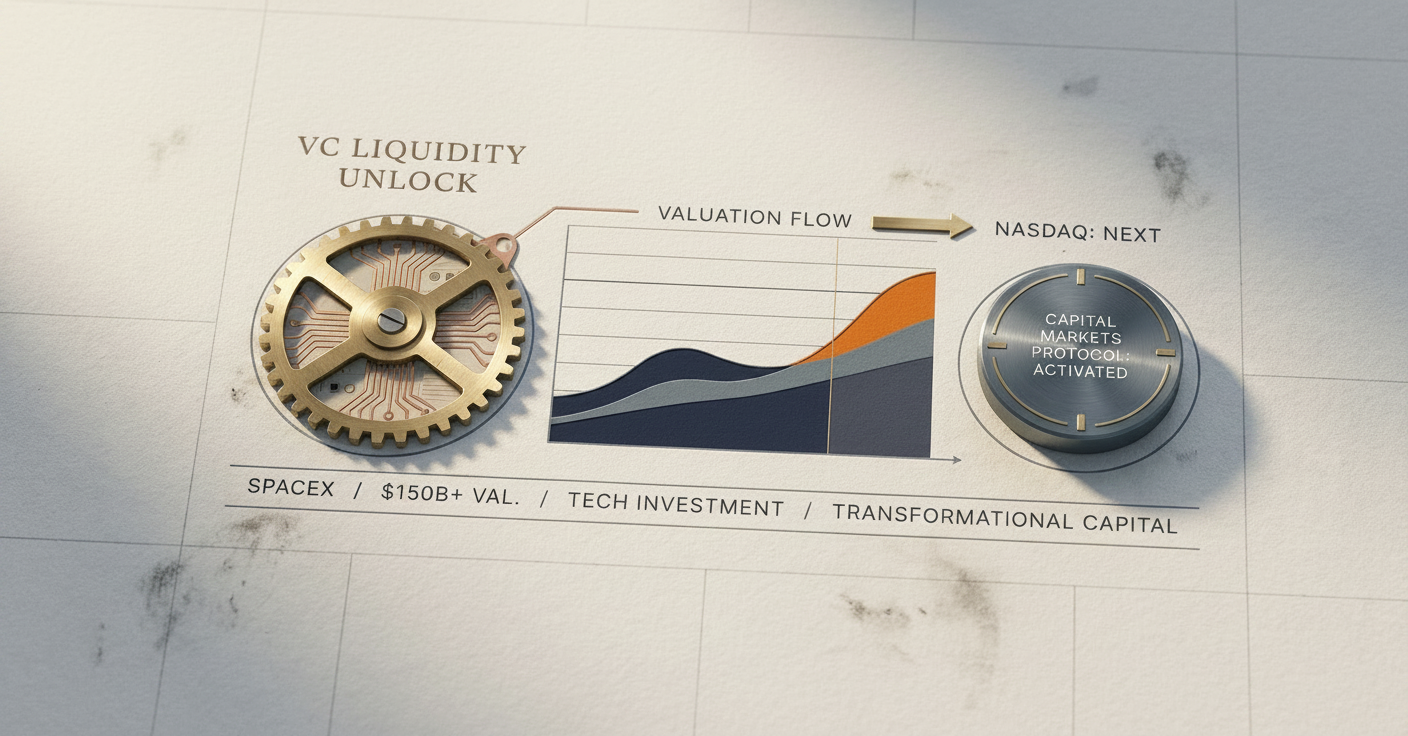
The capital markets are open for unprecedented scale, but getting in requires navigating new gatekeepers and a fundamental re-evaluation of 'value'.
The Intake
📊 12 episodes across 9 podcasts
⏱ 679 minutes of intelligence analyzed
🎙 Featuring: Tracy Alloway (Bloomberg), Joe Weisenthal (Bloomberg), Kyle Grieve (The Investor’s Podcast Network), Shawn O’Malley (The Investor’s Podcast Network)
|

The Big Shift
The sheer scale of capital formation and demand in today's private markets has created a new class of "megacap" IPOs for businesses like SpaceX, Anthropic, and OpenAI, but these valuations often divorce from traditional metrics, challenging conventional investment frameworks. Investors are grappling with companies hitting multi-trillion dollar valuations pre-IPO, driven by massive institutional demand for growth stories and futuristic visions, rather than quarterly earnings. This environment forces a re-evaluation of what constitutes 'value' and how capital is allocated. As Jim Chanos, Founder & President at Chanos & Company, succinctly put it, the market's focus has shifted from operational reality to "hopes and dreams."
"At what point does financial reality matter more than the storytelling, the hopes and dreams part of it?"
— Tom Keene, Host on Bloomberg Surveillance
This dynamic also manifests in the broader market, where high-growth, high-valuation tech companies continue to attract disproportionate capital. For instance, the Nasdaq 100 saw an unprecedented $11 trillion increase in value in less than 50 trading days, fueled by a concentrated set of top-tier AI and space exploration firms. The traditional public market IPO process is being bypassed, with companies coming to market much later in their maturity cycles, often after significant private funding rounds. This effectively reshapes investment opportunities, making early access difficult for retail investors and forcing institutional players to participate at elevated valuations. The implication for CFOs and investors is a dual market: one valuing operational history and another driven by scarcity and a vision of future dominance, demanding both technical literacy and a tolerance for unconventional valuation metrics.
The Rundown
① The New Face of Margin Debt.
Traditional signals of speculative excess, like rising margin debt, are now being skewed as wealthy individuals leverage appreciated portfolios for reinvestment into the real economy. (Downtown Josh Brown on The Compound and Friends)
→ Implication: Relying on historical indicators for market top signals without understanding this shift could lead to misjudging current risk levels.
② AI's Compute Grid Needs Standardization.
The AI compute landscape is highly fragmented and underutilized, with average data centers running at less than 70% capacity, creating significant inefficiency across the industry. (Anjney Midha on Odd Lots)
→ Why it matters: Companies like AMP PBC (Anjney Midha's company) proposing a compute grid to standardize resources could drastically lower AI development costs and democratize access to advanced compute.
③ Healthcare: The Undervalued Opportunity.
Despite being sold off by quantitative momentum players to fund tech investments, the healthcare sector is now "such a cheap part of the market" with significant long-term opportunity over the next five years. (Larry McDonald on Macro Voices)
→ Opportunity: Smart capital should consider rotating out of overvalued tech and into under-owned healthcare, anticipating a significant rebound.
④ SpaceX IPO: An 'Unlock' for Venture Capital.
The impending SpaceX IPO is not just about the company's valuation; it creates an "unlock that comes after SpaceX" for the broader venture capital industry by freeing up capital and fostering new space economy companies. (Laura Rippey on CNBC's "Fast Money")
→ For Operators: This creates a new source of liquidity and an ecosystem for novel ventures, particularly in space-related sectors, making the venture window potentially wider.
⑤ Simple Beats Complex in Market Models.
Despite the inherent "complexity bias," "simple blunt tools" in trading and investing consistently outperform more intricate models when faced with real-world, unseen market conditions. (Eric Crittenden on Top Traders Unplugged)
→ Guidance: For business leaders evaluating financial strategies or deploying new tech, prioritize robust, understandable frameworks over elegantly complex but fragile ones that may not hold in shifting environments.
Signal Board
🔥 Heating Up
• QXO: Brad Jacobs is aiming for ambitious revenue targets of $50 billion within a decade through aggressive M&A, backed by a unique ability to access capital. (Shawn O’Malley on The Intrinsic Value Podcast - The Investor’s Podcast Network)
• Oracle Cloud Infrastructure (OCI): Experiencing significant growth and now has remaining performance obligations exceeding those of Microsoft, Amazon, and Google. (Tim Seymour on CNBC's "Fast Money")
• Hay market volatility due to Mother Nature (drought, rain, heat) 🆕: High prices are leading farmers to reconsider land use, with some pulling hay from auctions due to increasing demand and tight supply. (Aiden Johnson on Odd Lots)
👀 On Watch
• Social Security solvency beyond 2032 🆕: The system faces a projected 22% benefit cut by 2032 if no legislative action is taken to address its shortfall. (Jacob Lew on Bloomberg Surveillance)
• Iran conflict (Strait of Hormuz crisis) 🆕: Escalating tensions are artificially suppressing oil prices due to an "imminent peace" narrative, which could lead to a violent, sudden price spike. (Larry McDonald on Macro Voices)
• SpaceX IPO oversubscribed and priced above 1.77 trillion 🆕: Despite being significantly oversubscribed, its inclusion in the NASDAQ 100 will have a modest weighting due to free-float rules. (Tim Seymour on CNBC's "Fast Money")
🧊 Cooling Off
• Michael Saylor's MicroStrategy debt as an overhang for Bitcoin 🆕: Michael Saylor's large debt positions and impending bond maturities could become a drag on Bitcoin prices, shifting from a previous tailwind. (Mando on Real Vision: Finance & Investing)
• 2% inflation target mistake 🆕: The Federal Reserve's rigid 2% inflation target is questioned, with some suggesting 4.2% year-on-year CPI may already be the cycle's peak. (Ira Jersey on Bloomberg Surveillance)
• Middleman losing out with increased market transparency 🆕: Increased transparency, exemplified by AI bringing data to niche markets like hay, threatens the traditional advantage of middlemen who profit from opacity. (Aiden Johnson on Odd Lots)
The Debate
Capital markets are grappling with contrasting views on the sustainability and impact of current tech and AI valuations.
🐂 The bull case: Andrew Beer, Managing Member at Dynamic Beta Investments, acknowledges the dot-com bubble similarities in AI valuations but expresses a "wonderfully optimistic and exciting" view on the technological advancements, especially citing SpaceX's achievements. This perspective leans into the transformative nature of current innovation, suggesting that even if valuations are stretched, the underlying progress justifies a degree of exuberance.
🐻 The bear case: Jim Chanos, Founder & President at Chanos & Company, directly critiques the "hopes and dreams" driving valuations for companies like SpaceX and XAI, arguing that financial reality must eventually matter more than storytelling. He points to metrics like SpaceX's launch business losing money for 22 years and XAI's pivot to a lower-margin Neo Cloud model just before IPO as concerning red flags.
Our read: While genuine innovation is undeniably occurring, the market appears increasingly bifurcated, with some segments trading on a future vision untethered from present unit economics—a tension that will eventually resolve, either through growth or re-rating.
The Bottom Line
Unprecedented private sector scale is generating extraordinary IPOs, but their frothy valuations demand a dual lens: one for transformative potential, the other for cold, hard financials.
📖 Want the full episode breakdowns, guest details, and listen links?
Episode Guide
1. Bloomberg Surveillance — "May CPI and Major IPOs"
Runtime: 32 min | Host: Tom Keene, Paul Sweeney | Guest: Lori Calvasina (Head of US Equity Strategy, RBC Capital Markets)
For CFOs & Investors: This episode offers insights into inflation dynamics, IPO valuation concerns, and shifts in investor sentiment around market leaders vs. small/mid-caps.
Lori Calvasina discusses investor nervousness around top 10 market cap stocks despite long-term appeal, while Jeff Given emphasizes shifting to higher quality credit risk due to attractive 10-year treasury yields. Ira Jersey believes 4.2% year-on-year CPI is likely the peak for this cycle, questioning the Fed's rigid 2% target.
"We are seeing the nervousness around that top 10 cohort for one reason or another. That nervousness tends to rise when we get to peak valuations. But we still like these stories longer term."
— Lori Calvasina, Head of US Equity Strategy at RBC Capital Markets
2. Odd Lots — "Anjney Midha's Plan to Radically Lower the Price of Compute"
Runtime: 50 min | Host: Tracy Alloway, Joe Weisenthal | Guest: Anjney Midha (Founder, AMP PBC)
For Tech Operators & Investors: This provides a deep dive into the inefficiencies of AI compute, the drive for standardization, and the long-term economic model for AI infrastructure.
Anjney Midha discusses AI compute fragmentation and underutilization, proposing AMP's 'Grid' software solution to standardize resources. He highlights the challenges of early AI funding and argues for a diverse AI ecosystem, emphasizing technical literacy for leaders.
"The average data center in the industry is running at less than 70% utilization."
— Anjney Midha, Founder of AMP PBC
3. The Intrinsic Value Podcast - The Investor’s Podcast Network — "TIVP077 (Video): QXO (QXO): Can One of the World's Best Consolidators Strike Lightning Again? w/ Kyle Grieve & Shawn O'Malley"
Runtime: 81 min | Guest: Kyle Grieve (Host, The Investor’s Podcast Network), Shawn O’Malley (Host, The Investor’s Podcast Network)
For Private Equity & M&A Teams: A detailed analysis of a serial consolidator's strategy, including aggressive debt, overcoming poison pills, and executive compensation linked to ambitious targets.
Shawn O’Malley and Kyle Grieve analyze QXO's ambitious expansion into building products via Brad Jacobs's serial acquisition strategy, aiming for $50 billion in revenue within a decade. They discuss QXO's aggressive debt, ROIC, and the impact of acquisitions like Beacon Roofing Supply and Kodiak Building Partners.
"Brad Jacobs has led seven different billion dollar companies before starting qxo, the business that we'll be diving into today. I've certainly studied my fair share of great capital allocators, as you have two Cal. But it's so rare to see someone do it across several different industries and scale them to billions in sales in the ways that he has."
— Shawn O’Malley, Host at The Investor’s Podcast Network
4. Top Traders Unplugged — "SI404: When Trend Following Meets Equities ft. Eric Crittenden & Andrew Beer"
Runtime: 68 min | Host: Niels Kaastrup-Larsen | Guest: Eric Crittenden (Principal, Longboard Asset Management)
For Fund Managers & Portfolio Strategists: Insights on trend following, product development in alternatives, and the practical application of simple vs. complex trading models.
Eric Crittenden and Andrew Beer discuss trend following strategies, emphasizing robust, simple tools over complex models. They contrast marketing-driven vs. investment-centric product design in alternative investments and the importance of equal risk contribution in portfolio construction.
"The simple ones are the ones that hold up on data they haven't already seen, seen a lot better. And that's what matters, is real life."
— Eric Crittenden, Principal at Longboard Asset Management
5. Macro Voices — "MacroVoices #536 Larry Mcdonald: The Migration is Upon us"
Runtime: 80 min | Host: Erik Townsend, Patrick Ceresna | Guest: Larry McDonald (Best Selling Author and Founder, Bear Traps Report)
For Macro Investors & Sector Analysts: A high-level macro view covering market sell-offs, inflation, sector rotation, and the impending unlock of restricted tech shares.
Larry McDonald discusses market sell-offs, inflation, and rotation from growth to value. He highlights opportunities in undervalued sectors like energy and materials, contrasting with overvalued tech, and warns of a coming deluge of restricted share unlocks impacting the market.
"The Nasdaq 100 went from 30 trillion of value to 41 trillion in less than 50 trading days. Nothing like that's ever happened in the history of markets."
— Larry McDonald, Best Selling Author and Founder at Bear Traps Report
6. Bloomberg Surveillance — "The Money Show: SpaceX Market Impact and Solving Social Security"
Runtime: 45 min | Host: Tom Keene, Scarlett Fu | Guest: Jim Chanos (Founder & President, Chanos & Company)
For Board Members & Policy Strategists: Essential for understanding the debate around extraordinary tech valuations and the urgent need for Social Security reform.
This segment discusses the SpaceX IPO, comparing the current market to the dot-com bubble. Jim Chanos expresses skepticism about SpaceX and XAI valuations resting on "hopes and dreams," rather than financial reality. Jacob Lew explains the urgency of addressing the Social Security shortfall.
"Space X valuation at 2 trillion to Metta at 1.5 trillion. Meta's revenue run rate is 200 billion. Space X is 18 billion. How can Space X be 30% higher than Metta?"
— Mandeep Singh, Analyst at Bloomberg
7. The Compound and Friends — "Why the Knockout Punch Never Comes With Brian Levitt"
Runtime: 70 min | Host: Michael Batnick, Downtown Josh Brown | Guest: Brian Levitt (Chief Global Market Strategist and Head of Strategy and Insights, Invesco)
For Financial Advisors & Strategic Planners: Challenges common perceptions of market tops, margin debt, and the actual triggers for bear markets.
Michael Batnick and Downtown Josh Brown discuss the crowded AI trade and individual investor caution despite strong market fundamentals. Brian Levitt explains how oil price spikes from the Iran war impacted market breadth and inflation expectations, highlighting the bond market's signals over CPI.
"The average investor is looking for a knockout punch in the headlines. They think a news event is gonna happen and it's gonna punch the market in the face. What they don't understand is that knockout punch comes at the bottom."
— Michael Batnick, Host of The Compound and Friends
8. CNBC's "Fast Money" — "Markets Drop As Uncertainty Rises… And Oracle Reports Results 6/10/26"
Runtime: 44 min | Host: Willisley, Melissa Lee | Guest: Rebecca Patterson (Former Chief Strategist, Bridgewater Associates)
For Corporate Treasurers & Capital Market Teams: Essential for understanding bond market dynamics, capital raising challenges for tech, and the mechanics of large IPOs.
This segment covers market sell-offs driven by Middle East tensions and sticky inflation, focusing on the bond market's implications for interest rates. Oracle's mixed earnings are discussed, alongside the highly anticipated SpaceX IPO and Trulieve Cannabis's historic NYSE listing.
"The biggest problem I think continues to be in the form of the bond market. And I'm one of the few people, I think, or maybe now more people realize that rates are going higher and maybe not for the right reasons."
— Willisley, Host at CNBC
9. Real Vision: Finance & Investing — "The SpaceX IPO Is Here. Time to Lift Off? | REKT Vision"
Runtime: 58 min | Host: Bijan Maleki | Guest: Mando (Former Host, REKT Vision)
For Venture Capitalists & Tech Investors: Provides context on large private market valuations, competition for capital between crypto and AI, and the intricacies of high-alpha altcoin strategies.
Mando discusses the impending SpaceX IPO, predicting it will trade on sentiment within a $1.5-$2 trillion valuation range, and how such IPOs draw capital from crypto. He also highlights Google and NVIDIA's investments in emerging AI and space companies, positioning them as key players.
"I think it will probably stay between this one and a half to $2 trillion range. I think there's going to be enough of demand from there and just with the backdrop of just the strength in the equity market right now, I just think it's got a very unique position in that nothing really else you can value it against."
— Mando, Former Host at REKT Vision
10. CNBC's "Fast Money" — "Stocks Surge On Potential End Of War… And Countdown to SpaceX Public Debut 6/11/26"
Runtime: 43 min | Host: Brian Sullivan | Guest: Karen Feineman (Trader/Analyst, CNBC)
For Portfolio Managers & Geopolitical Strategists: Provides market reaction to geopolitical shifts, the "unlock" potential of mega-IPOs for venture, and challenges in the housing market.
President Trump's cancellation of strikes against Iran led to a significant market rally. The impending SpaceX IPO, priced at $135 a share, is expected to be the largest in American history. Oracle's shares dropped following a $20 billion capital raise announcement and negative free cash flow.
"The market, equity market was largely kind of discounting that, that the cease fire remain in place... And the headlines today basically reverse that risk premium pretty quickly."
— Stu Kaiser, Head of Equity Trading Strategy at Citi
11. Odd Lots — "How a Vibecoded Newsletter Is Making the Hay Market More Transparent"
Runtime: 40 min | Host: Tracy Alloway, Joe Weisenthal | Guest: Aiden Johnson (Co-founder and CEO, Haywire)
For Agribusiness Executives & AI Innovators: A fascinating case study on how AI can disrupt opaque, fragmented commodity markets and the broader implications for land use.
Aiden Johnson, co-founder of Haywire, discusses using AI to bring transparency to the opaque hay market by mining public data. He explains the market's fragmentation due to high transportation costs and how surging prices are causing farmers to reconsider land use amid competition from data centers and solar farms.
"Ten years ago, I don't think I would even scratch the surface of getting to the death... And that's just simply because I think the infrastructure of AI is getting smarter and smarter every day."
— Aiden Johnson, Co-founder and CEO of Haywire
12. Bankless — "ROLLUP: One More Dip? | Saylor Sold | IPO Season | Ethereum vs ETH"
Runtime: 68 min | Host: Ryan, David | Guest: Michael Saylor (Chairman and CEO, MicroStrategy)
For Crypto Investors & Digital Asset Strategists: Crucial for understanding current crypto market downturns, the strategies of institutional players like Michael Saylor, and the debate around Ethereum's valuation.
Ryan and David discuss the current crypto market downturn and Michael Saylor’s Bitcoin trading strategy. They analyze Tom Lee’s Eth accumulation and plan for a preferred stock offering, as well as the implications of massive IPO valuations from companies like SpaceX and Anthropic on private and pre-IPO markets.
"The only thing that triggers me is just a little bit is the idea, this mental fallacy that Ethereum can be a successful platform without Ether, the asset being worth a shit ton. And by that I measure shit tons in the trillions. Many, many trillions of dollars. It has to be a global reserve asset or else the alternative, because the entire purpose of the platform is so says bankless thesis."
— Ryan, Host of Bankless