
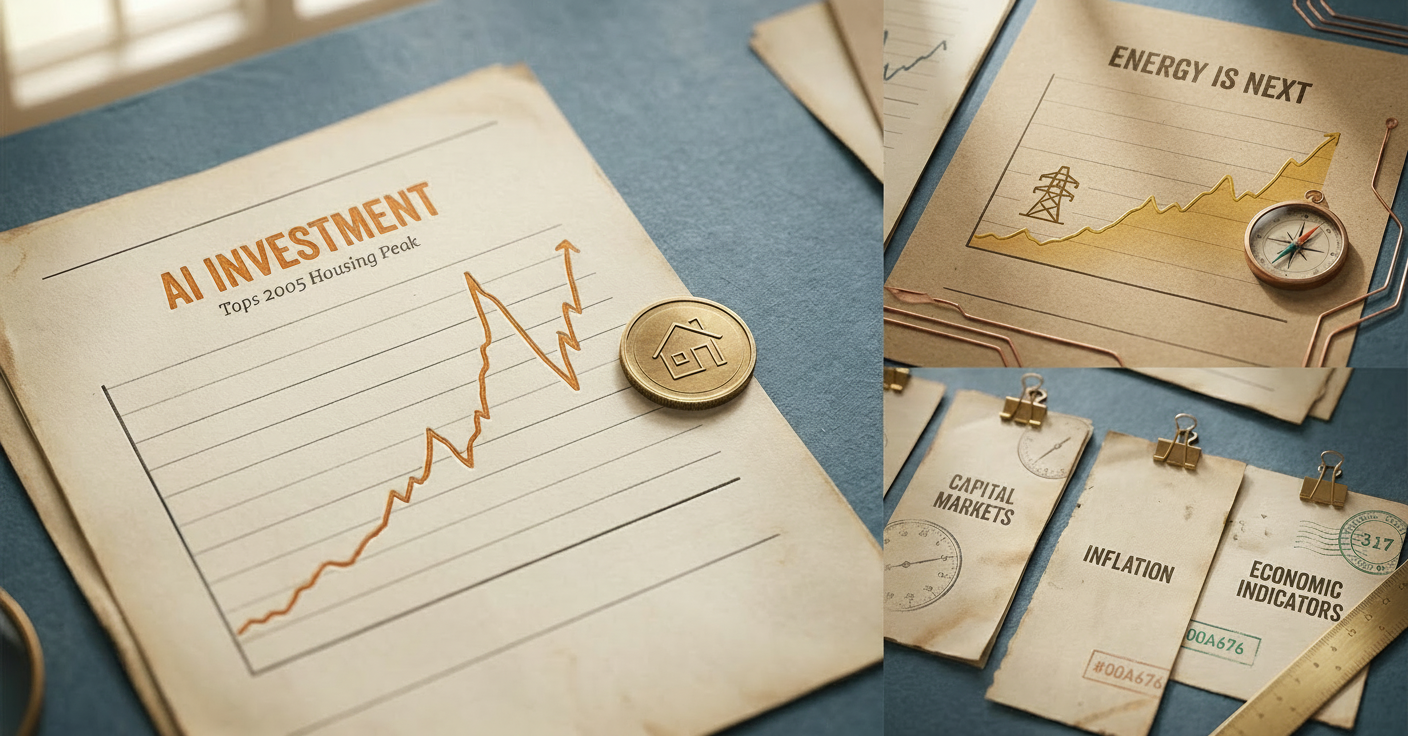
The AI boom now runs so hot that it’s bending traditional capital markets, creating unexpected opportunities and risks in everything from tech IPOs to geopolitical energy strategies.
The Intake
📊 12 episodes across 9 podcasts
⏱ 680 minutes of intelligence analyzed
🎙 Featuring: Erik Townsend (Macro Voices), Michael Every (Rabobank), Patrick Ceresna (Macro Voices), Rory Johnston (Commodity Context)
|

The Big Shift
The sheer scale of AI investment is redefining economic indicators and market dynamics, now surpassing the peak housing investment of the 2000s and creating both inflation-driving demand and unexpected market fragmentation.
Why it's happening: The AI boom, initially concentrated in Mag 7 tech giants, has broadened its impact, driving enormous capital expenditure into physical infrastructure like data centers and energy. This spending is so significant that it's challenging traditional macroeconomic frameworks, with some economists debating whether import-heavy AI growth fully reflects in GDP despite its clear impact on risk appetite and business cycles. Skanda Amarnath, Co-founder and Executive Director of Employ America, highlighted that "It's plausible that the AI boom would be on par with the share of the US economy housing investment represented its 2005 peak," underscoring the magnitude of this shift.
"A lot of the growth from AI leaks abroad in the form of imports. So that actually counts against GDP."
— Neil Dutta, Head of Economics at Renaissance Macro Research on The Compound and Friends
The broader implication: This investment surge creates unique inflationary pressures, particularly around energy and compute infrastructure, but simultaneously allows for unexpected market fragmentation where large cap tech can decouple from broader market sentiment. Brannin McBee, Co-founder of CoreWeave, noted a "tens of billions of dollars" backlog from financial services clients, indicating the demand for AI compute is far broader than just AI labs. This demand, while driving economic activity, also creates bottlenecks, with the primary constraint shifting from GPU scarcity to securing 'powered shell' data centers. This dynamic suggests that if you're not factoring AI-driven capital flows into your business model, you're missing a critical piece of the capital structure puzzle.
The level to watch: Monitor the cost and availability of industrial power and specialized compute. These are the new limiting reagents in the economy, and their pricing will dictate capital allocation decisions far more than traditional interest rate signals alone.
The Rundown
① SpaceX IPO: The Retail Magnet.
Elon Musk is disrupting traditional IPO allocations by reserving 30% of the SpaceX 🆕 float for retail investors, a move that is flipping the traditional Wall Street-first order. (David Gura on Bloomberg Surveillance)
→ Why it matters: This indicates an era of increasing democratization in high-profile deals, shifting power dynamics in capital markets and creating new considerations for retail-driven market sentiment and liquidity events. Retail investors should wait at least a year. (Jason Moser on Motley Fool Money)
② The Fed's New Mandate?
The Federal Reserve might be shifting its focus beyond traditional inflation targeting to include supporting economic statecraft and national security goals, a move not aligned with historical mandates. (Michael Every on Macro Voices)
→ The Implication: If Fed policy becomes intertwined with national security, expect less predictable rate paths and potentially higher tolerance for inflation, directly impacting long-term capital planning and financing costs for businesses.
③ Trend Following: Geopolitical Crisis Alpha.
Managed futures, particularly through a multi-manager approach, demonstrate highly positive returns during periods of escalating geopolitical risk, effectively acting as a 'geopolitical risk strategy'. (Katy Kaminski on Top Traders Unplugged)
→ Why it matters: For operators and investors, this suggests diversifying beyond traditional equity-heavy portfolios with managed futures could offer critical hedges against increasing global instability and inflation-induced trends, improving overall risk-adjusted returns.
④ GPU Compute is Not Fungible.
The concept of GPU Fungibility 🆕 is challenged by varying operational efficiencies and software stacks across different cloud providers, meaning an H100 GPU in one cloud may not perform identically in another, hindering the commoditization of compute. (Brannin McBee on Odd Lots)
→ Your Move: Don't assume all GPU capacity is equal; evaluate vendors not just on raw hardware but on their entire stack, as performance differentials can significantly impact the cost and efficiency of AI workloads and thus your operating leverage.
⑤ Meta's Debt Shift.
Meta, once a net cash company, is now considered a net debt company by the market, potentially impacting its valuation multiple due to significant AI infrastructure investments. (Tim Seymour on CNBC's "Fast Money")
→ The Takeaway: Even tech giants are feeling the capital intensity of the AI race; CFOs should scrutinize their own balance sheets and capital plans for AI investments, given the potential for increased leverage and re-rated multiples. "Every drop this year, every drop recently has been a buying opportunity." said Tim Seymour, Participant at CNBC.
Signal Board
🌡️ Heating Up
• AI Investment Boom: Already surpassing the peak housing investment of the 2000s, with capital pouring into infrastructure and specialized compute. (Skanda Amarnath on The Compound and Friends)
• Crisis Alpha: Managed futures are demonstrating powerful positive returns during periods of escalating geopolitical risk, particularly from commodity and fixed income trends. (Marat Molyboga on Top Traders Unplugged)
• Federal Reserve Rate Hikes: Stronger-than-expected jobs numbers are boosting bets on a Fed rate hike by year-end, indicating persistent inflationary pressures. (Kristina Campmany on Bloomberg Surveillance)
🧊 Cooling Off
• Gold Prices: Unexpected weakness in gold prices amidst geopolitical turmoil, attributed partly to individuals selling gold for easily transferable dollars for international travel and asset purchases. (Michael Every on Macro Voices)
• Mean Variance Optimization: Skepticism is growing about its practical utility in portfolio construction due to its heavy reliance on predicting unpredictable futures. (Marat Molyboga on Top Traders Unplugged)
• Wix.com 🆕: Despite strong financials and a strategic AI acquisition (Base44), the market is heavily discounting the company, reflecting fears of AI disruption. (Daniel Mahncke on The Intrinsic Value Podcast - The Investor’s Podcast Network)
👀 On Watch
• IPO Market Overheating and Retail Investor Risk 🆕: The increasing inclusion of retail investors in high-profile IPOs like SpaceX raises concerns about market 'casino-like' behavior and underpricing. (David Gura on Bloomberg Surveillance)
• CoreWeave 🆕: Significant broadening of customer base beyond traditional AI labs and hyperscalers, with a tens-of-billions-dollar backlog from financial services clients. (Brannin McBee on Odd Lots)
• Non-fungibility of GPU compute 🆕: Performance differences across cloud providers for the same GPUs due to software and operational expertise, hindering commoditization. (Brannin McBee on Odd Lots)
• Base44 🆕: An AI-native web builder acquired by Wix.com, considered by some to be effectively valued at $0 by the market despite its rapid growth. (Daniel Mahncke on The Intrinsic Value Podcast - The Investor’s Podcast Network)
The Debate
The market is currently debating the investment opportunity and risk associated with high-profile tech IPOs like SpaceX, especially concerning retail investor involvement.
🐂 The bull case: Proponents argue that the increased allocation to retail investors, as seen with SpaceX, democratizes access to high-growth opportunities that have historically been reserved for institutional investors. This allows founders to capture more of the IPO pop value, rather than leaving it to investment banks to underprice. David Seamus, CEO of Hyper Liquid Strategy, highlighted on CNBC's "Fast Money", "Every one likes seeing a pop. It's nice to say you got a pop. But like, that pop is coming out of the pocket of the existing investors and going into the pocket of the new investors."
🐻 The bear case: Critics warn that this trend invites unsophisticated retail investors into highly speculative ventures, often driven by narrative rather than fundamentals. They point to the potential for significant losses if IPOs are overhyped and the underlying business fundamentals fail to meet aggressive projections. During a discussion on Motley Fool Money, Jason Moser cautioned, "Retail investors would be better served to sit and wait, give this thing some time to play out. Please, please, please think twice before opening a brokerage account just to jump into this ipo."
Our read: While increased retail access is nominally inclusive, the current sentiment around IPOs like SpaceX suggests an environment of speculative fervor where investor protection is often secondary to hype. Exercise extreme caution.
The Bottom Line
The unstoppable AI spending spree is not merely a tech story—it's a capital re-allocation event that is reshaping market structures, inflation dynamics, and even the future mandate of central banks, demanding a re-evaluation of every capital decision you make.
📖 Want the full episode breakdowns, guest details, and listen links?
Episode Guide
Macro Voices — "MacroVoices #535 Michael Every: NAFTA and NAPTHA – Warcraft & Fartcraft"
Runtime: 97 min | Host: Erik Townsend | Guest: Michael Every (Global Strategist for Economics and Markets, Rabobank), Rory Johnston (Founder, Commodity Context)
For the Strategic Operator: Discover how geopolitical shifts in energy markets and potential redefinitions of central bank mandates could impact your long-term capital allocation and risk management strategies.
Erik Townsend and Patrick Ceresna discuss the ongoing geopolitical crisis with Iran and its impact on global oil markets, inflation, and economic statecraft with Michael Every, Global Strategist at Rabobank.
"It's just logically ridiculous to conceive of a Fed saying, well, we're not going to change. We're going to keep doing everything Greenspan did or Bernanke did or Yellen did, and who cares about the struggle for AI, who cares about the struggle for the supply side, who cares about national security, who cares that we're at a war at the moment or that we need to rearm rapidly to make sure that we can fight the next one, wherever that were to pop up. None of that matters to us. We're just going to look at 2% of CPI."
— Michael Every, Global Strategist for Economics and Markets at Rabobank
Bankless — "ROLLUP: Bitcoin’s Confidence Game | Bitmine’s ETH Bet | Token Rotation | U.S. Perps"
Runtime: 58 min | Host: Haseeb | Guest: Michael Saylor (Executive Chairman, MicroStrategy), Tom Lee (CEO, Bitmine)
For the Crypto Investor: Unpack the nuanced signals from Bitcoin's recent sell-off and the emerging trends in crypto tokenomics, including new yield instruments and the impact of evolving US perp licenses.
Haseeb and David discuss the current market downturn, particularly focusing on Michael Saylor and MicroStrategy's recent Bitcoin sale and its impact on market sentiment.
"If you are selling Bitcoin, the whole system breaks. So I think that's the lesson he's learned and he's ultimately going to have to choose one of two bad options."
— Haseeb, Host at Bankless
Top Traders Unplugged — "SI403: Trend Following in an Era of Geopolitical Risk ft. Marat Molyboga & Katy Kaminski"
Runtime: 84 min | Host: Niels Kaastrup-Larsen | Guest: Marat Molyboga (Chief Risk Officer and Director of Research, Efficient Capital Management), Katy Kaminski (Speaker, Unknown)
For the Portfolio Manager: Gain insights into how managed futures can provide crucial 'crisis alpha' during periods of geopolitical instability and inflation, optimizing portfolio risk-adjusted returns through diversified strategies.
Niels, Marat Molyboga, and Katie Kaminski discuss the often misunderstood role of managed futures in portfolios. Marat emphasizes that while managed futures provide crisis alpha, investors frequently make behavioral mistakes like performance chasing, leading to disappointment and de-allocation before the next crisis.
"We're all humans, we're all susceptible to behavioral biases. And what I find as the two main mistakes that investors make is performance chasing at both manager level as well as the industry level."
— Marat Molyboga, Chief Risk Officer and Director of Research at Efficient Capital Management
The Compound and Friends — "Neil Dutta & Skanda on Why the Recession Signals Are All Wrong"
Runtime: 70 min | Host: Michael Batnick | Guest: Neil Dutta (Head of Economics, Renaissance Macro Research), Skanda Amarnath (Co-founder and Executive Director, Employ America)
For the CFO & Economist: Understand why traditional recession signals might be misleading given the massive AI investment boom, and what this implies for inflation, labor markets, and the future of economic growth.
Michael Batnick discusses the unusually high prices for Knicks tickets, even exceeding Super Bowl prices, attributing it to wealthy individuals' discretionary spending.
"This whole, like it's not really counting to GDP because it's imports totally misses the point of what a boom is all about. It's about the spending."
— Skanda Amarnath, Co-founder and Executive Director of Employ America
Bankless — "Venice is Here to Win: How a Private AI Company Plans to Take On OpenAI and Anthropic"
Runtime: 59 min | Host: David | Guest: Jon (Head of Strategy, Venice), Jesse (CTO, Venice)
For the Tech Innovator: Explore the critical importance of privacy-first AI, Venice's unique tokenomics, and its "agent-first" strategy as a foundational layer for autonomous AI agents.
This segment introduces Jon, Head of Strategy at Venice, and Jesse, CTO at Venice, who discuss the critical importance of private AI.
"If you've ever put anything into an AI model that you wouldn't want published, why privacy is important. I think we founded Venice on this principle that it's somewhat dystopian that a small handful of tech companies are building databases of everybody's most intimate thoughts."
— Jesse, CTO at Venice
CNBC's "Fast Money" — "Stocks Tumble To Wrap Up Week… And Tim Cook’s Last Developer’s Conference 6/5/26"
Runtime: 43 min | Host: Brian Bennett | Guest: Tim Seymour (Participant, CNBC), Steve Grasso (Participant, CNBC)
For the Equity Investor: Analyze the market's reaction to large tech's AI capex race, the impact of strong economic data on Fed rate hike probabilities, and key shifts within the tech sector.
The NASDAQ and S&P 500 experienced significant drops, with the NASDAQ recording its biggest point loss ever and semiconductor stocks leading the sell-off.
"The market saying 25, 26 basis points priced in. I'd looked at it basically as a 50% chance of a 50 basis point hike. But really again the big takeaway is the rate cut. That's toast."
— Mike Schumacher, Head of Macro Strategy at Wells Fargo Securities
CNBC's "Fast Money" — "A Market Rotation Underway… And Reaction to LuluLemon’s Latest Results 6/4/26"
Runtime: 44 min | Host: Melissa Lee | Guest: Karen Finerman (Trader, CNBC's Fast Money), Dan Nathan (Trader, CNBC's Fast Money)
For the M&A and IPO Strategist: Understand the current market rotation from tech to financials, fueled by anticipated IPOs like SpaceX, and how perpetual futures are becoming an accurate predictor of pre-IPO valuations.
This segment of Fast Money discusses the market rotation from tech to financials, with big banks gaining from anticipated IPOs like SpaceX.
"When you look at the Cerebras ipo, if you look at where it was trading on Hyper Liquid leading up to the pricing, and you look at where it went post pricing, it was literally a straight line. It was like a perfect predictor of where it was going to trade. And you can see on the screen the point where the IPOs were priced was way lower."
— David Seamus, CEO of Hyper Liquid Strategy on CNBC's "Fast Money"
Motley Fool Money — "IPO Season: Why Patience Is The Name of the Game"
Runtime: 41 min | Host: Travis Hoium | Guest: Lou Whiteman (Motley Fool Money), Jason Moser (Motley Fool Money)
For the Private Equity / VC Investor: Evaluate the realism of optimistic market predictions around quantum computing and autonomous vehicles, and the potential conflicts of interest in high-valuation IPOs like SpaceX.
This segment of Motley Fool Money, hosted by Travis Hoium with guests Lou Whiteman and Jason Moser, delves into the current market downturn, particularly affecting AI-related tech stocks, and the upcoming IPO season.
"When one thing goes up indefinitely, it's bound to not last forever. Whether or not this is the beginning of the end or just a blip, I think we'll see."
— Jason Moser, Motley Fool Money
Bloomberg Surveillance — "Bloomberg Money: The Rise of Casino Culture and Cash Isn't Always King"
Runtime: 38 min | Host: Tom Keene | Guest: Scarlet Fu (Host, Bloomberg), Michael McKee (Reporter, Bloomberg)
For the Retail Investment Strategist: Explore the implications of Elon Musk's direct retail allocation in the SpaceX IPO and the broader debate around market 'casino-like' behavior amidst a backdrop of rising inflation and evolving financial literacy.
Tom Keene and Scarlet Fu discuss the jobs report with Michael McKee, highlighting the surprising upward revision for April and the potential wage inflation linkage.
"Elon Musk has reserved about 30% of the space X float next week for retail clients. That is absolutely huge and represents it's a flipping of the order."
— David Gura, Host, Bloomberg This Weekend on Bloomberg Surveillance
Bloomberg Surveillance — "Instant Reaction: US Adds 172,000 Jobs, Boosting Bets on Fed Rate Hike by Year-End"
Runtime: 19 min | Host: Tom Keene | Guest: Paul Sweeney (Host, Bloomberg), Claudia Sahm (Chief Economist, New Century Advisors)
For the Macroeconomist: Grapple with the implications of a strong May jobs report on Federal Reserve policy, moderate wage growth, and the surprising dominance of AI's impact on the labor market as a key investor concern.
The May jobs report significantly exceeded expectations with 172,000 jobs added, leading to discussions about the Federal Reserve's potential rate hikes.
"This isn't such a worrisome print in that wage growth was still pretty moderate. We're still seeing slowing in wage growth. So you know the Fed is not anti jobs, they're anti inflation."
— Claudia Sahm, Chief Economist at New Century Advisors
Odd Lots — "How CoreWeave Sees the Market for Compute Right Now"
Runtime: 51 min | Host: Joe Weisenthal | Guest: Brannin McBee (Co-founder and Chief Development Officer, CoreWeave)
For the Tech Infrastructure Investor: Dive into the evolving AI compute market, from the shift to broader enterprise adoption beyond AI labs to the critical bottlenecks in data center expansion and the non-fungibility of GPUs.
CoreWeave co-founder Brannin McBee discusses the current landscape of the AI compute market, highlighting the shift towards broader enterprise adoption beyond initial AI lab experimentation.
"Our financial services client backlog is in the tens of billions of dollars at this point. And so we're now talking about things outside of AI labs, outside of hyperscalers."
— Brannin McBee, Co-founder and Chief Development Officer of CoreWeave
The Intrinsic Value Podcast - The Investor’s Podcast Network — "TIVP075 (Video): WIX: The Most Asymmetric AI Bet? w/ Daniel Mahncke & Shawn O’Malley"
Runtime: 76 min | Host: Daniel Mahncke | Guest: Shawn O'Malley (Host, The Investor's Podcast Network)
For the Value Investor: Evaluate Wix's current valuation as a potential asymmetric AI bet, focusing on its strategic acquisition of Base44 and resilience despite market skepticism about AI disruption.
Daniel Mahncke and Shawn O'Malley discuss Wix's current valuation, which, despite a 30% stock drop after recent earnings, presents an interesting value opportunity at four to five times free cash flow.
"It's certainly one of the biggest AI victims and we will get to the valuation later, but it's trading at about four to five times free cash flow now."
— Daniel Mahncke, Host, The Intrinsic Value Podcast - The Investor’s Podcast Network