
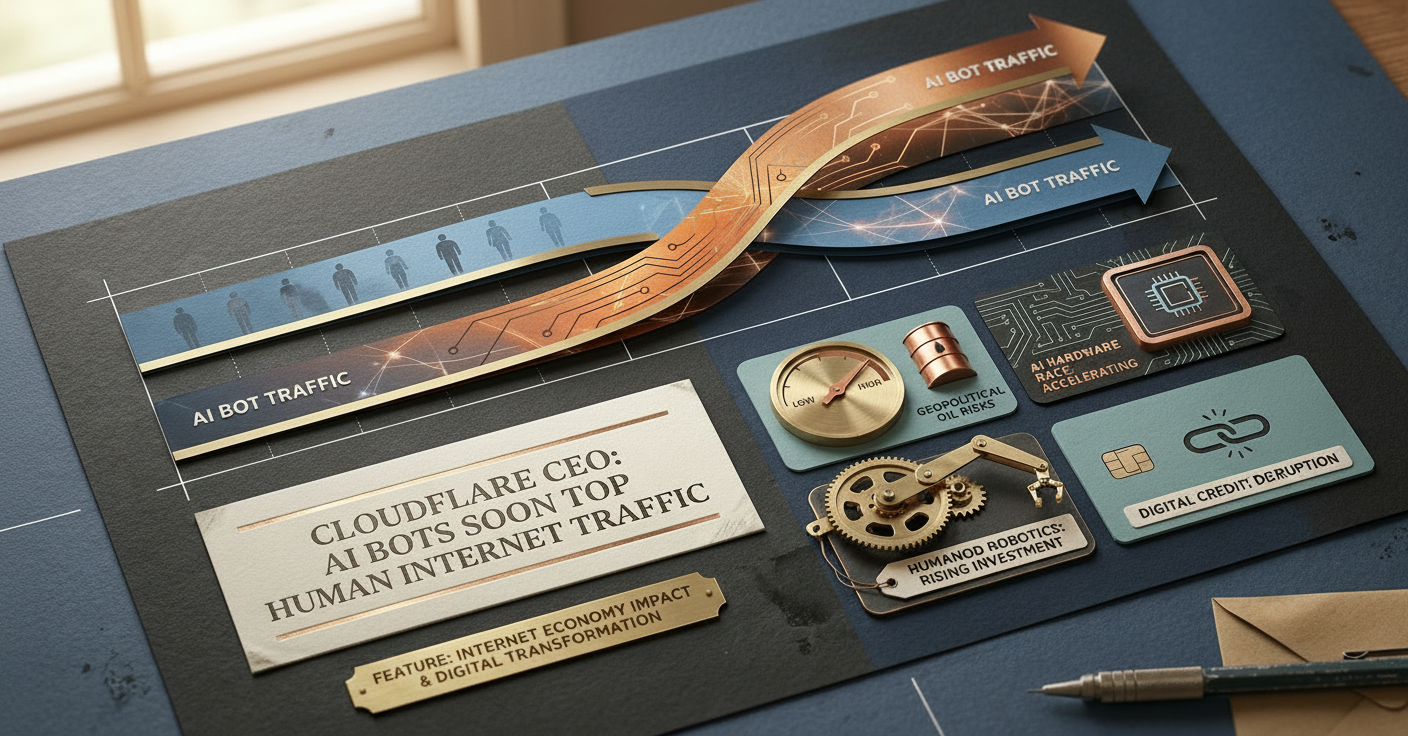
The global credit system is undergoing a quiet revolution, transforming digital assets into capital and turning AI from a novelty into an existential threat for traditional business models.
The Intake
📊 12 episodes across 11 podcasts
⏱ 737 minutes of intelligence analyzed
🎙 Featuring: Andrew Feldman (Cerebras), Joe Weisenthal (Bloomberg), Tracy Alloway (Bloomberg)
|

The Big Shift
The internet's ad-based economic model is facing an extinction-level event, driven by the dramatic rise of AI answer engines and bot traffic, fundamentally reshaping how content is valued and monetized. Cloudflare CEO Matthew Prince argues this transition threatens the entire publishing ecosystem, as AI strip-mines content without attributing traffic or revenue to original creators. This challenge forces a re-evaluation of internet business models, moving away from engagement metrics to direct compensation for data and infrastructure.
"What’s increasingly happening is those answers are getting better and better. And the way Google gets them, they go out and they spider the web, they effectively strip mine the Internet, they pull it back and then they give you the answer."
— Matthew Prince, CEO of Cloudflare on Bankless
Cloudflare 🆕 is at the forefront, grappling with the shift towards an "agent-driven internet" where AI bots are projected to surpass human traffic by early 2027. This necessitates new micropayment systems if content creators and infrastructure providers are to remain economically viable. Simultaneously, traditional credit markets are staring down a $300 trillion disruption from digital credit instruments, powered by Bitcoin, which offer superior liquidity and transparency (Jeff Walton on Bankless). This convergence means your business’s digital presence and its capital structure are both subject to unprecedented forces of change. The levels to watch are plummeting CPMs for online publishers and the accelerating adoption rate of Bitcoin-backed credit products, which, even at 0.5% penetration, could double Bitcoin’s market cap
The Rundown
① AI Hardware is Reshaping Competition, Not Just Accelerating Performance.
Cerebras CEO Andrew Feldman highlighted how their wafer-scale chips, 58 times larger than standard GPUs, achieve 15 times faster AI inference by uniquely integrating vast amounts of fast memory, suggesting a new front in the AI arms race beyond traditional GPU dominance. (Andrew Feldman on Odd Lots)
→ Why it matters: If you're building or investing in AI, be aware that Nvidia’s CUDA ecosystem is losing market share in frontier AI models—a trend that may accelerate as alternative hardware architectures gain traction, shifting where competitive advantages are built.
② The Strait of Hormuz is at a Critical Choke Point.
Morgan Downey, author of "Oil 101," warns that if the Strait of Hormuz remains closed for another month, oil prices could surge to $150–$200, necessitating significant demand destruction across the global economy. (Morgan Downey on Macro Voices)
→ The Level: Prepare your contingency plans for WTI crude hitting $150-200 within the next 30-60 days; this isn't a low-probability event but a >50% probability that demands immediate stress testing of your operations.
③ Humanoid Robotics Are Entering Your Home and Workforce Sooner Than You Think.
Derek Yan from KraneShares 🆕 believes that within three to five years, humanoids capable of performing actual work could be in our homes, not just factories, driven by advances in AI models and cheaper hardware while addressing labor shortages. (Derek Yan on Animal Spirits Podcast)
→ Strategic Opportunity: The majority of value in the emerging humanoid robotics ecosystem is currently captured by component manufacturers, not integrators, indicating a significant investment opportunity in the underlying "body" of these robots.
④ Traditional Banks are Vulnerable to Digital Credit Disruption.
Jeff Walton 🆕 of Strive 🆕 argues that digital credit instruments built on Bitcoin offer superior liquidity and transparency, poised to disrupt traditional credit, equity, real estate, and money markets currently operated by banks with thin balance sheets. (Jeff Walton on Bankless)
→ Implication for CFOs: The emergence of Bitcoin as "digital capital" rather than just "digital gold" fundamentally expands your opportunities for capital formation, particularly if you're operating with fractional reserves and need to leverage new pools of accessible capital.
⑤ SpaceX is Pivoting to AI, Not Just Rockers.
SpaceX is positioning itself as an AI-first entity, with 76% of its Q1 capital expenditures directed towards AI, surpassing its investment in rockets, indicating a strategic shift that could re-rate the company's valuation. (Jon Quast on Motley Fool Money)
→ Forecasting Next Moves: This signals that even the most asset-heavy, infrastructure-focused companies are aggressively re-allocating capital towards AI, impacting supply chains and competitive landscapes across diverse industries, from space to enterprise software.
Signal Board
🔥 Heating Up
• Sea Limited (SE)🆕: Its fintech arm, Monee, holds a significant edge over Mercado Pago in credit risk assessment for Southeast Asian consumers due to its deep integration with Shopee e-commerce data. (Daniel Mahncke on The Intrinsic Value Podcast - The Investor’s Podcast Network)
• AI Arms Race: Investment in AI and related capital expenditures are continuing at an aggressive pace, with companies like SpaceX allocating 76% of Q1 capex to AI. (Dan Ives on Bloomberg Surveillance)
• Physical AI🆕: Humanoid robots are advancing rapidly, with a projected 3 billion unit market primarily driven by component suppliers, signifying a massive industrial shift. (Derek Yan on Animal Spirits Podcast)
• Data Center Funding: Innovative GPU-backed loans are maturing, establishing a robust debt market for financing AI compute infrastructure. (Andrew Feldman on Odd Lots)
👀 On Watch
• Strait of Hormuz Closure Impact on Oil Prices🆕: If the closure persists for another month, the global economy could face $150-$200 oil prices, requiring significant demand destruction. (Morgan Downey on Macro Voices)
• Shopee 🆕: Despite fierce competition, Shopee's long-term investment thesis relies on increasing consumer wealth in Southeast Asia, which could disrupt its foundational mobile-first, low-end device strategy if consumers upgrade. (Daniel Mahncke on We Study Billionaires - The Investor’s Podcast Network)
• AI Answer Engines: These are disrupting traditional ad-based internet monetization by "strip-mining" content, threatening publishers’ economic viability and potentially leading to a "smaller Internet." (Matthew Prince on Bankless)
• GPU-backed Loans: CoreWeave's pioneering of GPU-backed loans was innovative, successfully making a bet on a new financial instrument in AI infrastructure. (Andrew Feldman on Odd Lots)
❄️ Cooling Off
• Nvidia's CUDA ecosystem: Nvidia's market share in leading frontier AI models has declined by 70% in one year due to the rise of alternative hardware architectures and open-source models. (Andrew Feldman on Odd Lots)
• Strategic Petroleum Reserve (SPR): The US SPR is dwindling to functionally empty, creating a critical vulnerability by removing a key buffer against oil supply shocks. (Malcolm Moore on Unhedged)
• Bitcoin Implied Volatility: Bitcoin's ETF has seen implied volatility collapse to an all-time low, with some options traders viewing its historically key appeal as fundamentally broken. (Oliver Renick on CNBC's "Fast Money")
• SaaS Apocalypse: Predictions of a widespread "SaaS apocalypse" have proven overstated, with companies like Workday and Zoom showing revenue acceleration, contradicting earlier bearish projections. (John on Motley Fool Money)
The Debate
The resilience of the market against negative economic indicators is a major point of contention.
🐂 The bull case: Downtown Josh Brown argues that the S&P 500's performance is almost entirely driven by AI-related growth and capital expenditure, masking broader economic issues. "There's 263 companies in the S and P that are involved in building the AI infrastructure... Almost everything happening that's positive is directly related to AI capex build out or selling AI something to people." (Downtown Josh Brown on The Compound and Friends)
🐻 The bear case: Brian Levitt notes that while there's a generational mix of investment and speculation, the market isn't as excessively speculative as many perceive, suggesting valuations are supported by broad-based double-digit earnings growth in the S&P 500. "What I see is particularly a generational mixture of investment versus speculation. But I wouldn't say they're as excessive as people think." (Brian Levitt on Bloomberg Surveillance)
Our read: While AI is clearly a dominant driver, the underlying earnings suggest that beyond a few mega-caps, the market isn't entirely detached from fundamentals, but AI's influence amplifies its moves.
The Bottom Line
AI's accelerating hardware race and digital credit's disruptive ascent are rewriting the rules for finance and business models, testing both physical chokepoints and the very fabric of the internet's economy.
📖 Want the full episode breakdowns, guest details, and listen links?
Episode Guide
Odd Lots — "Why Cerebras CEO Andrew Feldman Built The World's Largest Computer Chip"
Runtime: 52 min | Host: Joe Weisenthal | Guest: Andrew Feldman (CEO and Founder, Cerebras)
For the Capital Allocator: This discussion with Cerebras CEO Andrew Feldman provides critical insight into the financial engineering and R&D behind breakthrough AI hardware, highlighting the innovative GPU-backed loan market and strategic geopolitical implications of chip manufacturing.
This episode dives into Cerebras's massive AI chips, 58 times larger than traditional designs, and the significant engineering and investment needed for this innovation. Feldman also discusses the strategic implications of AI for white-collar jobs and the impact of export controls on the semiconductor industry.
"It's 58 times larger than any other chip that had ever been."
— Andrew Feldman, CEO and Founder of Cerebras on Odd Lots
The Intrinsic Value Podcast - The Investor’s Podcast Network — "TIVP072 (Video): Sea Limited (SE): Can Sea Limited 10x Again? w/ Daniel Mahncke & Shawn O’Malley"
Runtime: 99 min | Host: Daniel Mahncke | Guest: Daniel Mahncke (Host, The Investor's Podcast Network)
For the Emerging Markets Investor: Explore the unique ecosystem of Sea Limited, from gaming funding e-commerce and fintech, with a deep dive into the nuances of credit underwriting in Southeast Asian markets and competitive dynamics against rivals like TikTok Shop.
This episode covers Sea Limited's journey from gaming to e-commerce and fintech, funded by its mobile game, Free Fire. The hosts compare Monee to Mercado Pago, emphasizing the company's focus on underserved local customers and its strategic infrastructure investments in Southeast Asian e-commerce despite strong competition.
"I think it's a really interesting point that we should go back to, and I never would have thought about this, but you're absolutely right. There are certain types of transactions that are more reflective of credit worthiness than others."
— Shawn O’Malley on The Intrinsic Value Podcast - The Investor’s Podcast Network
Macro Voices — "MacroVoices #533 Morgan Downey: The Return of Oil 101"
Runtime: 83 min | Host: Hedge Fund Manager Erik Townsend | Guest: Morgan Downey (CEO and Author of Oil 101, Boxwood)
For the Geopolitical Risk Manager: Gain essential context on the unprecedented impact of the Middle East crisis on oil markets, including dire predictions for prices if the Strait of Hormuz closure continues, and the strategic shifts in global oil infrastructure.
Morgan Downey explains why the Middle East crisis is the most significant oil market event since World War II, forecasting a surge to $150–$200 if the Strait of Hormuz remains closed. He discusses the inadequacy of current prices to trigger demand destruction and anticipates significant overland pipeline investments.
"This is it. The most significant event in the oil market. And since, you know, Probably World War II, to be honest, even it's greater than the 1970s crises. It's larger. It's a larger event."
— Morgan Downey, CEO and Author of Oil 101 at Boxwood on Macro Voices
Unhedged — "The oil reserves dwindle"
Runtime: 22 min | Host: Katie Martin | Guest: Katie Martin (Markets Columnist and Host, Financial Times)
For the Operations Executive: Understand the critical state of global oil reserves, the misinterpretation of futures curves by policymakers, and the precarious balance between operational needs and strategic stockpiles amid ongoing geopolitical tensions.
Katie Martin and Malcolm Moore discuss the critical state of global oil and gas reserves due to the war in Iran and the partially blocked Strait of Hormuz. They highlight the danger of depleted strategic reserves and how the oil futures curve misleadingly suggests a calm outlook, often misinterpreted by politicians.
"It's a problem and it's a big problem because politicians and all sorts of people are looking at the futures curve and saying we don't need to worry. You know, the price in a few months time is $80 a barrel, $90 a barrel. We can live with $90 a barrel. That was a normal price for oil not so long ago. Okay, they're misunderstanding what that curve actually means."
— Malcolm Moore, Energy Editor at Financial Times on Unhedged
Animal Spirits Podcast — "Talk Your Book: Investing in the Rise of the Robots"
Runtime: 35 min | Host: Michael Batnick | Guest: Michael Batnick (Host, Animal Spirits Podcast)
For the Technology Investor: Discover the investment thesis for humanoid robots, focusing on the valuation disconnect between component manufacturers and brand integrators, and the market-sizing potential comparable to smartphones and automobiles.
Michael Batnick and Ben Carlson discuss investment opportunities in humanoid robots with Derek Yan from KraneShares. Yan details rapid AI advances making these robots feasible in three to five years, addressing labor shortages. He highlights that most current value is in component manufacturers rather than integrators, with a projected market of 3 billion units globally.
"The majority of the exposure actually is in the body. That's where we believe actually captured most value."
— Derek Yan, Senior Investment Strategist at KraneShares on Animal Spirits Podcast
Bloomberg Surveillance — "Single Best Idea with Tom Keene: Brian Levitt & Dan Ives"
Runtime: 5 min | Host: Tom Keene | Guest: Brian Levitt (Global Market Strategist, Invesco)
For the Portfolio Strategist: Get a concise overview of the generative AI "arms race" and its implications for capital allocation in the tech sector, balancing perceived speculation with underlying fundamental growth.
Tom Keene discusses investment and speculation with Brian Levitt of Invesco, then Dan Ives from Wedbush Securities joins to talk about the AI arms race. They acknowledge AI's significant impact across sectors and high demand for related technologies, while noting a generational mix in market participation.
"In this arms race no company whether it's large cap tech, small cap international could basically not go down this route because eventually what's going to happen is the cost and the monetization they'll flip flop over the next few years."
— Dan Ives, Managing Director and Senior Equity Research Analyst at Wedbush Securities on Bloomberg Surveillance
Bankless — "Cloudflare Needs 100M TPS from Crypto to Fix the Internet | CEO Matthew Prince"
Runtime: 93 min | Host: Bankless | Guest: Matthew Prince (Co-founder and CEO, Cloudflare)
For the Digital Strategist: Matthew Prince provides a stark assessment of how AI bot traffic will soon surpass human traffic, challenging the internet's current ad-based monetization models and forcing a fundamental rethink of digital content economics.
Matthew Prince, CEO of Cloudflare, discusses how AI bot traffic is set to exceed human traffic by early 2027, challenging the internet's ad and subscription models. He critiques the current internet for incentivizing "rage-bait" and advocates for a new model that compensates creators and infrastructure providers in an agent-driven internet.
"I actually make an argument that a lot of what’s wrong with the world today, a lot of why you’ve had this massive rise in populism, A lot of the reason why the world feels so divided is because that’s been the business model of media, that’s been the business model of the Internet is how do we actually provoke rage and cause people to click on things so that we can serve them ads."
— Matthew Prince, Co-founder and CEO of Cloudflare on Bankless
We Study Billionaires - The Investor’s Podcast Network — "TIP816: Sea Limited (SE): Can Sea Limited 10x Again? w/ Daniel Mahncke & Shawn O’Malley"
Runtime: 97 min | Host: The Investor's Podcast Network | Guest: Daniel Mahncke (Guest Analyst, The Investor's Podcast Network)
For the Private Equity Manager: This episode offers a granular look at the competitive landscape in Southeast Asian e-commerce, highlighting the strategic infrastructure investments and monetization challenges faced by Sea Limited against new entrants like TikTok Shop.
Daniel Mahncke and Shawn O'Malley analyze Sea Limited's strategies, comparing its fintech and e-commerce operations to Mercado Libre. They detail Shopee Money's QR-code expansion, discuss Shopee's success in Southeast Asia, and examine the intense competition from TikTok Shop, Lazada, and cross-border platforms.
"Monee's underwriting is primarily built on shopping purchase behavior, which is again marketplace data, which is very similar to what MercadoLibre also had."
— Daniel Mahncke, Guest on We Study Billionaires - The Investor’s Podcast Network
The Compound and Friends — "Memory Is a Bubble, Nvidia’s Blow-Out Quarter, SpaceX Is Coming With Jan Van Eck"
Runtime: 88 min | Host: Michael Batnick | Guest: Michael Batnick (Host, Ritholtz Wealth Management)
For the Institutional Investor: Explore the structural vs. cyclical nature of mega-cap tech dominance, the S&P 500's AI-driven growth decoupling from broader economic indicators, and the looming impact of major private tech IPOs like SpaceX and Anthropic.
Michael Batnick, Downtown Josh Brown, and Jan Van Eck discuss mega-cap tech dominance, the S&P 500's AI-driven growth despite negative economic indicators, and the expected wealth creation from impending IPOs like SpaceX and Anthropic. They also touch on the US national debt and the Federal Reserve's policy shifts.
"It's a structural permanent shift, in my opinion, because the amount of money that it takes to compete these days... the moats are more durable, I think, than they have been in the past."
— Michael Batnick, Host at Ritholtz Wealth Management on The Compound and Friends
Bankless — "Bitcoin’s $300T Credit Market Opportunity | Jeff Walton"
Runtime: 78 min | Host: David | Guest: Jeff Walton (Chief Risk Officer, Strive)
For the Fintech Innovator: Dive into how Bitcoin is evolving into "digital capital" through new credit products like SATA and STRETCH, offering a disruptive alternative to traditional credit markets with superior liquidity and risk-return profiles.
David and Jeff Walton discuss Bitcoin's evolution into "digital capital" via innovative credit products like SATA and STRETCH. Walton, Chief Risk Officer at Strive, explains how these products manage risk and leverage Bitcoin's compounding value to offer attractive yields, potentially disrupting traditional credit markets.
"The total addressable market of this product is absolutely astronomical. It's huge. Right. These instruments."
— Jeff Walton, Chief Risk Officer at Strive on Bankless
Motley Fool Money — "SpaceX IPO Nears & Retail Makes a Comeback"
Runtime: 41 min | Host: Travis Hoium | Guest: Travis Hoium (Host, The Motley Fool)
For the Growth Investor: Analyze SpaceX's strategic pivot to AI, the market's desensitization to extraordinary AI growth, and surprisingly robust retail consumer spending trends that defy broader economic concerns.
This segment focuses on SpaceX's impending IPO, revealing its strategic shift to an AI-first entity, with 76% of Q1 capital expenditures directed toward AI. It also covers NVIDIA's post-earnings stock drop despite impressive growth, and strong retail earnings from Target and Walmart, indicating a more robust consumer economy.
"80% of [SpaceX] TAM is for enterprise AI. That is extraordinary. But it's putting its money where its mouth is here. 76% of first quarter capital expenditures going to AI. In other words, what it is spending in AI is more expensive than putting rockets into space."
— Jon Quast, Guest at The Motley Fool on Motley Fool Money
CNBC's "Fast Money" — "What’s in Store for Warsh, and Countdown to OpenAI IPO 5/22/26"
Runtime: 44 min | Host: Melissa Lee | Guest: Melissa Lee (Host, CNBC)
For the Macro Strategist: Examine the potential impact of a new Fed Chair on monetary policy, the implications of a steepening yield curve for financials, and the surprising collapse of Bitcoin's implied volatility amidst tech market rallies.
The "Fast Money" hosts discuss new Fed Chair Kevin Warsh's potential impact on monetary policy and the broader market, including volatility and semiconductor performance. Ben Emmons provides insights on Warsh's focus on balance sheet shrinkage, which could steepen the yield curve and benefit banks. They also highlight Bitcoin's underperformance and upcoming IPOs.
"If he does and inflation moderates, it would ultimately be a Goldilocks opportunity for bonds and stocks together."
— Ben Emmons, Founder and Chief Investment Officer at FedWatch Advisors on CNBC's "Fast Money"