
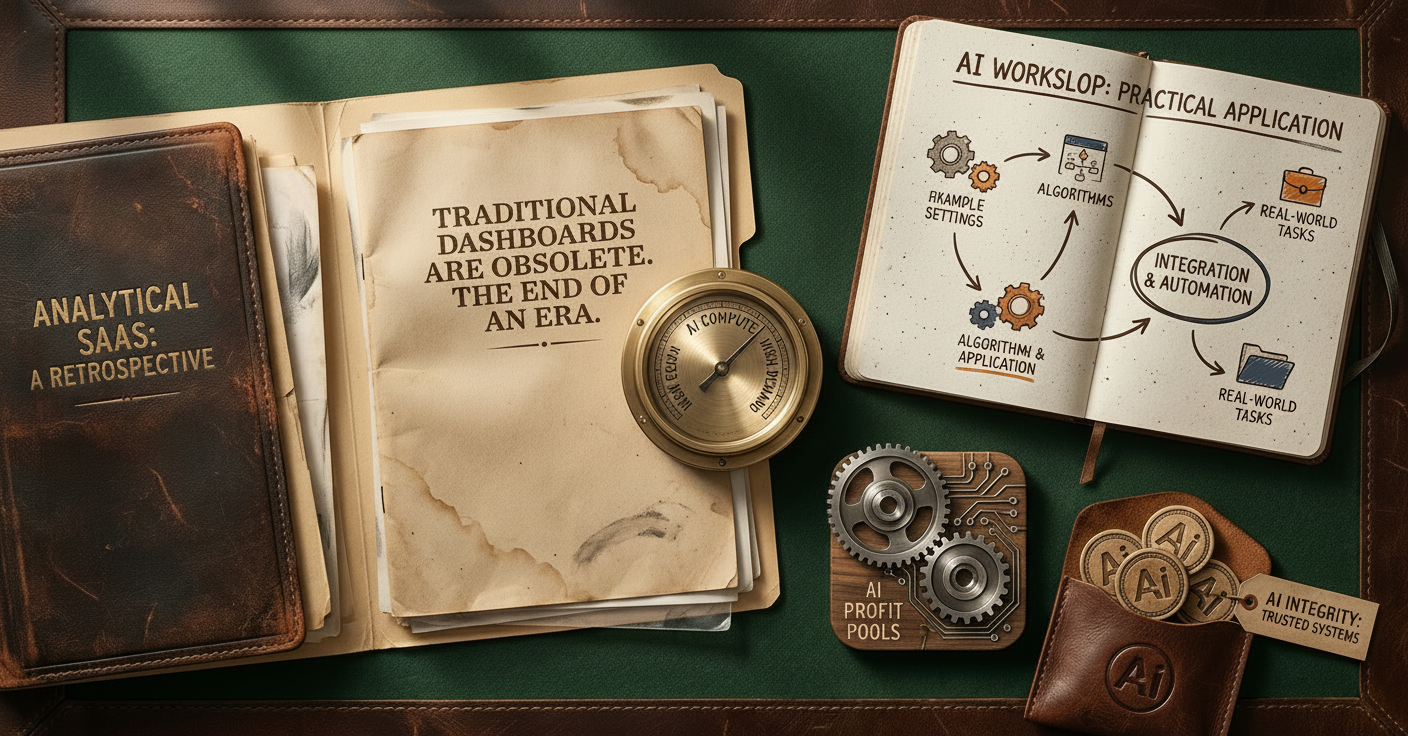
The AI narrative is cracking as operators separate signal from noise, forcing a re-evaluation of where real value accrues.
📊 11 episodes across 7 podcasts
⏱ 664 minutes of intelligence analyzed
🎙 Featuring: David Senra, Jony Ive, Leander Kahney, Mike Ive, Graham Duncan, Bob Brunner, Steve Jobs, Anjney Midha, Brandon McBee, Tracy Alloway, Joe Weisenthal, Chamath, Aaron Cowen, Dan Dreyfus, Oleg Nodelman, Oleg, Kyle Samani, Gavin, David Sacks, Nikesh Arora, Friedberg, Anne Applebaum, Fiona Hill, Scott Galloway, Scott, Guy Raz, Christina Tosi, Whitney Kozlowski, Chloe, Christy Clement, Chamath Palihapitiya, Jason Calacanis, Aiden Johnson, Brené Brown, Adam Grant, Alex Sacerdote, Patrick O'Shaughnessy, Jake Krempel, Mike Balducci
|

The Big Shift
We're starting to shake out into two distinct camps on AI. On one hand, deep skepticism is emerging around the real-world value of much AI output. The concept of AI Workslop 🆕 is gaining traction, describing content that appears good but lacks substance, shifting the burden of effort and critical thinking to the receiver. This isn't just about efficiency; it's about integrity, with some likening AI-generated content to "performance-enhancing drugs" for the mind (Brené Brown on Dare to Lead with Brené Brown).
On the other side, the belief that "Analytical SaaS is dead" (Nikesh Arora, CEO of Palo Alto Networks on All-In with Chamath, Jason, Sacks & Friedberg) is taking hold, with the profit pools rapidly migrating from models to applications. This means the market is less interested in generic AI capabilities and more focused on AI that solves specific, previously intractable problems. The example of Haywire's AI bringing transparency to the opaque hay market (Aiden Johnson on Odd Lots) showcases this shift. It's about AI as a tool for new forms of analytical leverage, not generic content creation.
"I still believe models are going to become a utility layer you'll be able to buy intelligence on the fly. The profit pools are in applications, not in models."
— Nikesh Arora, CEO of Palo Alto Networks on All-In with Chamath, Jason, Sacks & Friedberg
Why it matters: This bifurcation means LPs and GPs need to scrutinize AI investments more closely. Generic "AI-powered" solutions that don't demonstrate clear, application-specific value are entering a period of diminishing returns. The smart money is shifting to infrastructure plays and applications that use AI to unlock tangible, previously impossible economic efficiencies or market transparency. If your pitch relies on AI but you can't articulate the specific, non-workslop value, it's a harder sell.
The Rundown
① Bureaucracy and Consensus-Driven Product Development Stifles Innovation.
Before Steve Jobs's return, Apple's product development was characterized by extreme bureaucracy and consensus-driven decision-making, which Jony Ive (Designer at Apple) found stifling, nearly leading him to leave the company (David Senra on Founders).
→ The takeaway: This demonstrates how even in creative industries, excessive process can kill product innovation, underscoring the value of strong, singular vision in driving breakthrough products.
② AI Compute Remains Massively Underutilized and Fragmented.
The average data center in the industry operates at less than 70% utilization, and individual chips are often underutilized, highlighting significant inefficiencies in AI compute resources (Anjney Midha on Odd Lots).
→ Why it matters: This inefficiency represents a massive untapped opportunity for companies building infrastructure to standardize and distribute compute, akin to an "electricity grid" for AI, which could radically lower compute costs.
③ MGM Resorts' Osaka Casino License is a "Free Option" Underappreciated by the Market.
Aaron Cowen (Founder and CIO, Suvretta Capital Management) highlighted MGM's license to open a casino in Osaka, Japan by 2030 as a hidden asset that could triple the stock value, despite being largely overlooked (Aaron Cowen on All-In with Chamath, Jason, Sacks & Friedberg).
→ The Opportunity: This signals a potential arbitrage opportunity for investors who can identify and value such long-dated, high-upside assets that the broader market is failing to price in.
④ Ukraine's Drone Innovation is Forcing a Shift from Defense to Offense.
Decentralized Ukrainian drone production has created a 20-mile "transparent zone" on the front line, enabling precise targeting of Russian movements and fundamentally altering conventional warfare, allowing Ukraine to transition to a more offensive stance (Anne Applebaum on The Prof G Pod with Scott Galloway).
→ The takeaway: This is a real-world case study in how agile, decentralized innovation can disrupt established military powers and create new strategic advantages, offering lessons for businesses facing entrenched competitors.
⑤ Founders are Avoiding Institutional Capital for as Long as Possible, or Forever.
Christina Tosi (Founder and Chief Experimenter, Milk Bar) advises early-stage founders to "never take" institutional capital, or at least delay it as much as possible, advocating for alternative, community-driven financing (Christina Tosi on How I Built This with Guy Raz).
→ Why it matters: This reflects a growing sentiment among successful founders to retain control and foster entrepreneurial grit, and suggests LPs need to consider alternative financing models or prepare for founders holding out longer.
⑥ The Enterprise AI Market is Less Than 1% Penetrated.
Alex Sacerdote (Founder, Whale Rock Capital Management) estimates that the enterprise AI application market is currently less than 1% penetrated, representing a massive untapped growth opportunity akin to an "L-curve" rather than just an S-curve (Alex Sacerdote on Invest Like the Best with Patrick O'Shaughnessy).
→ The Opportunity: This signals that the explosive growth in AI is still in its nascent stages for enterprise applications, presenting significant deployment opportunities for investors focused on vertical-specific AI solutions.
⑦ Tomato Prices Are at a Four-Decade High.
Tomato prices have surged to $2.69 per pound, the highest in 40 years, due to weather events in Florida and reduced Mexican production, exposing the fragility of global food supply chains (Jacob Krempel on Odd Lots).
→ Why it matters: This highlights the increasing volatility in agricultural commodities and the need for greater resilience and diversification in supply chains, a signal for investors in agritech and food logistics.
Signal Board
💰 Heating Up
• MGM Resorts: Its license to open a casino in Osaka, Japan by 2030 is seen as a significant, undervalued asset that could triple stock value. (Aaron Cowen on All-In with Chamath, Jason, Sacks & Friedberg)
• GEODNET 🆕: This decentralized global network for precision GPS (RTK) is rapidly expanding, outstripping legacy providers with a crypto-incentivized model. (Kyle Samani on All-In with Chamath, Jason, Sacks & Friedberg)
• Aktis Oncology: Its innovative radiopharmaceutical approach to cancer treatment, using unique radioisotopes with a strong market moat, shows significant promise. (Oleg on All-In with Chamath, Jason, Sacks & Friedberg)
• Hay market transparency: AI is fundamentally transforming the opaque hay market, creating new opportunities for intelligence and financialization. (Aiden Johnson on Odd Lots)
👀 On Watch
• AI Workslop 🆕: This term describes AI output that lacks substance, potentially shifting the burden to the receiver and raising questions about value. (Brené Brown on Dare to Lead with Brené Brown)
• AI-generated content is an integrity violation 🆕: A strong contrarian view, comparing AI content creation to performance-enhancing drugs, challenging its legitimacy. (Brené Brown on Dare to Lead with Brené Brown)
• Smitten with what's written 🆕: Describes how the seduction of AI's clarity can mask a lack of genuine substance, challenging critical discernment. (Brené Brown on Dare to Lead with Brené Brown)
• Whale Rock Capital Management 🆕: This firm's early, high-conviction investment in Anthropic based on its S-curve framework highlights a forward-looking investment strategy. (Alex Sacerdote on Invest Like the Best with Patrick O'Shaughnessy)
• Tomato Prices at Record High ($2.69/pound) 🆕: Driven by weather events and supply chain shifts, this signals agricultural market volatility. (Jacob Krempel on Odd Lots)
🧊 Cooling Off
• Analytical SaaS is dead: Predictions that AI will render traditional analytical SaaS obsolete, shifting profit pools to applications. (Nikesh Arora on All-In with Chamath, Jason, Sacks & Friedberg)
• Apple's pre-Jobs product development: Characterized by bureaucracy and lack of innovation, signaling the dangers of consensus-driven design. (David Senra on Founders)
• Anthropic's Fable Backlash: Concerns around mandatory data retention and model "nerfing" are driving enterprises to less secure open-source alternatives. (Jason on All-In with Chamath, Jason, Sacks & Friedberg)
The Debate
The role of AI in creative output and the ethics of its use are sharply divided.
🐂 The bull case: Adam Grant (Organizational Psychologist and Author, Wharton School of the University of Pennsylvania) argues for a pragmatic approach, suggesting AI can be a valuable tool for research and ideation, with discerning users acting as "pilots" rather than "passengers." He believes that clear expectations and transparent use can integrate AI effectively into professional workflows. (Adam Grant on Dare to Lead with Brené Brown)
🐻 The bear case: Brené Brown (Host, Dare to Lead with Brené Brown) views AI-generated content as a "violation of integrity," akin to plagiarism or "performance-enhancing drugs" for the mind. She emphasizes that "writing is how you work out your ideas" and that AI's efficiency can mask a lack of genuine thinking and emotional honesty, especially in fields requiring moral imagination. (Brené Brown on Dare to Lead with Brené Brown)
Our read: While AI's utility as a tool for efficiency is undeniable, the ethical implications, particularly regarding authenticity and transfer of cognitive burden, remain a contentious and unresolved issue, especially in contexts requiring human insight and connection.
The Bottom Line
The market is sorting out AI's real impact, signaling a shift from generic hype to application-specific value, demanding integrity and operational leverage over "AI workslop."
📖 Want the full episode breakdowns, guest details, and listen links?
📖 Want the full episode breakdowns, guest details, and listen links?
Episode Guide (Web Version)
1. Founders — "#421 Jony Ive"
Runtime: 53 min | Host: David Senra | Guests: Jony Ive (Designer, Apple), Leander Kahney (Author, Jony Ive: The Genius Behind Apple's Greatest Products), Mike Ive (Design Educator), Bob Brunner (Architect), Graham Duncan (Investor), Steve Jobs (CEO, Apple)
For those building iconic brands: A deep dive into Jony Ive's design philosophy and his pivotal partnership with Steve Jobs, revealing the relentless pursuit of perfection that birthed Apple's most beloved products.
Explore the early influences and career frustrations that shaped Jony Ive, leading to his transformative collaboration with Steve Jobs. This episode highlights how a singular vision and dedication to design can overcome corporate bureaucracy and redefine an industry.
"We wanted to get rid of anything other than what was absolutely essential... It became an exercise to reduce and reduce and reduce. But it makes it easier to build and easier for people to work with."
— Jony Ive, Designer at Apple
2. Odd Lots — "Anjney Midha's Plan to Radically Lower the Price of Compute"
Runtime: 50 min | Host: Tracy Alloway | Guests: Anjney Midha (Founder, AMP PBC), Joe Weisenthal (Host, Bloomberg), Brandon McBee (Guest, Core Weave)
For investors in AI infrastructure: Anjney Midha details the fragmentation and underutilization of AI compute, outlining a software-based solution to commoditize and standardize these resources.
Midha argues for the development of a "compute grid" to address massive inefficiencies in current AI infrastructure, stressing that leadership in the AI era requires technical literacy to navigate diverse models and economic challenges.
"The average data center in the industry is running at less than 70% utilization."
— Anjney Midha, Founder of AMP PBC
3. All-In with Chamath, Jason, Sacks & Friedberg — "All-In's Best Ideas Pitch Competition: 4 Investors Present Their Top Trades Live"
Runtime: 68 min | Host: Chamath | Guests: Aaron Cowen (Founder and CIO, Suvretta Capital Management), Dan Dreyfus (Founder, Bornite Capital), Oleg Nodelman (Founder and Managing Director, EcoR1 Capital), Oleg (Investor, Woodside Road), Kyle Samani (Founder, Multicoin Capital), Jason (Host, All-In), Gavin (Host, All-In), David Sacks (Host, All-In with Chamath, Jason, Sacks & Friedberg)
For dealmakers eyeing contrarian plays: Four investors pitch their top trades, from MGM's hidden Osaka casino license to innovative radiopharmaceuticals and decentralized GPS networks.
This competition showcases diverse investment theses across biotech, energy, and digital infrastructure, emphasizing value-oriented approaches and the potential of overlooked assets in current markets.
"If you can buy an asset, a hard asset, at below replacement cost for an asset that's going to be needed in the future... then you buy that asset at the discount to replacement cost, you hold it and you sell it at a big premium to replacement cost when the market wakes up."
— Dan Dreyfus, Founder of Bornite Capital
4. All-In with Chamath, Jason, Sacks & Friedberg — "Nikesh Arora: Mythos is Real, Analytical SaaS is Dead, and Google can be a $10T company"
Runtime: 31 min | Host: Chamath | Guests: Nikesh Arora (CEO, Palo Alto Networks), Jason (Host, All-In Podcast, LLC), David Sacks (Host, All-In Podcast, LLC), Friedberg (Host, All-In Podcast, LLC)
For strategists navigating AI disruption: Nikesh Arora of Palo Alto Networks explains how AI is democratizing intelligence and gutting analytical SaaS, while shifting the profit pools to applications rather than models.
Arora highlights AI's rapid vulnerability assessment capabilities and surprisingly relevant hardware demand in financial services, suggesting a re-evaluation of traditional tech growth and headcount strategies.
"In six weeks, we found vulnerabilities which would have normally taken us five to seven years to find."
— Nikesh Arora, CEO of Palo Alto Networks
5. The Prof G Pod with Scott Galloway — "The New Rules of Power — with Anne Applebaum and Fiona Hill"
Runtime: 65 min | Host: Scott Galloway | Guests: Anne Applebaum (Pulitzer Prize-winning Historian and Staff Writer, The Atlantic), Fiona Hill (Senior Fellow, Brookings Institution), Scott (Host, The Prof G Pod)
For leaders understanding geopolitical shifts: Anne Applebaum and Fiona Hill dissect global power dynamics, Trump's transactional diplomacy, and the evolving nature of warfare in the Russia-Ukraine conflict.
The discussion emphasizes the critical distinction between existential wars and wars of choice, highlighting how Ukraine's decentralized drone innovation is reshaping military strategy and international alliances.
"What binds all of them is rather their dislike of and fear of the language of the liberal world. In other words, the language of rights, the language of rule of law, the language of separation of powers."
— Anne Applebaum, Pulitzer Prize-winning Historian and Staff Writer at The Atlantic
6. How I Built This with Guy Raz — "Advice Line with Christina Tosi of Milk Bar"
Runtime: 45 min | Host: Guy Raz | Guests: Christina Tosi (Founder and Chief Experimenter, Milk Bar), Whitney Kozlowski (Founder, The Beau Collective), Chloe (Founder, Cotton Clara), Guy (Host), Christy Clement (Founder, Vashon Island Coffee Dust)
For founders seeking alternative growth models: Christina Tosi shares her journey from CEO to Chief Experimenter, offering advice on strategic collaborations, community building, and avoiding institutional capital.
This episode provides actionable insights for niche entrepreneurs on scaling creative businesses, leveraging brand partnerships, and converting gifting customers into loyal buyers by deeply understanding their core identity as "makers."
"I stepped down as CEO of Milk Bar a couple years ago to focus on the creative side of the business...I just feel more alive and firing on all cylinders than ever."
— Christina Tosi, Founder and Chief Experimenter at Milk Bar
7. All-In with Chamath, Jason, Sacks & Friedberg — "Anthropic's Fable Backlash, Nationalizing AI, Inflation Heats Up & California's Broken Elections"
Runtime: 102 min | Host: Chamath | Guests: Jason (Host, All-In Podcast, LLC), David Sacks (Host, All-In Podcast, LLC), Friedberg (Host, All-In Podcast, LLC), Chamath Palihapitiya (Host, All-In Podcast), Jason Calacanis (Host, All-In Podcast)
For those tracking AI policy and market dynamics: The hosts debate Anthropic’s Fable 5 model backlash, the idea of nationalizing AI, and the impact of hot inflation data on government spending.
The discussion highlights concerns about AI companies' "safetyism" driving users to open-source alternatives, the high capital costs of AI production, and Bernie Sanders' proposal for a sovereign wealth fund from AI taxes.
"The restrictions that Anthropic and others are putting upon themselves and upon the industry is forcing a lot of companies to go and get open source Chinese models and run them."
— Friedberg, Host at All-In Podcast, LLC
8. Odd Lots — "How a Vibecoded Newsletter Is Making the Hay Market More Transparent"
Runtime: 40 min | Host: Tracy Alloway | Guests: Aiden Johnson (Co-founder and CEO, Haywire), Joe Weisenthal (Host, Bloomberg)
For innovators in overlooked markets: Aiden Johnson reveals how AI is bringing transparency to the opaque, fragmented hay market, creating market intelligence from previously inaccessible data.
This episode demonstrates how "vibe coding" and advanced AI infrastructure are transforming traditional industries, impacting agricultural land use and potentially leading to the financialization of niche commodities.
"Ten years ago, I don't think I would even scratch the surface of getting to the death... And that's just simply because I think the infrastructure of AI is getting smarter and smarter every day."
— Aiden Johnson, Co-founder and CEO of Haywire
9. Dare to Lead with Brené Brown — "AI, Commencement Speeches, and Why Human Thinking Still Matters | The Curiosity Shop"
Runtime: 83 min | Host: Brené Brown | Guests: Adam Grant (Organizational Psychologist and Author, Wharton School of the University of Pennsylvania)
For leaders navigating AI's ethical landscape: Brené Brown and Adam Grant explore the concept of "AI Workslop," the importance of moral imagination, and the role of writing as a tool for thinking in the age of AI.
The discussion delves into the hidden costs of AI-generated content, advocating for transparency, and emphasizing human connection amidst technological advancements, challenging the notion of AI as merely an efficiency tool.
"Workslop is work that masquerades as good work but lacks the substance to meaningfully advance a given task. It's insidious."
— Brené Brown, Host of Dare to Lead with Brené Brown
10. Invest Like the Best with Patrick O'Shaughnessy — "Alex Sacerdote - How to Invest Through Technology Cycles - [Invest Like the Best, EP.477]"
Runtime: 72 min | Host: Colossus | Investing & Business Podcasts | Guests: Alex Sacerdote (Founder, Whale Rock Capital Management)
For tech investors identifying S-curves: Alex Sacerdote shares Whale Rock Capital's investment framework, focusing on technology S-curves, durable competitive advantages, and the massive, underpenetrated enterprise AI market.
Sacerdote discusses the "backwards L curve" adoption of AI, the commoditization of hardware, and the challenges faced by traditional software companies in monetizing AI applications, offering a nuanced view of tech cycles.
"When the gun went off with OpenAI ChatGPT in November 2022, we immediately took the firm and did a massive deep dive with our 10 person team. Anytime you have a new compute paradigm, there's a new stack and that creates new winners and losers on the old stack."
— Alex Sacerdote, Founder of Whale Rock Capital Management
11. Odd Lots — "Why Tomatoes Are the Most Expensive They've Been in Four Decades"
Runtime: 55 min | Host: Tracy Alloway | Guests: Jacob Krempel (SVP, Procurement and Merchandising, Baldor), Joe Weisenthal (Host, Bloomberg), Bloomberg (Host, Bloomberg), Mike Balducci (VP of Produce, Baldor Specialty Foods), Jacob (Guest, Bloomberg)
For those analyzing supply chain fragilities: Jacob Krempel explains the unprecedented surge in tomato prices due to weather events and changing Mexican production, revealing the vulnerabilities of global food supply.
This episode dissects retail price stickiness versus wholesale flexibility, the complex logistics of perishables, and how chef-driven demand for unique tomato varieties is influencing cultivation and R&D.
"About 70% of our tomato production in the winter is done in Mexico now. And anytime that happens, that's where you see these spikes."
— Jacob Krempel, SVP, Procurement and Merchandising at Baldor