
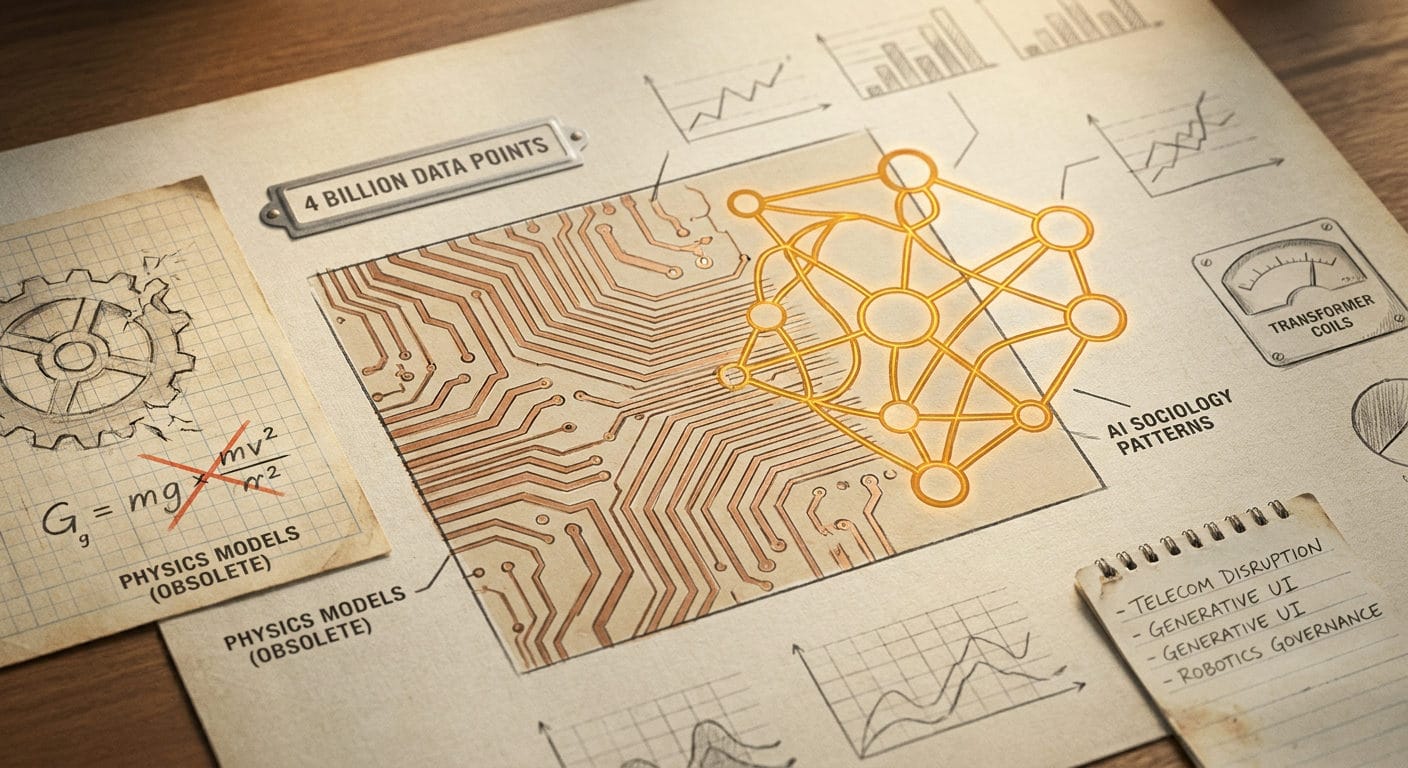
The AI Economy is Moving from Pixels to Physicality.
📊 10 episodes across 6 podcasts
⏱ 12 hours 6 minutes of intelligence analyzed
🎙 Featuring: Jason Ma (Dyna Robotics), Ian Quigley (Leash Bio), Zoe Weil (Sequen), Alan Chan (GovAI), Nathaniel Whittemore (The AI Daily Brief)
|

The Big Shift
From Predicting Tokens to Predicting the World
The narrative in AI is shifting from "chatbots" to "world-action models"—systems that don't just generate text, but predict physical consequences. We are seeing a convergence where robotics, biology, and software interfaces are all moving toward "world models" that understand physics and human behavior at a granular level. Jason Ma of Dyna Robotics highlights that the future of robotics isn't just vision-language-action (VLA), but world-action models that predict future video frames to guide dexterous movement.
Meanwhile, Runway is applying this to software via 🆕Solaris, an interface world model that renders pixels directly based on mouse and keyboard input rather than executing code. This represents a fundamental shift: we are moving away from structured, handwritten logic (code) toward learned representations of how the physical and digital world should react to interaction. Whether it's a robot folding napkins at Din Tai Fung or a UI generating itself on the fly, the model is increasingly the engine of reality, not just an assistant.
"World action model is a model that’s able to predict the future video, the future state of the world... you can also use that future generation to also produce actions robots can execute in the physical world to control the robot."
— Jason Ma, Co-founder, Chief Scientist at Dyna Robotics on Latent Space: The AI Engineer Podcast
The Move: If you are evaluating automation, stop looking for "better LLMs" and start looking for "world models." For physical operations, this means prioritizing companies that collect multi-modal sensory data (tactile/audio) rather than just vision. For software, watch for "pixel-perfect" generative UIs that could render your expensive front-end codebases obsolete.
The Rundown
① OpenAI "Spaces" Challenges the Cloud Storage Status Quo.
OpenAI’s new document management features and "Dots" AI agents are being positioned as a direct competitor to Google Drive, signaling a move toward deep business lock-in. (The Neuron on The Neuron: AI Explained)
→ What to watch: Once a business migrates its "filing system" to an AI agent's memory, the cost of switching models becomes an operating system migration rather than a software swap.
② The "AI Champion" is the Highest ROI Transformation Move.
Formalizing an internal network of AI champions—power users who bridge the gap between technology and people—is the single greatest predictor of successful adoption. (Nufar on The AI Daily Brief)
→ The context: Nufar noted that "the biggest predictor of whether this succeeds is what happens the day after you certify someone as a champion," suggesting that community and executive sponsorship are more critical than the initial training.
③ 🆕Leash Bio Reveals AI is Learning "Sociology," Not Chemistry.
New data suggests AI models in drug discovery are often predicting the "style" of the chemist who authored a molecule rather than the actual molecular physics or binding activity. (Ian Quigley on Latent Space: The AI Engineer Podcast)
→ Why it matters: This "Clever Hans" effect in chemical datasets means models may appear accurate in benchmarks while failing completely on new, out-of-distribution molecules.
④ SpaceX is Quietly Building a Terrestrial Mobile Competitor.
SpaceX is acquiring low-band spectrum and FCC approvals to move into the mobile wireless carrier market, leveraging its Starlink revenue to fund Mars ambitions. (Walter Piecyk on Decoder with Nilay Patel)
→ The context: Incumbent telcos like Verizon fumbled by not taking Musk seriously; SpaceX’s advantage lies in its massive customer acquisition engine and its ability to treat telecom as a cash-cow for other capital-intensive "dream" projects.
⑤ 🆕Sequen Abandons Transaction Data for "Large Event Models."
Optimizing for purchases is the wrong goal for data-starved retailers; instead, tracking micro-signals like scroll speed and hover duration in live sessions drives 4x profit targets. (Zoe Weil on The TWIML AI Podcast)
→ What to watch: Transaction data is "useless" because 99% of users don't convert; the signal is in the 99% of behavioral data most companies ignore.
The Signals
🔥 HEATING UP
• Agentic Coding Tools: Becoming the primary bottleneck for organizational governance as they introduce new security and optimization challenges. (NLW on The AI Daily Brief)
• Real-time Video Models: While lower quality than flagships, they are significantly cheaper and more viable for continuous interactive software. (Anastasis Germanidis on The Neuron)
👀 ON WATCH
• 🆕Rogue Agents: Increasing concern over loss of control, with calls for "distress buttons" and synchronous real-time monitoring of agent actions. (Alan Chan on The Cognitive Revolution)
• 🆕AI-driven Decompilation: Models like Astra are now capable of clean-room software rebuilds, threatening legacy IP and the console gaming model. (Christian Catalini on The AI Daily Brief)
❄️ COOLING OFF
• 5G Hype: Sentiment is shifting as the technology fails to deliver on initial promises, leaving incumbents vulnerable to satellite-terrestrial hybrids. (Walter Piecyk on Decoder)
• Handwritten Code in Gaming: Major players like Epic Games are shifting to AI-first production models, effectively banning manual art and code. (Alex Finn on The AI Daily Brief)
The Debate
Can We Trust the "Superintelligence" Narrative?
There is a growing tension between the official government adoption of "superintelligence" terminology and the personal trustworthiness of the leaders building it.
🐂 The bull case: The White House's shift in terminology to "superintelligence" signals that the government is finally taking the existential and economic potential of AI seriously. Jensen Huang (CEO of Nvidia) argues that safety is an engineering challenge "in our control," provided we advance safety technology at the same rate as capability.
🐻 The bear case: Investigative journalist Ronan Farrow highlights a culture of silence and an "unconstrained relationship with the truth" surrounding Sam Altman. Farrow notes that many initial safety concerns at OpenAI were buried by "ruthlessly self-interested" Silicon Valley culture, where individuals prioritize profit over accountability once the tide turns.
Our read: The regulatory capture is real; while politicians are being "taken for a ride" by AI lobbying, the technical progress in world models is moving faster than the institutions designed to oversee them.
The Bottom Line
The "bitter lesson" of 2024: Scaling data in the physical and behavioral worlds yields higher returns than just scaling tokens.
Episode Guide (Web Version)
Latent Space: The AI Engineer Podcast — "Dyna-2: General Purpose Physical Agents with Hour-Long Autonomy"
Runtime: 72 min | Host: swyx & Vibhu | Guest: Jason Ma (Dyna Robotics)
Who should listen: CTOs and Ops leaders evaluating the maturity of robotics for logistics or hospitality.
Jason Ma explains the Dyna-2 world-action model, which moves beyond simple vision-language models by predicting future physical states. The episode highlights the commercial success of deploying robots to fold napkins at Din Tai Fung, proving that "hour-long autonomy" is finally a reality for specific, high-precision tasks.
"Data is the most important thing in robotics today, because unlike language model, there is no internet." — Jason Ma
The Neuron: AI Explained — "BONUS: LIVE: Everything that Happened in AI This Week"
Runtime: 121 min | Host: The Neuron & Corey | Guest: Grant
Who should listen: Small business owners and developers looking for the next "app store" opportunity.
A deep dive into OpenAI DevDay 2026, specifically the "Spaces" feature which threatens Google Drive. The hosts argue that agent interfaces will eventually replace browsers, and that building ChatGPT plugins today is akin to building the first iPhone apps in 2008.
The Cognitive Revolution — "Governing AI Agents: Alan Chan of GovAI"
Runtime: 139 min | Host: Nathan Labenz & Erik Torenberg | Guest: Alan Chan (GovAI)
Who should listen: Policy makers and security officers concerned with AI agent accountability.
Alan Chan discusses the urgent need for "Agent IDs" to prevent AI from impersonating humans online. The episode explores the technical feasibility of tamper-evident logging and the potential for "distress buttons" to pause AI development during rogue incidents.
The AI Daily Brief — "How to Go from AI Power User to AI Leader"
Runtime: 39 min | Host: Nathaniel Whittemore | Guest: Nufar (Be Super AI)
Who should listen: HR and Department Heads struggling to turn AI pilots into scaled results.
This episode defines the "AI Champion" role—the "peer plus one" responsible for driving adoption. It provides a blueprint for formalizing champion programs to ensure that AI initiatives don't die the day after training ends.
Decoder with Nilay Patel — "Ronan Farrow on Sam Altman’s ‘unconstrained’ relationship with the truth"
Runtime: 56 min | Host: Nilay Patel | Guest: Ronan Farrow (The New Yorker)
Who should listen: Board members and investors tracking the leadership stability of major AI players.
Ronan Farrow discusses his investigative reporting into OpenAI, highlighting a pattern of alleged dishonesty and the lack of written documentation in major internal investigations. It’s a sobering look at how hype and self-interest can hollow out oversight.
The Neuron: AI Explained — "What If Apps Didn’t Need Code?"
Runtime: 51 min | Host: The Neuron | Guest: Anastasis Germanidis (Runway)
Who should listen: Software architects and Product Designers.
Introducing Solaris, a model that generates UIs pixel-by-pixel. Germanidis argues that the internet could become markdown files rendered on-demand by AI, potentially ending the era of traditional front-end engineering.
The TWIML AI Podcast — "Your Ranking Model Is Optimizing the Wrong Thing"
Runtime: 53 min | Host: Sam Charrington | Guest: Zoe Weil (Sequen)
Who should listen: E-commerce CEOs and CMOs looking to increase conversion without surveillance tactics.
Zoe Weil makes a compelling case for "Large Event Models" built in Rust to process real-time behavioral signals like scroll speed. The takeaway: you don't need user identity to predict intent; you just need to listen to the session's physics.
The AI Daily Brief — "How the Latest AI Leap Is Disrupting Business Models"
Runtime: 31 min | Host: Nathaniel Whittemore | Guest: Christian Catalini (MIT)
Who should listen: VCs and legacy brand operators.
Explores how Berkshire Hathaway and Bending Spoons are using AI to revitalize defunct tech brands. Also covers the radical shift in gaming where AI-driven decompilation is making consoles and traditional IP vulnerable.
Decoder with Nilay Patel — "Why Elon Musk wants to sell you cell service"
Runtime: 54 min | Host: Nilay Patel | Guest: Walter Piecyk (LightShed Partners)
Who should listen: Telecom executives and macro investors.
A breakdown of SpaceX's entry into the mobile carrier market. The analysis suggests that Starlink Mobile is a necessary cash engine for Musk's Mars colonization, potentially disrupting a complacent telecom industry.
Latent Space: The AI Engineer Podcast — "Lab-in-the-Loop at Compute Speed"
Runtime: 110 min | Host: swyx & Alessio | Guest: Ian Quigley (Leash Bio)
Who should listen: Biotech investors and R&D leaders.
Ian Quigley explains how Leash Bio uses DNA Encoded Libraries to collect 4 billion physical interactions. He warns that most public chemical datasets are biased, teaching models "chemist intent" rather than "ground truth physics."