
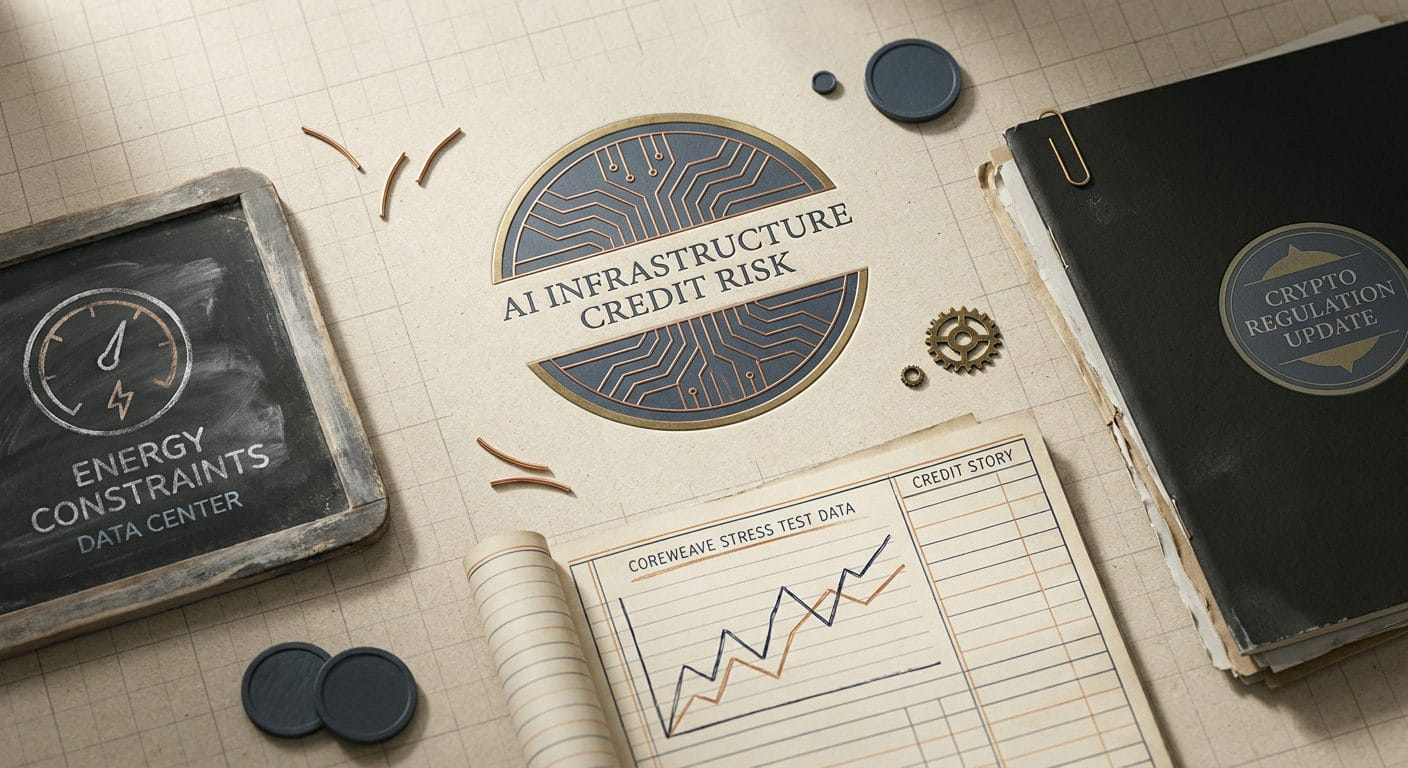
The AI narrative is shifting from "boundless growth" to a high-stakes credit story where the cost of compute-related debt is threatening to spark a broader high-yield contagion.
The Intake
📊 10 episodes across 7 podcasts
⏱ 8 hours 36 minutes of intelligence analyzed
🎙 Featuring: Steve Eisman (Neuberger Berman), Downtown Josh Brown (Ritholtz Wealth Management), Michael Batnick (Ritholtz Wealth Management), Jeff Yan (Hyperliquid Labs), Mike Selig (CFTC), Yasir Arafat (Alo Atomics)
|

The Big Shift
For the past 18 months, the AI trade was an equity story driven by Capex projections. This week, the signal flipped: AI is now a credit story. The unraveling of CoreWeave’s highly leveraged data center plays is the first real stress test for the infrastructure funding market, and the "spillover" risk to broader high-yield and equity markets is no longer theoretical.
Why it matters: Market participants are finally scrutinizing the plumbing. NVIDIA’s revenue concentration—70% from just five customers—and Oracle’s massive backlog (half of which belongs to OpenAI) reveal a fragile ecosystem where a single credit event at a private lab could trigger a systemic shock. We are moving from the "implementation phase" to the "accountability phase," where the cost of capital matters more than the size of the LLM.
"If OpenAI went bankrupt tomorrow... I think the US economy would go into a recession immediately."
— Steve Eisman, Managing Director and Portfolio Manager at Neuberger Berman on The Compound and Friends
The Level: Watch the 10-year Treasury yield and the spreads on compute-related debt. Ben McMillan (IDX Advisors) notes that while the S&P sits near highs, 50% of stocks are effectively in a bear market. If credit markets continue to lead equities downward, the "AI narrative" will not be enough to prevent a valuation reset across the hyperscaler stack.
The Rundown
① The CFTC’s Federal Path for Crypto Spot Margin.
Proposed Reg CTX and Reg CAM 🆕 aim to establish a federal route for retail spot margin and leverage, circumventing the fragmented "state money-transmitter" patchwork currently governing US exchanges. (Mike Selig on Bankless)
→ Why it matters: This is a massive regime change for US crypto market structure; firms can choose the federal CAM route to offer leverage legally onshore, provided they maintain functional separation between brokerage and clearing.
② Hyperliquid’s "Dutch Auction" for Perpetual Listings.
Hyperliquid 🆕 is using a Dutch auction mechanism to allocate scarce deployment slots for new perpetual contracts, aiming to house 90%+ of all global finance on a neutral blockchain protocol. (Jeff Yan on Odd Lots)
→ Capital Signal: By requiring an auction process for listing, the protocol prevents the "dog coin" proliferation seen on other chains, prioritizing institutional-grade instruments over speculative noise.
③ The 9,000-Year Scaling Problem for Nuclear SMRs.
While Alo Atomics 🆕 plans to mass-produce small nuclear reactors (SMRs) to power AI data centers, the sheer scale of global fossil fuel dependency presents a daunting timeline. (Yasir Arafat on Macro Voices)
→ Strategic Constraint: Erik Townsend noted that a factory producing 1 GW/year would take 9,000 years to replace current fossil fuel use; the real bottleneck isn't the reactor design, but the "undeveloped HALEU supply chain" and enriched uranium scarcity.
④ Aritzia’s High-Margin US Conquest.
Canadian "everyday luxury" brand Aritzia 🆕 is maintaining 46% gross margins despite tariff headwinds by aggressively shifting production from China to Vietnam and centralizing US distribution in Ohio. (Kyle Grieve on The Intrinsic Value Podcast)
→ Operator Insight: With a 12-18 month payback period on new boutiques and $1,000/sq ft productivity, Aritzia is outperforming the $400-$700 industry average, positioning it as a rare compounding retail play.
⑤ Air-Freight Capacity Swallowed by Data Centers.
AI data-center construction is currently absorbing a staggering 42% of total global air-freight capacity, creating a massive supply-demand imbalance for traditional retailers. (Oscar de Bok on Bloomberg Surveillance)
→ Supply Chain Risk: With US-bound air-freight demand rising 15% against single-digit supply growth, shipping rates will remain elevated regardless of geopolitical routing improvements in the Suez.
Signal Board
🔥 HEATING UP
• Apple AI Monetization: Analysts estimate a $75/share incremental value as Apple becomes the "toll collector" for 2.5B iOS devices. (Dan Ives on CNBC)
• Nuclear Fuel Recycling: Fast-spectrum reactors could extend uranium reserves from 117 years to 12,000 years. (Yasir Arafat on Macro Voices)
👀 ON WATCH
• Reg CTX 🆕: The potential for onshore retail crypto leverage could bring massive liquidity back to US-regulated entities. (Mike Selig on Bankless)
• Apple Foldable iPhone Duo: Preorder demand is "extraordinary" despite the $1,999 price tag, targeting 40% market share by 2027. (CNBC Fast Money)
❄️ COOLING OFF
• Nike (DTC Strategy): Retreating from middlemen allowed rivals like Alo to seize prime retail shelf space permanently. (Shawn O’Malley on The Intrinsic Value Podcast)
• US Quit Rate: Falling to 2015 levels suggests a static workforce and a labor market that is less robust than headline numbers imply. (Stacey Vanek Smith on Bloomberg Surveillance)
The Debate
Topic: Is the Federal Reserve forced into an untelegraphed October rate hike?
🐂 The bull case: Aditya Bhave (BofA) argues an October hike is necessary to prove Chair Warsh is serious about breaking from forward guidance. Inaction risks allowing broadening inflation expectations to become entrenched as survey measures edge higher.
🐻 The bear case: Market pricing for an October move is effectively zero (4-5 basis points). Skeptics argue the Fed cannot afford to surprise the market so violently while credit stress in the "compute" sector is already flashing red.
Our read: The Fed is trapped between "narrative dependence" and a brewing credit crunch; a surprise hike would likely detonate the already-strained AI infrastructure debt market.
The Bottom Line
The AI "narrative" has hit a credit wall; watch data center debt spreads, not GPU sales, to gauge the next leg of this cycle.
Episode Guide (Web Version)
CNBC's "Fast Money" — "Coreweave’s Impact On AI Trade… And Netflix Results On Deck 10/16/26"
Runtime: 43 min | Host: Melissa Lee | Guest: Ben Emmons (FedWatch Advisors), Tim Seymour
Who should listen: Growth investors and tech analysts tracking the intersection of credit markets and AI valuations.
The desk debates the "unraveling" of the Neo-cloud and CoreWeave, questioning if high borrowing costs will permanently break the leverage-heavy data center model.
"I think the credit market is currently leading the equity market and rightfully so." — Bonawyn Eison
The Compound and Friends — "How OpenAI Could Cause a US Recession With Steve Eisman"
Runtime: 50 min | Host: Josh Brown | Guest: Steve Eisman (Neuberger Berman)
Who should listen: Institutional allocators and macro strategists assessing systemic risk in the private AI lab ecosystem.
Eisman argues that OpenAI and Anthropic have become "systemically important" and that a lack of moats in LLMs makes the current supply chain dangerously fragile.
"70% of Nvidia's accounts receivable... is from five customers." — Steve Eisman
Macro Voices — "MacroVoices #554 Yasir Arafat: Mass Manufacturing Nuclear Power Plants"
Runtime: 73 min | Host: Erik Townsend | Guest: Yasir Arafat (Alo Atomics)
Who should listen: Energy sector investors and data center operators solving for the 2030 power crunch.
A deep dive into SMR production economics and the "nuclear waste hack" that could extend fuel availability for millennia.
"You don't make nuclear cheap by building one perfect reactor... You make it cheap by building the same good reactor a thousand times." — Yasir Arafat
Odd Lots — "Jeff Yan's Plan to Bring the Entire Financial Industry Onto Hyperliquid"
Runtime: 58 min | Host: Joe Weisenthal | Guest: Jeff Yan (Hyperliquid Labs)
Who should listen: DeFi builders and fintech executives monitoring the migration of institutional finance to on-chain rails.
Yan explains the vision of Hyperliquid as a "neutral protocol" for all of finance, using mathematical constraints to ensure fair clearing and liquidations.
"Hyper Liquid is a protocol... The tagline or aspirational goal is housing all of finance." — Jeff Yan
Bloomberg Surveillance — "Potential Market Rebound and Shipping Latest"
Runtime: 30 min | Host: Tom Keene | Guest: Oscar de Bok (DHL), Ben McMillan (IDX)
Who should listen: Logistics heads and supply chain managers planning for peak season amidst AI-driven capacity shortages.
A stark look at how AI data centers are siphoning air-freight capacity, coupled with a warning on equity dispersion hidden beneath low VIX levels.
The Intrinsic Value Podcast — "TIVP103: Aritzia (ATZ.TO): The Women's Apparel Brand Conquering the US"
Runtime: 85 min | Host: Kyle Grieve | Guest: Shawn O’Malley
Who should listen: Retail operators and value investors looking for "compounding machines" with high ROIC.
An exhaustive analysis of Aritzia's unit economics, vertical integration, and the failed DTC experiment at Nike that created an opening for competitors.
Bankless — "The CFTC’s Proposed Rules to Reshape US Crypto Markets"
Runtime: 71 min | Host: David Hoffman | Guest: Mike Selig (CFTC Chair)
Who should listen: Crypto founders and legal counsel navigating the new SEC/CFTC "trilogy" of regulations.
A breakdown of the proposed Reg CTX and CAM, which could finally bring retail spot margin trading to regulated US exchanges.
CNBC's "Fast Money" — "Rate Drop Helps Fuel Bounces… And Apple And Meta’s AI Partnership 10/15/26"
Runtime: 43 min | Host: Melissa Lee | Guest: Dan Ives (Wedbush), Savita Subramanian (BofA)
Who should listen: Equity traders looking for "toll collector" plays in the consumer AI highway.
Analysis of the Apple-Meta partnership and why healthcare is currently the sector seeing the most profound AI productivity gains.
Bloomberg Surveillance — "Bank Earnings, Why Consumers Are 'Roughed Up' & Real Estate Trends"
Runtime: 42 min | Host: Tom Keene | Guest: Jonathan Miller, Bess Freedman
Who should listen: Real estate developers and wealth managers monitoring the "wealth effect" impact on consumer spending.
Discussion on the 5-million-home deficit and the growing reliance of American households on investment income over wages.
Bloomberg Surveillance — "Bloomberg Surveillance TV: October 19th, 2026"
Runtime: 21 min | Host: Jonathan Ferro | Guest: Peter Tchir (Academy Securities), Aditya Bhave (BofA)
Who should listen: Macro traders and policy watchers focused on the Fed's October credibility test.
A debate on whether the Fed will shock markets with an untelegraphed hike and the "paradox" of AI credit relief potentially harming equity growth.