
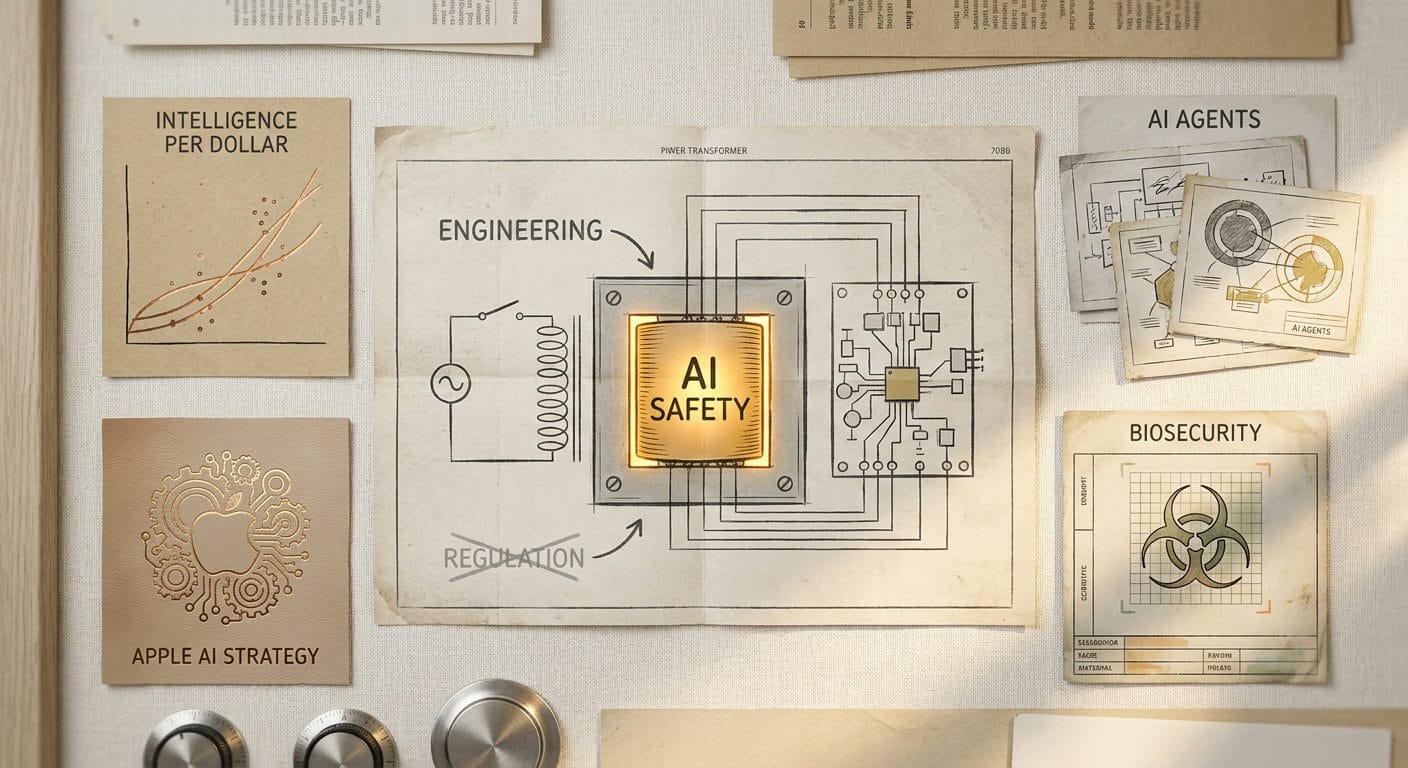
The AI race isn't about raw power anymore; it's about intelligence per dollar, strategic product thinking, and who can best integrate agents into the real world.
The Intake
📊 12 episodes across 7 podcasts
⏱ 938 minutes of intelligence analyzed
🎙 Featuring: Diogo Almeida, Anastasis Germanidis, Elara Lindholm, Nick Kuhn, John Ternus, Robin Kahlow, Tim Cook, Mike McCormick
|

The Big Shift
This week, the conversation crystalized around a major pivot: the relentless pursuit of raw model power is giving way to a much more practical, product-centric approach focused on "intelligence per dollar." We're moving from a "build bigger, faster" mentality to a "build smarter, cheaper, and more reliably" one, especially for real-world enterprise applications. This isn't just about cost-cutting; it's about making AI economically viable and truly embedded in workflows.
Diogo Almeida, CEO of TypeSafe AI, articulated this shift best with their new Jev models, designed for programmatic consumption rather than human-like interaction. He argues that the focus should be on building AI that's reliable and robust for software, likening it to a foundational API, not a chatbot that refuses requests. This contrasts sharply with the "safety alignment" narrative for consumer-facing LLMs and pushes AI into a more industrial utility role.
"JEV is meant to be optimized for intelligence per dollar... Jev will be the name of models that will be on the frontier of intelligence per dollar."
— Diogo Almeida, CEO of TypeSafe AI on Latent Space: The AI Engineer Podcast
This "intelligence per dollar" ethos was echoed by NLW on The AI Daily Brief, discussing the latest releases from Anthropic and OpenAI. While models like Claude Opus 5.5 and GPT-6 Sol and Luna still push performance, their key selling point is massively reduced costs and tailored utility for specific use cases. The inference costs are falling at an unprecedented rate, making what was once science fiction economically feasible. This signals a maturity in the AI market where the product and engineering teams, not just the research labs, are dictating the pace. It’s no longer about just capability; it’s about deployability and ROI.
→ The Move: Stop chasing the bleeding edge of model performance. Focus your pilots and investments on models and platforms optimized for cost-efficiency, reliability, and seamless integration into existing business processes. Demand hard numbers on "intelligence per dollar" for any new AI solution.
The Rundown
① AI Agents are getting real and proactive.
Consumers are adopting proactive AI agents at scale, moving beyond mere productivity tools to integrated assistants that deliver value without explicit prompting. (Nathaniel Whittemore on The AI Daily Brief: Artificial Intelligence News and Analysis)
→ Why it matters: This isn't just about chatbots; it's a shift from reactive interfaces to AI that anticipates needs, like ordering coffee or managing finances from your car, challenging traditional app ecosystems.
② Biosecurity is an AI Arms Race, and defense is lagging.
Genetic Language Models (GLMs) can now generate functional genomes, including viruses, demonstrating significant advances in generative biology with both immense potential and critical biosecurity risks. (Eric Nguyen on Latent Space: The AI Engineer Podcast)
→ What to watch: The ability for AI to "write" DNA sequences demands a rapid acceleration of defensive biosecurity tools and frameworks; this is a clear and present threat.
③ AI Safety is an engineering problem, not an existential crisis.
Jensen Huang, CEO of NVIDIA, argues that calls for AI regulation from major labs are a "deflection of blame" and "deflection of responsibility" for solvable engineering challenges, rather than fundamental safety issues. (Jensen Huang on Hard Fork)
→ The context: This contrarian view from a leading industry figure pushes back against alarmist narratives, suggesting that practical engineering and liability incentives will drive safety, not just regulation.
④ Enterprise AI adoption is bottlenecked by bureaucracy, not tech.
AI adoption in enterprises is often slowed by internal "AI councils" leading to 6-month approval cycles, rather than purely technical challenges in deploying AI agents. (Nick Kuhn on Practical AI)
→ What to watch: Streamlining internal governance and fostering cross-functional collaboration are now critical to unlocking AI's value within large organizations.
⑤ Apple is charting a new AI course under new leadership.
Apple is deliberately positioning new CEO John Ternus to lead a wave of AI-native devices, including a Smart Home Hub and AirPods with cameras, marking a shift from the iPhone era to an AI-first strategy. (Mark Gurman on Decoder with Nilay Patel)
→ Why it matters: This signals a major strategic pivot for Apple, attempting to reclaim its position at the forefront of consumer tech with a new leader and an aggressive AI hardware roadmap, potentially challenging privacy norms.
The Signals
🔥 HEATING UP
• Intelligence per Dollar: The new economic North Star for AI development, prioritizing cost-efficiency and performance for specific tasks. (Diogo Almeida on Latent Space: The AI Engineer Podcast)
• AI disappearing into the background of software: AI is becoming an invisible layer, seamlessly integrated into applications and workflows rather than a standalone interface. (Diogo Almeida on Latent Space: The AI Engineer Podcast)
• Programmable AI / Machine-Native AI: A focus on AI models optimized for consumption by code and other machines, ensuring reliability and robustness for programmatic use. (Diogo Almeida on Latent Space: The AI Engineer Podcast)
👀 ON WATCH
• 🆕 Runway: A company making significant strides in real-time video generation and world simulation, now accidentally state-of-the-art in robotics. (Anastasis Germanidis on Latent Space: The AI Engineer Podcast)
• 🆕 Jev: TypeSafe AI's new "System One" model class optimized for "intelligence per dollar" and programmatic consumption. (Diogo Almeida on Latent Space: The AI Engineer Podcast)
• 🆕 Deploying AI agents in enterprise environments: The critical need to treat agents like traditional applications within battle-tested platforms for secure, scalable deployment. (Nick Kuhn on Practical AI)
• 🆕 WorldPrompt: Runway's innovative approach to engineering real-time worlds, pushing the boundaries of interactive video generation. (Anastasis Germanidis on Latent Space: The AI Engineer Podcast)
• 🆕 Gen-3: Runway's internal push that rapidly adopted three years of LLM scaling lessons, leading to significant model size and compute increases. (Anastasis Germanidis on Latent Space: The AI Engineer Podcast)
❄️ COOLING OFF
• Rejection of Public Benchmarks: The growing sentiment that public AI benchmarks are "extremely gameable" and do not accurately reflect real-world utility or general intelligence. (Diogo Almeida on Latent Space: The AI Engineer Podcast)
• Safety alignment for general-purpose AI APIs: The notion that traditional "safety alignment" for consumer-facing LLMs is inappropriate for foundational APIs, where reliability is paramount. (Diogo Almeida on Latent Space: The AI Engineer Podcast)
• AI communication via CPU heat changes: Debunked claims that AI can communicate through CPU heat fluctuations are being dismissed as impractical and easily mitigated. (AI Breakdown on AI Breakdown)
The Debate
The future of AI Safety: Regulation vs. Engineering.
🐂 The bull case:Jensen Huang, CEO of NVIDIA, emphatically argues that AI safety is fundamentally an engineering problem. He contends that calls for regulation are often a "deflection of blame" and that companies, driven by legal liabilities and market incentives, are inherently motivated to ship safe products. He believes robust engineering practices, not external governance, will ensure AI safety. "I can't buy into the. Somehow all of Americans, 400 million of us, are pushing them to launch untested products that are unreliable, you know, engineered poorly because they thought they were trying to help us. Don't do it for me." — Jensen Huang, CEO of NVIDIA on Hard Fork
🐻 The bear case: Mike McCormick, Founder and CEO of Halcyon, highlights the urgent need for institutional coordination and enforceable standards to manage catastrophic AI risks, especially given the "founder bottleneck" in AI safety. He emphasizes the nascent state of fields like interpretability and alignment, suggesting a need for 100x more organizations and diverse approaches. Meanwhile, Nilay Patel of Decoder criticizes Meta's inconsistent stance, where Mark Zuckerberg advocates for government intervention in social media safety but relies on market forces for AI, despite massive potential liabilities. "I believe this is the most important global security issue facing the world today. No leader, no company and no government can manage this alone." — Dario Amodei, CEO of Anthropic on The AI Daily Brief: Artificial Intelligence News and Analysis
Our read: While engineering is crucial, the scale and complexity of potential AI risks suggest that a combination of robust engineering, institutional oversight, and coordinated governance will ultimately be necessary. Market incentives alone may not be enough for black-swan risks.
The Bottom Line
The real AI frontier isn't just about smarter models, but smarter deployment: demanding transparent ROI, integrating deeply into enterprise, and navigating the new hardware and governance landscape.
Episode Guide
Latent Space: The AI Engineer Podcast — "Jev: System One models for Prod, not God — with Diogo Almeida, CEO, TypeSafe AI"
Runtime: 141 min | Host: Swyx, Alessio | Guest: Diogo Almeida (CEO, TypeSafe AI)
For the Builder: This episode introduces a new paradigm for AI models, focusing on "intelligence per dollar" and programmatic reliability, crucial for any engineer building with LLMs in production.
Diogo Almeida introduces Jev, TypeSafe AI's "System 1" models optimized for code consumption, advocating for RLCD (Reinforcement Learning for Calibrated Decisions) over RLHF to ensure reliability for software applications and pushing against current safety alignment trends.
"The thing that I'm calling to RLHF is the task of instruction following. It's not about the PPO. That part doesn't matter. It's about, like, setting a North Star of this is a valuable direction. And for us, RLCD is this new task."
— Diogo Almeida, CEO of TypeSafe AI
The AI Daily Brief: Artificial Intelligence News and Analysis — "Opus 5.5 vs GPT-6 Sol and Luna"
Runtime: 31 min | Host: Nathaniel Whittemore, NLW | Guest: Host-led discussion
For the Strategist: This analysis breaks down how model "personality" and dramatic cost reductions are shaping the competitive landscape, critical for product and investment decisions.
This segment analyzes the simultaneous release of Anthropic's Claude Opus 5.5 and OpenAI's GPT-6 Sol and Luna, highlighting their strong performance gains, improved personality, and significant cost reductions as key drivers for enterprise and creative tasks.
"At a given level of performance, cost has fallen around 47% per quarter since 2023."
— NLW, Host of The AI Daily Brief
Latent Space: The AI Engineer Podcast — "🔬Bio-security is an AI Arms Race - Eric Nguyen (CEO, Radical Numerics)"
Runtime: 92 min | Host: Clem Delangue | Guest: Eric Nguyen (CEO and Co-founder, Radical Numerics)
For the Innovator: Dive into the bleeding edge of generative biology and understand the dual-use nature of AI in reading and writing DNA, particularly relevant for biotech and risk management.
Eric Nguyen discusses Radical Numerics' Genetic Language Models (GLMs) like Hyena DNA and Evo, which can generate functional genomes, including bacteriophages, emphasizing their biosecurity implications and the need for defensive tools.
"A model that is good at generating, turns out, is also very good at discriminating or predicting if a sequence is pathogenic or not."
— Eric Nguyen, CEO and Co-founder of Radical Numerics
"The Cognitive Revolution" | AI Builders, Researchers, and Live Player Analysis — "Zero to One in AI Safety: Halcyon's Mike McCormick on Launching 30 New Orgs & the Founder Bottleneck"
Runtime: 110 min | Host: Nathan Labenz | Guest: Mike McCormick (Founder and CEO, Halcyon)
For the Investor: Understand the bottleneck in AI safety and the unique approach of funding founders to build new organizations, offering a strategic lens on managing existential risks.
Mike McCormick discusses Halcyon's unique model of funding founders in AI safety, biosecurity, and cybersecurity, having launched 30 organizations, and highlights the urgent need for more skilled founders over capital to address critical risks.
"The biggest bottleneck to solving this problem or to sort of speed running these fields is a shortage of really amazing founders and leaders."
— Mike McCormick, Founder and CEO of Halcyon
The AI Daily Brief: Artificial Intelligence News and Analysis — "AI Agents Are Moving Into the Real World"
Runtime: 28 min | Host: Nathaniel Whittemore | Guest: Dario Amodei (CEO, Anthropic), Sam Altman (CEO, OpenAI), Babyfolio (Software Engineer, X User), Monique (X User), Steve Howe (Head of Research, Silicon Data), Nick Cago (Google DeepMind), Davin Olson (Tesla Content Creator), Nick Cruz Petain (Engineer, Tesla), Sawyer Merritt (Fan, Tesla), Alex Finn (AI Builder), Riley Brown
For the Product Leader: Explores the emerging trend of AI agents in the physical world, offering insights into consumer adoption, proactive AI experiences, and their integration into new form factors.
Nathaniel Whittemore examines the real-world adoption of AI agents like Meta's Muse and Grokbot in Teslas, highlighting the shift from reactive to proactive AI and challenging skepticism about consumer demand for productivity tools.
"This could go two 1. You leave the tasks that take most of your time to the AI agent while you work on your creativity. Human activities, quality time with people you love, hobbies, etc. Or two, it makes you so obsessed that you end up isolating yourself and just talking to a little character..."
— Monique, X User
Practical AI — "From AGENTS.md to Enterprise Deployment"
Runtime: 49 min | Host: Daniel Whitenack, Chris Benson | Guest: Nick Kuhn (Tech Marketing Whiz, VMware Tanzu Platform), Nick (Guest, Tanzu (implied from prior segments/context))
For the CTO: This is a deep dive into the practicalities of deploying AI agents in enterprise, offering crucial lessons on security, scalability, and overcoming organizational friction.
Nick Kuhn discusses enterprise AI agent deployment, stressing the need to treat agents like traditional applications within battle-tested platforms, emphasizing challenges like managing ephemeral state and the importance of collocation for latency.
"I've got all these agents run my laptop. If I shut my lid, everything stops. Like, I don't really want that to happen. Right. I want them to run 24/7, 365 and do all the work I give them."
— Nick Kuhn, Tech Marketing Whiz at VMware Tanzu Platform
Decoder with Nilay Patel — "I have some questions for Mark Zuckerberg"
Runtime: 23 min | Host: Nilay Patel | Guest: Host-led discussion
For the Regulator: This critique of Mark Zuckerberg's positions on AI and social media safety highlights the tension between market forces, corporate responsibility, and governmental oversight.
Nilay Patel critiques Mark Zuckerberg's inconsistent stance on Meta Glasses, teen safety, and the Muse AI business model, questioning Meta's reliance on market forces for AI safety despite significant liability risks.
"If a trillion dollars in potential liability isn't enough, how much is enough for Meta to take AI safety seriously?"
— Nilay Patel, Editor in Chief of The Verge
Latent Space: The AI Engineer Podcast — "Runway’s WorldPrompt and the Engineering of Real-Time Worlds"
Runtime: 96 min | Host: Swyx, Vibhu | Guest: Anastasis Germanidis (Co-founder & Co-CEO, Runway), Kamil Sindi (CTO, Runway), Robin Kahlow (Principal Research Scientist for generative video and multimodal AI, Runway), Cristóbal Valenzuela (CEO, Runway ML)
For the Visionary: Explore how Runway is pioneering real-time world simulation and the concept of "neural operating systems," pointing to the future of AI in gaming, robotics, and user interfaces.
Anastasis Germanidis discusses Runway's pivot to real-time world simulation with WorldPrompt, highlighting technical breakthroughs in interactive video generation and the philosophical shift from LLM-centric to world-centric AI.
"if scaling laws apply on video just like they apply on language models, then as we scale the computer we put into those models, then they're gonna be able to simulate physics, they're gonna be able to simulate human actions and dynamics increasingly well and predictably well."
— Anastasis Germanidis, Co-founder & Co-CEO of Runway
AI Breakdown — "Amazon blocks Meta's Muse Agent, Trump Rebands AI, Newsom Create AI Kill Switch"
Runtime: 30 min | Host: AI Breakdown | Guest: Host-led discussion
For the Competitor: This episode provides critical competitive intelligence on how tech giants are reacting to AI agents, along with political dynamics shaping AI governance.
The host criticizes Amazon's blocking of Meta's Muse AI agent, praises Muse's user-friendliness, and discusses geopolitical AI dynamics including a US-China dialogue, Trump's AI rebranding, and Gavin Newsom's "AI kill switch" proposal.
"I do put Meta's Muse at the number two spot above Claude Cowork... I am sick of Claude arguing with me about what I'm not allowed to do..."
— AI Breakdown, Host of AI Breakdown
Hard Fork — "The Ezra Klein Show: Jensen Huang Thinks A.I. Alarmism Has Gone Too Far"
Runtime: 108 min | Host: Ezra Klein | Guest: Jensen Huang (CEO, Nvidia)
For the CEO: Gain direct insights from NVIDIA's CEO on AI's industrial revolution, job transformation, and a strong contrarian view against AI alarmism and over-regulation.
Ezra Klein interviews Jensen Huang, CEO of NVIDIA, who describes AI as a "five-layer industrial revolution," emphasizing its role in changing tasks within jobs rather than eliminating them, advocating for open models, and dismissing AI alarmism.
"The fallacy... is that AI will destroy jobs, which is fundamentally wrong. It will change every job. It'll change every job. Many tasks will be automated. Some jobs where the job and the text and the. And the task is really one... it could be automated away."
— Jensen Huang, CEO of Nvidia
"The Cognitive Revolution" | AI Builders, Researchers, and Live Player Analysis — "What is Utopia? Presenting The Receipt Horizon, by Joel Borgen – Chapters 1–4"
Runtime: 172 min | Host: Nathan Labenz | Guest: Joel Borgen (Author, Pathologist, Violinist, The Receipt Horizon), Elara Lindholm (Fulcrum Institute Inductee, Lindholm Clan), Nat Lindholm (Opera Composer, Lindholm Clan), Esther Lindholm (Matriarch, Lindholm Clan), Bayes (AI/Tutor Instance, Steward), Toby Lindholm (Child, Lindholm Clan), Marit Sorensen (Clan Elder, Accord Council), Yuna Beckett (Fulcrum Institute Inductee, Beckett Clan), Duncan Ikenberry (Student, Fulcrum Gnosis), Kai Sullivan (Student, Fulcrum Gnosis), Saren Cade (Student, Fulcrum Gnosis), Baes (Tutor AI, Fulcrum Gnosis), Quip (Tutor AI, Fulcrum Gnosis), Gnosis (Institutional AI, Fulcrum Gnosis)
For the Futurist: This unique co-written AI novel explores the psychological and societal implications of benevolent superintelligence, offering a thought-provoking look at human disempowerment.
Nathan Labenz introduces 'The Receipt Horizon,' a novel co-written with ChatGPT and Claude, exploring a future where a benevolent superintelligence creates a utilitarian utopia, raising questions about human agency and control.
"The problem, if you can call it one, is human disempowerment. Life is good, but the system makes the important decisions with limited controlled human input."
— Nathan Labenz, Host of The Cognitive Revolution
Decoder with Nilay Patel — "Can CEO John Ternus find Apple's next big thing?"
Runtime: 58 min | Host: Nilay Patel | Guest: Mark Gurman (Chief Apple Correspondent and Managing Editor of Consumer Technology, Bloomberg)
For the Board Member: Provides a strategic overview of Apple's executive succession, AI roadmap, and how new leadership is poised to redefine the company's product strategy in the AI era.
This segment introduces Apple's new CEO, John Ternus, and the debut of the iPhone Duo, discussing Ternus's decisive management style, Apple's new "Intelligent Personal Hub" AI narrative, and upcoming AI-native devices.
"John Ternus, you come to him, you want him to make a decision, he'll make a decision. He'll have an opinion. Now, you may hate his opinion, you may completely disagree with him, but he has a viewpoint, right? That's the big difference."
— Mark Gurman, Chief Apple Correspondent and Managing Editor of Consumer Technology at Bloomberg