
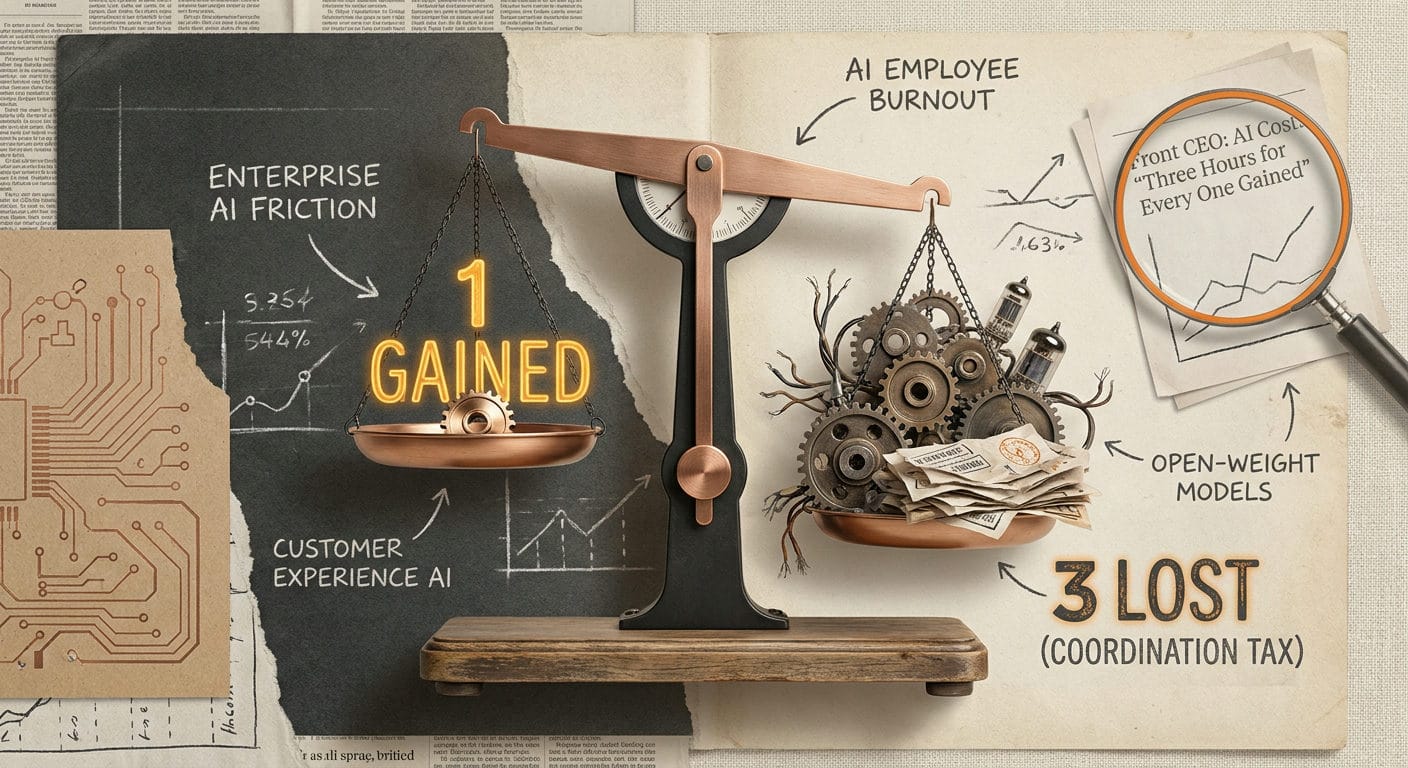
The biggest challenge for enterprise AI isn't the tech, it's the invisible friction costing three hours for every one gained.
The Intake
📊 12 episodes across 10 podcasts
⏱ 695 minutes of intelligence analyzed
🎙 Featuring: Nathan Labenz, Thomas Sohmers, Sean Wang, Thomas Somers
|

The Big Shift
The narrative around AI in business has subtly but significantly shifted: from a pure cost-cutting or efficiency play, the real battleground is now taming the "coordination tax" that AI is currently exacerbating within organizations. While AI promises unparalleled gains, its current implementation often creates more internal friction and complexity than it solves, leading to employee burnout and stifled productivity, particularly in customer-facing operations. This isn't just about technical deployment; it's about the unforeseen human cost of integrating nascent AI workflows.
Dan O'Connell, CEO of Front, starkly outlined the issue: "For every hour of actual customer resolution, organizations spend roughly three hours on internal coordination: the handoffs, context transfers, escalation management, and back-channel communication that happens invisibly between customer interactions." This "coordination tax" isn't a bug; it's an unacknowledged feature of early AI adoption, where systems are capable but not yet seamless. The focus for most leaders, O'Connell explains, isn't headcount reduction, but rather improving net revenue retention and customer experience – goals often derailed by this hidden overhead.
"For every hour of actual customer resolution, organizations spend roughly three hours on internal coordination: the handoffs, context transfers, escalation management, and back-channel communication that happens invisibly between customer interactions."
— Dan O'Connell, CEO of Front on Eye On A.I.
Paul Cuglietta (Customer Services Director, Simplyhealth) echoed this, highlighting that gaining internal buy-in for AI necessitates clear governance frameworks and cross-functional teams, acknowledging that the biggest hurdle is often a 'mindset' issue more than a 'readiness' one. The takeaway is clear: the most sophisticated AI model means little if its introduction grinds your internal operations to a halt. The next frontier of enterprise AI isn't just about more intelligence; it's about designing for fluid human-AI collaboration.
The move:
Stop viewing AI solely through a cost-reduction lens. Map your internal coordination bottlenecks. Implement AI governance and cross-functional teams to actively measure and mitigate the "coordination tax" before it burns out your best people.
The Rundown
① Consumer AI Isn't Paying Its Way (Yet).
Despite the hype, an A16z report indicates 98% of US households don't pay for AI subscriptions, with the top 1% of users spending as much as the bottom 50% combined. (NLW on The AI Daily Brief)
→ Why it matters: This signals a major gap between enterprise adoption and mass consumer willingness to pay, pushing AI companies to explore entertainment and advertising-led monetization models rather than pure productivity gains.
② Frontier AI Labs Are Running Up Against the Unknown.
Leaders at frontier AI labs are acknowledging a potential "level of intelligence we just shouldn't go past" and are even considering compute caps on pre-training runs. (Nathan Labenz on The Cognitive Revolution)
→ The context: This marks a stark shift from unbridled growth, indicating a growing internal consensus among top researchers that ethical and safety guardrails, including potentially self-imposed limits, are becoming a real-world consideration, not just theoretical debate.
③ AI Decisions are Often a "Flip of a Coin."
LLM decisions, even when planning responses, are determined by the stochastic generation of the next token, not always a deterministic internal process, and critical tokens can cause abrupt "forking paths." (Eric Bigelow on The Cognitive Revolution)
→ What to watch: This randomness highlights the current limitations of interpretability and control in advanced models, demanding robust human-in-the-loop oversight for consequential AI applications and raising questions about "chain-of-thought" reliability.
④ Open-Weight Models Are Becoming the Enterprise Standard.
Companies are increasingly shifting to open-weight AI models, driven by cost optimization (especially when spending over $100M annually on closed models) and data sovereignty concerns, with "Beam" from ReflectionAI offering 3-4x reasoning efficiency. (Misha Laskin on No Priors)
→ Why it matters: This trend indicates a maturation of the AI market where enterprises prioritize ownership and customization over API convenience, pushing for more performant and auditable open-source alternatives to frontier models.
⑤ AI Is Accelerating Scientific Discovery, But Reality Still Rules.
Periodic Labs is building AI scientists that integrate with physical high-throughput experiments to discover new materials, emphasizing that "intelligence is necessary but not sufficient; new knowledge is created when ideas are found to be consistent with reality." (Liam Fedus and Ekin Dogus Cubuk on Latent Space)
→ The context: This demonstrates the shift from purely simulation-based AI to systems that can learn from and interact with the physical world, highlighting the ongoing importance of real-world data and experimentation even for "superintelligent" discovery.
The Signals
🔥 HEATING UP
• Open-Weight Models: Vercel AI Gateway reports 78.4% token usage for open models vs. 21.6% for closed, indicating a significant developer preference. (NLW on The AI Daily Brief)
• Narrative Intelligence: The ability to continuously evolve one's story in real-time is crucial for leaders adapting to rapid change in the AI era. (Reed Frerichs on Practical AI)
• AI for Customer Experience: Customer demand for fast, accurate, and personalized responses is pushing organizations beyond basic chatbots to agentic AI. (Paul Cuglietta on The AI in Business Podcast)
👀 ON WATCH
• 🆕 Coordination Tax: AI implementation is currently exacerbating internal coordination issues, costing three hours for every hour of customer resolution. (Dan O'Connell on Eye On A.I.)
• 🆕 Jev: A new model from TypeSafe designed for 'machine-native intelligence' that optimizes for reliable software decisions rather than human-consumable text. (Diogo Almeida on The TWIML AI Podcast)
• 🆕 Meta's Muse: Positioned as a free, consumer-focused AI agent, leveraging Meta's distribution against OpenAI's enterprise-focused Dots. (Hayden Field on Decoder with Nilay Patel)
• 🆕 RLCD (Reinforcement Learning from Calibrated Decisions): A proprietary process that aims to provide engineers with transparent, tunable controls and trustworthy probabilities for integrating intelligence into software applications. (Diogo Almeida on The TWIML AI Podcast)
❄️ COOLING OFF
• Misleading 'swarms of agents' terminology: The marketing term "swarms of agents" is criticized as misleading jargon for parallel processing software. (AI Breakdown on AI Breakdown)
• Mid-tier SaaS: AI agents replacing traditional SaaS solutions are signaling a transformative potential that could "kill" many existing SaaS models. (Sean Wang on The Cognitive Revolution)
• Anthropic's security guardrails: New safety guardrails in models like Haiku 5.5 are raising concerns about potential false positives and models "nannying" users. (AI Breakdown on AI Breakdown)
The Debate
Is AI deployment primarily about cutting costs, or improving customer experience?
🐂 The bull case: Dan O'Connell (CEO, Front) states unequivocally that for most customer operations leaders, "the vast majority of people are focused on not reducing costs, but how to actually drive improve nrr [net revenue retention]." AI is being deployed to deliver an exceptional customer experience, not just to cut people.
🐻 The bear case: While not explicitly stated as a "bear case," the prevalent market narrative and early AI implementations often focus on efficiency and automation, which implicitly leads to cost reduction and headcount concerns. The "coordination tax" itself implies a current inefficiency AI introduces before potentially solving it, a cost that organizations are implicitly bearing.
Our read:
The evidence this week strongly supports the "customer experience first" approach, with cost reduction as a secondary, often unrealized, benefit in the initial phases of AI integration.
The Bottom Line
AI's true enterprise value won't be in raw intelligence, but in how effectively we eliminate its self-inflicted "coordination tax" to unlock genuine human-machine synergy.
Episode Guide (Web Version)
1. Decoder with Nilay Patel — "OpenAI has a Muse problem"
Runtime: 45 min | Host: Nilay Patel | Guest: Hayden Field (Senior AI Reporter, The Verge), Aiden (Staff Writer, The Verge)
Who should listen: CEOs and product leaders grappling with consumer vs. enterprise AI adoption strategies, especially those competing with tech giants.
This episode contrasts Meta's consumer-focused AI agent, Muse, with OpenAI's enterprise-targeted Dots, highlighting Meta's advantage in consumer product design and distribution despite OpenAI's superior models. It delves into user trust, data privacy, and the challenges of monetizing consumer AI, suggesting Meta's transaction-based model could create a "corrupt butler" scenario.
"I am absolutely not ready to give Meta 1oz of data more than it already has. This feels like a big issue for every agent."
— Nilay Patel, Host at The Verge
2. "The Cognitive Revolution" | AI Builders, Researchers, and Live Player Analysis — "AI:AM: A Level We Shouldn't Pass? Notes from The Curve + Tokens vs. Salaries & Is SaaS Cooked?"
Runtime: 88 min | Host: Nathan Labenz | Guest: Thomas Sohmers (Co-founder & CTO, Positron), Sean Wang (Founder / Organizer, Late in Space / AI Engineer conferences), Thomas Somers (Co-founder, Positron), Swix (Organizer, AI Engineer Conference), Evan Miyazono (Runs, Atlasignota), Edward Hu (Lead AI Modeling, Merkor)
Who should listen: CTOs and investors tracking frontier AI capabilities, hardware advancements, and the evolving role of AI engineers.
This discussion reveals off-the-record concerns from frontier AI lab leaders about humanity approaching an intelligence threshold, with some considering compute caps. It also covers Positron's breakthroughs in memory-efficient AI chips, and the "Kill My SaaS" initiative, signaling a future where AI agents replace traditional software.
"There likely is, let's say, a level of intelligence that we just shouldn't go past. What? Yeah, first time I'd ever heard that from a Frontier Lab leader."
— Nathan Labenz, Host of The Cognitive Revolution
3. Latent Space: The AI Engineer Podcast — "Synthesis Superintelligence: from Semiconductors to Superconductors — Periodic Labs’ Liam Fedus and Ekin Dogus Cubuk"
Runtime: 84 min | Host: swyx | Guest: Liam Fedus (Co-founder, Periodic Labs), Ekin Dogus Cubuk (Co-founder, Periodic Labs), Brandon (Host), Muratan Aikol (Computational Material Science Expert, Periodic Labs), Joe Czechosy (Lab Lead (on leave from MIT), Periodic Labs), Daniel Chica (Synthesis Expert, Periodic Labs), Dima Bahindao (Lead, AI & LLM Efforts (Inventor of Neural Network Attention), Periodic Labs), Ray Nakano (Former Tech Lead at OpenAI, Periodic Labs)
Who should listen: R&D leaders, VCs, and innovators interested in how AI is accelerating scientific discovery through integration with physical experimentation.
Periodic Labs' co-founders explain how their "AI scientists" discover new materials by combining AI systems with high-throughput physical experiments, emphasizing that scientific discovery requires intelligence to meet reality. They highlight the importance of physical labs for data, training AI on the scientific process itself, and managing data quality.
"Intelligence is necessary but not sufficient. New knowledge is created when ideas are found to be consistent with reality."
— Liam Fedus, Co-founder of Periodic Labs
4. The AI in Business Podcast — "Inside the Shift Toward Smarter Automated CX - with Paul Cuglietta of Simplyhealth"
Runtime: 22 min | Host: Daniel Faggella | Guest: Paul Cuglietta (Customer Services Director, Simplyhealth)
Who should listen: CEOs, COOs, and Customer Service VPs implementing AI to enhance customer experience and operational efficiency.
Paul Cuglietta discusses how customer demand for fast, personalized responses is driving agentic AI adoption in CX. He emphasizes disciplined implementation, rigorous testing, AI governance frameworks, and building cross-functional teams to gain internal buy-in and align AI initiatives with company purpose.
"It's not so much a readiness thing, it's a mindset thing, it's a willingness more than a readiness."
— Paul Cuglietta, Customer Services Director at Simplyhealth
5. "The Cognitive Revolution" | AI Builders, Researchers, and Live Player Analysis — "How Agents Decide: Goodfire's Eric Bigelow on Critical Tokens, Phase Shifts, & In-Context Learning"
Runtime: 122 min | Host: Nathan Labenz | Guest: Eric Bigelow (Member of Technical Staff, Goodfire)
Who should listen: CTOs, AI researchers, and developers focused on LLM interpretability, reliability, and the implications of stochastic decision-making.
Eric Bigelow explores how LLMs make decisions through "forking paths" in neural text generation, where critical tokens can cause abrupt shifts. He highlights the stochastic nature of token generation and the concerning unreliability of chain-of-thought monitoring in frontier models, emphasizing the need for interpretability and open-source models for research.
"One of my big takeaways from this... is that models, even to some extent, when they plan out their responses, what they're actually going to say at every single moment is really determined by the flip of a coin, which is what token will it generate next?"
— Eric Bigelow, Member of Technical Staff at Goodfire
6. The AI Daily Brief: Artificial Intelligence News and Analysis — "Why Companies Want AI They Can Own"
Runtime: 27 min | Host: NLW | Guest: NLW (Host, The AI Daily Brief)
Who should listen: Business leaders and investors examining the strategic landscape of open-weight AI models, national security implications, and enterprise data sovereignty.
This episode discusses the increasing enterprise demand for open-weight AI models driven by cost efficiency and data sovereignty. It covers Sam Altman's controversial safety stance, the formation of a "Super Intelligence Force" by the President, and the critical role of open source in building trust for AI adoption in government and businesses.
"Open source is how enterprises and the government will ultimately trust AI."
— Joe McCann, Investor
7. No Priors: Artificial Intelligence | Technology | Startups — "Beam: The Great American Open Model with ReflectionAI Co-Founder and CEO Misha Laskin"
Runtime: 70 min | Host: Sarah Guo | Guest: Misha Laskin (Co-founder and CEO, ReflectionAI), Elad Gil (Host, No Priors: Artificial Intelligence | Technology | Startups)
Who should listen: Founders, investors, and technical leaders in AI infrastructure and model development, particularly those building or investing in open-weight AI.
Misha Laskin discusses the immense capital and complexity required to build frontier AI labs, with costs potentially reaching tens of billions. He highlights ReflectionAI's 'Beam' model, an open-weight alternative with 3-4x reasoning efficiency, achieved through extensive reinforcement learning. Laskin argues for the geopolitical benefits of open models and advocates that "openness is safety" in AI.
"If you're spending, let's say, $100 million plus, which is not uncommon at all on closed models a year, then you start thinking about, well, maybe I should figure out a more optimal way to do this."
— Misha Laskin, Co-Founder and CEO of ReflectionAI
8. AI Breakdown — "OpenAI's Releases "Intelligent UI" and Anthropic's New Model"
Runtime: 25 min | Host: AI Breakdown | Guest: Host-led discussion
Who should listen: Anyone interested in the latest model releases, UI innovations, and the practical implications of local AI and AI marketing jargon.
This episode covers OpenAI's "Intelligent UI" for GPT-6, Anthropic's new Haiku 5.5 model (noting efficiency vs. safety concerns), and critiques Microsoft's supply chain issues. The host expresses skepticism about American companies adopting Chinese-controlled AI and criticizes "swarms of agents" as misleading jargon, while promoting the future of local AI models.
"I hate feeling like I'm getting nannied by my AI model. And so I own my. The reason I bring this up is because I worry when they say they added new safeguards in."
— AI Breakdown, Host of AI Breakdown
9. The TWIML AI Podcast (formerly This Week in Machine Learning & Artificial Intelligence) — "Why Jev Is Changing How We Build With AI with Diogo Almeida - #779"
Runtime: 90 min | Host: Sam Charrington | Guest: Diogo Almeida (Co-founder and CEO, TypeSafe)
Who should listen: AI engineers, product managers, and software architects focused on building reliable AI into core software applications.
Diogo Almeida introduces Jev, a model from TypeSafe optimized for "machine-native intelligence" and reliable software decisions rather than human-consumable text. He argues that current LLMs (optimized for strings) fail at basic automation, and Jev, using RLCD, aims to bridge this gap by focusing on calibrated, discrete decisions, providing transparent controls for engineers.
"AI is just so unbelievably smart, yet so unbelievably useless at the kinds of things you'd really expect it to be useful for."
— Diogo Almeida, Co-founder and CEO of TypeSafe
10. Practical AI — "Narrative intelligence and the human advantage"
Runtime: 44 min | Host: Daniel Whitenack | Guest: Reed Frerichs (Executive/Leadership Coach, MIT Sloan Fellows Program), Chris Benson (Principal AI and Autonomy Research Engineer, Host of Practical AI), Reid Webster (Guest, Self-employed, storyteller/creator)
Who should listen: Leaders, executives, and individuals looking to thrive and adapt in an AI-driven world through personal growth and emotional intelligence.
Reed Frerichs discusses "narrative intelligence" – the ability to continuously evolve one's story in real-time – as crucial for leaders in the AI era. He outlines a three-step process (Own, Author, Act) for embracing change and uncertainty, emphasizing aligning values, managing imposter syndrome, and fostering humility to adapt to the rapid pace of AI advancement.
"Narrative intelligence is the ability to continuously evolve one's story in real-time, especially in the face of rapid change."
— Reed Frerichs
11. Eye On A.I. — "The Coordination Tax: Why AI Is Burning Out Your Best People | Dan O'Connell, Front"
Runtime: 51 min | Host: Craig Smith | Guest: Dan O'Connell (CEO, Front)
Who should listen: Operations leaders, HR executives, and CIOs deploying AI, particularly in customer-facing roles, and concerned about internal efficiency and employee well-being.
Dan O'Connell discusses how AI currently impacts customer operations, challenging the narrative that AI primarily cuts headcount. He reveals a "coordination tax" of roughly three hours for every hour of customer resolution, making AI deployment more complex. Front's platform aims to integrate human and AI agents to improve net revenue retention and customer experience, not just reduce costs.
"For every hour of actual customer resolution, organizations spend roughly three hours on internal coordination: the handoffs, context transfers, escalation management, and back-channel communication that happens invisibly between customer interactions."
— Dan O'Connell, CEO of Front
12. The AI Daily Brief: Artificial Intelligence News and Analysis — "Point-Counterpoint: Consumers Will Never Pay for AI"
Runtime: 27 min | Host: Nathaniel Whittemore | Guest: NLW (Host, The AI Daily Brief)
Who should listen: Product managers, marketers, and strategists in consumer tech and AI exploring monetization and adoption challenges.
This episode debates consumer AI adoption, citing an A16z report that 98% of US households don't pay for AI subscriptions. NLW explores whether this signals an untapped market or a fundamental limitation, discussing arguments for early adoption, the perceived lack of "serious utility," and alternative monetization strategies like entertainment AI and advertising as demonstrated by Suno and ChatGPT's growth.
"The top 1% of AI buyers spend as much as the bottom 50% combined, but then also the incredible gap in households that buy any AI versus those that don't."
— NLW