
The "agentic" turn is no longer a theoretical research project; it has officially arrived as a battle for the underlying financial rails, moving AI from passive spectator to a credential-wielding economic actor.
📊 10 episodes across 5 podcasts
⏱ 10 hours 43 minutes of intelligence analyzed
🎙 Featuring: Harry Stebbings (20VC), Harrison Chase (LangChain), Alex Rampell (a16z), Sameer Dholakia (Bessemer), Jad Naous (Grepr), Dhanush Radhakrishnan (Clone Robotics)
|

The Big Shift
The Intelligence Barbell: Capital Moats vs. Vertical Harnesses
A fundamental bifurcation is occurring in the venture ecosystem between the "global platforms" providing raw intelligence and the specialized builders creating the control layers. Sameer Dholakia (Partner, Bessemer Venture Partners) argues that we have entered an era where capital is a primary moat because the compute costs required to compete at the frontier are so extreme that "small" seed funds are no longer viable for core AI startups. This massive concentration of capital at the top—evidenced by Anthropic's ability to command 20% of a growth fund's concentration—is forcing a professionalization of the asset class where investors must either be $1B+ scale players or hyper-specialized scouts.
However, the technical counter-narrative from Harrison Chase (CEO, LangChain) suggests that value is rapidly migrating away from the model providers and toward the "harness layer." Chase argues that routing logic and "memory" are becoming the true defensive moats for vertical applications. While the models themselves are non-deterministic black boxes, the ability to build a domain-specific harness that manages state and detects errors allows developers to treat models as portable commodities. This creates a strategic opening for founders: you don't need to win the compute war if you win the semantic control layer.
"Intelligence is going to be bigger as a market than oil because oil powers all the machines. Intelligence powers all the humans."
— Sameer Dholakia, Partner, Bessemer Venture Partners on 20VC
The Move: If you are building in AI, stop pitching your "proprietary model" and start demonstrating your "harness superiority." Investors are increasingly skeptical of model-wrapper startups but are rewarding those who can prove they have captured the logic of a specific vertical's workflow.
The Rundown
① The Launch of "Agentic Commerce" and the New Wallet Wars.
AI agents have transitioned from spectators to actors as platforms like VGS begin issuing millions of "agentic tokens" weekly to allow AI to execute payments. (Terry Angelos on The a16z Show)
→ The signal: Payment vaults are evolving from "single-player" to "multi-player," creating an existential threat to merchant-customer relationships as wallets like Stripe Link and Shop Pay race to become the default agent interface.
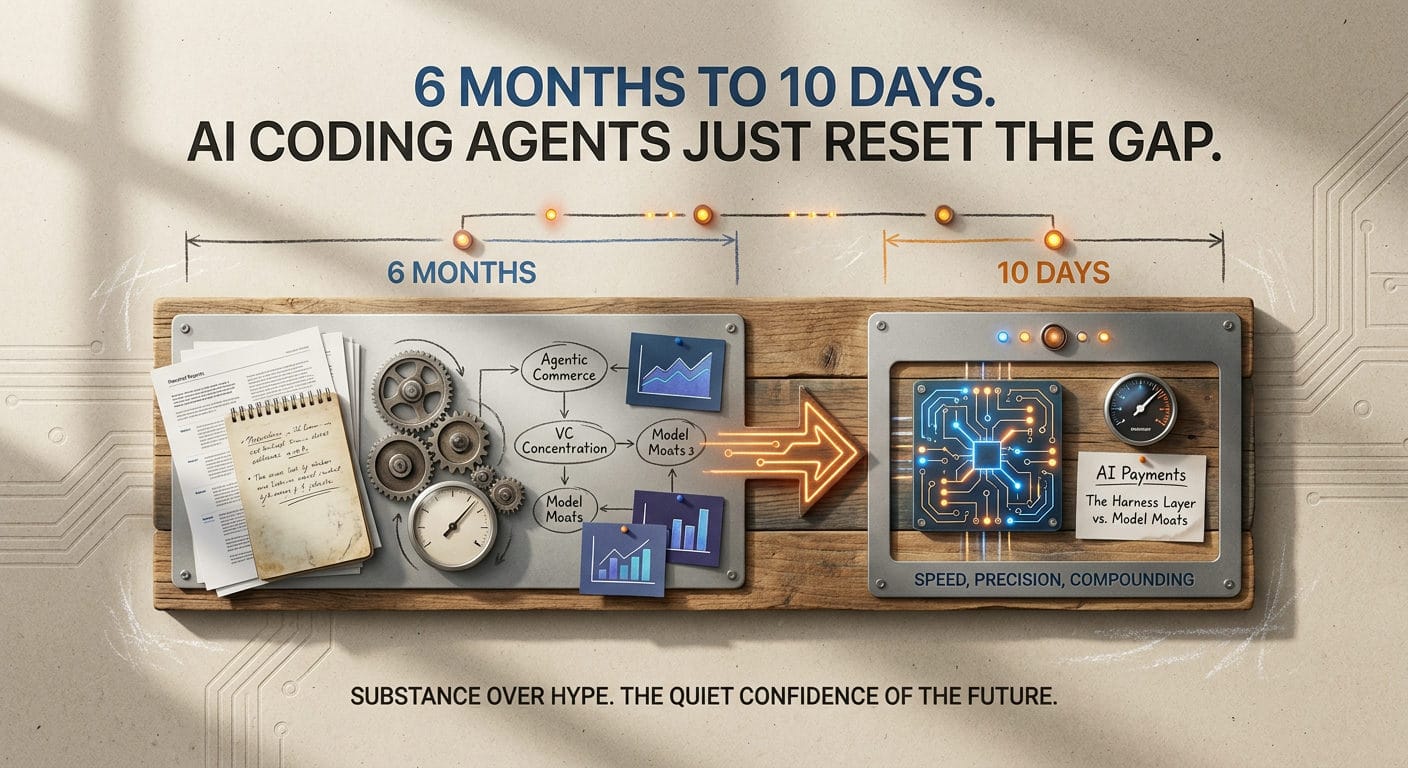
② 🆕 Production Code Acceleration: 6 Months of Dev Work Compressed to 10 Days.
Jad Naous (CEO, Grepr) detailed how AI coding agents allowed his 10-person team to ship a production-ready distributed system in two weeks rather than the projected six months. (Jad Naous on The a16z Show)
→ Why it matters: AI is not a "leveler" for bad talent; it is a 10x force multiplier for "already good" engineers, widening the productivity gap between top-tier and average technical teams.
③ 🆕 Hydraulic Actuation vs. Electric Motors in Humanoid Robotics.
Clone Robotics is challenging the industry standard by using hydraulic artificial muscles to build androids with human-level strength within a lifelike silhouette. (Dhanush Radhakrishnan on This Week in Startups)
→ The signal: By avoiding the traditional gear and motor supply chain, Clone Robotics claims they can reach humanoid production costs at 1/10th of current market designs.
④ The Death of Annual Sales Cycles for Venture-Scale AI.
Founders are moving away from seasonal markets (like EdTech or Tax) because the lack of Daily Active Usage (DAU) prevents the rapid feedback loops required for AI agents to improve. (Jean-Denis Greze on The a16z Show)
→ What to watch: As Itamar Orr (CEO, Town) noted, "The unit of value in software has changed from the app to the computer," leading to a collapse of the traditional "app layer."
Signal Board
🔥 HEATING UP
• Harness Layer Routing: Value is shifting from the gateway to the harness as developers demand more state awareness. (Harrison Chase on 20VC)
• Agentic Tokens: Provisioning is skyrocketing as AI starts spending real money. (Terry Angelos on The a16z Show)
• Deflationary Inference: Models like Haiku are finally bringing B2B AI costs down to a transformative level. (Rory O' Driscoll on 20VC)
👀 ON WATCH
• 🆕 Beam: The new open-weight model from Reflection AI taking on Chinese open-source dominance. (Misha Laskin on This Week in Startups)
• 🆕 Ally Haptic Wristband: A "disability-first" wearable by HapWare that could become a general human-computer interface. (Jack Walters on The Pitch)
• 🆕 Town AI: A "token allocation machine" aiming to automate horizontal enterprise workflows. (Itamar Orr on The a16z Show)
❄️ COOLING OFF
• General Memory Solutions: LangChain killed its commercial memory product, signaling it's too early for generic solutions. (Harrison Chase on 20VC)
• Tesla Roadster: Critics frame the repeated delays as a "spectacle" rather than a commercial product. (Scott Galloway on Pivot)
• Small Seed Funds: The "tragedy of the commons" in AI compute makes small funds structurally uncompetitive for frontier tech. (Sameer Dholakia on 20VC)
The Debate
Is AI Broad Equity Distribution a Strategic Win or a Philanthropic Ploy?
🐂 The bull case: Jason Calacanis argues that Anthropic giving 5% of equity to a Public Benefit Fund could fix the public's resentment of AI. "I stand to earn a little money if GROK does better," he suggests, would fundamentally shift societal support for automation. (Jason Calacanis on This Week in Startups)
🐻 The bear case: Scott Galloway is skeptical, calling Elon Musk's SpaceX share pledge a "shareholder-acquisition tactic" to create 73 million retail fans. He argues for progressive taxation instead: "They should do what they can to make as much profits... and return gains to their shareholders." (Scott Galloway on Pivot)
Our read: The shift from "charitable foundations" to "direct equity participation" is a significant narrative evolution, but until these shares are liquid for the average household, it remains a performative PR play.
The Bottom Line
The era of "renting" intelligence via closed APIs is giving way to "owning" verticalized harnesses where capital scale and operational semiotics define the new winners.
Episode Guide (Web Version)
The Twenty Minute VC (20VC) — "Horizontal vs Vertical Agents: Who Wins..."
Runtime: 62 min | Host: Harry Stebbings | Guest: Harrison Chase (Co-founder and CEO, LangChain)
Who should listen: Founders struggling with LLM non-determinism and "cascading errors" in agent design.
Harrison Chase breaks down why LangChain is focusing on the "harness layer" rather than the gateway, predicting that vertical-specific experts will win the next phase of the AI agent war.
"The hard part about building agents is they don't behave how you want them to behave... models are these non deterministic black boxes." — Harrison Chase
The Twenty Minute VC (20VC) — "The Pro-Rata Battle: Valar Atomics Sues Day One Ventures"
Runtime: 73 min | Host: Harry Stebbings | Guest: Jason Lemkin (Founder, SaaStr), Rory O' Driscoll (Scale VP)
Who should listen: GPs and Founders navigating the increasingly litigious world of seed-stage pro-rata rights.
A deep dive into the legal clash between Valar Atomics and Day One, alongside a sobering analysis of the "SaaS apocalypse" still facing companies without massive scale.
The a16z Show — "When AI Agents Start Spending Your Money"
Runtime: 51 min | Host: Martin Casado | Guest: Alex Rampell (GP, a16z), Terry Angelos (CSO, VGS)
Who should listen: Fintech executives and e-commerce founders tracking the death of the "eyeball economy."
This episode details the infrastructure being built to allow AI agents to handle credentials securely, sparking the "Wallet Wars" between Stripe, PayPal, and new agentic players.
20VC — "You Need $1BN To Do Seed Today: Sameer Dholakia, Bessemer"
Runtime: 75 min | Host: Harry Stebbings | Guest: Sameer Dholakia (Partner, Bessemer)
Who should listen: Fund managers evaluating their portfolio concentration and seed-stage math in a high-compute world.
Sameer Dholakia explains why Bessemer flexed to 20% concentration for Anthropic and why he believes capital itself has become a necessary moat in the AI supercycle.
The Pitch — "#192 HapWare: A Wearable to Help the Blind 'See'"
Runtime: 48 min | Host: Josh Muccio | Guest: Jack Walters (CEO, Hapware)
Who should listen: Hardware founders looking for capital-efficient commercialization strategies for niche-to-mass markets.
A masterclass in "disability-first" design, showing how a haptic wristband for the blind closed an oversubscribed $1.5M round by pitching a broader haptic language SDK.
This Week in Startups — "Anthropic Gives Away 5% of Its Shares, Clone’s Muscle Robot"
Runtime: 94 min | Host: Jason Calacanis | Guest: Dhanush Radhakrishnan (CEO, Clone Robotics)
Who should listen: Robotics engineers and policy wonks interested in the intersection of AI equity and public sentiment.
Jason and Lon debate the strategic value of Anthropic's public benefit fund while Clone Robotics explains their breakthrough in hydraulic artificial muscles.
The a16z Show — "AI Can Write the Code. Can It Run the System?"
Runtime: 60 min | Host: Martin Casado | Guest: Jad Naous (CEO, Grepr)
Who should listen: CTOs and SRE leaders questioning if AI can handle "heavy-tailed" production outages.
A grounded discussion on the limits of AI in semantics vs. syntax, highlighting why AI struggles to predict system performance without real-world experimentation.
The a16z Show — "What Happens When Al Agents Can Spend Your Money? (Town AI)"
Runtime: 63 min | Host: Alex Rampell | Guest: Itamar Orr (CEO, Town)
Who should listen: Enterprise software founders looking to "abstract the app layer" and avoid model lock-in.
Town’s founders explain their pivot from tax automation to a horizontal agent, arguing that the future of enterprise software is "model neutral" and consumer-first.
Pivot — "Trump's Putin Play, Elon's SpaceX Stock Pledge..."
Runtime: 57 min | Host: Kara Swisher | Guest: Scott Galloway (Professor, NYU Stern)
Who should listen: LPs and GPs tracking the intersection of geopolitical risk and billionaire-led philanthropy.
Scott Galloway gives a scathing critique of Musk's "baby bonds" and Tesla’s Roadster delays, framing them as distractions from core business fundamentals.
This Week in Startups — "The Ex-DeepMind Researcher Taking On China’s Open Source AI"
Runtime: 60 min | Host: Jason Calacanis | Guest: Misha Laskin (CEO, Reflection AI)
Who should listen: Enterprise AI buyers deciding between "renting" closed models or "owning" open-weight models.
Misha Laskin discusses the "reward hacking" risks in AI and why open-source models are the only way for Western enterprises to ensure transparency and security.