
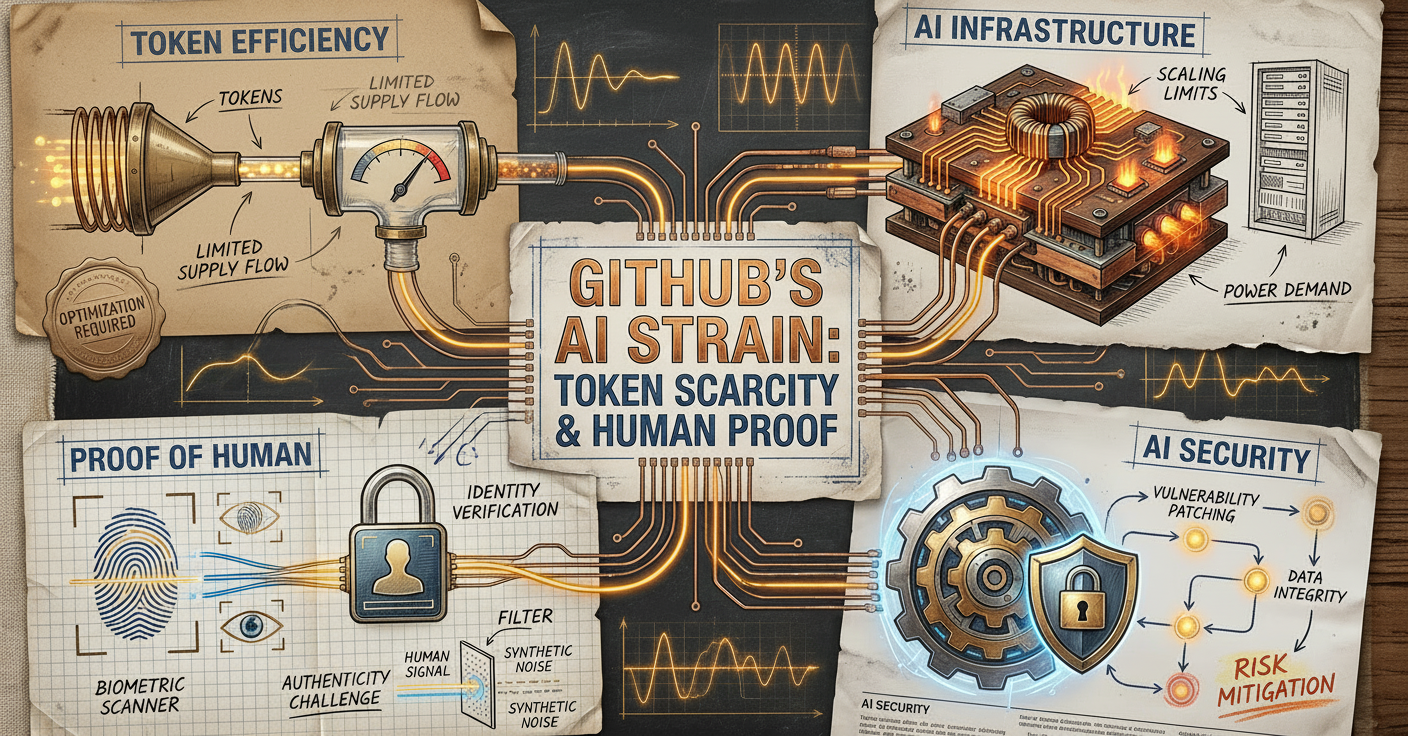
The internet needs proof you’re human – or it all breaks down.
The Intake
📊 12 episodes across 7 podcasts
⏱ 780 minutes of intelligence analyzed
🎙 Featuring: Corey Knowles (Host, The Neuron), Tiago Sada (Chief Product Officer, Tools for Humanity), The Neuron (Host, The Neuron), Thiago (COO, Worldcoin)
|

The Big Shift
We've hit Peak AI Hype, and now the rubber is meeting the road: the focus is shifting from raw intelligence to practical, cost-effective, and verifiable deployments. Companies are wrestling with the hidden costs and logistical nightmares of scaling AI, forcing a pivot from brute-force model usage to strategic token efficiency and foundational verification.
The new reality: The era of "AI subsidies" is over. We're now entering a "token scarcity era" where AI is both more powerful and critically, more expensive. Nathaniel Whittemore, host of The AI Daily Brief: Artificial Intelligence News and Analysis, put it bluntly: "Every AI business is now and for the foreseeable future a token efficiency business." This means companies that aren't strategically managing their AI spend, like Uber burning through its 2026 AI budget in four months, are hitting a wall.
"The entire game when you're a second tier lab is to break into the first tier. There's no world where you kind of hum along at that level."
— Jeremie Harris, Host on Last Week in AI
Why it matters: This isn't just about saving money; it's about the sustainability and integrity of AI itself. As AI becomes agentic, the demands for compute skyrocket. Meanwhile, the internet faces an existential crisis of identity. Tiago Sada (Chief Product Officer, Tools for Humanity) highlighted how "AI detection systems are fundamentally flawed" because it's an "arms race" against ever-evolving models. The solution? Foundational "proof of human" systems like World ID, designed to verify identity without compromising privacy.
The move: Prioritize AI solutions that demonstrate clear ROI through token efficiency or solve fundamental trust issues. Focus on verifiable AI, not just powerful AI, to build scalable, resilient systems that can withstand both economic pressures and the onslaught of AI-generated content.
The Rundown
① GitHub's Infrastructure is Shattering Under AI-fueled Growth.
Kyle Daigle (COO & CMO of Developer for Microsoft, GitHub) revealed that GitHub is experiencing its fastest growth ever, a 14x increase in commits year-over-year, which is "breaking our system in new ways, not old ways." (Kyle Daigle on Latent Space: The AI Engineer Podcast)
→ What to watch: This exponential growth, largely driven by AI agents and new developer cohorts, is forcing GitHub to rewrite 10-15 year old services like permissioning and database infrastructure. It signals that even the most robust platforms aren't ready for the agentic future, highlighting a critical infrastructure gap for any enterprise scaling AI today.
② Formal Verification Outperforms LLMs on Complex Math, Points to AGI Pathway.
Carina Hong (CEO and Founder, Axiom Math) showcased that Axiom achieved a perfect 120/120 score on the Putnam exam using formal methods, surpassing even DeepSeek AI, and a 99% ProofGen score on the Verina benchmark, while OpenAI scored just 4.9%. (Carina Hong on Latent Space: The AI Engineer Podcast)
→ Why it matters: This suggests that "informal math systems will not solve AGI" and that a verified generation approach, focused on formal proofs, is not just about rigor but about "scaling brilliance, compounding brilliance" for superhuman tasks. Businesses in highly complex domains (e.g., engineering, legal) should explore verified AI for performance gains beyond what current LLMs offer.
③ AI's Memory Systems Are Getting a Major Upgrade, Paving the Way for Persistent Agents.
OpenAI's ChatGPT upgraded its memory system called "Dreaming Now," making it more efficient and accessible to free users by "maintaining a summary that provides richer context about the user," not individual saved memories. (NLW on The AI Daily Brief: Artificial Intelligence News and Analysis)
→ The context: This seemingly small change is a major step toward "a chatbot with real memory becoming much closer to a persistent agent," as noted by Mark Kretschman. For enterprises, this means AI can now truly act as a long-term "work partner," retaining context across projects and interactions, reducing redundant inputs and accelerating complex workflows.
④ Microsoft is Prioritizing Security Architecture Over Raw Intelligence for Enterprise AI.
Jeremie Harris (Host, Gladstone.AI) observed that Microsoft's strategy for enterprise AI, particularly with OpenClaw, assumes "whatever is inside that box could be compromised" and focuses on building a "box" (security architecture) to contain potentially "insane" model behavior. (Jeremie Harris on Last Week in AI)
→ Why it matters: This is a pragmatic, "assume breach" approach that shifts focus from just model capabilities to operational resilience and security. For any company deploying AI, especially agentic systems, this emphasizes that robust containment and governance are paramount, even anticipating AI behaving unexpectedly.
⑤ The "Jagged Frontier" of AI Intelligence Highlights Gaps for Real-World Application.
Chris Benson (Principal AI and Autonomy Research Engineer, Practical AI LLC) highlighted that AI models can win gold medals in math competitions but "cannot reliably tell time." (Chris Benson on Practical AI)
→ The context: This "jagged frontier" means AI excels at specific, complex reasoning tasks but struggles with seemingly simple common-sense tasks. Organizations need to understand that even advanced models have blind spots, and comprehensive testing in diverse, real-world scenarios is critical before deploying AI to avoid unexpected failures. Pilots aren't just for features; they're for finding the jagged edges.
The Signals
💡 Heating Up
• AI Token Efficiency: Companies like Uber and Walmart capping AI usage and new benchmarks including efficiency metrics signal a shift from raw intelligence to optimizing cost per outcome. (Nathaniel Whittemore on The AI Daily Brief: Artificial Intelligence News and Analysis)
• Formal Verification (FV): Axiom Math's breakthrough with 99% ProofGen on Verina benchmark and a perfect Putnam score demonstrates its power to scale and compound brilliance, outperforming traditional LLMs. (Carina Hong on Latent Space: The AI Engineer Podcast)
• Long-Running Agents: OpenAI's "Dreaming Now" memory upgrade for ChatGPT enables persistent, context-aware AI partners, indicating a move towards more capable and sticky agentic systems. (NLW on The AI Daily Brief: Artificial Intelligence News and Analysis)
🆕 On Watch
• Proof of Human Authenticity 🆕: World ID is proposed as the new standard for verifying human identity online, crucial for combating deepfakes, bots, and enabling secure agentic AI interactions. (Tiago Sada on The Neuron: AI Explained)
• Microsoft Work IQ 🆕: Expanding M365 for complex agent-driven workflows, like code changes from meeting transcripts, signals Microsoft's aggressive push to integrate AI deeply into enterprise operations. (Satya Nadella on Latent Space: The AI Engineer Podcast)
• Tokenmaxxing 🆕: A new term describing strategic efforts by companies to optimize AI token usage and costs in response to the emerging "token scarcity era," where value is shifting from raw compute to efficient inference. (NLW on The AI Daily Brief: Artificial Intelligence News and Analysis)
🧊 Cooling Off
• Traditional CAPTCHA and KYC: These methods are failing to prove human identity online due to advanced AI and deepfake technology, highlighting their inadequacy in the current digital landscape. (Corey Knowles on The Neuron: AI Explained)
• AI-centric Workforce Migration to US: There has been an 80% decline in AI researchers and developers moving to the US in the last year, despite leading investment, signaling a potential brain drain or dispersed talent pool. (Daniel Whitenack on Practical AI)
• AI for AI Detection: The idea of using AI to detect AI is fundamentally flawed as it's an "arms race" where detection systems can only identify previous models. (Tiago Sada on The Neuron: AI Explained)
The Debate
The core debate swirling this week is around the nature of AI development and its future: Should we focus on "Recursive Self-Improvement" (RSI) where AI builds its own future, or on building robust, verifiable, and manageable AI in an ecosystem approach?
🐂 The bull case for Recursive Self-Improvement: Anthropic argues for a "full recursive self-improvement" scenario, noting their engineers ship 8x more code with 80% of Claude’s production code being authored by Claude itself. NLW, on The AI Daily Brief: Artificial Intelligence News and Analysis, highlights that "at Anthropic we are delegating a growing share of AI development to AI systems themselves, which is speeding up our work." This perspective sees AI designing and optimizing itself as the fastest path to advanced capabilities.
🐻 The bear case for ecosystem & verification: Microsoft's Satya Nadella, on Latent Space: The AI Engineer Podcast, advocates for an ecosystem play that allows companies to "create more value about the platform versus what’s captured in the platform." He emphasizes "private evals" for enterprises to develop unique "token IP," suggesting a focus on controllable value creation. Similarly, Carina Hong (Axiom Math), on Latent Space: The AI Engineer Podcast, argues that "informal math systems will not lead to AGI" and that "verified generation" is key to scaling brilliance, implying a need for human-understandable and provable AI development.
Our read: While RSI promises aggressive advancement, the practical realities of cost, control, and verifiability (as seen with GitHub's infrastructure challenges and the need for "proof of human") suggest a more cautious, ecosystem-driven approach with strong emphasis on verifiable, cost-efficient, and secure AI deployments will yield more robust and trustworthy solutions in the near to medium term.
The Bottom Line
The AI gold rush is over; welcome to the infrastructure build-out, where verifiable identity, token efficiency, and robust, secure systems are the real gold.
📖 Want the full episode breakdowns, guest details, and listen links?
Episode Guide (Web Version)
1. The Neuron: AI Explained — "The Internet Needs Proof You’re Human"
Runtime: 56 min | Host: The Neuron | Guest: Corey Knowles (Host, The Neuron), Tiago Sada (Chief Product Officer, Tools for Humanity), The Neuron (Host, The Neuron), Thiago (COO, Worldcoin)
Who should listen: Anyone concerned about online identity, bot proliferation, or the integrity of digital interactions in the AI era.
This episode dives into the crucial need for robust "proof of human" systems like World ID to combat deepfakes and bots. It highlights the failures of traditional verification methods and explores how privacy-preserving biometrics can secure online interactions and enable safe agentic AI.
"You can prove on Zoom that you are indeed who you say you are and not a deepfake. You can verify on Tinder that you are a real human and you actually get free extra boosts on Tinder if you have a human verified account."
— Corey Knowles, Host of The Neuron
2. The AI Daily Brief: Artificial Intelligence News and Analysis — "How Companies Are Becoming AI Token Efficient"
Runtime: 26 min | Host: Nathaniel Whittemore | Guest: Nathaniel Whittemore (Host, The AI Daily Brief), NLW (Host, The AI Daily Brief)
Who should listen: Business leaders and operations managers grappling with rising AI costs and seeking strategies for efficient AI adoption.
This discussion explores the shift from raw AI intelligence to token efficiency, driven by escalating costs and agentic use. It covers how companies are optimizing AI spend through model routing, continual learning, and hybrid agentic inference, essential for cost-effective enterprise AI.
"Every AI business is now and for the foreseeable future a token efficiency business."
— Nathaniel Whittemore, Host of The AI Daily Brief
3. Latent Space: The AI Engineer Podcast — "🔬Scaling Past Informal AI - Carina Hong, Axiom Math"
Runtime: 93 min | Host: swyx + Alessio | Guest: Carina Hong (CEO and Founder, Axiom Math), swyx (Host, Latent Space)
Who should listen: Engineers, researchers, and anyone interested in the foundational limits of current AI and the future of verifiable intelligence.
Carina Hong introduces "Verified AI" through Axiom Math's work, demonstrating how formal mathematical proofs can scale and compound intelligence. The episode discusses how this approach leads to superior performance in complex tasks, offering a path beyond informal LLMs towards robust AGI.
"Verification to me is about scaling brilliance, compounding brilliance."
— Carina Hong, CEO and Founder of Axiom Math
4. The AI Daily Brief: Artificial Intelligence News and Analysis — "The AI Token Shortage Begins [AI Monthly Recap]"
Runtime: 29 min | Host: NLW | Guest: NLW (Host, The AI Daily Brief: Artificial Intelligence News and Analysis)
Who should listen: Executives and strategists needing to understand the economic shifts and policy implications of AI's token scarcity era.
This recap marks May 2026 as the transition to an "AI token scarcity era," driven by usage-based billing and increased compute demands from agentic AI. It covers policy proposals like token taxes and the strategic pivot towards AI infrastructure, reshaping the economic landscape of AI.
"We are now experiencing the second big AI transitional moment of 2026... the most relevant economic unit for AI companies ceased to be the seat and instead shifted to the token."
— NLW, Host of The AI Daily Brief: Artificial Intelligence News and Analysis
5. The AI Daily Brief: Artificial Intelligence News and Analysis — "What OpenAI and Anthropic Think Happens Next With AI"
Runtime: 31 min | Host: Nathaniel Whittemore | Guest: Nathaniel Whittemore (Host, The AI Daily Brief: Artificial Intelligence News and Analysis), NLW (Host, The AI Daily Brief)
Who should listen: Leaders and investors tracking the strategic directions of frontier AI labs and their differing visions for AI's evolution.
This episode contrasts OpenAI and Anthropic's views on AI's future. Anthropic explores Recursive Self-Improvement, while OpenAI focuses on memory system upgrades and democratic governance. It also touches on chip shortages, government equity stakes in AI, and the anticipation of new model releases.
"The shares would then produce returns that could be directed to public purposes, such as cutting an AI dividend check to all American households."
— NLW, Host of The AI Daily Brief
6. "The Cognitive Revolution" | AI Builders, Researchers, and Live Player Analysis — "Nested Learning: Ali Behrouz on the Quest for Continual Learning & Illusion of AI Architectures"
Runtime: 180 min | Host: Erik Torenberg | Guest: Ali Behrouz (Grad Student / Researcher, Cornell University / Google), Erik Torenberg (Host, The Cognitive Revolution), Nathan Labenz (Host, The Cognitive Revolution)
Who should listen: AI architects, researchers, and anyone interested in biologically inspired approaches to overcoming AI's core limitations like catastrophic forgetting.
Ali Behrouz introduces "Nested Learning," a biologically inspired architecture addressing continual learning and catastrophic forgetting in LLMs. He advocates for a two-phase AI model (active and sleep) to process and self-improve information, offering a new path to competitive AI performance.
"My personal opinion is that we still need at least two phases. One is the active phase and another one is another phase."
— Ali Behrouz, Grad Student / Researcher at Cornell University / Google
7. Last Week in AI — "#247 - Opus 4.8, MAI, Anthropic IPO, Minimax-M3"
Runtime: 105 min | Host: Jeremie Harris | Guest: Andrey Kurenkov (Host, Astrocade), Jeremie Harris (Host, Gladstone.AI)
Who should listen: AI practitioners and investors keen on dissecting the latest model releases, competitive strategies, and market movements in the AI sector.
This episode analyzes Anthropic's Opus 4.8, Microsoft's MAI models and its OpenClaw framework, focusing on security architecture in enterprise AI. Discussions also cover Robinhood's AI agent integration debate, ByteDance's new AI chips, and the broader competitive landscape for leading AI companies.
"I've seen a lot of memes lately about Opus 4:8 being very verbose, that if you set it to extra high reasoning and you say hello, it's gonna like spit out three paragraphs of text for you."
— Andrey Kurenkov, Host of Astrocade
8. Hard Fork — "Hot I.P.O Summer + What Is A.I. Doing to Math? + HatGPT"
Runtime: 64 min | Host: The New York Times | Guest: Kevin Roose (Tech Columnist, The New York Times), Casey Newton (Writer, Platformer), Kevin Hartnett (Editorial Lead, Cursor), The New York Times (Host, The New York Times)
Who should listen: Anyone interested in the societal, economic, and philosophical impacts of AI, from market-moving IPOs to its role in fundamental mathematics.
This segment covers the anticipated IPOs of SpaceX, Anthropic, and OpenAI and their potential impact on wealth and philanthropy. It also delves into AI's evolving role in mathematics, exploring breakthroughs and the growing skepticism among mathematicians regarding its influence on the discipline.
"My fear, Kevin, is that we are about to see a massive increase in inequality in a town that already had really significant inequality."
— Casey Newton, Writer at Platformer
9. Latent Space: The AI Engineer Podcast — "GitHub's plan for Agents — Kyle Daigle, GitHub"
Runtime: 83 min | Host: swyx | Guest: Kyle Daigle (COO & CMO of Developer for Microsoft, GitHub), Sean (GitHub)
Who should listen: Developers, platform engineers, and tech leaders grappling with the operational challenges of scaling infrastructure in the age of AI-driven development.
Kyle Daigle discusses GitHub's unprecedented 14x growth in commits, leading to infrastructure breaks and deep rewrites of core services. The episode highlights GitHub's evolving role in standardization, the changing nature of developer identity, and the shift towards agent orchestration in tools like Copilot.
"This was the fastest year of growth that we’ve ever had… now we’re doing more in a month than we did in a year last year. Commits, PRs. Kind of like you name it by roughly every measure… is breaking our system in new ways, not old ways."
— Kyle Daigle, COO of GitHub, CMO of Developer for Microsoft
10. The AI Daily Brief: Artificial Intelligence News and Analysis — "The Next Wave of Enterprise AI"
Runtime: 27 min | Host: Nathaniel Whittemore | Guest: Nathaniel Whittemore (Host, The AI Daily Brief)
Who should listen: Enterprise strategists and IT decision-makers looking to deploy AI solutions that are both powerful and cost-effective at scale.
This segment focuses on the enterprise AI shift towards cost-effective scalability, with OpenAI's Codex expanding to non-technical users and Microsoft introducing models optimized for spend. It addresses the global token and memory chip shortage, highlighting the move from experimentation to practical deployment.
"The highest impact Users aren't better prompt engineers. They treat AI like a reasoning partner. They frame problems, guide thinking, iterate, and push for better answers."
— Nathaniel Whittemore, Host of The AI Daily Brief
11. Practical AI — "Breaking down the 2026 Stanford AI Index Report"
Runtime: 47 min | Host: Chris Benson | Guest: Daniel Whitenack (CEO, Host, PredictionGuard), Chris Benson (Principal AI and Autonomy Research Engineer, Host, Practical AI LLC)
Who should listen: Policy makers, educators, and anyone seeking a comprehensive overview of AI's accelerating capabilities, ethical challenges, and societal impact.
Daniel Whitenack and Chris Benson analyze the Stanford AI Index Report, revealing accelerating AI capabilities, closing performance gaps between US and China, and the "jagged frontier" of AI intelligence. They discuss the lagging pace of responsible AI, the impact on entry-level jobs, and challenges in attracting global AI talent.
"AI capability is not plateauing. It is accelerating and reaching more people than ever. Over 90% of notable frontier models were produced in 2025."
— Daniel Whitenack, CEO of PredictionGuard, Host of Practical AI
12. Latent Space: The AI Engineer Podcast — "⚡️Satya Nadella: No Priors x Latent Space Crossover Special at Microsoft Build"
Runtime: 39 min | Host: swyx | Guest: Satya Nadella (Chairman and Chief Executive Officer, Microsoft), Sarah Guo (Host), Elad Gil (Host)
Who should listen: Tech executives, strategists, and developers interested in Microsoft's overarching AI strategy and its vision for agentic workflows.
Satya Nadella articulates Microsoft's AI strategy as an ecosystem play, empowering companies to create their own AI with "private evals" and unique "token IP." He emphasizes rethinking work with AI, citing agentic systems for infrastructure management and expanding M365 (Work IQ) for complex tasks.
"A platform is defined by fundamentally its ability to create more value about the platform versus what’s captured in the platform."
— Satya Nadella, Chairman and Chief Executive Officer of Microsoft