
The AI battle royale is setting the priorities for both nation-states and enterprises, making secure data management and compute access the new high ground.
The Intake
📊 12 episodes across 8 podcasts
⏱ 601 minutes of intelligence analyzed
🎙 Featuring: Corey (The Neuron: AI Explained), Grant (Host), John Bicket (CTO and Co-founder, Samsara), Dylan
|

The Big Shift
The intensifying AI arms race is forcing a fundamental re-evaluation of how businesses manage their most critical assets: data and compute. This isn't just about technical upgrades; it's a strategic imperative shaping geopolitical alliances and enterprise security postures.
Why it matters: Nations like the UAE are getting fast-tracked access to advanced AI chips, while companies are grappling with the implications of exposing sensitive data to new AI systems. This pressure cooker environment is accelerating the move to specialized AI infrastructure and forcing a shift from perimeter-based security to data-centric protection.
What was heard: On The AI Daily Brief: Artificial Intelligence News and Analysis, NLW highlighted that Apple's lawsuit against OpenAI isn't just about trade secrets, but a signal that the AI race now involves hardware and geopolitics. Ryan Fedisiak commented on the geopolitical reality that "It is clear we are moving closer toward a world where the Gulf is an essential node in a globally distributed network of hubs running USAI inference workloads."
Meanwhile, Todd Vancil (Vice President of Veeam's Securiti AI Sales Engineering Team) on The AI in Business Podcast stressed that "Ultimately the very lifeblood of AI is data. And as we're looking to optimize our businesses, the data that is most valuable to them turns out to be their most sensitive data." This means companies are compelled to give AI access to their most sensitive data, creating new security vulnerabilities.
"If I want to leverage AI to innovate in my business, to streamline, to optimize or to innovate, I have to, I have to give AI access to my most sensitive data."
— Todd Vancil, Vice President of Veeam's Securiti AI Sales Engineering Team on The AI in Business Podcast
The move: Prioritize unified data governance and invest in specialized AI infrastructure. The old security playbooks won't cut it, and compute access is becoming a national security issue.
The Rundown
① China's Kimi K3 Model Challenges Western AI Dominance.
NLW on The AI Daily Brief: Artificial Intelligence News and Analysis discussed Moonshot's Kimi K3, an open-weights model nearing the performance of Frontier models like Fable 5 and GPT-5.6, signaling that Chinese labs are no longer lagging behind their Western counterparts. (The AI Daily Brief: Artificial Intelligence News and Analysis) ▶ Listen
→ Why it matters: Despite its high benchmarks, Kimi K3's significant resource demands still make it impractical for most, yet its rapid development indicates a competitive shift in global AI capabilities, potentially leading to new geopolitical and cybersecurity concerns.
② Enterprise Browsers are Becoming the New AI Security Perimeter.
Bradon Rogers (Chief Customer Officer, Island) on Eye On A.I. explained how traditional security models are failing against consumer-driven AI tools in the workplace, leading Island to develop "AI Protect" to embed policy directly into the browser and user workflows, preventing data leakage and controlling agent behavior. (Eye On A.I.) ▶ Listen
→ What to watch: As AI becomes integrated into every user application, the enterprise browser emerges as a critical control point for data exfiltration and policy enforcement, forcing a rethink of DLP strategies that have historically struggled with operational overhead.
③ AI Infrastructure Requires Multi-Cloud Strategies for Specialized Workloads.
Corey Sanders (SVP of Product, CoreWeave) on Practical AI highlighted that AI’s unique demands, particularly for massive training workloads, necessitate specialized infrastructure beyond traditional cloud offerings, stressing the need for a multi-cloud approach rather than a single vendor solution. (Practical AI) ▶ Listen
→ The context: While large clouds offer fungible compute, AI workloads need deeply interconnected, pre-planned infrastructure for optimal performance and cost-effectiveness, suggesting that enterprises will increasingly rely on a mix of specialized and general-purpose clouds, especially as AI engineering teams grow.
④ AI Engineering is Shifting Towards "Harness" and "Loop" Control.
On The AI Daily Brief: Artificial Intelligence News and Analysis, NLW discussed that AI engineers are recalibrating their relationship with AI autonomy, moving from simply prompting models to engineering reliable systems around them with concepts like 'harness engineering' and 'loop engineering' for control. (The AI Daily Brief: Artificial Intelligence News and Analysis) ▶ Listen
→ Why it matters: This focus on human oversight and structured interaction patterns means the biggest takeaway from the AI Engineer World's Fair is the re-emergence of the human at the center of agentic systems, moving away from unbridled agent autonomy.
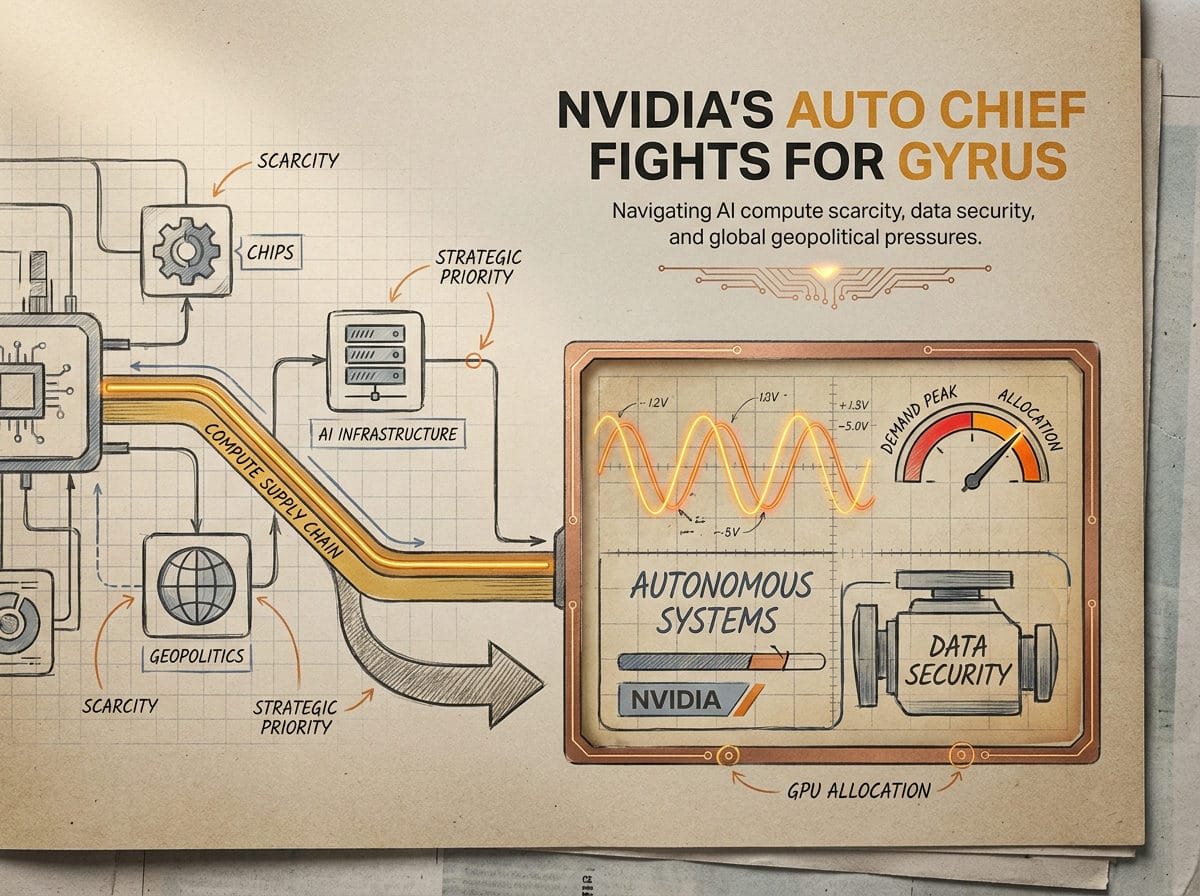
⑤ Nvidia's Head of Automotive Struggles for Compute, Despite Internal Priority.
Nilay Patel on Decoder with Nilay Patel discussed with Xinzhou Wu (Head of Automotive, Nvidia) the challenges of securing enough GPU compute for automotive AI, even within Nvidia, underscoring the universal scarcity of AI resources across the industry. This reflects Nvidia’s internal priority system for GPU allocation given high demand, even within the company. (Decoder with Nilay Patel) ▶ Listen
→ What to watch: The scramble for AI compute is escalating, even for hardware giants, indicating a prolonged bottleneck that will impact development timelines and costs across all AI-driven sectors, particularly those with long development cycles like automotive.
⑥ Privacy-First Companies are Prioritizing Growth to Counter Big Tech.
Bart Butler (CTO, Proton) on Decoder with Nilay Patel argued that privacy-focused companies like Proton must prioritize aggressive growth to challenge the paradigm set by big tech, viewing their expansion as essential to offer a viable, trusted alternative. (Decoder with Nilay Patel) ▶ Listen
→ The context: This contradicts the traditional view of small, niche privacy providers and suggests a new strategic imperative where market dominance is crucial for privacy and user trust, even for companies historically focused on a non-profit model. Butler noted that "No company is going to go to jail for you."
The Signals
⬆️ Heating Up
• Data Level Security for AI Deployment: Enterprises must shift from perimeter security to securing data itself, using classification and controlled access. (Todd Vancil on The AI in Business Podcast)
• Software Defined Vehicle (SDV) 🆕: The automotive industry is rapidly transitioning to AI-defined software and systems, profoundly reshaping vehicle architecture and development. (Xinzhou Wu on Decoder with Nilay Patel)
• AI-specific cloud infrastructure: Specialized, interconnected GPU setups are becoming critical for large-scale AI training workloads, distinct from general-purpose cloud. (Corey Sanders on Practical AI)
👀 On Watch
• Kimi K3 🆕: A powerful open-weight Chinese AI model with benchmarks approaching frontier models, signals a closing gap in global AI capabilities. (NLW on The AI Daily Brief: Artificial Intelligence News and Analysis)
• Agent Studio 🆕: Samsara's new platform helps businesses automate workflows and generate reports by applying AI to telematics data, enhancing physical operations efficiency. (John Bicket on The Neuron: AI Explained)
• GPT 5.6 🆕: OpenAI's latest model and ChatGPT Work are intensifying competition and price wars in the AI model market. (Andrey Kurenkov on Last Week in AI)
⬇️ Cooling Off
• Unbridled agent autonomy: The AI engineering community is recalibrating away from fully autonomous agents, emphasizing human oversight and structured interaction patterns. (NLW on The AI Daily Brief: Artificial Intelligence News and Analysis)
• Traditional enterprise security models: Perimeter-based security is proving inadequate for the AI era, unable to cope with consumer-driven AI tools in the workplace. (Bradon Rogers on Eye On A.I.)
• Perpetuation of AI risk fetish: Some AI companies are critiqued for leading with grim societal collapse scenarios rather than focusing on the positive impacts of AI. (NLW on The AI Daily Brief: Artificial Intelligence News and Analysis)
The Bottom Line
The global AI race demands a dual focus: fortifying data security and securing specialized compute access, or risk being outmaneuvered by competitors and geopolitical shifts.
📖 Want the full episode breakdowns, guest details, and listen links?
Episode Guide (Web Version Excerpt)
1. The AI Daily Brief: Artificial Intelligence News and Analysis — "Is Kimi K3 Really Fable Class?"
Runtime: 28 min | Host: Nathaniel Whittemore, NLW | Guest: NLW (Host, The AI Daily Brief)
For the Strategic Leader: Understand how a new front-runner in open-source AI is disrupting market expectations and challenging the West's technological lead.
This episode unpacks Moonshot's Kimi K3, a powerful Chinese open-weights model, discussing its impressive benchmarks against leading models despite notable limitations in reliability, speed, and cost. It highlights the rapid advancement of Chinese AI and raises critical questions about international cooperation and cyber risk vetting.
"My conclusion so far is that Kimik 3 may be the first model to narrow the gap with leading US closed source models to less than 3 months." — Joo Kan, Training Analyst on The AI Daily Brief: Artificial Intelligence News and Analysis
▶ Listen
2. The AI in Business Podcast — "Preparing Enterprise Data for Safe AI Deployment - with Todd Vancil of Securiti AI"
Runtime: 32 min | Host: Daniel Faggella | Guest: Todd Vancil (Vice President of Veeam's Securiti AI Sales Engineering Team, Securiti AI)
For the C-Suite: Learn how to proactively secure your crucial data assets as AI forces their exposure to new systems, demanding a multidisciplinary governance approach.
Todd Vancil from Securiti AI emphasizes that data is the "lifeblood" of AI, and its exposure to new systems creates significant security gaps. The discussion shifts from traditional perimeter security to data-level protection through classification, labeling, and controlled access, underscoring the need for C-suite involvement and crisis planning.
"Ultimately the very lifeblood of AI is data. And as we're looking to optimize our businesses, the data that is most valuable to them turns out to be their most sensitive data." — Todd Vancil, Vice President of Veeam's Securiti AI Sales Engineering Team on The AI in Business Podcast
▶ Listen
3. Eye On A.I. — "Inside the Enterprise Browser Rebuilding Security for the AI Era | Bradon Rogers, Island"
Runtime: 56 min | Host: Craig Smith | Guest: Bradon Rogers (Chief Customer Officer at Island, Island)
For the CTO/CISO: Discover how the enterprise browser is evolving into a critical security layer, capable of enforcing policy for AI tools and preventing data leakage in complex workflows.
Bradon Rogers from Island discusses the inadequacy of traditional security models for AI-driven environments and introduces "AI Protect," a solution embedding policy directly into the browser. This approach aims to unify security for diverse AI providers, offer visibility, and simplify DLP by using application boundaries.
"AI Protect is really two fundamental, very foundational things for island, but very difficult for most status quo traditional providers. It is, it is about having visibility, understanding who's using what and building policies." — Bradon Rogers, Chief Customer Officer at Island on Eye On A.I.
▶ Listen
4. Hard Fork — "The A.I. Trade Secrets War + Economists Say ‘We Must Act Now’ + HatGPT"
Runtime: 70 min | Host: Kevin Roose, Casey Newton | Guest: Fiji Simo (Former CEO of Applications, later CEO of AGI Deployment, OpenAI)
For the Investor: Get an insider's view on the intensifying legal and competitive battles shaping the AI industry, and the economic implications of unchecked AI development.
This episode from Hard Fork delves into the escalating competition and legal disputes within the AI industry, including Apple's lawsuit against OpenAI for trade secret theft. It highlights the growing animosity between leading AI labs, the release of new models, and economists' calls for proactive policies to manage AI's economic and societal impact.
"I think that we are heading into a period where there may be real and dangerous risks associated with these very powerful systems. And these companies should be open to collaboration and solving this problem together." — Kevin Roose, Tech Columnist at The New York Times on Hard Fork
▶ Listen
5. Practical AI — "The Future of AI Infrastructure with CoreWeave"
Runtime: 50 min | Host: Chris Benson | Guest: Corey Sanders (Senior Vice President of Product, CoreWeave)
For the CIO/Head of Engineering: Learn why specialized AI infrastructure and a multi-cloud strategy are essential for optimizing intensive AI training workloads and coping with rising compute costs.
Chris Benson and Corey Sanders discuss the shift from general-purpose to AI-specific cloud infrastructure, emphasizing CoreWeave's role in providing specialized platforms for massive training workloads. They cover the complexities of agentic engineering, AI loop optimization, and the critical need for a multi-cloud approach to manage diverse AI applications efficiently.
"One of the biggest requirements for many of these training workloads is they're sort of these large tranches of deployments that are all deeply interconnected. So they're all working together." — Corey Sanders, Senior Vice President of Product at CoreWeave on Practical AI
▶ Listen
6. The Neuron: AI Explained — "AI That Rides Along With Truck Drivers"
Runtime: 42 min | Host: Corey, Grant | Guest: John Bicket (CTO and Co-founder, Samsara)
For the Operations Leader: Explore how AI is transforming physical operations and fleet management, leveraging IoT data to enhance safety, productivity, and driver coaching.
John Bicket, CTO of Samsara, details how AI is being used with IoT devices like dash cams and telematics to improve safety and productivity for large fleets. The discussion covers Samsara's Agent Studio for automating workflows, their AI Ride-Alongs for driver coaching, and the company's cultural adoption of AI for extreme personalization in physical operations.
"It's a level of context that a human has never is not able to piece together and recognize patterns at that level." — John Bicket, CTO and Co-founder at Samsara on The Neuron: AI Explained
▶ Listen
7. Last Week in AI — "#252 - GPT 5.6, Grok 4.5, Nemotron-Labs-Diffusion, AI 2040"
Runtime: 85 min | Host: Andrey Kurenkov, Jeremie Harris | Guest: Andrey Kurenkov (Host, Last Week in AI)
For the Policy Maker: Understand the complexities of AI model releases, government oversight, and the surprising competitive maneuvers of major tech players in the AI landscape.
Andrey Kurenkov and Jeremie Harris analyze recent AI model releases, including OpenAI's GPT-5.6 and SpaceXAI's Grok 4.5, highlighting intensifying competition and price wars. They critically discuss the inconsistent government oversight of frontier AI, Meta's struggles with synthetic media models, and the emerging trend of tech giants monetizing excess AI computing power.
"It definitely, it's tuned conservative, not politically, but like it's tuned to refuse to answer questions when there's any doubt. So its false refusal rates on benign requests are higher than peers considerably in some cases, especially on things like Cyber, higher than GPT5.5 and Opus." — Andrey Kurenkov, Host at Last Week in AI on Last Week in AI
▶ Listen
8. Decoder with Nilay Patel — "Yes, even Nvidia's head of automotive is fighting for compute"
Runtime: 72 min | Host: Nilay Patel | Guest: Xinzhou Wu (Head of Automotive, Nvidia)
For the Automotive Executive: Gain insight into how the automotive industry's AI transition is driving new demands for compute, data, and software architecture, with Nvidia at the forefront.
Nilay Patel interviews Xinzhou Wu from Nvidia's automotive division about the shift to software-defined and AI-defined vehicles. Wu outlines Nvidia's comprehensive platform strategy, from chips to open-source models, emphasizing synthetic data generation and the unique challenges of the automotive sector, including the scarcity of compute and the long development cycles.
"We are using AI to rewrite most of the software in car. That's what we call the AI defined vehicle essentially." — Xinzhou Wu, Head of Automotive at Nvidia on Decoder with Nilay Patel
▶ Listen
9. The AI Daily Brief: Artificial Intelligence News and Analysis — "How the Escalating AI Wars Benefit You"
Runtime: 31 min | Host: NLW | Guest: NLW (Host, The AI Daily Brief)
For the Strategist: Analyze the broader implications of the AI market's escalating competition, including shifts in hardware, geopolitical alliances, and the emerging economic models of AI value.
NLW discusses the widening scope of AI competition, from Apple's lawsuit against OpenAI to geopolitical maneuvering like the easing of export controls for UAE's AI chip access. He also touches on the ongoing AI price war, the prioritization of cheaper and smarter models, and differing views on whether the current acceleration signals an AI bubble.
"If learning flows in only one direction, economic value converges towards the owner of the learning infrastructure rather than the creators of the knowledge itself. Therefore, it's imperative that we distribute the learning infrastructure to every firm so that they can control their own learning loop." — Satya Nadella, CEO of Microsoft on The AI Daily Brief: Artificial Intelligence News and Analysis
▶ Listen
10. The AI Daily Brief: Artificial Intelligence News and Analysis — "AI Optimism vs. AI Pessimism"
Runtime: 23 min | Host: Nathaniel Whittemore | Guest: Nathaniel Whittemore (Host, The AI Daily Brief)
For the Thought Leader: Engage with the evolving discourse around AI's societal impact, discerning between nuanced discussions and alarmist narratives.
NLW critiques the shifting AI societal risk discourse, moving from fear-mongering to more balanced conversations. He specifically calls out Anthropic's ad campaign for perpetuating grim AI narratives, while also noting that actual unemployment rates remain stable despite rapid AI advancements, challenging some pessimistic predictions.
"It is a perpetuation of this long term fetish that AI companies have had with quote unquote acknowledging all the bad sides and the risks rather than just selling the positive vision." — NLW, Host of The AI Daily Brief: Artificial Intelligence News and Analysis on The AI Daily Brief: Artificial Intelligence News and Analysis
▶ Listen
11. Decoder with Nilay Patel — "Proton’s CTO: No company is going to jail for you"
Runtime: 84 min | Host: Nilay Patel | Guest: Bart Butler (CTO, Proton)
For the Privacy Advocate: Understand how privacy-focused tech companies are structured to resist governmental pressures and maintain user trust, even amidst aggressive growth strategies.
Bart Butler, CTO of Proton, explains the company's commitment to privacy-preserving software, backed by end-to-end encryption and a user-funded business model. He discusses Proton's unique foundation structure designed to safeguard its mission and the strategic importance of aggressive growth to challenge big tech and provide viable, privacy-first alternatives.
"No company is going to go to jail for you. Right? That said, you can arrange structures such that there are safeguards here." — Bart Butler, CTO of Proton on Decoder with Nilay Patel
▶ Listen
12. The AI Daily Brief: Artificial Intelligence News and Analysis — "5 AI Engineering Trends for Non-Engineers"
Runtime: 28 min | Host: Nathaniel Whittemore | Guest: Nathaniel Whittemore (Host, The AI Daily Brief)
For the Non-Technical Executive: Get a concise overview of the most impactful AI engineering trends, offering a strategic head start on understanding the future of AI work and organizational design.
NLW distills five key trends from the AI Engineering World's Fair, focusing on the recalibration of AI autonomy. Topics include 'harness engineering' (surrounding systems), 'loop engineering' (control), 'software factories' (enterprise AI), coding agents as interfaces, and 'skill engineering.' These trends highlight a renewed focus on human oversight and structured interaction patterns within AI systems.
"The most fascinating through line across all of these trends is a recalibration of our relationship with autonomy." — NLW on The AI Daily Brief: Artificial Intelligence News and Analysis
▶ Listen