What if the most important AI policy isn't coming from governments, but from our enterprise buying behavior?
The Intake
📊 12 episodes across 8 podcasts
⏱ 704 minutes of intelligence analyzed
🎙 Featuring: Corey Knowles, Grant Harvey, John de Wasseige, Arthur Fernandes Araujo, Debanjan Saha, Evan Feinberg, Sergey Edunov, Thomas von Tschammer, Amy Lanzi, Ramin Hasani, Dr. Dana Suskind
|

The Big Shift
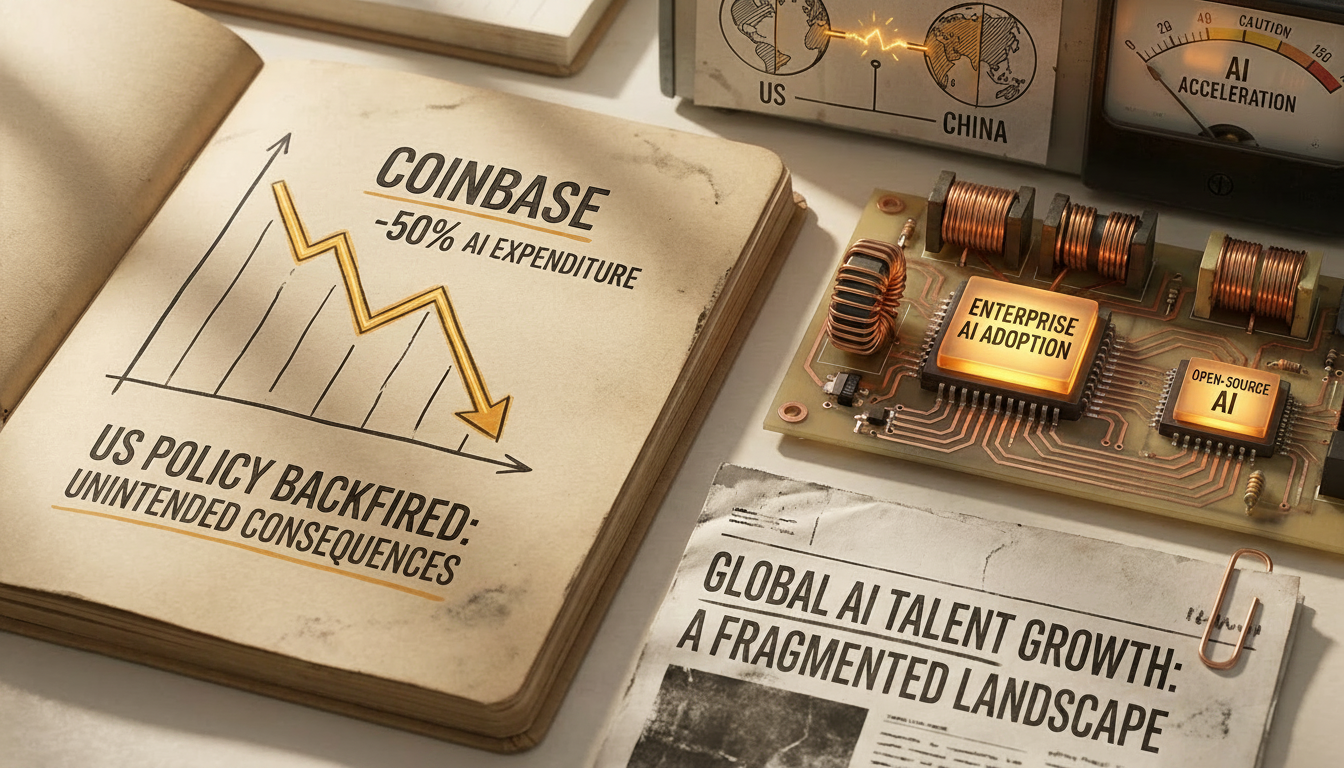
Forget government bans; market forces and real-world adoption are shaping the AI landscape faster than any policy. While policymakers squabble over theoretical threats and try to control access to frontier models, enterprises are quietly — and sometimes loudly — shifting their AI spend, favoring open-source, cheaper alternatives, and purpose-built solutions over the flagship models politicians are busy regulating. This isn't just about cost-cutting; it's a strategic embrace of pragmatism that's sidestepping top-down control.
Why it's happening: The US government's attempt to restrict access to frontier AI models, exemplified by the "Mythos ban" and limited release of OpenAI's GPT 5.6, has created an "authoritarian limbo" where companies are left uncertain about future access and reliability. This uncertainty, coupled with the rapid advancement of open-source and non-US models, is pushing businesses to diversify their AI stack. Nathaniel Whittemore, Host of The AI Daily Brief: Artificial Intelligence News and Analysis, highlighted reports suggesting Chinese AI systems are already matching the performance of models like Anthropic's Mythos, adding that
"The US government has many levers it can pull if it feels like Chinese companies are attacking its companies. Like for example, they could sanction companies that they believe have caught distilling. They can prevent them from selling their wares in America."
— The New York Times, Host on Hard Fork
Even more tellingly, Coinbase reportedly cut its AI bill in half by switching to cheaper Chinese open-source models (The AI Daily Brief: Artificial Intelligence News and Analysis). This isn't just a cost play; it's a statement that practical solutions trump geopolitical considerations for many enterprises.
The broader pattern: This shift is impacting everything from talent acquisition to product design. Companies adopting AI are actually growing headcount faster, particularly at the entry level, suggesting AI is augmenting work rather than simply replacing it (The AI Daily Brief: Artificial Intelligence News and Analysis). Meanwhile, in specialized fields like drug discovery and engineering, purpose-built AI models are enabling breakthroughs and accelerating design cycles at unprecedented rates (Latent Space: The AI Engineer Podcast, "The Cognitive Revolution" | AI Builders, Researchers, and Live Player Analysis), far outpacing the general-purpose LLMs that dominate public discourse. This indicates a bifurcation: general AI for efficiency, specialized AI for innovation, and a growing resistance to relying solely on a handful of regulated frontier models.
The move: Enterprises need to actively explore and pilot a diverse range of AI models, including open-source and specialized solutions, to reduce dependency on heavily regulated frontier models and leverage the rapid advancements happening outside the mainstream. Focus on integration, skill development, and fostering an AI-driven innovation culture over waiting for regulatory clarity.
The Rundown
① AI Adoption Fuels Headcount Growth (Not Displacement), Especially at Entry-Level.
Companies aggressively adopting AI are seeing significant headcount growth, with high AI adopters growing 10% on average over the past two years, versus flat growth for low adopters. This growth is particularly pronounced at the entry level (The AI Daily Brief: Artificial Intelligence News and Analysis).
→ Why it matters: The narrative of AI as a job destroyer often overshadows its potential as a job creator. For mid-market companies, early and strategic AI adoption could be a competitive advantage for talent acquisition and growth, not just cost-cutting. This suggests that AI is enabling new, more productive roles.
② CMO Role is "Dying," Evolving into a Growth-Focused, Data-Driven CGO.
Amy Lanzi (CEO, Digitas North America) argues the traditional Chief Marketing Officer role is transforming into a Chief Growth Officer (CGO) role, driven by the need for data-centric, business-outcome-focused leadership rather than purely creative campaign management (Decoder with Nilay Patel).
→ What to watch: This signals a profound shift in marketing leadership. Companies need to rethink the skill sets for top marketing brass, prioritizing analytical prowess, systems thinking, and direct business impact over traditional brand building alone. If your CMO isn't evolving, they aren't leading.
③ "Super Agents" are Automating Previously Impossible Tasks, Not Just Mundane Ones.
Debanjan Saha (CEO, DataRobot) highlighted 'super agents' that can perform tasks currently beyond human capabilities, such as real-time digital twin simulations for oil & gas pipeline leak detection, moving beyond simple task automation (The AI in Business Podcast).
→ Why it matters: This isn't workforce augmentation; it's capability expansion. Enterprises should identify areas where AI agents can tackle problems that were previously intractable, opening up entirely new operational efficiencies and competitive advantages,
"What I am mostly excited about is number three and number four and that is thinking about work in a very, very different way. And it's going to be both efficient and improve productivity as well as it's going to be transformative."
— Debanjan Saha, Chief Executive Officer at DataRobot
④ AI-Native Engineering Accelerates Design Cycles, Outperforming Human Intuition.
Thomas von Tschammer (Neural Concept) explains how AI-driven workflows allow companies like Jaguar Land Rover to increase design evaluations from 50 to 1,500 per day, with AI generating designs that often defy human intuition yet prove superior ("The Cognitive Revolution" | AI Builders, Researchers, and Live Player Analysis).
→ The context: This "third revolution" in product development has massive implications for industries like automotive and manufacturing. Businesses not leveraging AI for design exploration risk being out-innovated on timelines, cost, and performance by competitors embracing AI-native engineering principles.
⑤ Frontier AI Models are Subject to a De Facto Licensing Regime, Undermining US Standard-Setting.
Nathaniel Whittemore (The AI Daily Brief: Artificial Intelligence News and Analysis) detailed how major frontier AI models like Anthropic's Mythos and OpenAI's GPT 5.6 are being released to a limited group of "trusted partners" at what appears to be the US government's request, creating an opaque licensing system outside formal legislation.
→ What to watch: This ad-hoc governmental intervention not only creates uncertainty for developers and enterprises but also risks undermining the US's ability to set global AI standards, potentially pushing the Global South towards non-US, open-source alternatives, as Emily Weinstein (Former Official, Commerce Department) noted that "I think we're seeing another example of the Huawei strategy in the context of open source AI models. China is able to offer not even just the models, but often the underlying or associated infrastructure at either no cost or significantly lower cost."
⑥ Device-Native Foundation Models are Challenging Cloud-Centric AI Dominance.
Ramin Hasani (CEO, Liquid AI) highlighted the success of Liquid AI's device-native foundation models, achieving high efficiency and over 1 million weekly downloads on Hugging Face with significantly fewer GPUs than competitors, targeting robotics and edge devices with limited resources ("The Cognitive Revolution" | AI Builders, Researchers, and Live Player Analysis).
→ Why it matters: The pursuit of "intelligence on the edge" signifies a strategic shift from massive, cloud-dependent LLMs towards smaller, more efficient models that run directly on devices. This opens up new possibilities for AI applications in environments with limited connectivity or compute, potentially lowering costs and improving privacy for many use cases.
The Signals
🔥 Heating Up
• AI-driven Workflows: Accelerating design cycles and enabling hyper-personalization across industries. (Thomas von Tschammer on "The Cognitive Revolution" | AI Builders, Researchers, and Live Player Analysis)
• Enterprise Digital Employee Paradigms: Frameworks for managing AI agents akin to human employees, ensuring accountability. (Debanjan Saha on The AI in Business Podcast)
• Device-native foundation models 🆕: Efficient AI designed for edge devices and robotics, reducing cloud dependency. (Ramin Hasani on "The Cognitive Revolution" | AI Builders, Researchers, and Live Player Analysis)
• AI and Job Augmentation: High AI adoption correlated with increased headcount, especially entry-level. (Nathaniel Whittemore on The AI Daily Brief: Artificial Intelligence News and Analysis)
• 1 Angstrom RMSD threshold for core molecule interaction 🆕: A critical benchmark for effective drug discovery, far more stringent than current academic standards. (Evan Feinberg on Latent Space: The AI Engineer Podcast)
👀 On Watch
• Anthropic Claude Fable 5 🆕: Its export restrictions were lifted, making it a critical tool for developers seeking to exploit its capabilities. (AI Breakdown)
• AI regulation impact on open source and Chinese models 🆕: US government policy inadvertently pushes companies towards non-US or open-source AI. (Emily Weinstein on The AI Daily Brief: Artificial Intelligence News and Analysis)
• Liquid AI 🆕: Achieving significant downloads with high efficiency, challenging traditional large model approaches. (Ramin Hasani on "The Cognitive Revolution" | AI Builders, Researchers, and Live Player Analysis)
• Dario Amodei 🆕: Anthropic CEO's public stance on AI safety is seen by some as a strategic move to benefit his company. (Corey on The Neuron: AI Explained)
• Chinese AI systems reaching frontier AI capabilities: Reports suggest parity with US models, challenging assumptions about US AI dominance. (Nathaniel Whittemore on The AI Daily Brief: Artificial Intelligence News and Analysis)
❄️ Cooling Off
• Traditional Chief Marketing Officer role 🆕: Evolving to focus on growth and data, diminishing the role of pure brand campaigns. (Amy Lanzi on Decoder with Nilay Patel)
• 2 Angstrom RMSD benchmark is 'slop': Widely accepted academic benchmark for drug discovery deemed insufficient for real-world efficacy. (Evan Feinberg on Latent Space: The AI Engineer Podcast)
• Open source is a threat to US AI company profits 🆕: Policy decisions around US models inadvertently bolster open-source and foreign competitors. (Corey on The Neuron: AI Explained)
• Prediction markets as a cure for Instagram addiction: An ethically questionable and counter-intuitive proposal. (The New York Times on Hard Fork)
• The Wrong Promises 🆕: General-purpose LLMs struggle significantly with specific domain applications without specialized training. (Thomas von Tschammer on "The Cognitive Revolution" | AI Builders, Researchers, and Live Player Analysis)
The Debate
The US Government's AI Regulation: Helping or Hurting US AI Leadership?
🐂 The bull case: Advocates for strict government oversight, like some interpretations of the "Mythos ban," argue that restricting access to frontier AI models is crucial for national security and preventing misuse. They believe this protects critical infrastructure and ensures safe, responsible development. Nathaniel Whittemore (Host, The AI Daily Brief: Artificial Intelligence News and Analysis) noted the government's dual interest in preventing China from leading in advanced AI while attempting to ensure broad diffusion of US models.
🐻 The bear case: Critics argue that such heavy-handed intervention is counterproductive, stifling innovation and pushing global partners towards non-US models. Corey (Host, The Neuron: AI Explained) bluntly stated,
"Why would you set up your infrastructure and build your whole company around... OpenAI model that you can't run on your own server, if at some point the government can request that gets taken down?"
— Corey, Host of The Neuron: AI Explained
This perspective highlights how regulatory uncertainty makes proprietary US models unreliable for businesses, inadvertently accelerating the adoption of open-source or Chinese alternatives.
Our read: While safety is paramount, poorly conceived or opaque regulations risk undermining US leadership by making its flagship AI models less attractive to global enterprises, creating a vacuum for competitors.
The Bottom Line
As governments stumble to regulate, the real AI policy is being written by enterprise buying decisions, accelerating a pragmatic shift towards diverse, efficient, and often open-source models.
📖 Want the full episode breakdowns, guest details, and listen links?
Episode Guide (Web Version)
1. The AI Daily Brief: Artificial Intelligence News and Analysis — "Mythos Comes Back But Not for Everyone"
Runtime: 33 min | Host: Nathaniel Whittemore (Host, The AI Daily Brief: Artificial Intelligence News and Analysis) | Guest: Emily Weinstein (Former Official, Commerce Department), Daniel Remyer (Former Tech Advisor, State Department), Saif Khan (Former Advisor, Commerce Department), Brian Armstrong (CEO, Coinbase), Alex Finn (AI Entrepreneur), Charles Foster (Meter Eval), Miles Brundage, Dean Ball (AI Policy Advisor, OpenAI), Andrew Curran
For the Policy-Minded CEO: This episode reveals how informal government intervention is shaping frontier AI access, and its unintended consequences for US competitiveness and global adoption.
The segment details the emergence of an informal licensing regime for frontier AI models like Anthropic's Mythos and OpenAI's GPT 5.6. It raises concerns about transparency, fairness, and the potential impact on US competitiveness, citing how reports on benchmark "cheating" and restricted access impact broader innovation. It also covers Coinbase's shift to cheaper Chinese open-source models due to US policy.
"Still, what's clear from the letter is that frontier AI models, if you were in any doubt, are now subject to a licensing regime. It's a licensing regime that hasn't been passed by Congress, established in an executive order, or even fully articulated in public. At this moment, it is a licensing model based on the whims of Howard Lutnick."
— Nathaniel Whittemore, Host of The AI Daily Brief
2. The AI Daily Brief: Artificial Intelligence News and Analysis — "AI Companies Are Hiring More"
Runtime: 28 min | Host: Nathaniel Whittemore (Host, The AI Daily Brief: Artificial Intelligence News and Analysis) | Guest: Eric Karazian (Lead Economist, Ramp), Aaron Levy (CEO, Box)
For the HR-Focused Executive: This one challenges the common narrative of AI-driven job displacement, showing how AI adoption actually correlates with increased headcount, particularly for entry-level roles.
The episode highlights how companies aggressively using AI are growing headcount faster, especially at the entry level, contrary to job displacement fears. It covers OpenAI's proposal to give the US government a 5% stake, Meta's exploration of selling AI compute, and the mixed reactions to Fable 5's return, showing the evolving AI-jobs narrative and company strategies.
"They found that companies with high AI adoption were growing headcount at 10% on average across the past two years, while companies with low AI adoption were basically flat."
— Nathaniel Whittemore, Host of The AI Daily Brief
3. The AI in Business Podcast — "Reengineering Work with Intelligent Agents - with Debanjan Saha of DataRobot"
Runtime: 31 min | Host: Daniel Faggella (CEO and Head of Research, Emerj Artificial Intelligence Research) | Guest: Debanjan Saha (Chief Executive Officer, DataRobot)
For the Operations Leader: Debanjan Saha outlines how "digital employees" (AI agents) are fundamentally re-engineering enterprise work, even automating tasks impossible for humans, and the new frameworks needed to manage them.
Daniel Faggella introduces Debanjan Saha to discuss "digital employees" and how they are re-engineering work. Debanjan categorizes agents into personal, line-of-business specific, and "super agents" that can perform humanly impossible tasks. He emphasizes managing digital employees with frameworks similar to human employees, ensuring accountability and traceability in a hybrid workforce.
"What I am mostly excited about is number three and number four and that is thinking about work in a very, very different way. And it's going to be both efficient and improve productivity as well as it's going to be transformative."
— Debanjan Saha, Chief Executive Officer at DataRobot
4. Hard Fork — "Fable Ban Reversed + Dr. Dana Suskind on Parenting With A.I. + Prediction Market Drama"
Runtime: 67 min | Host: Kevin Roos (Tech Columnist, The New York Times), Casey Noon (Platformer), Kevin Roose (Host, The New York Times), Casey Newton (Host, The New York Times), The New York Times (Host, The New York Times) | Guest: Dr. Dana Suskind (Pediatric Surgeon and Childhood Development Expert, Professor, Founder and Co-Director of the TMW Center for Early Learning and Public Health, Author, University of Chicago)
For the Board Member Concerned with Ethics: Dr. Dana Suskind offers a "DETECT" framework for evaluating AI products for children, highlighting the critical need for human connection amidst AI's growing ability to mimic interaction.
This segment discusses the reversal of the US Commerce Department's restrictions on Anthropic's Fable, plus Dr. Dana Suskind's insights on parenting with AI. She emphasizes maintaining human connection for child development and suggests a "DETECT" framework for parents to evaluate AI products. It also touches on prediction market controversies and Instagram's algorithm customization.
"Human connection is irreplaceable. It is what we need to protect and double down on. But O is owning your imperfections... P is protecting the early years... Lastly is E, if you're going to use it, use it to enhance, not replace."
— Dr. Dana Suskind, Pediatric Surgeon and Childhood Development Expert at University of Chicago
5. The Neuron: AI Explained — "Can AI Agents Learn From Expert Corrections?"
Runtime: 53 min | Host: Corey Knowles (Host, The Neuron), Grant Harvey (Host, The Neuron), Corey (Host, The Neuron: AI Explained), Grant (Host, The Neuron: AI Explained) | Guest: John de Wasseige (Forward Deployed Engineer, OpenAI), Arthur Fernandes Araujo (Forward Deployed Engineer, OpenAI), Arthur (Engineer, OpenAI), John (Engineer, OpenAI)
For the CTO/AI Implementer: OpenAI's forward-deployed engineers discuss real-world AI agent development in tax, emphasizing how expert human corrections are crucial for continuous AI self-improvement.
Corey and Grant interview John de Wasseige and Arthur Fernandes Araujo from OpenAI about Tax AI, a Codex-powered agent for tax preparation. They discuss how expert corrections become structured signals for the AI's continuous self-improvement and the challenges of real-world tax documents. The segment highlights the necessity of human expertise for review and feedback in successful AI deployments.
"The big idea is using a self improvement loop where expert corrections become evals. Codex investigates the relevant traces and code paths and engineers review bounded fixes before anything ships."
— Corey Knowles, Host of The Neuron
6. Latent Space: The AI Engineer Podcast — "🔬 The Coolest Diffusion Research Isn't in LLMs — Evan Feinberg & Sergey Edunov, Genesis Molecular AI"
Runtime: 109 min | Host: swyx (Host, Latent Space), Alessio (Host, Latent Space), (Host) | Guest: Evan Feinberg (Founder and CEO, Genesis Molecular AI), Sergey Edunov (CTO, Genesis Molecular AI)
For the Scientific or R&D Leader: Genesis Molecular AI reveals that the most innovative diffusion research is in 3D structure prediction for drug discovery, far beyond LLMs, and achieving sub-Angstrom accuracy for real-world impact.
Evan Feinberg and Sergey Edunov discuss advancements in small molecule drug discovery using AI. Sergey highlights the vast chemical search space, while Evan emphasizes the innovation in 3D structure prediction, a critical area for drug discovery. They explain how Genesis uses physics-based modeling and synthetic data to overcome data limitations and achieve accurate, generalizable AI models.
"We sort of had to wait for the right primitive to get created, and that turned out to be diffusion… Actually, some of the most innovative diffusion research that’s happening in our field is happening in 3D structure prediction right now."
— Evan Feinberg, Founder and CEO of Genesis Molecular AI
7. "The Cognitive Revolution" | AI Builders, Researchers, and Live Player Analysis — "1000 Designs a Day: Neural Concept's Thomas von Tschammer on AI-Native Engineering"
Runtime: 89 min | Host: Nathan Labenz (Host, The Cognitive Revolution) | Guest: Thomas von Tschammer (Co-founder and Managing Director US, Neural Concept)
For the Manufacturing or Product Development Head: Neural Concept's Thomas von Tschammer details how AI is enabling a "third revolution" in engineering дизайн, allowing 1,500 design evaluations daily and creating designs beyond human intuition.
Thomas von Tschammer discusses the evolution of engineering design, explaining how physics-aware AI models enable a "third revolution" in product development. This allows companies like Jaguar Land Rover to drastically compress development cycles and explore more designs, leading to better performance and efficiency in automotive design.
"Using AI, we are seeing that third revolution. So from prototype to CAD and numerical solvers to AI, where thanks to AI, you don't get results in days, but you get them in minutes. And if you can get results in minutes, it means that you don't explore 50 designs a year, maybe a hundred designs a year, but now thousands on different coffees. And that drastically accelerates your development cycles."
— Thomas von Tschammer, Co-founder and Managing Director US of Neural Concept
8. Decoder with Nilay Patel — "The CMO is a dying role, says Digitas' Amy Lanzi"
Runtime: 56 min | Host: Nilay Patel (Editor-in-Chief and Host, The Verge) | Guest: Amy Lanzi (CEO, Digitas North America)
For the Marketing Executive: Amy Lanzi argues the traditional CMO role is dying, giving way to a Chief Growth Officer focused on data-driven business results and authentic brand building in an AI-driven world.
Nilay Patel speaks with Amy Lanzi about the advertising industry, AI's impact, and the evolving role of the CMO. Lanzi highlights the chaotic environment of AI promises, the pressure from tech platforms, and Digitas' restructuring to incorporate intelligence and systems thinking, emphasizing data-driven brand building.
"The marketing function is now a business function. It needs a data layer. Where do you see the creative fitting into it? The fundamentals matter more than anything."
— Amy Lanzi, CEO of Digitas North America
9. The Neuron: AI Explained — "BONUS: Government Banning AI Fallout: China, the economy, what's at risk, and what you should do."
Runtime: 84 min | Host: Grant (Host, The Neuron: AI Explained), Corey (Host, The Neuron: AI Explained) | Guest: Host-led discussion
For the Geopolitical Strategist: The hosts discuss how government intervention in AI, like the Fable 5 controversy, risks driving the US economy towards Chinese and open-source models, potentially destabilizing the market.
This segment discusses recent AI industry turmoil, focusing on Fable 5's withdrawal and OpenAI's GPT 5.6 limited rollout. The hosts critically examine Anthropic CEO Dario Amodei's statements, suggesting his fear-mongering is strategic. They explore the economic implications of government intervention, highlighting the US economy's dependence on AI infrastructure and the potential for a market crash.
"I think it's increasingly regulations like this have the potential to increase that chance [of an AI bubble collapse]."
— Corey, Host of The Neuron: AI Explained
10. The AI Daily Brief: Artificial Intelligence News and Analysis — "How Big Is the AI Economy?"
Runtime: 28 min | Host: NLW (Host, The AI Daily Brief) | Guest: Host-led discussion
For the CFO/Investor: NLW reveals the AI economy's $175 billion annualized run rate, growing three times faster than previous IT waves, driven by validated revenue rather than just hype.
NLW details the AI economy's rapid growth (a $175 billion annualized run rate, three times faster than previous IT waves). He discusses the "State of the AI Economy" report, highlighting validated revenue and AI demand outpacing skepticism. He notes shifts in AI economics, with Amazon renegotiating deals and Meta implementing controls to prevent model distillation.
"AI companies have banked 110 billion over the past 12 months and are at an annualized run rate of 175 billion."
— NLW, Host of The AI Daily Brief
11. AI Breakdown — "Anthropic's Fable 5 is Back! SpaceX Builds AI Device"
Runtime: 18 min | Host: AI Breakdown (Host, AI Breakdown) | Guest: Host-led discussion
For the Tech Innovator: This episode reports on lifted export restrictions for Fable 5, SpaceX's entry into AI devices, and Meta planning to resell AI compute, signaling intensified competition and new market plays.
The US Commerce Department lifted export restrictions on Anthropic’s Fable 5. SpaceX is entering the AI device market with an XAI-tech-powered handset. Meta is launching "Meta Compute" to resell excess AI capacity, competing with cloud giants. Separately, a "Bioshocking" jailbreak was demonstrated, bypassing AI guardrails, and Cloudflare will block mixed-use AI crawlers.
"The U.S. commerce Department is lifting export restrictions on Fable 5. If you have any sort of project that you've been working on, whether that's, you know, coding, I would recommend using Fable 5 on it. You have one week from today to get as much usage out of it."
— AI Breakdown, Host of AI Breakdown
12. "The Cognitive Revolution" | AI Builders, Researchers, and Live Player Analysis — "Intelligence on the Edge: Liquid AI's Ramin Hasani on the Search for Device-Native Foundation Models"
Runtime: 108 min | Host: Nathan Labenz (Host, The Cognitive Revolution), Nathan (Host, The Cognitive Revolution) | Guest: Ramin Hasani (CEO, Liquid AI)
For the Hardware CEO: Ramin Hasani (Liquid AI) details the breakthrough of device-native foundation models, achieving high efficiency and scalability by solving neural network dynamics in closed form, challenging large cloud models.
Ramin Hasani discusses Liquid AI's quest for efficient, device-native foundation models, inspired by biological neural networks. He highlights the company's achievement in solving differential equations for neural dynamics in closed form, enabling greater scalability. Liquid AI's models demonstrate success in robotics and edge devices, ranking highly in downloads and securing partnerships with companies like Shopify and Mercedes-Benz.
"For the first time we actually solved that. And in this was like 2022... we solved the liquid neural network kind of interaction of neurons with each other in closed form for the first time."
— Ramin Hasani, CEO of Liquid AI