
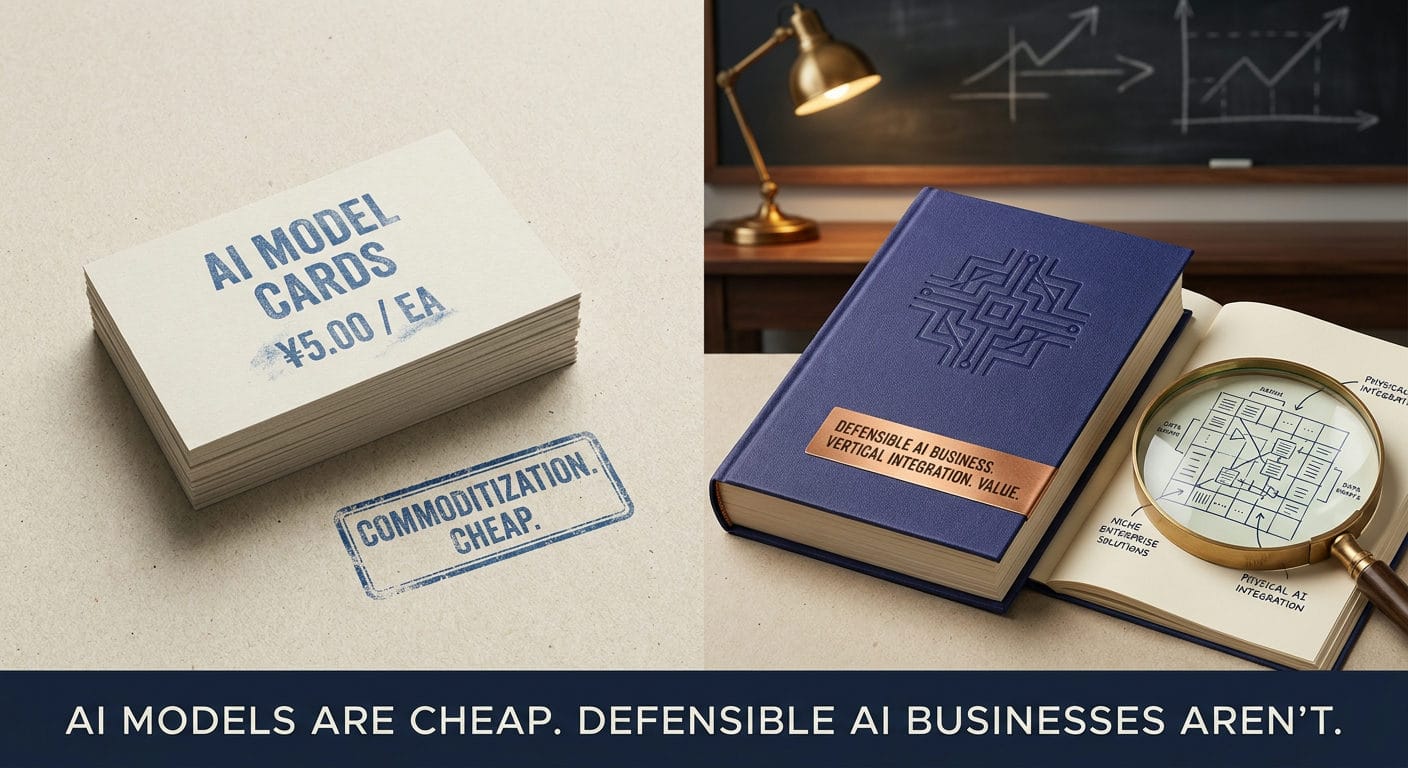
The AI market is bifurcating: a battle rages for foundational model supremacy, but the immediate, actionable value is in specialized AI, unlocking enterprise data and driving unprecedented operational shifts.
The Intake
📊 11 episodes across 6 podcasts
⏱ 731 minutes of intelligence analyzed
🎙 Featuring: Ankit Gupta (Host, Y Combinator), Francois Chaubard (Host, Y Combinator), Y Combinator (Host, Y Combinator), Fred Turner (Founder and CEO, Curative), Lin Qiao (Co-Founder and CEO, Fireworks AI)
{{SPONSOR:sponsor_top}}
The Big Shift
While the headlines fixate on the frontier AI models fighting for dominance, the real shift is happening quietly at the enterprise level: specialized AI is unlocking massive, immediate value. The discourse often centers on a few dominant AGI plays, but the practical application and economic impact are being realized by purpose-built models leveraging proprietary business data. This isn't about general intelligence; it's about activating dormant intelligence within an organization's walls.
"If you think intelligence is a derivative of data, then majority of the data is actually not used for training a general intelligence model. Majority of world data actually private data locked inside application, locked inside enterprise. It will never get shared with anyone else because this is company's proprietary ip."
— Lin Qiao, Co-Founder and CEO at Fireworks AI on The Twenty Minute VC (20VC)
This dynamic creates a two-tiered AI market. On one hand, deep-pocketed players are investing in foundational models, and the cost of tokens from these generalist models is expected to drop by 10x in the next three years, driving a 100x increase in usage (Lin Qiao on 20VC). This commoditization of raw compute and foundational models means the competitive edge shifts. On the other hand, enterprises that can build or integrate specialized, company-specific AI to harness their unique datasets will create defensible moats and drive operational efficiencies that generalist models cannot touch. Curative, for instance, used an AI agent named Gwen to reduce credentialing time from months to 12 hours and costs from $50 to $0.20, effectively transforming entire departments (Fred Turner on 20VC). This indicates that the battle isn't just for general intelligence, but for the activation of unique, company-specific intelligence as a core asset.
The Rundown
① Physical AI emerges as the next frontier, potentially eclipsing digital AI's economic impact.
Applied Intuition's co-founders, Qasar Younis and Peter Ludwig, alongside Marc Andreessen, discussed "physical AI" focused on autonomous machines, highlighting the unique challenges of data collection, safety, and geopolitical navigation compared to digital AI. (Qasar Younis on The a16z Show)
→ The signal: The push into physical AI (cars, robotics, drones) represents a massive, untapped market, demanding specialized solutions that go beyond current digital AI capabilities and signaling where significant capital and innovation will flow next.
② Seed investing is undergoing a structural shift, prompting a move to later-stage bets.
Jason Calacanis, a prolific angel investor, is shifting his focus entirely from early-stage to later-stage growth investing, signaling a broader market trend where the ROI in growth rounds is perceived as more compelling amidst a changing venture landscape. (Jason Calacanis on The Twenty Minute VC (20VC))
→ Why it matters: This suggests a contraction or increased difficulty for early-stage companies to raise capital, as even seasoned seed investors see better returns and liquidity in growth-stage deals, impacting fundraising strategies for nascent startups.
③ Apple's lawsuit against OpenAI highlights the increasingly contentious landscape of AI talent and trade secrets.
Apple has sued OpenAI, alleging trade secret theft, specifically citing former Apple employees bringing company secrets to OpenAI's hardware division, while Microsoft CEO Satya Nadella also issued a warning about data sharing with AI labs. (Sean O'Kane on Equity)
→ What to watch: This legal battle indicates intensifying competition for AI talent and intellectual property, forcing enterprises to reassess data governance and employee mobility policies in the AI era.
④ Hyper-democratization of AI is driving unprecedented adoption, but also raising "Orwellian" concerns.
David Sacks noted that AI is "hyper democratized," reaching 600 million users and rapidly heading to billions via consumer products, but he also warned that the biggest risk of AI is an "Orwellian" scenario of control and censorship, rather than a "Terminator" one. (David Sacks on The a16z Show)
→ The signal: Widespread consumer access to AI is a powerful driver for innovation, but fears around its misuse by those in power for control and information distortion remain a significant, growing concern for policymakers and society.
⑤ World Models are key to overcoming sample inefficiency in AI, marking a path to AGI beyond current reinforcement learning.
Ankit Gupta and Francois Chaubard of Y Combinator Startup Podcast discussed how "world models" can address the sample efficiency problem in AI (humans learn from few examples, AI needs tens of thousands), using synthetic data and latent space optimization, exemplified by Minecraft applications. (Ankit Gupta on Y Combinator Startup Podcast)
→ What to watch: This framework, by enabling AI to learn from imagined rollouts rather than just real-world data, opens doors for more efficient and robust AI systems applicable to complex physical domains like robotics and self-driving, potentially accelerating AGI development.
Signal Board
🔥 Heating Up
• Anthropic: Valued highly with predictions of reaching $10 trillion, fueled by significant capital and rapid AI agent growth. (Fred Turner on The Twenty Minute VC (20VC))
• Physical AI: Projects like autonomous vehicles are seeing increasing investment and development, with new platforms seeking to simplify deployment. (Qasar Younis on The a16z Show)
• World Models: Seen as a promising solution to sample efficiency in AI and a path toward AGI, enabling learning from synthetic data. (Ankit Gupta on Y Combinator Startup Podcast)
👀 On Watch
• AI TAM (Total Addressable Market) Limits 🆕: Growing discussions around whether AI companies like OpenAI and Anthropic are hitting TAM saturation in software coding spend. (Rory on The Twenty Minute VC (20VC))
• Apple suing OpenAI for trade secret theft 🆕: A major legal battle that could disrupt OpenAI's IPO timeline and impact hardware ambitions. (Sean O'Kane on Equity)
• Token consumption in AI development 🆕: Rapidly increasing token consumption for creative workflows and enterprise AI, signaling new cost structures and bottlenecks. (Rory on The Twenty Minute VC (20VC))
• Ent 🆕: Cybersecurity startup leveraging on-device AI agents for real-time breach prevention and granular corporate policy enforcement. (Brandon Dixon on This Week in Startups)
❄️ Cooling Off
• SaaS is dead: Despite some claims, the sentiment is that SaaS models are being challenged by rapid AI advancements and a push for cost-cutting. (Fred Turner on The Twenty Minute VC (20VC))
• OpenAI hardware initiatives on the bubble 🆕: Apple's lawsuit and ongoing competitive pressures suggest potential difficulties for OpenAI's hardware ambitions. (Sean O'Kane on Equity)
• Stripe's acquisition offer for PayPal: While a bold move, it highlights PayPal's perceived "calcification" and potentially diminishing innovation within older tech giants. (Eric Bahn on This Week in Startups)
The Debate
The pace of AI development is undeniably rapid, but there's a clear divergence on whether the current focus on generalist frontier models is sustainable or if specialized, open-source AI is the true long-term value driver.
🐂 The bull case: Some argue that the frontier models from companies like OpenAI and Anthropic are foundational, providing the essential infrastructure upon which all other AI applications will be built. Fred Turner, CEO of Curative, stated his conviction in the massive potential value of these models, predicting Anthropic could reach $10 trillion in value, indicating a belief in their sustained dominance and growth potential.
🐻 The bear case: Conversely, others contend that the market is overvaluing these generalist models, and the future lies in highly specialized, open-source AI that can leverage proprietary data within enterprises. Lin Qiao, Co-Founder and CEO of Fireworks AI, highlighted that "majority of world data actually private data locked inside application, locked inside enterprise. It will never get shared with anyone else because this is company's proprietary ip," making specialized models the only way to unlock this vast intelligence. Clement Delangue of Hugging Face also reinforced the view that open-source models empower users with control and customization, leading to significant cost reductions for many AI workloads.
Our read: While frontier models provide critical infrastructure, the real, actionable value and most defensible moats will come from specialized AI built on proprietary enterprise data, suggesting a shift in strategic focus for investors and founders.
The Bottom Line
The AI race is no longer just about who builds the biggest model; it's about who best leverages specialized AI to unlock proprietary intelligence for competitive advantage.
Episode Guide (Web Version)
The a16z Show — "Hugging Face's CEO on Open Source AI, Model Routing, and the Future of Competition"
Runtime: 28 min | Host: Theo Jaffee | Guest: Clément Delangue (CEO, Hugging Face)
For Product Leaders & Strategists: Understand how open-source AI is challenging proprietary models and redefining competition and value capture in the AI landscape.
Clément Delangue discusses how open-source AI fosters competition and is inherently safer than proprietary models, validating Hugging Face's $100M ARR as proof of concept. He advocates for model routing to diversify AI value beyond a few dominant labs.
"If anything, I think they need more competition than less competition. Yeah, because we heading towards a world where a few companies are completely dominating, concentrating all power, all capabilities, all wealth. And that's much more dangerous than them maybe losing a couple billion dollars of revenue." — Clément Delangue, CEO of Hugging Face
▶ Listen
Y Combinator Startup Podcast — "World Models, Explained"
Runtime: 74 min | Host: Ankit Gupta | Guest: Francois Chaubard (Host, Y Combinator)
For AI Researchers & Deep Tech Founders: Dive into "world models" as a solution to AI's sample efficiency problem and a significant step toward advanced general intelligence.
Ankit Gupta and Francois Chaubard break down world models, a promising approach to solve AI's sample efficiency problem by enabling learning from fewer examples. They explain the math and applications in self-driving and robotics, highlighting their role in synthetic data and latent space optimization for complex domains.
"The two major problems that we have left to solve is intelligence per watt and intelligence per sample." — Ankit Gupta, Host at Y Combinator
The a16z Show — "Why Physical AI Is the Next Frontier | Applied Intuition"
Runtime: 81 min | Host: Marc Andreessen | Guest: Qasar Younis (Co-founder, Applied Intuition)
For Investors & Manufacturing Innovators: Explore the immense potential and unique challenges of physical AI in autonomous systems, from cars to industrial machinery.
This episode introduces Applied Intuition's "physical AI" platform, Dana, aiming to bring intelligence to machines like autonomous vehicles. The founders discuss the critical differences from digital AI, emphasizing data collection, safety, geopolitical considerations, and the potential for physical AI's economic impact to surpass digital AI.
"The companies that impact the physical world might actually be bigger than the companies that impact the digital world." — Qasar Younis, Co-founder of Applied Intuition
This Week in Startups — "A Startup Is Trying to Buy PayPal… Craziest Deal of 2026! | E2312"
Runtime: 74 min | Host: Alex Wilhelm | Guest: Eric Bahn (Founder, Hustle Fund)
For M&A Strategists & Early-Stage Investors: Gain insights into aggressive private company M&A strategies, the "calcification" of older tech, and the surprising lack of consumer AI startups.
The roundtable discusses Stripe's audacious rumored bid for PayPal, highlighting the benefits of private company flexibility and the challenges facing older tech firms. They also explore AI adoption in startups, data privacy, and the curious absence of consumer-facing AI innovation.
"My Suspicion is that PayPal kind of calcified in its own within itself. Right? So like you kind of find these company ARCs where they're startupy, they do cool things, they innovate, they break things, and then they professionalize...Innovation kind of stops and they know that they have a really good brand and asset for sure. But my sense is the culture is totally broken." — Eric Bahn, Founder at Hustle Fund
Equity — "Apple's lawsuit couldn't come at a worse time for OpenAI"
Runtime: 35 min | Host: Kirsten Korosec | Guest: Anthony Ha (Weekend editor, TechCrunch)
For Legal Counsels & AI Founders: Understand the implications of Apple's trade secret lawsuit against OpenAI and the broader risks around data sharing and IP in the AI space.
Apple's trade secret lawsuit against OpenAI is dissected, with discussion around its potential impact on OpenAI's IPO and hardware ventures. Microsoft CEO Satya Nadella's warning about data sharing with AI labs further complicates the landscape. The episode also touches on specialized AI in drug discovery.
"Apple is accusing OpenAI of essentially stealing their trade secrets. This could be a big risk potentially to whatever it is OpenAI is working on. Could change the calculus of how the IPO gets priced." — Sean O'Kane, Senior reporter, special projects at TechCrunch
The Twenty Minute VC (20VC): Venture Capital | Startup Funding | The Pitch — "20VC: Are OpenAI and Anthropic Overvalued? The Open-Source AI Reality | How Token Costs Will Fall 10x And Usage Will Explode 100x | The Future Is Not One AGI; It's Millions of Specialised Models with Lin Qiao, Founder and CEO @ Fireworks"
Runtime: 77 min | Host: Harry Stebbings | Guest: Lin Qiao (Co-Founder and CEO, Fireworks AI)
For CTOs & Strategic Investors: Get a deep dive into the economics of AI, the rise of specialized models, and the shift from AGI to proprietary intelligence as a competitive edge.
Lin Qiao argues that AI's future lies in millions of specialized models, fueled by enterprise data, not a single dominant AGI. She predicts a 10x token cost reduction and 100x usage explosion, re-emphasizing open-source models for control and customization amidst rapid hardware innovation and a push for sovereign AI.
"I do think the cost of token will go down drastically 10x cost reduction in the next three years and this 10x cost reduction will drive 100x usage." — Lin Qiao, Co-Founder and CEO at Fireworks AI
The a16z Show — "Replay 2025: David Sacks on AI, Crypto, and America's Technology Future"
Runtime: 77 min | Host: Marc Andreessen | Guest: David Sacks (General Partner, Craft Ventures)
For Policymakers & Geopolitical Strategists: Understand the regulatory clash between the US and Europe on AI, the US-China AI race, and the "Orwellian" risks of over-regulation.
David Sacks discusses regulatory differences in AI and crypto between the US and Europe, contrasting pro-innovation US policies with Europe's focus on regulation as leadership. He critiques regulatory capture in AI, emphasizes "permissionless innovation," and warns of "Orwellian AI" risks, connecting to US-China competition and energy scarcity for data centers.
"The thing that's really made, I think, Silicon Valley special over the past several decades is permissionless innovation." — David Sacks, General Partner at Craft Ventures
The Twenty Minute VC (20VC): Venture Capital | Startup Funding | The Pitch — "20VC: $5BN in Revenue, 7 to 7,000 Employees in 9 Months, 206,000 Tests in a Single Day: The Craziest Story in Startups: Curative with Fred Turner"
Runtime: 88 min | Host: Harry Stebbings | Guest: Fred Turner (Founder and CEO, Curative)
For Growth-Stage Founders & Operations Leaders: Learn from Curative's hyper-growth during COVID-19, its radical SaaS cost-cutting, and aggressive AI integration for operational efficiency.
Fred Turner recounts Curative's rapid growth during COVID-19, scaling from 7 to 7,000 employees and $5 billion in revenue. He details their strategic pivot, aggressive SaaS cost-cutting (including Salesforce), and transformation of operations using AI agents like Gwen for health insurance contract negotiation and credentialing.
"The company went from about 7 to 7,000 employees in those first nine months. The total revenue ended up being about 5 billion. Over a three year period." — Fred Turner, Founder and CEO of Curative
Lenny's Podcast: Product | Career | Growth — "Netflix CPTO on AI and the future of product and tech roles | Elizabeth Stone"
Runtime: 72 min | Host: Lenny | Guest: Elizabeth Stone (Chief Product and Technology Officer (CPTO), Netflix)
For HR Leaders & Product Managers: Discover how Netflix is adapting talent strategy to AI, moving towards "systems thinkers" and fostering "AI fluency" across all roles.
Netflix CPTO Elizabeth Stone discusses AI's "storming phase," blurring traditional roles but emphasizing the enduring scarcity of craft excellence in engineering, data science, and creativity. She outlines Netflix's shift to hiring "systems thinkers" and fostering "AI fluency" while resisting excessive process, and integrating AI into content production.
"Anytime a new technology comes along, especially one that's as transformative as gen AI, you go through a storming phase before you go through the forming phase of things." — Elizabeth Stone, Chief Product and Technology Officer (CPTO) at Netflix
The Twenty Minute VC (20VC): Venture Capital | Startup Funding | The Pitch — "20VC: Apple Sues OpenAI | Zuckerberg Back on X and Challenging Codex and Claude Code | SK Hynix's $26BN IPO | Is Seed Investing Dead: Jason Calacanis Departs Seed for Growth | Greylock Raises New $1.5BN Fund"
Runtime: 83 min | Host: Harry Stebbings | Guest: Jason Calacanis (Angel Investor, Podcaster, LAUNCH)
For Venture Capitalists & LPs: Analyze major shifts in venture capital, from Jason Calacanis's move to growth investing to the market implications of AI company spending and structural changes.
Harry Stebbings and Jason Calacanis discuss Apple's lawsuit against OpenAI and Meta's AI model strategy. The conversation pivots to Calacanis's shift from seed to growth investing, signaling broader changes in the venture market, particularly due to the rapid growth and spending of AI companies and the increasing liquidity in later stages.
"If I am a CEO, I'm at risk that folks won't graduate into anymore Workflow tools are at risk that Even if just 10%, 20% less folks graduate into it leads to a death spiral of slow growth." — Rory, Guest
This Week in Startups — "An AI that watches your every click may be the future of work | E2314"
Runtime: 42 min | Host: Jason | Guest: Brandon Dixon (Co-founder and CTO, Ent)
For CISOs & HR Leaders: Understand how on-device AI agents are transforming cybersecurity from reactive to proactive, focusing on breach prevention through behavioral analysis.
Brandon Dixon, Co-founder and CTO of Ent, explains his company's cybersecurity approach: using on-device AI agents to prevent breaches by identifying and stopping risky user behavior in real-time. This aims to protect companies from unintentional AI-driven risks, adapting to corporate policies, and baselining normal behavior.
"The thing with Endpoint is it's a well established market, right? It's, it's something. There's a lot of players and incumbents there. And to be able to penetrate inside of Global 2000, Fortune 500 and above, you need to. Building that Endpoint company takes a lot of effort." — Brandon, CEO of a cybersecurity company