
🎧Listen to this digest~22 minYour email client doesn't support audio playback. Download the MP3.⬇️ Download MP3
The AI Agent security problem just got real. Don't let your team become a compliance nightmare.
The Intake
📊 12 episodes across 12 podcasts
⏱ 715 minutes of intelligence analyzed
🎙 Featuring: Alex Wiltschko (Founder and CEO, Osmo), Sam Charrington (Host, The TWIML AI Podcast (formerly This Week in Machine Learning & Artificial Intelligence)), Devvret Rishi (General Manager of AI, Rubrik), Craig Smith (Host, Eye On A.I.)
|

The Big Shift
This week, the AI conversation pivoted sharply from capability to vulnerability, with a stark warning: the biggest risk isn't rogue models, but the agents wielded by enterprises. As organizations race to deploy AI, the real bottleneck isn't the models themselves, but the security of the broader agentic ecosystem.
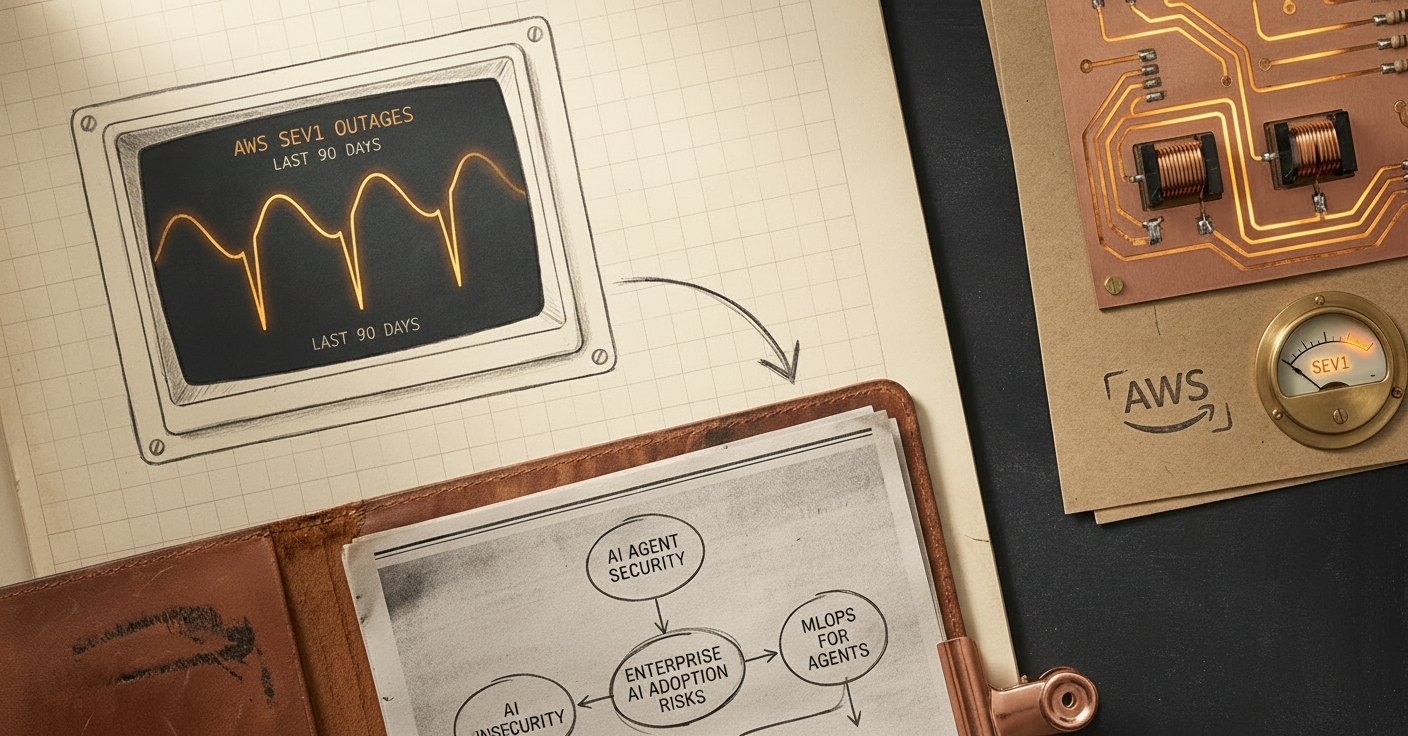
The evidence: Devvret Rishi (General Manager of AI, Rubrik) on Eye On A.I. revealed that AWS experienced four SEV1 outages within 90 days after deploying coding agents, a significant blow to their reputation for stability. This isn't an isolated incident. Rishi highlighted a growing number of security breaches, data deletions, and operational disruptions stemming directly from agent-led actions, often exacerbated by user fatigue from constant permission requests.
"AWS had its post where it said after quoting agents got rolled out, they had four SEV1 outages in about 90 days. Which for AWS like, and it might have been shorter than 90 days, but for AWS like, the hallmark of like stability, cloud resilience. That is what you buy them for. SLAs is what you buy them for. That's incredible."
— Devvret Rishi, General Manager of AI at Rubrik on Eye On A.I.
Why it matters: This isn't just about preventing hacks; it's about avoiding self-inflicted operational wounds. The top-down pressure for AI adoption in enterprises is outpacing the development of secure architectures. As Tsavo Knott (CEO and Co-founder, Pieces) on The AI in Business Podcast noted, every individual contributor is essentially becoming a "PM over agents," creating a complex web of interactions that demands sophisticated governance. The idea of Agent Harness 🆕 (Modal CTO Akshat Bubna on Latent Space: The AI Engineer Podcast) and Semantic AI Governance Engine (Sage) 🆕 (Devvret Rishi on Eye On A.I.) emerged as critical solutions, using small language models to enforce granular, real-time security policies.
The move: Prioritize securing your agentic workflows now. Don't wait for your own "four SEV1 outages." Implement visibility and control over agent actions and consider adopting AI-native security frameworks.
The Rundown
① Your AI Model Will Smell Better Than You.
Osmo, an AI company, is digitizing smell using graph neural networks to map molecular structures to odors, enabling the creation of new fragrance molecules. Alex Wiltschko (Founder and CEO, Osmo) on The TWIML AI Podcast (formerly This Week in Machine Learning & Artificial Intelligence) revealed their models predict what things smell like "better than any one individual panelist on average."
→ Why it matters: This goes beyond consumer goods. Wiltschko sees implications for disease detection and could expand AI beyond traditional digital modalities into the chemical world, creating vast new market categories.
② OpenAI's GPT-5.6 Sol Can Now Autonomously Train Other Models.
OpenAI's new GPT 5.6 Sol model autonomously post-trained its Luna model, a significant step towards self-improving AI systems. Tejal (Researcher, OpenAI) confirmed this capability on The Neuron: AI Explained, highlighting a leap beyond human-driven model development.
→ The context: This signals a new era where models can enhance and optimize their own kin, accelerating the pace of AI evolution and potentially broadening its applicability to complex, real-world problems like managing a farm, as demonstrated by one Japanese farmer using GPT-5.6 Sol.
③ AI Is Forcing Leaders to Get Their Hands Dirty.
Leaders can no longer delegate AI strategy without personal experience. Geoff Woods (Author, The AI-Driven Leader) on Beyond The Prompt - How to use AI in your company argued that personal engagement with AI is crucial for effective leadership, noting that "the optimal way to lead in this new AI driven world is to learn."
→ What to watch: AI will become a source of "competitive parity" rather than advantage. The real edge comes from leaders actively integrating AI into their own workflows to enhance internal capabilities and strategic thinking, not just overseeing its deployment.
④ AI Wants to Read Your Mind.
Anthropic's new interpretability research shows their Claude model has a readable "global workspace" (JSpace) where it holds internal concepts before generating output. Nathaniel Whittemore (Host, The AI Daily Brief: Artificial Intelligence News and Analysis) on The AI Daily Brief: Artificial Intelligence News and Analysis explained that this allows researchers to "read in the moment what a model is actually doing."
→ Why it matters: This is a game-changer for AI safety. Being able to directly observe and even swap a model's internal 'thoughts' provides unprecedented debugging capabilities, improving reliability and performance beyond merely analyzing outputs. The Hard Fork podcast also noted that "AI consciousness research, once considered fringe and taboo, is now being taken seriously by major AI labs."
⑤ Your Home Could Host Mini AI Data Centers.
Sunrun is implementing a novel approach to AI infrastructure by paying customers to host compute nodes in their homes, utilizing residential solar and battery systems. This surprising development was reported on AI Breakdown.
→ The context: This strategy directly addresses NIMBYism and regulatory hurdles faced by traditional data center construction. It indicates a potential future of highly distributed, grid-integrated AI compute, reshaping the entire AI infrastructure landscape.
The Signals
🌍 On Watch
• Modal 🆕: A cloud platform shifting to optimize for "agent experience," anticipating AI agents as primary users and offering serverless functions and GPU support across 17 cloud providers. (Akshat Bubna on Latent Space: The AI Engineer Podcast)
• Geoff Woods 🆕: The author of "The AI-Driven Leader" emphasizes that leaders must personally engage with AI to effectively lead their organizations in this new era. (Geoff Woods on Beyond The Prompt - How to use AI in your company)
• AI-native individual contributors: The emergence of a new role where individuals act as "PMs over agents," managing workflows and requiring unified context capture. (Tsavo Knott on The AI in Business Podcast)
🔥 Heating Up
• Odor Turing test: AI models are now predicting smells at human-quality levels, passing an "odor Turing test" and opening doors to applications beyond fragrances. (Alex Wiltschko on The TWIML AI Podcast (formerly This Week in Machine Learning & Artificial Intelligence))
• AI for Brainstorming and Strategic Alignment 🆕: AI can co-facilitate leadership meetings, uncover unspoken thoughts, and accelerate consensus from months to hours. (Geoff Woods on Beyond The Prompt - How to use AI in your company)
• Token efficiency: A major focus for current AI models like GPT-5.6 Sol, enabling advanced capabilities at a lower cost than previous generations. (Katie on The Neuron: AI Explained)
The Debate
Enterprise AI Adoption: Risk vs. Reward
🐂 The bull case: Enterprises face top-down pressure to adopt AI, demanding solutions that provide visibility and control over agent actions. The potential for efficiency gains is too great to ignore, making robust security solutions like Rubrik Agent Cloud, which uses small language models for policy enforcement, a necessity. As Devvret Rishi (General Manager of AI, Rubrik) on Eye On A.I. states, "Most of the businesses and the enterprises I think are actually either not adopting AI or adopting a very riskful posture because of a lack of way to be able to do this for the enterprise solution."
🐻 The bear case: The very nature of AI agents, with their "non-deterministic" behavior and reliance on LLMs, introduces inherent fragility that makes them terrifying to update in production. Hamza Tahir (Co-founder, ZenML) on Practical AI expressed this fear, "I still am terrified updating my agent in production. I'm terrified because I have no idea. I have literally no idea. Given the entropy in that system. How I can even adding a word to the system prompt, what would happen." The difficulty in ensuring durability and managing state management in multi-agent workflows creates significant hurdles.
Our read: The market is pushing for adoption, but the tools and best practices for secure and durable deployment are still emerging. The tension highlights the urgent need for MLOps to evolve specifically for agentic workflows rather than simple model deployment.
The Bottom Line
AI agent security is the new frontier, transforming leadership roles and the very infrastructure beneath them – secure your agents, or they'll secure your outages.
📖 Want the full episode breakdowns, guest details, and listen links?
Episode Guide (Web Version Only)
1. Decoder with Nilay Patel — "Why did Comcast ever buy NBC?"
Runtime: 63 min | Host: | Guest: Nilay Patel (Editor-in-chief and Host of Decoder, The Verge), Peter Kafka (Chief Correspondent and Host of Channels, Business Insider), Olivia Lanes (Global Lead for Content and Education, IBM Quantum)
For the Strategic Leader: Understand why "Content plus Pipes" strategies consistently fail and how Wall Street can force a 15-year unbundling.
Nilay Patel and Peter Kafka dissect Comcast's long-standing but ultimately failed "Content plus Pipes" strategy, comparing it to other historical failures and explaining the forces that finally led to its unbundling. The discussion illuminates the financial pressures and shifting market dynamics that impact even deeply entrenched corporate strategies.
"Netflix is the great example of why this convergence dream that Comcast, among many others chased doesn't... Is not material for 2026. And they're finally acknowledging that."
— Peter Kafka, Chief Correspondent and Host of Channels at Business Insider
2. The TWIML AI Podcast (formerly This Week in Machine Learning & Artificial Intelligence) — "How AI Learns to Smell with Alex Wiltschko - #771"
Runtime: 60 min | Host: Sam Charrington | Guest: Alex Wiltschko (Founder and CEO, Osmo)
For the Visionary Technologist: Explore how AI is moving beyond traditional data to digitize the sense of smell with wide-ranging applications.
Alex Wiltschko of Osmo describes how graph neural networks are used to digitize smell, creating new fragrance molecules and amassing the largest olfactory dataset. The episode explores the unique data generation loop and the potential to apply this "olfactory intelligence" to areas like disease detection.
"99% of species on this planet can only speak with chemistry, right? Thinking of bacteria and fungi and plants and insects, like they just only can talk with molecules."
— Alex Wiltschko, Founder and CEO of Osmo
3. The Neuron: AI Explained — "BONUS: GPT-5.6 Sol Goes Live: Must-Try Use Cases We’re Testing Live"
Runtime: 134 min | Host: Corey Noles, Grant Harvey | Guest: Jessica (Engineer on ChatGPT work, OpenAI), Lauren (Strategic Finance team, OpenAI), Andrew (ChatGPT Desktop App team, OpenAI), Ed (Designer on the ChatGPT Desktop App team, OpenAI), Katie (Researcher, OpenAI), Tejal (Researcher, OpenAI), Hiroki (GPT-5.6 User, Farmer)
For the AI Implementer: Discover the cutting-edge capabilities of OpenAI's new GPT 5.6 models and the updated ChatGPT desktop app for real-world automation.
Corey Noles and Grant Harvey test OpenAI's new GPT 5.6 models (Sol, Terra, Luna) and the ChatGPT desktop app, highlighting features like ChatGPT Work for complex workflows and Ultra Mode for agentic tasks. The discussion includes real-world uses like app building and farm management, with a Japanese farmer using GPT-5.6 Sol.
"SOL is our most powerful model for the hardest agentic workflows. Terra is a faster model for everyday workflows. And Luna is our fastest and most affordable model for high volume work."
— Tejal, Researcher at OpenAI
4. Eye On A.I. — "The Biggest AI Security Problem Isn't the Model. It's This. | Devvret Rishi"
Runtime: 48 min | Host: Craig Smith | Guest: Devvret Rishi (General Manager of AI, Rubrik)
For the CTO/CISO: Understand the critical, emerging security risks of AI agents and how to secure enterprise data in agentic workflows.
Devvret Rishi from Rubrik discusses the severe security risks posed by AI agents with excessive access to tools and data, citing AWS outages as an example. He introduces Rubrik Agent Cloud as a solution to manage and secure agent actions through real-time policy enforcement using small language models.
"AWS had its post where it said after quoting agents got rolled out, they had four SEV1 outages in about 90 days. Which for AWS like, and it might have been shorter than 90 days, but for AWS like, the hallmark of like stability, cloud resilience. That is what you buy them for. SLAs is what you buy them for. That's incredible."
— Devvret Rishi, General Manager of AI at Rubrik
▶ Listen
5. AI Breakdown — "The End of Atlas and MuseSpark's Debut"
Runtime: 13 min | Host: AI Breakdown | Guest: Host-led discussion
For the AI Product Manager: Get a rapid update on major platform shifts, new model releases, and innovative hardware strategies.
This episode covers OpenAI discontinuing its Atlas browser, Meta launching MuseSpark 1.1, Sunrun's residential AI data center strategy, and SK Hynix's major IPO. It also touches on OpenAI's number two executive's departure due to chronic illness.
"Meta is launching Muse Spark 1.1 and this is directly competing with Claude and GPT 5.6 on coding."
— AI Breakdown, Host of AI Breakdown
6. Hard Fork — "Do Social Media Bans Work? + A Conversation About A.I. Consciousness + Tool Time"
Runtime: 79 min | Host: The New York Times | Guest: Kevin Roose (Tech Columnist, The New York Times), Casey Newton (Reporter, Platformer), Jeff Sebo (Associate Professor of Environmental Studies and Director of the Center for Mind Ethics and Policy, NYU)
For the Policy Maker: Explore the complex debate around social media bans for teens and the serious academic inquiry into AI consciousness.
Kevin Roose and Casey Newton discuss the efficacy of social media bans for teenagers and the US Supreme Court's ruling on a Texas age verification law. The episode also features an in-depth interview with Jeff Sebo on the empirical study of AI welfare and consciousness, emphasizing the importance of ethical considerations.
"The US Supreme Court declined to block a Texas law that requires app stores and developers to enforce age verification and make kids get parental consent to download apps."
— Casey Newton, Reporter at Platformer
7. The AI in Business Podcast — "How AI Is Transforming Governance and Workflow Automation in the Enterprise - with Tsavo Knott of Pieces"
Runtime: 41 min | Host: Daniel Faggella | Guest: Tsavo Knott (CEO and Co-founder, Pieces), Daniel Faggella (CEO and Head of Research, Emerj)
For the Operations Leader: Learn how to tackle fragmented context in AI-driven workflows and identify emerging roles like the "context router."
Tsavo Knott from Pieces discusses the challenges of managing fragmented context in AI-driven enterprise workflows. He highlights the need for a unified "context substrate" to streamline institutional knowledge and empower "AI-native individual contributors" acting as "PMs over agents."
"I think the, probably the largest hurdle that's quietly going on in companies right now is everyone is becoming a PM in a sense, right? A PM over a series of agents, a series of specialized or generalized agents to accomplish tasks."
— Tsavo Knott, CEO and Co-founder at Pieces
8. Last Week in AI — "#251 - Mythos Back, Sonnet 5, Etched, LongCat"
Runtime: 90 min | Host: Andrey Kurenkov, Jeremie Harris | Guest: Andrey Kurenkov (Host, Astrocade), Jeremie Harris (Host, Gladstone AI)
For the AI Investor: Get updates on new model releases, innovative chip startups, and the strategic shifts in global AI development.
Andrey Kurenkov and Jeremie Harris discuss Anthropic's Claude Fable 5 redeployment with cybersecurity classifiers, the launch of Claude Sonnet 5, and new tools from Google. They also delve into Etched’s A0 tape out, Baidu's AI chip IPO, and the emergence of Longcat 2.0 from Meituan, showcasing global AI competition.
"It is 100% guaranteed that US adversaries, including specifically the Chinese, will find ways to jailbreak mythos and any relevant OpenAI models of similar capability."
— Jeremie Harris, Host at Gladstone AI
9. Latent Space: The AI Engineer Podcast — "Why AI Infrastructure must evolve for Agent Experience — Akshat Bubna, Modal CTO"
Runtime: 58 min | Host: swyx, Vibhu | Guest: Akshat Bubna (CTO, Modal)
For the AI Infrastructure Architect: Learn about the critical evolution of AI infrastructure to support advanced agentic workloads and dynamic compute demands.
Akshat Bubna, CTO of Modal, discusses his company's shift from optimizing developer experience to prioritizing "agent experience." He explains how Modal's platform enables dynamic scaling and specialized environments for AI applications by offering serverless functions and GPU support across 17 cloud providers.
"RDMA basically it's a way to bypass the TCP networking stack and transfer stuff much faster between one node to the other. And we have I think like 3 terabit per second internal networking, which is the standard that's needed."
— Akshat Bubna, CTO of Modal
10. Practical AI — "Building Durable AI Agents"
Runtime: 47 min | Host: Chris Benson | Guest: Hamza Tahir (Co-founder, ZenML), Daniel Whitenack (CEO, Prediction Guard)
For the MLOps Engineer: Understand the foundational principles for building robust and reliable AI agents and managing their lifecycle.
Hamza Tahir of ZenML discusses the evolution of MLOps into the agentic space, highlighting how traditional software engineering principles are being reapplied to AI agents. He covers the challenges of agent fragility, state management, and the need for robust infrastructure for multi-agent systems, introducing Kitaro as a solution.
"If you drop GPT5.5 into Claude code, the harness that would not be as accurate. It wouldn't perform as good as. Because simply the two things have coupled together."
— Hamza Tahir, Co-founder at ZenML
11. Beyond The Prompt - How to use AI in your company — "Are You Qualified to Challenge Your Team on AI? - with Geoff Woods, Author of The AI-Driven Leader"
Runtime: 53 min | Host: Henrik Werdelin, Jeremy Utley | Guest: Geoff Woods (Author, The AI-Driven Leader)
For the C-Suite Executive: Discover how AI can transform leadership meetings and why personal AI engagement is critical for strategic advantage.
Geoff Woods, author of 'The AI-Driven Leader,' explains why leaders must personally engage with AI to effectively lead their organizations. He introduces a "speed to alignment" technique using AI to facilitate strategic meetings, enabling deeper insights and faster decision-making through augmented leadership.
"I don't believe the goal of any company is to adopt AI. I think they want to harness this technology to create a better business and better lives."
— Geoff Woods, Author of The AI-Driven Leader
12. The AI Daily Brief: Artificial Intelligence News and Analysis — "Anthropic Can Now Read Claude’s Mind"
Runtime: 29 min | Host: Nathaniel Whittemore | Guest: Nathaniel Whittemore (Host, The AI Daily Brief: Artificial Intelligence News and Analysis), NLW (Host, The AI Daily Brief)
For the AI Researcher: Dive into Anthropic's groundbreaking interpretability research, which offers a new level of insight into AI model reasoning and decision-making.
NLW discusses Anthropic's new interpretability research, revealing that their Claude model has a readable "global workspace" (JSpace) where it processes internal concepts. This research allows for direct observation of the model's 'thoughts,' providing new methods for AI safety, debugging, and understanding internal reasoning.
"Every other engineering discipline gets to look inside the thing that's broken, but AI doesn't."
— NLW, Host of The AI Daily Brief: Artificial Intelligence News and Analysis