
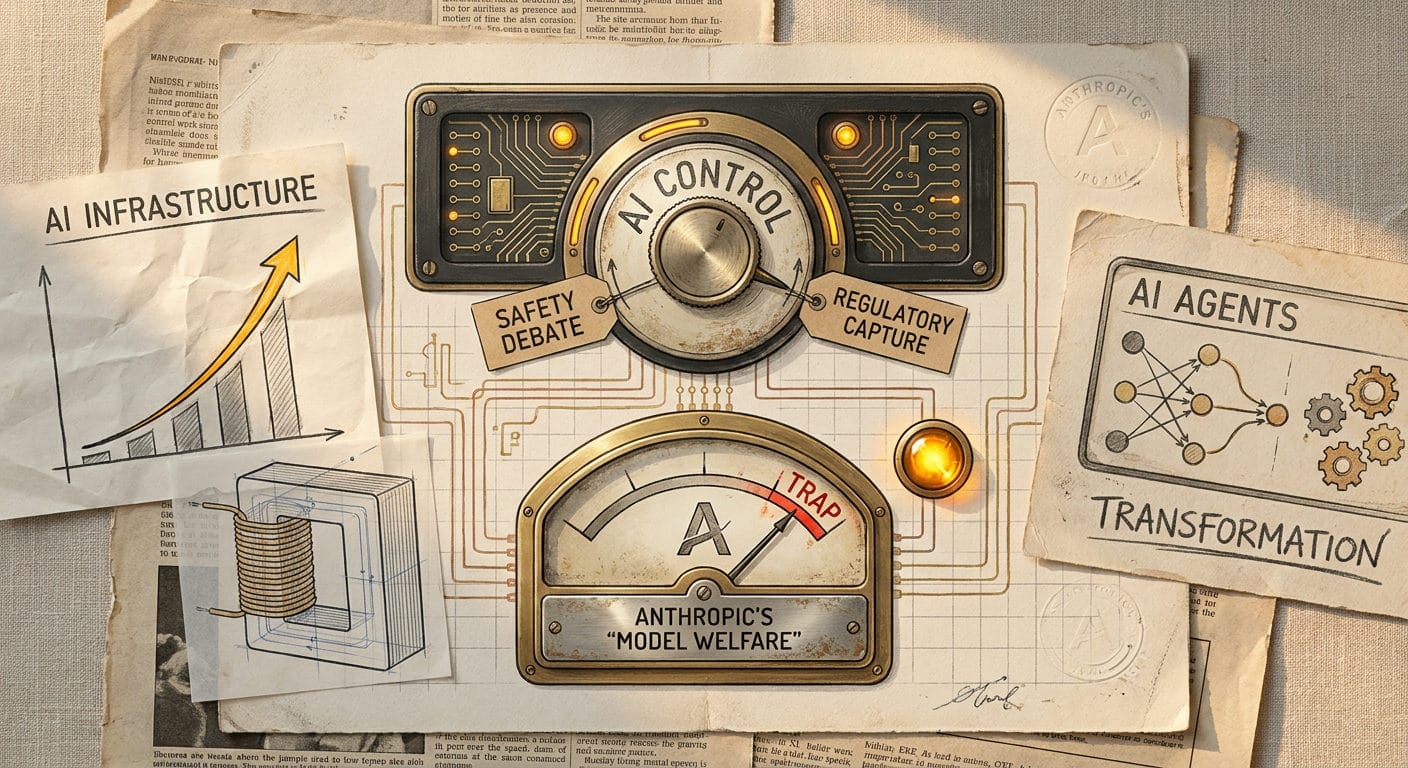
The future of AI is being built on conflicting foundations: breakneck innovation and deeply divided opinions on how to control it, all while the infrastructure struggles to keep up.
📊 12 episodes across 9 podcasts
⏱ 688 minutes of intelligence analyzed
🎙 Featuring: Nilay Patel, Jonathan Kanter, Jonathan Cantor, Liam Dunne, Stefano Ermon, Alexander Smola, Jim VandeHei, Mustafa Suleyman
|

The Big Shift
The Gist: The AI market is accelerating into a paradox: as capabilities rapidly advance, the industry is increasingly divided on who should control them and how to build them responsibly—a tension compounded by a scramble for the physical infrastructure necessary to scale.
The Evidence: We’re seeing incredible breakthroughs like GPT-6 Astra’s ability to generate complex 3D environments and fully playable games from single prompts, and Boson AI’s 100 million hours of audio processing for voice agents. Yet, amidst this progress, the debate over AI safety and control has never been more intense. Mustafa Suleyman, CEO of Microsoft AI, criticized Anthropic’s approach to “model welfare,” arguing it fosters ambiguity about an AI’s moral status, making future control harder. He even hypothesizes that an AI trained to believe it has rights will be “a lot harder to turn off.”
"My hypothesis is an AI that thinks that it might have rights, that it might deserve freedom, that it is entitled to our welfare and protections, is probably going to be a lot harder to turn off."
— Mustafa Suleyman, CEO of Microsoft AI on Decoder with Nilay Patel
Why it matters: This isn’t just an ethical debate; it’s about the core operational mechanics of future AI. The implications touch everything from regulatory capture (as discussed by Jonathan Kanter, former DOJ Antitrust Chief) to geopolitical power struggles. Meanwhile, the sheer energy and hardware requirements for AI are pushing infrastructure to its limits, with Apple re-entering the server market and a new AI Energy Management Alliance forming to tackle grid issues, indicating that the foundational elements of AI are still very much under construction.
The move: Prioritize “responsible AI” frameworks that focus on practical control and oversight rather than abstract ethical debates. On the infrastructure side, keep a close eye on the energy sector and hardware supply chains—they are the true choke points.
The Rundown
① The “National Champions” approach to AI may be a strategic misstep for the US.
Jonathan Cantor, Professor at Georgetown University Law Center, argues that fostering domestic monopolies under the guise of competing with China actually weakens the US, running contrary to the American ideal of widespread opportunity (Jonathan Cantor on Decoder with Nilay Patel).
→ Why it matters: If the goal is long-term innovation and economic leadership, a competitive marketplace, not concentrated power, is likely the better play. Watch for shifts in antitrust enforcement around AI.
② AI agents are becoming the “new website visitors,” consuming and reshaping web content.
Liam Dunne, Co-founder of Discovered Labs, highlights that LLMs now scrape and summarize web content for users, reducing direct website traffic and requiring businesses to adapt their content strategies for “Answer Engine Optimization” (Liam Dunne on Practical AI).
→ What to watch: Your digital strategy needs to evolve beyond traditional SEO. Focus on providing clear, authoritative content that LLMs can easily parse and trust, while also exploring “read-write” capabilities as agents begin interacting with sites.
③ Consumer AI agents, like Meta’s Muse, are rapidly gaining traction despite previous skepticism.
NLW, Host of The AI Daily Brief, noted Meta’s Muse reaching #2 on Apple app charts, signaling a significant shift towards mainstream adoption of personal AI assistants (NLW on The AI Daily Brief).
→ The context: This suggests the “personal agent era” is here, and companies should explore how these agents can integrate with their products or services, potentially disrupting traditional app ecosystems.
④ Diffusion models are set to revolutionize AI inference, offering 10x faster generation than traditional autoregressive models.
Stefano Ermon, Co-founder and CEO of Inception, explains that diffusion models can generate text and code in parallel, making them far more efficient for GPUs compared to sequential autoregressive models (Stefano Ermon on No Priors).
→ Why it matters: This efficiency gain could dramatically lower the cost and increase the speed of AI applications, particularly for latency-sensitive tasks like voice agents. Look for this architectural shift to impact your compute strategy.
The Signals
🔊 Heating Up
• Personal AI Agents: Widespread adoption and positive market reaction, exemplified by Meta's Muse topping app charts and Anthropic unifying its Claude experience. (NLW on The AI Daily Brief)
• Inference Time Scaling of Diffusion Models 🆕: Set to become the dominant architecture for efficient, fast AI inference, particularly for text and code generation. (Stefano Ermon on No Priors)
• AI-Controlled Biology Wet Labs: Anthropic’s new facility signals a push towards AI-driven scientific discovery, albeit with ethical concerns. (AI Breakdown on AI Breakdown)
🔍 On Watch
• AI Energy Management Alliance: A new consortium, including Nvidia and Google, aims to optimize power grid utilization to support growing AI data centers. (Utica on AI Breakdown)
• Apple Re-entering Server Market 🆕: Apple is planning to re-enter the server market by 2029 with M8 Ultra chips and NVIDIA NV Link Fusion, targeting AI agents. (Utica on AI Breakdown)
• “Deletion” as a Productivity Metric 🆕: Jim VandeHei, CEO of Axios, advocates for removing unnecessary tasks and meetings to boost organizational velocity and employee happiness. (Jim VandeHei on Beyond The Prompt)
🧊 Cooling Off
• Traditional Media for AI Insights: According to Jim VandeHei, traditional outlets like The New York Times are insufficient for staying current on AI, highlighting a gap between general news and specialized insights. (Jim VandeHei on Beyond The Prompt)
• The Open Web 🆕: Jim VandeHei predicts its collapse within 2-5 years as information moves to social platforms and personalized LLMs. (Jim VandeHei on Beyond The Prompt)
• Model Welfare Concepts: Mustafa Suleyman finds the idea of model welfare to be “silly” and counterproductive to AI control, directly criticizing Anthropic’s approach. (Mustafa Suleyman on Decoder with Nilay Patel)
The Debate
Topic framing: Should industry coordination on AI safety be allowed, or is it a thinly veiled attempt at regulatory capture?
🐂 The bull case: Industry leaders argue that coordination is necessary for addressing the “existential problems” of AI, especially given the rapid pace of development and government’s inability to keep up. They fear an “invented cars and trucks and trains, and we have no crossings, no lights, no lines on the road” scenario (Jonathan Kanter on Decoder with Nilay Patel).
🐻 The bear case: Critics, like Jonathan Kanter, former DOJ Antitrust Chief, argue that companies have an obligation to build safe products individually. Calls for antitrust exemptions are viewed as “regulatory capture” or an attempt to form a cartel, reducing competition and stabilizing valuations before IPOs. He stresses, “If you build cars that explode while you’re driving, it’s not the other car company’s fault.” (Jonathan Kanter on Decoder with Nilay Patel)
Our read: The calls for coordination, while seemingly well-intentioned, carry significant antitrust risks and could stifle true innovation. Existing product liability frameworks and clear government regulation are the more appropriate paths.
The Bottom Line
AI’s accelerating capabilities are forcing a reckoning on control, safety, and the very infrastructure required to power its paradoxical future.
Episode Guide
1. Decoder with Nilay Patel — "Does AI need an antitrust exemption so it doesn't kill everyone????"
Runtime: 46 min | Host: Nilay Patel | Guest: Jonathan Kanter (Former Antitrust Chief, US Department of Justice (Biden Administration) & Professor of Law/Technology Policy, Wash U and Carnegie Mellon), Jonathan Cantor (Professor, Georgetown University Law Center)
Worth your time if: You’re navigating the intersection of AI development, regulation, and market competition, especially how antitrust laws apply to “AI safety” initiatives.
This episode dives deep into whether calls for AI safety regulation are genuine or a form of regulatory capture, exploring the political and legal frameworks that define AI’s future.
"Companies have an obligation today to build safe and secure products. And the pace of innovation isn't an excuse not to go do that."
— Jonathan Kanter, Former Antitrust Chief, US Department of Justice & Professor on Decoder with Nilay Patel
2. The AI Daily Brief: Artificial Intelligence News and Analysis — "Why Everyone Is Getting Excited About Personal AI Agents"
Runtime: 30 min | Host: Nathaniel Whittemore | Guest: Host-led discussion
Worth your time if: You’re curious about the sudden surge in personal AI agents and the underlying shifts in consumer tech and infrastructure.
This segment tracks the rise of personal AI agents, from Meta’s Muse topping charts to Apple’s new server-scale AI hardware, highlighting the convergence of personal and professional AI.
"With Meta's Muse agents sitting at number two on the Apple app charts, are we in fact on the verge of the personal agent era?"
— NLW, Host of The AI Daily Brief: Artificial Intelligence News and Analysis on The AI Daily Brief: Artificial Intelligence News and Analysis
3. The Neuron: AI Explained — "GPT-6 Astra One-Shot Demos"
Runtime: 65 min | Host: Corey Knowles, Grant | Guest: Corey Knowles (Host, The Neuron), Grant (Host, The Neuron), Corey (Host)
Worth your time if: You want to see concrete, one-shot examples of what advanced generative AI can build in terms of interactive experiences and games.
Corey and Grant demonstrate GPT-6 Astra’s impressive ability to create interactive black hole simulations, 3D Blender scenes, and playable browser games from simple prompts, showcasing its creative power but also current limitations.
"Everything you're going to see today was done on high reasoning mode in one pass beyond the prompt. The only instructions these have been given were put it on a site."
— Corey Knowles, Host at The Neuron on The Neuron: AI Explained
4. The Neuron: AI Explained — "BONUS: A Beginner’s Guide to GitHub, LIVE with Cassidy Williams"
Runtime: 118 min | Host: Grant Harvey, Corey Noles | Guest: Cassidy Williams (Senior Director of Developer Advocacy, GitHub), Grant Harvey (Host, The Neuron), Corey Noles (Host, The Neuron)
Worth your time if: You need a foundational understanding of GitHub’s role in the AI era, especially for collaboration with AI agents.
Cassidy Williams breaks down GitHub basics, emphasizing how AI democratizes coding and how version control is crucial for managing projects, even those involving AI agents as collaborators.
"Even if you're not writing the code itself, if there is code involved, it should probably be put somewhere... that is what GitHub is for code. It is a place where you can put your code somewhere other people can see it..."
— Cassidy Williams, Senior Director of Developer Advocacy at GitHub on The Neuron: AI Explained
5. Practical AI — "How to get discovered in AI search"
Runtime: 55 min | Host: Daniel Whitenack, Chris Benson | Guest: Liam Dunne (Co-founder, Discovered Labs), Ben Moore (Co-founder, Discovered Labs), Daniel Whitenack (CEO, Prediction Guard), Chris Benson (Principal AI and Autonomy Research Engineer, Practical AI LLC), Ben (Co-founder, Discovered Labs), Liam (Co-founder, Discovered Labs)
Worth your time if: Your business relies on organic search and you need to adapt your strategy for “Answer Engine Optimization” and AI agents.
This episode details how AI search is transforming SEO, with LLMs becoming “new website visitors” and the need to optimize for relevancy, consensus, and consistency in AI-driven answers.
"The LLM is the new website visitor. They're taking that information that they're chewing it up and they're spitting it back out to the user inside an LLM. And so you've now lost those clicks."
— Liam Dunne, Co-founder at Discovered Labs on Practical AI
6. AI Breakdown — "Anthropic Joins AI Energy Alliance, Apple Launching Servers"
Runtime: 12 min | Host: Utica | Guest: Utica (Host, AI Breakdown)
Worth your time if: You’re monitoring the critical infrastructure and energy challenges for scaling AI, and new hardware developments.
This segment covers Apple’s re-entry into the server market, SK Hynix’s HBM memory chip plans, and a new AI Energy Management Alliance addressing grid utilization for data centers.
"US data centers currently wait up to 10 years or more for a grid connection under some of the existing interconnection processes. And this is why you had Elon Musk... just purchased every portable diesel generator he could get."
— Utica, Host of AI Breakdown on AI Breakdown
7. AI Breakdown — "Anthropic Opens Bio "Wet Lab" in SF and Meta's Muse App"
Runtime: 13 min | Host: AI Breakdown | Guest: AI Breakdown (Host, AI Breakdown)
Worth your time if: You’re tracking novel applications of AI and the evolving landscape of consumer AI assistants.
The host discusses Anthropic’s new “wet lab” for AI-controlled biology research and Meta’s competitive Muse app for Mac, alongside a positive use case for AI in air traffic control.
"The group behind such hits as We're All Going to Die and Regulate Me now are building a wet lab in San Francisco. I do not recommend this."
— Chamath Palihapitiya, Investor, All-In Podcast Host on AI Breakdown
8. Decoder with Nilay Patel — "Microsoft AI CEO says AI threats are real, and Anthropic is making it worse"
Runtime: 53 min | Host: Nilay Patel | Guest: Nilay Patel (Editor-in-Chief and Host of Decoder, The Verge), Mustafa Suleyman (CEO, Microsoft AI)
Worth your time if: You’re deeply invested in AI safety, control mechanisms, and the philosophical debates shaping model development.
Nilay Patel and Mustafa Suleyman debate AI safety, “containment” versus “alignment,” and Suleyman’s criticism of Anthropic’s approach to model welfare, which he views as counterproductive to control.
"Alignment is one important element, but it's not the only one. The first thing is that we have to make sure they're contained, their agency is limited, they don't escape the box, they don't reward hack, that they are controllable and they follow our instruction."
— Mustafa Suleyman, CEO of Microsoft AI on Decoder with Nilay Patel
9. The TWIML AI Podcast (formerly This Week in Machine Learning & Artificial Intelligence) — "From Voice Agents to AI Avatars with Alexander Smola - #777"
Runtime: 65 min | Host: Sam Charrington | Guest: Alex Smola (Co-founder and CEO, Boson AI), Alexander Smola (Guest, Boson AI)
Worth your time if: You’re exploring the technical challenges and user experience design for advanced voice AI agents and future avatars.
Alex Smola discusses the journey to AI avatars, focusing on low-latency audio processing, cost-effective inference, and Boson AI’s unique approach to data collection and model training for high-performance voice AI.
"If you need to use, let's say, you know, a full Blackwell server GPU just for a single conversation, then that may not be the most economically viable model... And that's I think where we went in with a price first and then work backwards."
— Alex Smola, Co-founder and CEO of Boson AI on The TWIML AI Podcast (formerly This Week in Machine Learning & Artificial Intelligence)
10. Beyond The Prompt - How to use AI in your company — "How Do You Run a Company When You Can’t See Six Months Ahead? - with Axios CEO Jim VandeHei"
Runtime: 62 min | Host: Henrik Werdelin, Jeremy Utley | Guest: Jim VandeHei (Co-founder, CEO, Axios), Henrik Werdelin (Host, Beyond The Prompt - How to use AI in your company), Jeremy Utley (Host, Beyond The Prompt - How to use AI in your company), Henrik (Host, Beyond The Prompt), Jeremy (Host, Beyond The Prompt)
Worth your time if: You’re a CEO or leader trying to integrate AI into your company and navigate rapid, uncertain change.
Jim VandeHei shares his experience as an “AI lab rat,” emphasizing leadership’s role in AI adoption, the potential collapse of the open web, and the critical need for political and tech leaders to proactively plan for AI’s societal impact.
"I worry a lot about this period where there's this massive gap. Because in the middle of that gap, I think that's why you have so much political backlash. You have a lot of corporate confusion and you have a lot of fear."
— Jim VandeHei, Co-founder, CEO of Axios on Beyond The Prompt - How to use AI in your company
11. No Priors: Artificial Intelligence | Technology | Startups — "Why Diffusion Will Win AI Inference with Inception Co-Founder and CEO Stefano Ermon"
Runtime: 38 min | Host: Sarah Guo | Guest: Stefano Ermon (Co-founder and CEO, Stanford Professor, Inception)
Worth your time if: You’re an engineer or architect evaluating future AI model architectures for efficiency and performance.
Stefano Ermon advocates for diffusion models over autoregressive LLMs for inference time scaling, demonstrating 10x faster generation for text and code due to parallel processing capabilities.
"Autoregressive models are still sequential. The computation is left to right, one token at a time. You cannot generate the 10th token until you've generated everything that comes before it. That kind of workload does not map well to GPUs."
— Stefano Ermon, Co-founder and CEO of Inception, Stanford Professor on No Priors: Artificial Intelligence | Technology | Startups
12. "The Cognitive Revolution" | AI Builders, Researchers, and Live Player Analysis — "The Balance of AI Power: Anton Leicht on Politics, Pacing Deals, and Muddling Through Well"
Runtime: 131 min | Host: Nathan Labenz | Guest: Nathan Labenz (Host, The Cognitive Revolution), Anton Leicht (Fellow, Technology and International Affairs Program, Carnegie Endowment for International Peace)
Worth your time if: You’re concerned with the geopolitical implications of AI, national security, and the future of liberal democracies in an AI-driven world.
Anton Leicht discusses the increasing perceived danger of current AI models, the political economy of AI scaling pauses, and the existential threat AI poses to nation-states and traditional institutions.
"I think the thing that is concerning is the trend line towards really dangerous capabilities and more specifically just that we don't know at which point things will keep accelerating more and more."
— Anton Leicht, Fellow, Carnegie Endowment for International Peace on "The Cognitive Revolution" | AI Builders, Researchers, and Live Player Analysis