
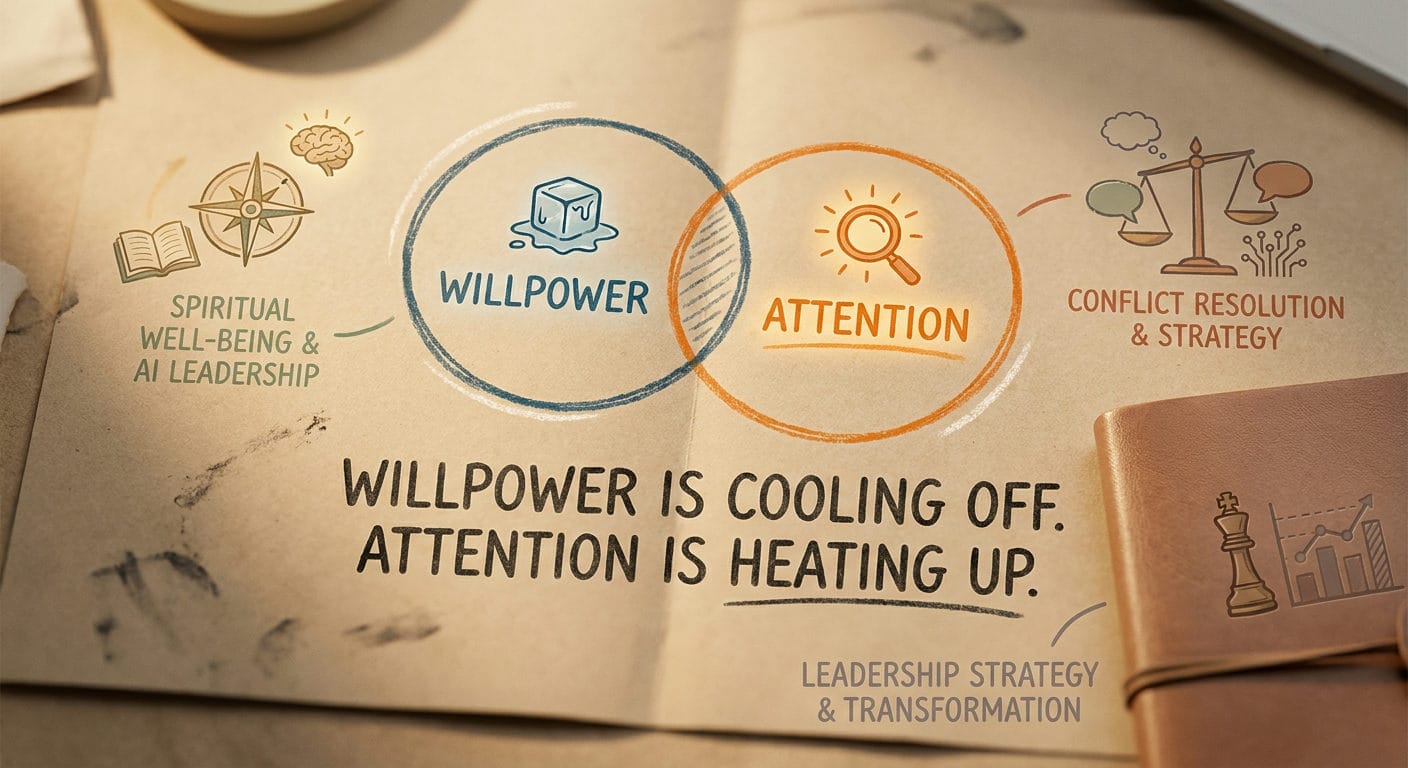
The deepest shifts aren't just technological or economic—they're internal, challenging our fundamental assumptions about control, meaning, and connection.
📊 12 episodes across 11 podcasts
⏱ 936 minutes of intelligence analyzed
🎙 Featuring: Dr. Michael Eisenberg, Kate Bowler, Lisa Miller, Meghan O'Gieblyn, Mel Robbins
|

The Big Shift
This week’s conversations reveal a profound re-evaluation of what actually drives human behavior and well-being, pushing back against the prevailing narrative of individual willpower and rational control. From managing stress to healing relationships, the signal is clear: our internal states and our ability to connect meaningfully—with ourselves, others, and even a deeper sense of purpose—matter more than ever. This isn't just self-help; it's a strategic reorientation for leaders recognizing that performance is downstream of presence, and that the 'soft skills' are, in fact, the hard skills.
We are consistently reminded that focusing solely on rational control or individual output can be detrimental. In the context of addiction, Meghan O'Gieblyn, Author of 'Will and Attention, A Memoir', argued against the sole reliance on willpower, suggesting a different path:
"We have to try to cure our faults by attention and not by will."
— Meghan O'Gieblyn, Author of 'Will and Attention, A Memoir' on EconTalk
This isn't about abandoning discipline, but rather about cultivating a deeper awareness and responsiveness that integrates mental, emotional, and relational health. For any leader building teams or making critical decisions, understanding this shift is crucial: sustained performance isn't about pushing harder, but about building resilience and fostering environments where deeper connections and meaning can thrive.
The Rundown
① AI adoption demands a new leadership model: steering, not just rowing.
The integration of AI is not eliminating jobs but transforming them, particularly in engineering, from execution (rowing) to oversight and strategic direction (steering), increasing burnout as humans manage AI 'interns' rather than fully delegating. (Molly Graham on Worklife with Adam Grant)
→ The insight: Leaders must redefine roles and expectations, explicitly acknowledging the new "mental tax" of managing AI, or risk widespread team exhaustion and diminished returns on AI investments.
② True trust in relationships, personal and professional, emerges from rapid and productive conflict.
Relationships thrive not on avoiding discomfort, but on the speed and effectiveness with which uncomfortable conversations occur and become productive. (Joe Hudson on The Art of Accomplishment)
→ The takeaway: Leaders should actively cultivate a culture where difficult discussions are seen as opportunities for growth, rather than threats, and equip teams with tools to navigate them swiftly and constructively.
③ Spiritual well-being is an innate human capacity, not just a religious construct.
Neuroscience research suggests universal brain circuits engage during transcendent experiences, regardless of background, indicating spirituality is a fundamental aspect of human cognition. (Lisa Miller on Hidden Brain)
→ The implication: Understanding and nurturing this innate capacity for meaning and transcendence can be a powerful, often overlooked, lever for fostering resilience, purpose, and overall well-being within an organization.
④ Male hormonal health is a critical diagnostic for overall systemic health.
Low testosterone symptoms like fatigue, poor mood, and low libido are often early warning signs for broader health issues, and addressing them can significantly improve quality of life and longevity. (Dr. Michael Eisenberg on The Mel Robbins Podcast)
→ The signal: For leaders, this highlights the interconnectedness of physical health with mental and emotional states, suggesting a holistic approach to employee well-being can yield significant returns in focus and productivity.
⑤ Purposeful engagement later in life builds cognitive resilience.
Engaging in meaningful activities, even in advanced age, can lead to hippocampal growth, demonstrating the brain's continued neuroplasticity and the cognitive benefits of sustained challenge. (Dr. Elissa Epel on Huberman Lab)
→ The opportunity: Organizations can benefit by designing roles and engagement opportunities that emphasize purpose and continued learning, recognizing that challenging, meaningful work extends cognitive vitality and contribution.
⑥ Personal transformation is often a process of "attending" rather than "willing."
Profound personal change isn't a direct act of willpower but often the culmination of unconscious incubation and "directed receptivity," suggesting that forcing outcomes can be less effective than patient observation. (Meghan O'Gieblyn on EconTalk)
→ The framework: This invites leaders to consider that some organizational shifts or individual development challenges may be better approached with a focus on cultivating awareness and allowing for emergent solutions, rather than imposing top-down mandates.
Signal Board
🔥 Heating Up
• Low Testosterone: Seen as a critical indicator for broader male health, with lifestyle factors like poor sleep and chronic stress directly impacting levels. (Dr. Michael Eisenberg on The Mel Robbins Podcast)
• Hard Conversations as a Metric: The speed and productivity of difficult discussions are emerging as key measures of relationship and organizational health. (Joe Hudson on The Art of Accomplishment)
• AI: Continues to redefine job roles, shifting human effort from "rowing" to "steering" in the face of increased automation. (Molly Graham on Worklife with Adam Grant)
👀 On Watch
• CIA 🆕: Discussions highlight the intelligence agency's power, over-classification tendencies, and deep ties to private tech companies, raising concerns about data sharing and government infiltration. (John Kiriakou on Modern Wisdom)
• Kate Bowler 🆕: Her personal battle with Stage IV cancer and critique of toxic positivity resonates, highlighting the need for "loving ambiguity" around suffering. (Kate Bowler on Hidden Brain)
• Lisa Miller 🆕: Her neuroscience research on innate spirituality points to universal brain circuits for transcendent experiences, suggesting a fundamental human need for meaning beyond religion. (Lisa Miller on Hidden Brain)
❄️ Cooling Off
• Willpower: While important, its limitations are being highlighted, with "attention" and "directed receptivity" proposed as more effective paths for deep personal transformation. (Meghan O'Gieblyn on EconTalk)
• Toxic Positivity: Critiqued for its harm when confronting real suffering, particularly in the context of the prosperity gospel, which blames individuals for their misfortunes. (Kate Bowler on Hidden Brain)
The Tension
This week’s conversations reveal a core tension between the human desire for rational control and the complex, often unconscious, forces that actually shape our lives and decisions.
🔵 The Case for Intentional Control: Many believe that direct action, willpower, and conscious decision-making are paramount for success and personal growth. Mel Robbins Podcast, Host of The Mel Robbins Podcast, champions conscious choice, stating, "Your move isn't forever, but when you change the environment you live in, it changes you forever." This perspective emphasizes leveraging an intentional mindset to shape one's reality and overcome challenges.
🔴 The Limits of Willpower: Countering this, other thinkers argue that an overreliance on willpower can be futile, and that deeper transformations often occur through less direct means. Freud and Jung, as discussed by Jordan Peterson, Host of The Jordan B. Peterson Podcast, highlighted that "you can't create your own values because you're not in control of yourself. You're not the sort of creature that can just tell yourself what to do." This suggests that our motivations are often autonomous, requiring "attention" and "directed receptivity" rather than brute force.
What's at stake: For leaders, this isn't just philosophical; it defines how you approach strategy, organizational change, and individual development. Is it about setting clear directives and expecting execution, or cultivating an environment for organic growth and emergent solutions?
The Bookshelf
Will and Attention, A Memoir by Meghan O'Gieblyn
Explores the human struggle with addiction, faith, and the limitations of willpower, advocating for the power of "attention." (Mentioned on EconTalk)
Lights Out by Jim Collins and Jerry Porras
A book about GE's decline, cited as an example of a company losing its edge. (Mentioned on The Knowledge Project)
Your Move
Actionable Next Steps
• Audit your team's AI integration strategy. Are you simply adding AI tools, or are you redefining roles to account for the "steering" effort and mental tax required to manage AI outputs effectively?
• Implement a "conflict speed" metric within your core team. How quickly are uncomfortable topics addressed, and how swiftly do those conversations become productive? Track and coach for improvement.
• Evaluate your organization's approach to well-being beyond standard benefits. Consider frameworks that tap into the innate human capacity for purpose and meaning, as these are powerful drivers of resilience.
• Review individual and team performance narratives. Are you fostering a "challenge response" to stress, where growth is emphasized, or is the default a "threat response" leading to burnout?
Episode Guide (Web Version)
1. The Mel Robbins Podcast — "The Ultimate Life Advice: How to Get Motivated, Build Confidence & Create Better Relationships"
Runtime: 66 min | Host: Mel Robbins | Guest: Mel Robbins (Host, The Mel Robbins Podcast)
For the Leader Seeking Personal Edge: This episode offers direct, actionable advice on emotional regulation, health optimization, and decision-making for enhanced personal and professional well-being.
Mel Robbins directly addresses listener questions on personal growth, emphasizing conscious decision-making and the importance of physical environment changes. She shares insights on metabolic health (protein/fiber goals) and emotional intelligence, introducing Dr. Marc Brackett's 90-second rule for emotional management.
"Your move isn't forever, but when you change the environment you live in, it changes you forever." — Mel Robbins, Host of The Mel Robbins Podcast
2. Very Bad Wizards — "Episode 342: A Boy's Best Friend (Hitchcock's "Psycho")"
Runtime: 114 min | Host: David, Tamler | Guest: Tamler Sommers (Professor, University of Houston), David Pizarro (Professor, Cornell University), David (Host, Very Bad Wizards), Tamler (Host, Very Bad Wizards)
For the Strategic Storyteller: Dive into Hitchcock's masterclass in psychological manipulation and visual storytelling, revealing enduring lessons on narrative control and audience perception.
David and Tamler discuss film critique, AI-generated content ethics, and then deeply analyze Alfred Hitchcock's "Psycho." They focus on its Freudian themes, cinematography, and the brilliant portrayal of Norman Bates, offering insights into character complexity and audience psychology.
"It's almost like, hilariously, the surface reading of the movie is the Freudian depth psychology reading, where it's like, a boy who's been ruined by a domineering mother and goes crazy. But there's so much more." — Tamler, Host
3. Worklife with Adam Grant — "The grief, loneliness, and burnout sweeping through the tech industry right now | from Lenny's Podcast"
Runtime: 95 min | Host: Molly Graham | Guest: Molly Graham (Host of WorkLife podcast, Founder of Glue Club, Author of Lessons newsletter, TED, Glue Club), Lenny (Host, Lenny's Podcast), Giving Away Your Legos (Molly Graham)
For the Tech Leader Navigating AI Integration: This episode unpacks the hidden costs of AI adoption—grief, loneliness, and burnout—and offers frameworks for re-evaluating professional roles.
Molly Graham revisits her "give away your Legos" advice in the age of AI, highlighting the emotional toll on tech workers. She discusses how delegating to AI is more like managing interns, increasing human oversight and contributing to burnout, and explores the critical tasks humans should not surrender to AI.
"The job used to be rowing and now it's steering. And I was like, I feel like there's a lot of people out in the world right now that are like, I don't want to fucking steer. Do you know what I mean? I want to row." — Molly Graham, Host of WorkLife podcast, Founder of Glue Club
4. The Jordan B. Peterson Podcast — "Follow Whatever Glitters In The Corner"
Runtime: 118 min | Host: Jordan Peterson | Guest: Jordan Peterson (Host, The Jordan B. Peterson Podcast), Constantine (Critic/Interlocutor), Charles Joseph (Artist and Residential School Survivor), Co-Host (Interviewer, The Jordan B. Peterson Podcast)
For the Visionary Leader Seeking Meaning: Explore the profound utility of ancient narratives for modern challenges, and the transformative power of pursuing genuine interest and responsibility.
Jordan Peterson interprets biblical stories, like Cain and Abel and Moses's burning bush, as foundational narratives for understanding sacrifice, responsibility, and transformation. He critiques Nietzsche's "death of God" proposition, arguing humans cannot simply invent values but are called to develop autonomous interests for deeper meaning.
"Both Freud and Jung noted that you can't create your own values because you're not in control of yourself. You're not the sort of creature that can just tell yourself what to do." — Jordan Peterson, Host of The Jordan B. Peterson Podcast
5. The Mel Robbins Podcast — "The Ultimate Guide to Male Hormones & Men’s Health"
Runtime: 71 min | Host: Mel Robbins | Guest: Mel Robbins (Host, The Mel Robbins Podcast), Dr. Michael Eisenberg (Professor of Urology, Director of Male Reproductive Medicine and Surgery Program, Stanford University)
For the Leader Prioritizing Holistic Wellness: Gain a critical understanding of male hormone health as a window into overall well-being, with implications for energy, mood, and long-term health.
Mel Robbins and Dr. Michael Eisenberg delve into male hormone health, covering testosterone levels, symptoms of low T, and its impact on overall well-being. They discuss how sleep, body fat, and stress affect hormones, debunk myths about testosterone replacement therapy, and address the psychological impact of erectile dysfunction.
"Men's hormone health is a window into his future health. So if you have a man in your life who just doesn't seem like himself anymore... that's why we're doing this episode." — Mel Robbins, Host of The Mel Robbins Podcast
6. The Art of Accomplishment — "3 Metrics Tell the Health of Every Relationship"
Runtime: 35 min | Host: Joe Hudson, Brett Kistler | Guest: Joe Hudson (Host, The Art of Accomplishment), Brett Kistler (Host, The Art of Accomplishment), Joe (Host, The Art of Accomplishment)
For the Team Builder & Relationship Architect: Discover three counterintuitive metrics to gauge the true health of any relationship or organizational dynamic, moving beyond superficial harmony.
Joe and Brett introduce three metrics for healthy relationships: the speed of uncomfortable conversations, how quickly they become productive, and individual empowerment to transform situations. They argue that genuine trust is built through successfully navigating conflict, not avoiding it, providing practical applications for businesses and families.
"The first metric is how long does it take to have an uncomfortable conversation? The second is how long does it take for that conversation to become productive? And the last one is how empowered do people feel to actually be able to transform the situation positively?" — Joe Hudson, Host of The Art of Accomplishment
7. EconTalk — "Addiction, Faith, and the Limits of Willpower (with Meghan O'Gieblyn)"
Runtime: 69 min | Host: Russ Roberts | Guest: Meghan O'Gieblyn (Author of 'Will and Attention, A Memoir', Author), Russ Roberts (Host of EconTalk, Shalem College and Stanford University's Hoover Institution)
For the Strategist Rethinking Behavioral Change: Challenge assumptions about willpower and discover the subtle power of "attention" in navigating addiction, faith, and personal transformation.
Russ Roberts and Meghan O'Gieblyn discuss her memoir, "Will and Attention," exploring the limits of willpower in addiction and faith. O'Gieblyn, drawing on Simone Weil and Iris Murdoch, argues for "attention" as a path to transformation, where character is formed through small acts and intuition, rather than grand conscious choices.
"We have to try to cure our faults by attention and not by will." — Meghan O'Gieblyn, Author of 'Will and Attention, A Memoir'
8. Modern Wisdom — "CIA Whistleblower: “The Shadow Government Is Real” - John Kiriakou - #1160"
Runtime: 156 min | Host: Chris Williamson | Guest: John Kiriakou (Former Counterterrorism Officer, Intelligence Whistleblower, CIA), Chris Williamson (Host, Modern Wisdom)
For the Executive Concerned with Geopolitical Risk & Data Security: Get an insider's view on the "deep state," over-classification, and the convergence of intelligence agencies with private tech, highlighting unseen power dynamics.
John Kiriakou, a former CIA officer, discusses the "deep state" and bureaucratic influence on US policy. He details CIA over-classification, the rising power of private tech companies in intelligence, and concerns about foreign infiltration and government surveillance of citizens' data, drawing parallels to historical manipulation.
"The President's not the definitive word because there really is such a thing as the deep state. And I say this all the time. You don't have to call it the deep state. You can call it the federal bureaucracy." — John Kiriakou, Former Counterterrorism Officer, Intelligence Whistleblower at CIA
9. Hidden Brain — "When Bad Things Happen to Good People"
Runtime: 92 min | Host: Shankar Vedantam | Guest: Hidden Brain, Shankar Vedantam (Host, Hidden Brain), Kate Bowler (Historian, Duke University), Lisa Miller (Psychologist, Professor, Columbia University)
For the Compassionate Leader & Sense-Maker: Confront the limitations of toxic positivity and learn to foster "loving ambiguity" around suffering, with insights on resilience and the neuroscience of spirituality.
Shankar Vedantam explores the 'Panglossian' worldview and its collapse in the face of tragedy. Kate Bowler recounts her Stage IV cancer diagnosis and critiques the prosperity gospel. Lisa Miller discusses the neuroscience of spirituality, suggesting it's an innate human capacity for transcendent experience, crucial for navigating life's challenges.
"I am a researcher who has spent so long studying these forms of American certainty. I'm really good at spotting which books in the marketplace blame people for their own illness." — Kate Bowler, Historian at Duke University
10. Huberman Lab — "Essentials: Manage Stress & Build Resilience | Dr. Elissa Epel"
Runtime: 35 min | Host: Andrew Huberman | Guest: Andrew Huberman (Professor of Neurobiology and Ophthalmology, Stanford School of Medicine), Dr. Elissa Epel (Professor of Psychiatry and Behavioral Sciences, University of California, San Francisco (UCSF)), Huberman (Host, Huberman Lab), Elissa Epel (Professor of Psychiatry, University of California, San Francisco)
For the Executive Cultivating Resilience: Learn scientifically-backed strategies for stress management, from mindset shifts to narrative construction, to build resilience and promote healthier aging.
Huberman and Dr. Elissa Epel discuss acute vs. chronic stress and individual responses. They cover top-down (mindset), bottom-up (body-based), and environmental stress strategies. Epel highlights how a "challenge mindset" and purposeful engagement (even in the elderly) can mitigate cellular aging and promote hippocampal growth, emphasizing the importance of coherent narratives.
"Technically it just means anytime we feel overwhelmed that we feel like the demands are too much for our resources... it really comes down to not the stressors or what happens to us, but really how we respond, the stress response." — Dr. Elissa Epel, Professor of Psychiatry and Behavioral Sciences at UCSF
11. The Glenn Show — "TGS Live: Sean Stevens and John McWhorter on Campus Free Speech + Q&A [Free Version]"
Runtime: 64 min | Host: Glenn Loury, John McWhorter | Guest: Glenn Loury (Host, The Glenn Show), John McWhorter (Host, The Glenn Show), Sean Stevens (Chief Researcher, Foundation for Individual Rights and Expression (FIRE)), Adam Gorski (Questioner, Listener), Denise (Questioner, Listener), Paul Bloom (Psychologist, Nonzero Newsletter), James Murphy (Questioner, Listener), Aaron Cara (Questioner, Listener), Aaron Kara (Audience Member)
For the Board Member or DEI Leader: Gain insights into the complex dynamics of free speech on campuses, particularly how social media and shifting faculty politics reshape open discourse.
Glenn Loury and John McWhorter interview Sean Stevens from FIRE about declining free speech on campuses, attributing it to faculty politics, university administration growth, and social media influence. They discuss the challenges of sensitive topics, the evolution of campus discourse post-2013, and the implications of AI on societal dialogue, urging caution against both Luddism and complacency.
"There's long been a shift happening I think in the faculty politics in the university... it's become much more skewed over the years towards left leaning progressive faculty." — Sean Stevens, Chief Researcher at Foundation for Individual Rights and Expression (FIRE)
12. The Knowledge Project — "Charlie Munger's Interview with Todd Combs"
Runtime: 21 min | Host: Shane Parrish | Guest: Charlie Munger (Investor, Vice Chairman of Berkshire Hathaway, Berkshire Hathaway), Todd Combs (Investment Manager, Berkshire Hathaway), Shane Parrish (Host, The Knowledge Project)
For the Investor & Strategic Decision-Maker: Absorb Munger's distilled wisdom on identifying exceptional talent, avoiding speculative pitfalls, and the profound value of a long attention span in investing.
This segment features an unreleased 2022 conversation with Charlie Munger, focusing on his investment philosophy. Munger emphasizes recognizing exceptional people, choosing solvable problems, and maintaining a long attention span. He advocates against the "gambling instinct" in modern markets, highlighting Berkshire Hathaway's strategic positioning to capitalize on downturns through cash reserves.
"What I am is a guy who's been able to take moderate obsession and a long attention span and turn them into pretty good results. Of course, a long attention span will help you a lot if you're reasonably smart." — Charlie Munger, Investor, Vice Chairman of Berkshire Hathaway