
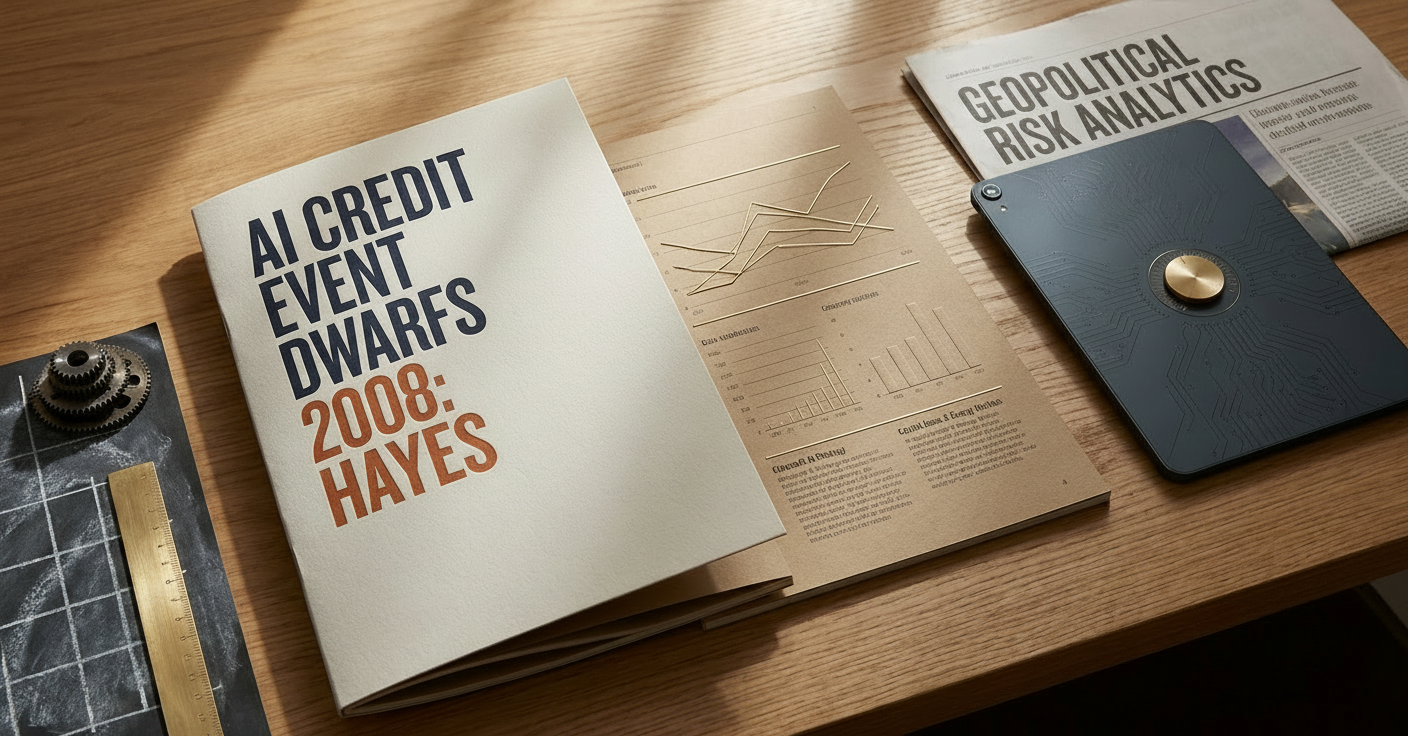
The new geopolitical playbook of "high-value pauses" is reshaping energy markets, while an unseen credit crunch brews in AI—meaning the cost of capital for your next big bet is likely higher than it appears.
The Intake
📊 12 episodes across 7 podcasts
⏱ 576 minutes of intelligence analyzed
🎙 Featuring: Shawn O’Malley (The Investor's Podcast Network), Daniel Mahncke (The Investor's Podcast Network), The Investor's Podcast Network (The Investor's Podcast Network), Shawn O'Malley (The Investor's Podcast Network)
|

The Big Shift
The geopolitical landscape is moving past traditional conflict, entering an era of "high-value pauses" where temporary truces reset strategic advantages without solving underlying tensions, fundamentally re-pricing risk in critical sectors like energy and technology. This week, we saw how the reported US-Iran deal is best understood not as a durable settlement, but as a tactical respite that allows parties to regroup and reorganize (Norman Roule on Bloomberg Surveillance).
Arthur Hayes, Co-Founder of BitMEX, foresees global restocking and geopolitical events driving hydrocarbon prices to "uncomfortably uncomfortable levels," a "fake out" the market is underestimating (Arthur Hayes on Bankless). This isn’t just about oil; it’s about the cost of doing business for energy-intensive AI model training and data centers.
"The reported US Iran deal is best understood as a high value pause in the current military phase of the conflict project, not a durable strategic settlement. The deal buys time. It does not buy trust."
— Norman Roule, Senior Adviser: Warfare & Terrorism Program at CSIS on Bloomberg Surveillance
For executive teams, this means understanding that capital markets are still discounting existential risks. Morgan Stanley’s Michael Zezas highlights the disconnect between elevated geopolitical uncertainty and calm equity markets (Michael Zezas on The Compound and Friends). Meanwhile, an AI credit event, driven by circular revenue deals and unrealistic depreciation schedules for GPUs, could dwarf the 2008 subprime crisis (Arthur Hayes on Bankless), impacting access to capital and potentially leading to a political backlash against AI itself. The risk isn't just about direct conflict, but about the cascading effects on supply chains, energy costs, and the stability of tech valuations.
The level to watch: Elevated geopolitical risk is not priced into equity markets, while a looming AI credit event represents an unquantified systemic risk to capital allocation and tech valuations.
The Rundown
① Layoffs are a lagging indicator, not a green light for investors.
Despite investor cheers for cost-cutting, layoff announcements are, on average, followed by poor stock returns for the companies that implement them, suggesting a disconnect between market perception and long-term company health (Emily Flippen on Motley Fool Money).
→ Why it matters: Boards and executive teams should critically evaluate the strategic implications of significant workforce reductions beyond immediate cost savings, considering potential cultural damage and long-term stock performance impacts.
② Microsoft is quietly commoditizing AI, and it could disrupt your tech stack.
Microsoft is actively pushing for cheaper AI models, including potentially integrating open-source Chinese AI models like DeepSea R4 into Copilot, which could disrupt the market for expensive proprietary LLMs (Tim Seymour on CNBC's "Fast Money").
→ The Signal: CFOs should prepare for a potential commoditization of AI model costs, impacting software budgets, procurement strategies, and the competitive landscape for AI-driven products.
③ The Fed is now navigating "communication blanks," increasing bond market volatility.
Federal Reserve Chairman Kevin Warsh’s hawkish stance on inflation, combined with his decision not to participate in the statement of economic projections, creates communication gaps that the market fills with uncertainty, leading to increased volatility in interest rates (Claudia Sahm on Bloomberg Surveillance).
→ Your Move: Businesses planning debt refinancing or capital raises in the next 12-18 months should factor in elevated interest rate volatility and potentially shorter windows of favorable pricing due to unpredictable Fed communication.
④ Reinsurance is quietly being rebuilt on stablecoins, offering unprecedented operational efficiency.
Re, an on-chain reinsurer, utilizes stablecoins to back US insurance companies, achieving significant operational efficiency with less than a dozen employees supporting half a billion in business, disrupting the traditional $1T reinsurance market (Karn Saroya on Bankless).
→ The Opportunity: Fintech leaders and institutional investors should evaluate the potential for blockchain-based solutions to dramatically reduce operational costs and enhance transparency in highly regulated financial sectors, creating new yield opportunities for stablecoin capital.
⑤ Even with geopolitical uncertainty, core human behavior drives market resilience.
Clients are becoming increasingly resilient to market volatility, sticking to their long-term convictions despite geopolitical events, with market reactions to crises being smaller than in previous years (Anneka Treon on Bloomberg Surveillance).
→ Why it matters: While external shocks persist, the underlying stability of investor behavior suggests that long-term strategic plans may be less susceptible to knee-jerk reactions, but should still build in optionality.
Signal Board
🔥 Heating Up
• Natural Gas Powering Data Centers: Hyperscalers are increasingly prioritizing energy reliability over net-zero goals, turning to natural gas for AI data centers, with Microsoft signing a 20-year deal with Chevron (Jon Quast on Motley Fool Money).
• Copa Holdings (CPA): The airline stands out as a "high-quality business" and the "single most profitable airline of any real scale in the Americas," trading at roughly 8 times earnings (Daniel Mahncke on The Intrinsic Value Podcast - The Investor’s Podcast Network).
• AI-resilient Financial Planning: Financial planning is highlighted as a highly resistant profession to AI displacement due to the enduring value of human relationships and personalized guidance (Ric Edelman on The Compound and Friends).
• Reinsurance Stablecoin Yields: Investors can earn high yields by providing stablecoin capital to on-chain reinsurers like 🆕RE, which deploy it into trust accounts for insurance companies (Avichal Garg on Bankless).
❄️ Cooling Off
• Layoff Announcements: Despite initial investor cheers for cost-cutting, layoff announcements are, on average, followed by poor stock returns (Emily Flippen on Motley Fool Money).
• AI and Software Stocks: The "Mag 7" trade shows signs of faltering amid a tech sell-off, with concerns over Microsoft pushing for cheaper AI models and a potential "SaaS apocalypse" (Tim Seymour on CNBC's "Fast Money").
• 🆕Perpetual Futures: Terry Duffy, outgoing CEO of 🆕CME Group, argues that perpetual futures have "no innovation" and are unsuitable for institutional hedging, as CME Group sues the CFTC over their classification and approval (Terry Duffy on CNBC's "Fast Money").
👀 On Watch
• Iran's Strategic Position: Iran is emerging from recent conflicts in a stronger strategic position, having withstood powerful assaults and now possessing increased leverage (Puneet Talwar on Bloomberg Surveillance).
• Credit Conditions for AI: An impending "AI credit event," potentially larger than 2008, is looming due to unsustainable pricing models and unrealistic GPU amortization schedules (Arthur Hayes on Bankless).
• 🆕Apple Product Pricing: Apple is reportedly planning to raise prices on its products to offset surging memory and storage chip costs, impacting consumer spending and tech adoption (Melissa Lee on CNBC's "Fast Money").
The Debate
The true impact of AI on the future of financial services.
🐂 The bull case: Financial planning is a highly AI-resistant profession due to the enduring value of human relationships and personalized guidance, differentiating it from other professions susceptible to AI displacement (Ric Edelman on The Compound and Friends). Edelman noted that "Accounting will be history decades before the financial planning industry is."
🐻 The bear case: While AI may not displace human advisors, it will transform the industry. Karn Saroya, Founder and CEO of 🆕RE, explained that fintechs are realizing AI workflows are infrastructure that can be offered as a service, profoundly changing operational efficiency (Karn Saroya on Bankless). This could drive a "second act" for fintechs as infrastructure providers, enabling smaller, high-scale firms.
Our read: The human element of financial advice remains crucial, but the back-office and operational efficiencies driven by AI and blockchain will reshape firms' cost structures and competitive advantages.
The Bottom Line
Navigating the new normal means discerning between geopolitical "pauses" and true stability while preparing for an AI credit crunch that will redefine the cost and availability of capital.
📖 Want the full episode breakdowns, guest details, and listen links?
📖 Want the full episode breakdowns, guest details, and listen links?
Episode Guide
1. Motley Fool Money — "More Layoffs, Acquisitions, and SpaceX Becomes AI Company"
Runtime: 41 min | Host: Travis Hoium | Guest: Lou Whiteman, Emily Flippen
For the CFO assessing M&A impact: This episode dissects the long-term implications of tech layoffs and a major acquisition by SpaceX, offering insights into market reactions beyond initial headlines.
This segment discusses the evolving perception of layoffs in the tech industry, initially cheered by investors for cost-cutting but now raising concerns about cultural damage and poor stock returns. It also covers Fox acquiring Roku, with debates on the strategic rationale and potential impact on Roku as an independent platform. Additionally, it delves into SpaceX's significant acquisition of Cursor for $60 billion, transforming it into a prominent AI company and examining the challenges of monetizing AI.
"On average, layoff announcements do tend to be followed by poor stock returns for the companies that announce layoffs."
— Emily Flippen, Guest at Motley Fool
2. Bloomberg Surveillance — "The Global Economic Outlook"
Runtime: 28 min | Host: Tom Keene, Paul Sweeney | Guest: Anneka Treon, Puneet Talwar
For the CEO recalibrating risk: Gain perspective on how clients are managing "normalized" volatility and the nuanced geopolitical shifts reshaping global dynamics.
ING Global Head of Private Banking, Anneka Treon, discusses how clients are becoming more resilient to market volatility and highlights a shift in European investment behavior. Ambassador Puneet Talwar discusses the current geopolitical landscape, focusing on Iran’s strengthened strategic position post-conflict and the implications of its growing influence, assessing the erosion of US leverage.
"So you see that clients are just increasingly resilient and steadfast with what they're doing, why they're doing it, and sticking to convictions."
— Anneka Treon, Global Head of Private Banking, Wealth Management, and Investments at ING Investments
3. The Compound and Friends — "The Most Invincible Career Path in Finance"
Runtime: 41 min | Host: Josh Brown, Rick Edelman | Guest: Ric Edelman
For the operator planning future talent: Discover why financial planning remains immune to AI displacement, highlighting the enduring value of human skills in a tech-driven world.
Ric Edelman discusses the shortcomings of the current higher education system and advocates for a strategic approach to college. He also explains why financial planning is a highly resistant profession to AI, highlighting the enduring value of human relationships and personalized guidance, arguing that while AI will augment back-office functions, client-facing relationships remain paramount.
"Accounting will be history decades before the financial planning industry is."
— Ric Edelman
4. We Study Billionaires - The Investor’s Podcast Network — "TIP825: Meta, Adobe, Booking Holdings w/ Stig Brodersen, Tobias Carlisle & Hari Ramachandra"
Runtime: 61 min | Host: Stig Brodersen | Guest: Tobias Carlisle, Hari Ramachandra
For the PE investor seeking deep value: Hear pitches on Meta's AI monetization, Booking Holdings' resilience against AI disruption, and Adobe's enduring market dominance.
Hari Ramachandra pitches Meta as a strong AI-powered advertising platform, noting its potential to outperform Google in ad revenues. Tobias Carlisle then discusses Booking Holdings, emphasizing its capital-light model and network effects, addressing concerns about AI disintermediation. Stig Brodersen introduces Adobe as his stock pick, highlighting its strong subscription revenue model and market dominance despite current market sentiment against SaaS companies.
"Meta is on track to beat Google in terms of ad revenues for 2026. Their forecasted ad revenue for 2026 is $243 billion, which will be $3 billion more than Google's."
— Hari Ramachandra
5. The Intrinsic Value Podcast - The Investor’s Podcast Network — "TIVP078 (Video): Copa Holdings (CPA): Is Buffett right about Airline Stocks? w/ Daniel Mahncke & Shawn O’Malley"
Runtime: 89 min | Host: Shawn O’Malley, Daniel Mahncke, The Investor's Podcast Network | Guest: Shawn O'Malley
For the capital allocator challenging conventional wisdom: An in-depth case study on Copa Holdings explains how one airline defies industry norms to deliver high profitability, offering lessons on competitive advantage.
Shawn O’Malley and Daniel Mahncke discuss why the airline industry is a historically poor investment due to high fixed costs and fierce competition, referencing Warren Buffett's skepticism. They introduce Copa Holdings as a potential outlier, boasting high profitability and trading at 8x earnings. The discussion delves into the competitive advantages that allow Copa to achieve this, specifically its low-cost producer strategy and an uncopyable network position through Panama's unique geographic location.
"COPA is the single most profitable airline of any real scale in the Americas, trading at roughly 8 times earnings."
— Daniel Mahncke, Host at The Investor's Podcast Network
6. CNBC's "Fast Money" — "AI and Software Stocks Struggle… And the Best Buys in Biotech 6/22/26"
Runtime: 43 min | Host: Brian, CNBC | Guest: Tim Seymour, Courtney Garcia, Dan Nathan, Guy Adami, Deirdre Bosa, Angelica Peebles, Eamon Javors, Philip White
For the investor diversifying beyond Mag 7: Understand the tech sell-off and the market's "broadening out" into infrastructure, energy, and biotech, identifying new growth areas.
This segment discusses a tech sell-off, with Google, Microsoft, Amazon, and Meta experiencing significant drops, exploring whether this signals the end of the "Mag 7" trade. The conversation highlights a "broadening out" in the market, favoring infrastructure and energy companies benefiting from AI spending. Simultaneously, it touches on Pfizer's setback with a failed lung cancer drug trial, and the surprising resilience and undervaluation of the luxury real estate market in New York City and San Antonio.
"Is the meg, is the Mag 7 trade over, right? Is the big cap tech trade over? Everybody kind of waiting for it to be over and every time the market goes down, we ask it that the market goes back up. This feels a little different."
— Dan Nathan, Trader at CNBC
7. Bankless — ""The Fed Can't Print Moore's Law" - How the AI Crash Sends Bitcoin to $1M | Arthur Hayes"
Runtime: 58 min | Host: Bankless | Guest: Arthur Hayes
For the institutional investor bracing for macro shocks: Arthur Hayes' provocative take on an impending AI credit event and its systemic impact, including potential implications for crypto and traditional finance.
Arthur Hayes returns to Bankless to discuss his cautious positioning, favoring capital preservation and T-bills, and predicts a "fake-out" in current low oil prices, anticipating uncomfortably high hydrocarbon prices. He speculates on the AI bubble, suggesting a credit event could dwarf the subprime crisis, fueled by circular revenue deals and unrealistic depreciation schedules. This segment also discusses the mechanics and importance of perpetual swaps (perps) in crypto and their potential to disrupt traditional finance.
"If we do get an AI credit event, number one, it'll be bigger than 2008 because the whole world is on this delusion that AI is the most, the biggest technology ever."
— Arthur Hayes, Co-Founder of BitMEX
8. Motley Fool Money — "Toy Story 5 Reaches For the Sky"
Runtime: 23 min | Host: Jon Quast | Guest: Matt Frankel, Rachel Warren
For the infrastructure investor identifying future demand: Unpack the surprising demand for natural gas to power AI data centers, revealing a critical shift in energy priorities for tech giants.
The podcast discusses the unexpected success of Toy Story 5 at the box office, highlighting Disney as a direct beneficiary and Apple as an indirect winner. The conversation then shifts to the increasing reliance on natural gas for powering AI data centers, with Microsoft and Chevron signing a 20-year deal in Texas. The hosts also address a listener's question regarding value investing in the current market, emphasizing that core principles remain relevant.
"Microsoft has signed a 20 year deal with Chevron to use natural gas to power its new data center in Pecos, Texas. This is as Microsoft is looking to double its AI data center capacity over the next two years."
— Jon Quast, Host of Motley Fool Money
9. The Compound and Friends — "The World You Knew Is Never Coming Back with Morgan Stanley’s Michael Zezas"
Runtime: 65 min | Host: Michael Batnick, Downtown Josh Brown | Guest: Michael Zezas
For the board member understanding regime change: Morgan Stanley's Michael Zezas articulates the post-globalization world, the disconnect between geopolitics and equity markets, and AI's real impact on GDP.
Michael Zezas, Deputy Global Head of Research at Morgan Stanley, discusses the shift in investor attitudes from prioritizing globalization to an emphasis on geopolitical resilience. He highlights the disconnect between elevated geopolitical uncertainty and calm equity markets and discusses the re-industrialization of Europe and Japan. Zezas also discusses the early stages of AI build-out and its impact on GDP growth through infrastructure development, while acknowledging the need for human judgment to navigate "AI slop" in research.
"Our call was and is that there's been a regime change driven by shifting voter preferences... and that geopolitical fragility is on the rise."
— Michael Zezas, Deputy Global Head of Research at Morgan Stanley
10. Bankless — "How Re is Rebuilding the $1T Reinsurance Market with Stablecoins | Karn Saroya & Avichal Garg"
Runtime: 59 min | Host: David | Guest: Karn Saroya, Avichal Garg
For the VC seeking disruptive tech: Explore Re's innovative model using stablecoins to overhaul the reinsurance market, demonstrating blockchain's potential for massive operational efficiency.
Karn Saroya, Founder and CEO of Re, explains that Re is an on-chain reinsurer utilizing stablecoins to back US insurance companies, highlighting that blockchain and smart contracts are ideal for reinsurance due to transparency. Avichal Garg of Electric Capital adds that Re’s model excels by leveraging smart contracts for cheaper auditing and regulatory compliance, and by tapping into the emerging stablecoin capital market, underscoring the potential for significant market disruption through operational efficiency.
"The operational efficiency allows you to offer a product that's better, cheaper, faster, and as a result, you can eat up market share."
— Avichal Garg, Investor at Electric Capital
11. CNBC's "Fast Money" — "An Overhaul of Fed Operations… And Terry Duffy Steps Down as CME Group CEO 6/17/26"
Runtime: 44 min | Host: Melissa Lee, CNBC | Guest: Steve Liesman, Michael Cintoplis, Gerard Cassidy, Tim Seymour, Karen Finerman, Dan Nathan, Guy Adami, Michael Kintopoulos, Terry Duffy
For the trader monitoring regulatory battles: Terry Duffy's departure from CME Group and the legal battle over perpetual futures reveal critical tensions in market regulation and innovation.
The segment discusses the Federal Reserve's recent meeting, where Chairman Kevin Warsh announced a major review of how the Fed operates. Despite a unanimous vote to leave rates unchanged, Warsh's hawkish stance on inflation led to market reactions, particularly in the bond market. The discussion also touches on Apple's potential price hikes due to surging memory costs. Terry Duffy then discusses his resignation from CME Group, the ongoing debate around perpetual futures, and CME Group's lawsuit against the CFTC.
"I think what that means is that the market is not really pricing in so much inflation in the future as it did before."
— Steve Liesman, Senior Economics Reporter at CNBC
12. Bloomberg Surveillance — "Bloomberg Surveillance TV: June 18th, 2026"
Runtime: 24 min | Host: Bloomberg | Guest: Ed Yardeni, Norman Roule, Claudia Sahm
For the policy advisor decoding Fed signals: Analyze the implications of Fed Chairman Kevin Marsh's hawkish stance and the internal divisions impacting monetary policy and market communication.
Ed Yardeni discusses Kevin Marsh, who, despite initial perceptions, presented a hawkish stance on inflation control, emphasizing price stability. Norman Roule analyzes the recent US-Iran interim peace deal, calling it a "high-value pause" rather than a lasting settlement. Claudia Sahm criticizes Kevin Marsh for not participating in the statement of economic projections, arguing it creates communication blanks and potential market volatility, while the Federal Reserve committee is divided on monetary policy, with some advocating for higher rates to combat persistent supply shocks.
"Markets are going to fill in the blanks, right? They're going to try to come up with some views that's going to mean we're going to have more uncertainty about what the Federal Reserve is going to do, which is going to lead to potentially more volatility in interest rates and investors are going to be compensated for that uncertainty."
— Claudia Sahm, Chief Economist at New Century Advisors