
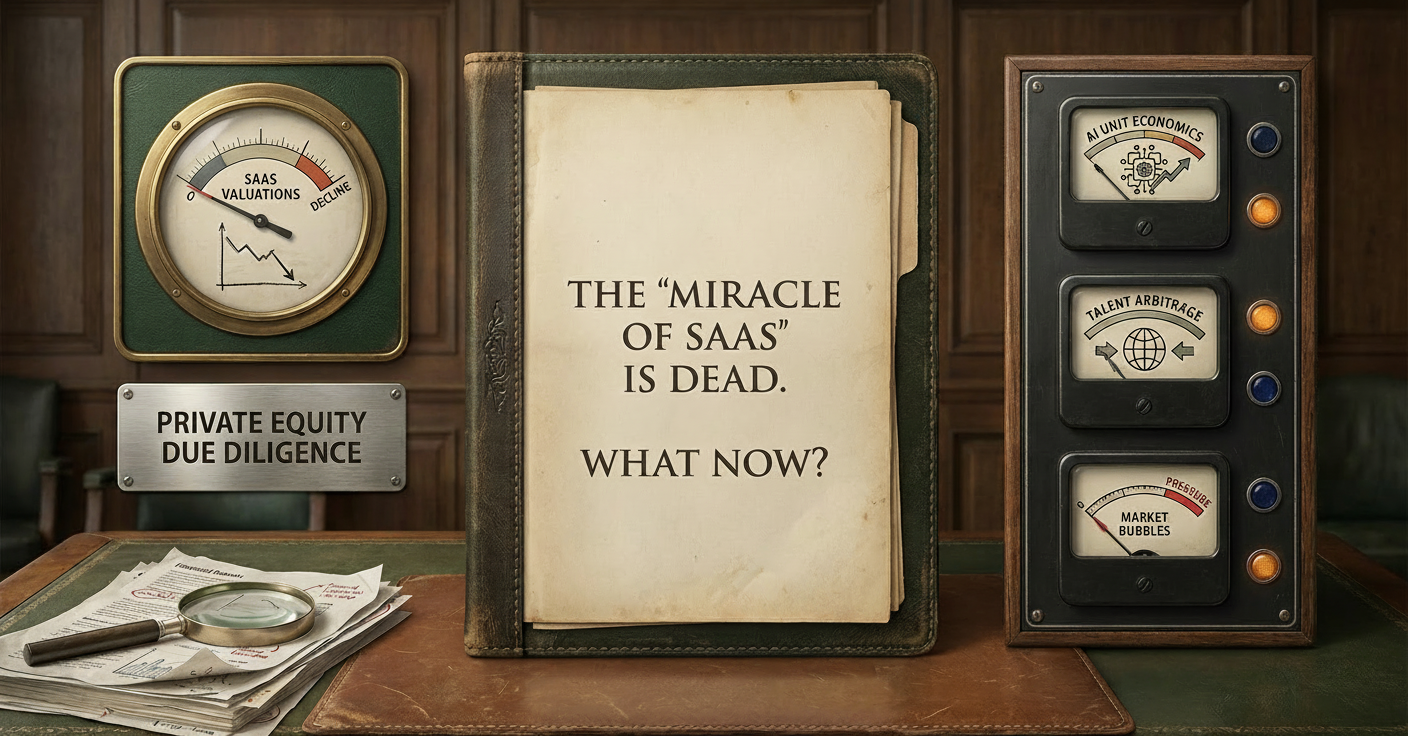
The AI narrative is shifting from unbridled growth to a cold, hard look at unit economics and the talent supply chain.
📊 11 episodes across 9 podcasts
⏱ 574 minutes of intelligence analyzed
🎙 Featuring: Kareem Amin, Patrick O'Shaughnessy, David Senra, Joseph Pulitzer, Kirby Montgomery, Daniel Pianko, Dan Bender, Jack Ma, Lukas Ingelheim, Ed Elson, Jeremy Grantham, Shazi Visram
|

The Big Shift
The honeymoon phase for AI is over; the market is pivoting from hype to hard economics. While the public talks about AI's revolutionary potential, the smart money is scrutinizing the underlying costs and infrastructure, realizing the "miracle of SaaS" with its near-zero marginal costs is severely challenged by AI's compute and token expenses. This isn't just about technical audits; it's a fundamental recalibration of what constitutes value and defensibility in an AI-driven world.
What's Happening: Private equity firms are now demanding a deep dive into an AI target's architectural scalability and unit economics, far beyond traditional IT due diligence. As Lukas Ingelheim, Managing Partner at Code & Co., bluntly puts it, "The miracle of SaaS is potentially dead, right? Or at least it's challenged." This signals a shift from simply acquiring SaaS companies for their recurring revenue to evaluating companies based on their ability to manage the very real, and often high, costs of AI infrastructure.
"I think ultimately what a lot of people are sleeping on today still is the miracle of SaaS is potentially dead, right? Or at least it’s, you know, severely. I don’t think necessarily it’s dead, but at least it’s challenged."
— Lukas Ingelheim, Managing Partner at Code & Co. on Private Equity Funcast
The Operational Reality: This isn't just a valuation adjustment; it's driving a new operational playbook. Firms are finding significant cost savings in optimizing cloud spend post-acquisition, sometimes identifying millions in annual savings for companies with $50-200 million ARR (Dan on Private Equity Funcast). This points to an endemic issue: many companies have been over-engineering or underscaling their cloud infrastructure, leading to massive inefficiencies. The scrutiny isn't just on technology but also on the talent to manage it.
The Move: Operators need to conduct an immediate, forensic audit of their cloud spend and AI unit economics. The market will no longer tolerate unchecked expenditure in the name of innovation. Proving efficient, scalable architecture and cost-effective AI implementation is becoming a non-negotiable for future investment or exit. This is about disciplined execution, not just grand visions.
The Rundown
① Talent Arbitrage is the New Alpha in Private Equity.
Achieve Partners is achieving top-tier DPI in US buyouts by focusing on talent-led investments, specifically targeting businesses constrained by labor shortages and implementing apprenticeship programs to train overlooked talent. (Daniel Pianko on The Private Equity Podcast, by Raw Selection)
→ Why it matters: This unconventional playbook bypasses traditional growth drivers, creating value through human capital development and demonstrating that social impact can directly drive outsized financial returns, particularly in middle-market buyouts.
② Brand Building in the AI Era is Harder Than Ever.
Despite lower barriers to entry for product creation, fragmented consumer attention makes real brand building exceptionally difficult today, demanding significant leverage of new channels like AI chatbot optimization. (Shazi Visram on How I Built This with Guy Raz)
→ Why it matters: Founders must integrate AI tools into their digital presence and marketing strategy from day one, like optimizing websites for ChatGPT, to cut through the noise and capture market share in a hyper-competitive landscape where traditional brand loyalty is eroding.
③ Capitalism Rewards Risk, Not Just Hard Work.
Kareem Amin, Co-founder and CEO of Clay, challenges conventional wisdom, stating that capitalism primarily rewards risk-taking above meritocracy or sheer effort. He attributes Clay's success to strategic risks in talent and company culture. (Kareem Amin on Invest Like the Best with Patrick O'Shaughnessy)
→ Why it matters: This perspective directly impacts how founders should approach strategy and resource allocation, suggesting an aggressive, calculated risk posture in areas like recruiting or brand-building is more impactful than incremental improvements or simply hard work.
④ China's AI Ascent is Geopolitical, Not Just Technological.
The US-China AI arms race is mirroring the nuclear arms race, with China's academic focus and pragmatic adoption contrasting sharply with US regulatory inaction, leading to a financial decoupling and a unique approach to AI labor displacement. (Ed Elson on The Prof G Pod with Scott Galloway)
→ Why it matters: Operators deploying AI solutions globally need to understand the fundamental divergence in how these two economic superpowers are approaching AI regulation and adoption, which will dictate market access, supply chains, and talent pools.
⑤ The ‘Miracle of SaaS’ is Challenged by AI’s Unit Economics.
The traditional SaaS model of near-zero marginal costs is being undermined by the high and unpredictable compute and token costs associated with AI implementation, forcing a rethink of underlying profitability. (Lukas Ingelheim on Private Equity Funcast)
→ Why it matters: This is a wake-up call for every SaaS business to deeply understand and optimize their AI-driven unit economics, recognizing that efficient architecture and cloud spend are no longer optional but critical for maintaining profitability and attractive valuations.
Signal Board
🔥 HEATING UP
• Talent-led investment strategy: PE firms generating top-tier returns by leveraging apprenticeship programs to address talent shortages in portfolio companies. (Daniel Pianko on Private Equity Podcast)
• quantum computing 🆕: Rapid advancements in molecular simulation are pushing quantum computing beyond theoretical interest to practical applications in fields like drug discovery. (Arvind Krishna on Masters of Scale)
• AI transformation in software evaluation 🆕: Private equity due diligence is shifting to evaluate defensibility, scalability, and unit economics of AI implementations, recognizing the end of traditional SaaS margins. (Lukas Ingelheim on Private Equity Funcast)
• Risk-taking and innovation in corporate culture: IBM's CEO argues the biggest risk is taking no risk, fostering a culture where innovation and even failures are embraced. (Arvind Krishna on Masters of Scale)
👀 ON WATCH
• AI impact on journalism and media: Journalists are differentiating themselves by uncovering unique angles and tacit knowledge AI cannot access, rather than just delivering content. (Jasmine Sun on Odd Lots)
• US vs. China AI development approaches: China's academic, collaborative, and open-source approach to AI development is contrasted with US focus, largely due to compute constraints. (Jasmine Sun on Odd Lots)
• agentic development 🆕: AI agents can now write code and submit pull requests, transforming software development but requiring human-in-the-loop oversight. (Dan Bender on Private Equity Funcast)
• Global fertility rate decline 🆕: This long-term "slow-burning" problem is highlighted as humanity's inability to address existential threats, impacting future economic and societal structures. (Jeremy Grantham on Odd Lots)
🥶 COOLING OFF
• Mass rebellion against short-term capitalism: Simon Sinek criticizes the "Jack Welch" form of capitalism, driving a global rebellion against short-termism and misaligned incentives prioritizing shareholders over employees. (Simon Sinek on Dare to Lead with Brené Brown)
• Market bubbles and valuations in AI: Current AI valuations, especially for companies like SpaceX and Nvidia, are signaling a bubble, drawing parallels to historical market crashes. (Jeremy Grantham on Odd Lots)
• OpenAI leaked financials and AI boom speculation: Leaked financials revealing significant losses for OpenAI despite high spending raise questions about the fundamentals of the AI boom versus speculative belief. (Ed Zetron on The Prof G Pod with Scott Galloway)
• Foundation models commoditization: IBM predicts foundation models will become commodities within 1-3 years, challenging the current high-valuation paradigm for leading AI model providers. (Arvind Krishna on Masters of Scale)
The Bottom Line
The market is prioritizing disciplined, cost-effective AI implementation and talent pipeline creation over speculative growth, forcing a return to fundamental unit economics.
📖 Want the full episode breakdowns, guest details, and listen links?
Episode Guide (Web Version)
1. How I Built This with Guy Raz — "Advice Line with Shazi Visram of Happy Family Organics"
Runtime: 45 min | Host: Guy Raz (Host, Wondery) | Guest: Shazi Visram (Founder, Happy Family Organics and Healthy Baby)
For Founders & Marketers: This episode offers practical advice on brand building and market entry strategies in competitive CPG spaces, especially for those leveraging unconventional product angles.
Guy Raz and Shazi Visram advise entrepreneurs on scaling niche products. They cover optimizing digital advertising with PR, differentiating in crowded markets, and strategically positioning 'better for you' products like protein sprinkles for consumer education.
"The hardest thing is to build a brand. It's even harder now than when you started. Happy baby. It's easy. The barriers to entry are easier and some. But the brand building is so much harder because our tension is just. It's being divided. Right. By a million different things."
— Shazi Visram, Founder of Happy Family Organics and Healthy Baby
Connects to: The Rundown (Brand Building in the AI Era is Harder Than Ever.)
2. Invest Like the Best with Patrick O'Shaughnessy — "Kareem Amin - The Unusual Approach to Company Building - [Invest Like the Best, EP.478]"
Runtime: 57 min | Host: Patrick O'Shaughnessy (CEO and Host of Invest Like the Best, Positive Sum) | Guest: Kareem Amin (Co-founder and CEO, Clay)
For CEOs & Strategic Leaders: This episode provides a counter-intuitive framework for company building, emphasizing risk, core values, and the leader's personal journey to unlock organizational potential.
Kareem Amin discusses Clay's unique, values-driven approach to company building, emphasizing courage, truth, and justice. He argues capitalism rewards risk more than hard work, advocating for introspection and an "over-investing" strategy in talent to build resilient, high-performing teams.
"Everybody talks about hiring fast and firing fast. We've had people who nine months in, were floundering and were like, this person is excellent. I know they are, but what's going on here? Is it the role? Is it the context? Is it our decision making that's limiting them? Eventually we find an amazing spot for that person and they become a superstar 50% of the time."
— Kareem Amin, Co-founder at Clay
Connects to: The Rundown (Capitalism Rewards Risk, Not Just Hard Work.)
3. Founders — "#422 Joseph Pulitzer"
Runtime: 53 min | Host: David Senra (Host, Founders Podcast) | Guest: Joseph Pulitzer (Journalist, Publisher, Politician)
For Business Leaders & Strategists: This episode offers historical lessons in aggressive business expansion, market dominance, and the often ruthless operational focus required to transform an industry.
David Senra dissects Joseph Pulitzer's journey from immigrant to media titan, highlighting his relentless work ethic, shrewd business acumen, and operational expertise. Pulitzer's strategies for acquiring and merging struggling newspapers demonstrate a masterclass in calculated risk-taking and market domination.
"Pulitzer knew that if he were to openly join the bidding, others would assume that he had seen in that paper something of value that had escaped everybody else's attention. And then the price would soar."
— David Senra
Connects to: Signal Board (Risk-taking and innovation in corporate culture)
4. The Private Equity Podcast, by Raw Selection — "$465M Exit and how to get to the top 5% in US Buyouts"
Runtime: 33 min | Host: Alex Rawlings (Host, Raw Selection) | Guest: Daniel Pianko (Co-Founder, Achieve Partners)
For GPs & Operating Partners: A must-listen for insights into a successful, non-traditional PE value creation strategy focused on human capital and social impact.
Daniel Pianko details Achieve Partners' talent-led investment strategy, which created a $465 million exit by addressing workforce shortages with apprenticeship programs. This approach builds internal talent pipelines, leading to increased revenue, margin expansion, and high retention rates, demonstrating a unique path to superior returns.
"What we're looking for is areas where you get with at least 10,000 unfilled jobs. With about two to three months of training, we can get someone to a 70 to 100 plus dollar rate."
— Daniel Pianko, Co-Founder of Achieve Partners
Connects to: The Rundown (Talent Arbitrage is the New Alpha in Private Equity.)
5. Dare to Lead with Brené Brown — "The Highest Performance Strategy is Caring About People ft. Simon Sinek"
Runtime: 81 min | Host: Brené Brown (Host, Dare to Lead Program) | Guest: Simon Sinek (Ethnographer, Author, Podcaster)
For Leadership & HR Executives: Essential for understanding how fostering a culture of care and strong team dynamics can be the most effective strategy for organizational performance and employee retention.
Simon Sinek, Brené Brown, and Adam Grant discuss a "mass rebellion against capitalism" driven by short-termism, advocating for long-term strategies built on human connection. They highlight that high-performing organizations are built on high-performing teams and that managing one's nervous system is a core leadership capability.
"There's this sort of mass rebellion around the world against capitalism. But it's the form of capitalism that exists now the sort of Milton Friedman, Jack Welch form of capitalism of short termism and using people to balance the books and rewarding shareholders before you take care of your employees or your customers."
— Simon Sinek
Connects to: Signal Board (Mass rebellion against short-term capitalism)
6. Odd Lots — "How Substack Creators Are Covering This Strange Markets Era"
Runtime: 31 min | Host: Tracy Alloway (Host, Bloomberg) | Guest: James van Geelen (Founder and Author, Citrini Research)
For Investors & Media Professionals: Insights into how AI and automation are reshaping industry dynamics, with implications for both market analysis and competitive strategy.
Substack creators discuss AI's market impact, job fears, and journalism's evolving role. They highlight China's academic AI focus and "bottleneck investing" in hardware. The conversation touches on financial resilience and the surreal experience of AI replicating human writing and robotics advancements.
"As a reporter, my job is to take the tacit or to take the private and to turn it into public knowledge. Like that particular task I think is extremely robust in the era of AI."
— Jasmine Sun, Author at Substack
Connects to: Signal Board (AI impact on journalism and media, US vs. China AI development approaches)
7. Masters of Scale — "IBM’s $10 billion bet on what comes after AI"
Runtime: 41 min | Host: Bob Safian (Host of Masters of Scale, WaitWhat) | Guest: Arvind Krishna (Chairman and CEO, IBM)
For Large Enterprise Leaders & Tech Investors: Provides a strategic roadmap for navigating enterprise AI adoption, quantum computing, and the critical importance of risk-taking in innovation for established companies.
IBM CEO Arvind Krishna discusses the commoditization of foundation models and the need for simplified enterprise AI adoption. He emphasizes effective integration for productivity, IBM's quantum computing investment, and fostering a culture of innovation by taking calculated risks, even with potential failures.
"I think right now we're using the 18 wheeler for everything. And this is the transition that I'll predict will happen within 24 months."
— Arvind Krishna, Chairman and CEO of IBM
Connects to: Signal Board (Foundation models commoditization, Risk-taking and innovation in corporate culture, quantum computing)
8. The Prof G Pod with Scott Galloway — "China Decode: Why China Got Locked Out of SpaceX and America’s Biggest IPOs (ft. Ed Elson)"
Runtime: 72 min | Host: Alice Han (Host, Vox Media Podcast Network) | Guest: Ed Elson (Guest, Prof. G Markets)
For Global Investors & Geopolitical Strategists: Critical for understanding the increasing financial decoupling between the US and China, and its implications for tech investments and AI development.
Alice Han and Ed Elson discuss China's exclusion from major US IPOs like SpaceX due to US restrictions and Beijing's capital controls. They explore the implications of a financial decoupling and the AI arms race, with China's proactive AI regulation contrasting with the US's perceived inaction.
"It's going to be very hard, I think, for the administration to really suppress China's AI rise. And I think that the, you know, history will look at the the AI arms race as being very comparable to the nuclear arms race."
— Ed Elson, Guest at Prof. G Markets
Connects to: The Rundown (China's AI Ascent is Geopolitical, Not Just Technological.)
9. Odd Lots — "Jeremy Grantham on How to Tell If a Bubble Is About to Burst"
Runtime: 60 min | Host: Tracy Alloway (Host, Bloomberg) | Guest: Jeremy Grantham (Co-founder and Long-Term Strategist, GMO)
For Macro Investors & Portfolio Managers: Essential listening for a veteran's perspective on identifying market bubbles and understanding current AI valuations through a historical lens.
Jeremy Grantham discusses market exuberance around AI and tech stocks, citing historical parallels to call the current valuations a bubble. He highlights intense competition among the "Mag 7" and expresses concerns about AI's energy consumption and humanity's neglect of long-term problems.
"My simple advice is usually try and avoid the Hype, check the numbers and 100 times sales pretty well does the job for you."
— Jeremy Grantham, Co-founder and Long-Term Strategist at GMO
Connects to: Signal Board (Market bubbles and valuations in AI, Global fertility rate decline)
▶ Listen
10. Private Equity Funcast — "How Private Equity Is Rethinking AI & Tech Due Diligence (According to Code & Co.)"
Runtime: 84 min | Host: Jim (Host, Private Equity Funcast) | Guest: Dan Bender (Managing Partner, Code & Co.)
For PE Deal Teams & Operating Partners: A deep dive into the evolving due diligence landscape for tech deals, highlighting the shift from traditional IT audits to critical evaluations of AI unit economics and architectural scalability.
This discussion explores how PE firms are overhauling tech due diligence for AI, focusing on architectural scalability and unit economics rather than just IT. They highlight significant cloud cost optimization opportunities and the emergence of "agentic development," where AI writes code, requiring human oversight.
"I think ultimately, no matter how you define SaaS... Ultimately, the miracle of SaaS was zero margin of cost... This doesn't exist anymore unless you do it right."
— Lukas Ingelheim, Managing Partner at Code & Co.
Connects to: The Big Shift, The Rundown (The ‘Miracle of SaaS’ is Challenged by AI’s Unit Economics.), Signal Board (AI transformation in software evaluation, agentic development)
11. The Prof G Pod with Scott Galloway — "The Week: SpaceX, Iran, and the World's First Trillionaire"
Runtime: 17 min | Host: George Hahn (Host, Vox Media Podcast Network) | Guest: Scott Galloway (Professor of Marketing, New York University Stern School of Business)
For Macro Strategists & VC Investors: Offers a critical perspective on high-profile IPOs and AI valuations, blending financial analysis with geopolitical context.
George Hahn and Scott Galloway discuss the SpaceX IPO as financial engineering with unusual NASDAQ concessions and artificial scarcity. They also scrutinize leaked OpenAI financials, raising questions about the AI boom's fundamentals versus speculative belief, alongside the geopolitical implications of the US-Iran framework agreement.
"What happened this week wasn't a market event. It was financial engineering."
— Scott Galloway, Professor of Marketing at New York University Stern School of Business
Connects to: Signal Board (OpenAI leaked financials and AI boom speculation)