
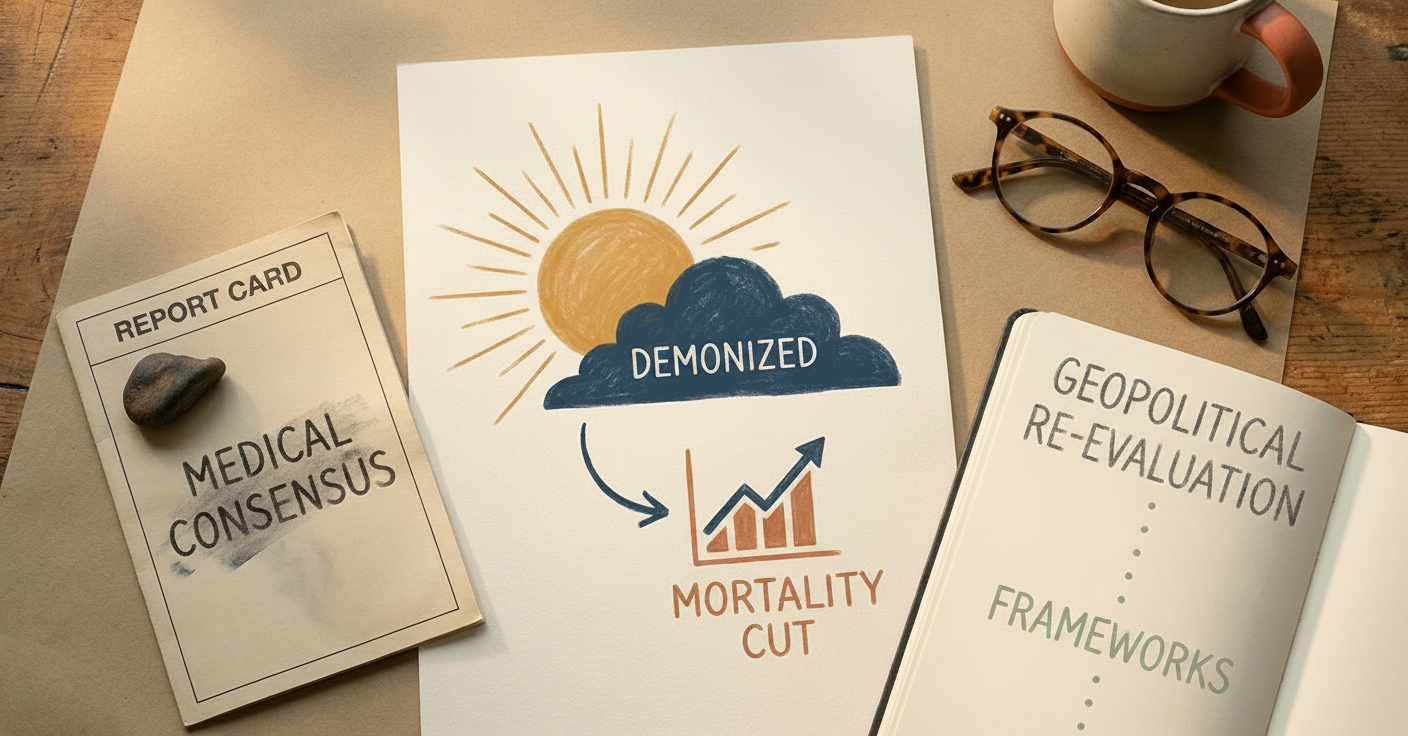
What if the most foundational assumptions about health, geopolitics, and personal growth are fundamentally flawed?
The Intake
📊 7 episodes across 6 podcasts
⏱ 529 minutes of intelligence analyzed
🎙 Featuring: Andrew Huberman, Coleman Hughes, Peter Beinart, Russ Roberts, Rowan Jacobsen, Sam Harris, Noah Smith, Quinlan Walther, Chris Williamson, Andy Stumpf
|

The Big Shift
The conventional wisdom undergirding foundational ideas in health, international relations, and individual psychology is not just incomplete, but actively misleading, creating "familiar hells" we opt for over unfamiliar heavens. This week's conversations reveal a striking pattern: what we've been told is good for us, or what we believe to be true about the world and ourselves, often runs counter to deeper scientific understanding or historical precedent. From the surprising benefits of sun exposure and the inefficacy of vitamin D supplements to the overlooked complexities of geopolitical conflicts and the subtle ways our own nervous systems trap us in unfulfilling patterns, the most interesting insights challenge the very frameworks we use to navigate reality.
Rethinking Health: The sun, demonized for decades, is being rehabilitated as a crucial component of cardiovascular health and even a reducer of mortality, putting the medical establishment's sunscreen-heavy advice into question. On EconTalk, Rowan Jacobsen, author of In Defense of Sunlight, argued, "The recommendations we've received for the past few decades no longer accurately reflect what we know about the science." He points out that the rise in skin cancer diagnoses correlates less with sun exposure and more with increased medical scrutiny, and that vitamin D supplements don't replicate the benefits of natural sunlight.
"The number one best predictor of skin cancer diagnosis in the US is the number of dermatologists in the county, not sun exposure."
— Rowan Jacobsen, Author on EconTalk
Unpacking Geopolitics: Similarly, the Israel-Palestine conflict is often framed through lenses that obscure rather than clarify. Peter Beinart, on Conversations With Coleman, challenges the long-held two-state solution, advocating for a one-state solution rooted in equality under the law, influenced by his direct interactions with Palestinian refugees. His perspective, refined despite his past Zionist positions, directly refutes the commonly accepted narratives that prioritize identity over universal rights.
Rewiring Our Inner Frameworks: In personal growth, ideas about self-worth and motivation are equally ripe for re-evaluation. Quinlan Walther on Modern Wisdom highlighted how our nervous systems often cling to "familiar hells" over unfamiliar heavens, where unhealthy but predictable relationship patterns are chosen over healthier, uncertain ones. Separately, Joe Hudson on The Art of Accomplishment challenged the effectiveness of shame as a motivator, noting that "shame, often experienced as 'shoulds,' is built to stop people from doing things, not to start them." Instead, connection and authenticity prove far more potent.
Why it matters: Leaders, investors, and operators often rely on established models and expert consensus. This week's pattern suggests significant opportunities (and risks) lie in scrutinizing those consensus views, understanding the second-order effects of widely accepted practices, and daring to explore contrarian perspectives that may ultimately prove to be more accurate and effective.
The Rundown
① Shame-based "shoulds" are counterproductive.
The common belief that shame motivates change is flawed; shame is designed to stop behavior, not initiate it. (Joe Hudson on The Art of Accomplishment)
→ The implication: Leaders aiming to foster innovation or new habits should focus on creating environments of psychological safety and curiosity, rather than using guilt or punitive measures that trigger shame and halt progress.
② Low-intensity stretching yields better long-term flexibility.
Contrary to the "no pain, no gain" mentality, very low-intensity static stretching (30-40% of pain threshold) is more effective for improving long-term range of motion than moderate-intensity static stretching. (Andrew Huberman on Huberman Lab)
→ The implication: Re-evaluate corporate wellness programs and personal routines to prioritize consistent, gentle movements over aggressive, infrequent efforts, which can lead to better employee health outcomes and reduced injury rates.
③ Social media is a "perfect addiction" because it allows multitasking.
Social media's low-resolution engagement allows users to multitask while still being aware of time-wasting, making it uniquely insidious and harder to disengage from. (Andrew Huberman and Andy Stumpf on Huberman Lab)
→ The implication: Acknowledge the addictive design of digital platforms when developing corporate digital usage policies, and consider strategies that promote focused work blocks and digital detox periods to combat this "perfect addiction" effect.
④ US national debt requires both tax increases and spending cuts.
With the US national debt approaching $40 trillion, comprehensive solutions require not just tax increases for the wealthy, but also on the upper middle class, alongside significant spending cuts, especially in healthcare. (Sam Harris and Noah Smith on Making Sense with Sam Harris)
→ The implication: Businesses should model scenarios for increased tax burdens and prepare for potential shifts in consumer spending as fiscal austerity measures or inflationary pressures impact the broader economy.
⑤ Your choice of partner reveals your self-worth.
The type of romantic partner an individual chooses acts as a "Rorschach test" for their self-worth, with unhealthy or familiar patterns often masquerading as resonance or attraction. (Quinlan Walther on Modern Wisdom)
→ The implication: Leaders can translate this insight by recognizing how subconscious patterns, often rooted in self-worth, influence team dynamics and hiring decisions; fostering a culture of self-awareness can lead to more effective and healthier professional relationships.
Signal Board
🔥 Heating Up
• Palestinian right of return: Peter Beinart argues for its legitimacy under international law, reshaping historical narratives of the Israel-Palestine conflict. (Peter Beinart on Conversations With Coleman)
• One-state solution (Israel-Palestine): Gaining traction among some former Zionists as a path toward equality under the law. (Peter Beinart on Conversations With Coleman)
• Neuroplasticity in Insular Cortex: Yoga practitioners demonstrating increased gray matter volume in this area, suggesting improved pain tolerance and nervous system control. (Andrew Huberman on Huberman Lab)
👀 On Watch
• Wingsuit Flying / BASE Jumping 🆕: Extreme sports discussed as unique mental resets that induce flow states but carry significant danger when the Dunning-Kruger effect applies. (Andy Stumpf on Huberman Lab)
• Nitric oxide production from sunlight 🆕: A significant, overlooked benefit of sun exposure that positively impacts cardiovascular health and overall mortality. (Rowan Jacobsen on EconTalk)
• Prioritizing Perfection Over Connection 🆕: A common coaching pattern where individuals sacrifice genuine connection for an unattainable ideal of flawlessness. (Joe Hudson on The Art of Accomplishment)
🧊 Cooling Off
• Modern Monetary Theory (MMT): Widely criticized as neither modern, monetary, nor a coherent theory but a series of unsubstantiated pronouncements from gurus. (Noah Smith on Making Sense with Sam Harris)
• Comparison of Israel to South Africa Apartheid: While a potent analogy, it's critiqued for overlooking crucial differences in geopolitical context and non-violent resistance strategies. (Coleman Hughes on Conversations With Coleman)
• Shaming Yourself into Change Doesn't Work 🆕: The counterintuitive finding that shame, often used as a motivator, actually halts action rather than starting it. (Joe Hudson on The Art of Accomplishment)
The Tension
The debate this week centers on the fundamental question of whether a nation-state can justly maintain an ethnic or religious identity at the expense of universal equality and human rights.
🔵 The Universalist View:Peter Beinart of Jewish Currents forcefully argues that any modern state must prioritize "equality under the law, rather than a principle of privilege or supremacy of one group over another." He champions a one-state solution in Israel-Palestine, arguing that it's the only path to justice, especially given the international law he cites regarding the Palestinian right of return. In his view, policies that treat people differently based on race, ethnicity, or religion are inherently unjust and unsustainable, drawing parallels to South Africa.
"I don't believe in the idea that states should have policies that treat people differently in order to try to preserve a particular racial, ethnic, religious demography."
— Peter Beinart, Writer and Author on Conversations With Coleman
🔴 The Nationalist/Survivalist View: While not fully endorsing the counterpoint in a single quote, Coleman Hughes, on Conversations With Coleman, raises significant strategic concerns about the immediate implications of dissolving an ethnically defined state. He questions whether a binational state could realistically avoid civil war if implemented tomorrow, especially given fundamental disagreements around issues like the "right of return" and security. His perspective acknowledges the complex reality of deeply entrenched ethno-religious identities and the potential for immediate, violent destabilization, even while sympathetic to the moral arguments for equality.
"If we made it into a binational state tomorrow, we would be very likely to see a civil war break out the next day or, you know, in some short period of time."
— Coleman Hughes, Host of Conversations With Coleman on Conversations With Coleman
What's at stake: This tension isn't just about Israel-Palestine; it's a microcosm of global dilemmas where universal human rights clash with national self-determination, forcing leaders to weigh aspirational ideals against the complexities of historical grievance and immediate geopolitical stability.
The Bookshelf
In Defense of Sunlight by Rowan Jacobsen
This book challenges conventional wisdom about sun exposure, arguing for its underappreciated health benefits and questioning the effectiveness and necessity of extensive sunscreen use, shifting perspectives on skin cancer and overall well-being. (Mentioned on EconTalk)
Your Move
Actionable Insights
• Audit "Best Practices": Identify one widely accepted "best practice" in your industry or company (e.g., in hiring, product development, or marketing) and critically examine if its underlying assumptions are still valid or if they're based on outdated models. Challenge the status quo.
• Reframe Feedback Mechanisms: If leadership feedback or performance reviews rely on shaming or punitive language, shift to a framework that emphasizes curiosity, capacity building, and future-oriented problem-solving. Focus on building connection over demanding perfection.
• Implement "Low-Intensity" Strategies: Consider how consistent, low-intensity efforts can yield better long-term results than sporadic, high-intensity pushes in areas like team development, customer retention, or product iteration. Look for areas where subtle, regular efforts compound.
• Evaluate Digital Hygiene Policies: Assess your organization's digital communication and social media policies. Given the addictive nature of platforms, explore strategies to encourage focused work and mindful digital breaks, rather than just banning phones.
• Review Strategic Narratives: When communicating complex strategies or major organizational changes, scrutinize whether the narrative overly simplifies or avoids uncomfortable truths, potentially leading to a "familiar hell" rather than a genuinely beneficial, but challenging, new path.
📖 Want the full episode breakdowns, guest details, and listen links?
Episode Guide (Web Version)
Huberman Lab — "Essentials: Improve Flexibility with Research-Supported Stretching Protocols"
Runtime: 36 min | Host: Andrew Huberman | Guest: Andrew Huberman (Professor of Neurobiology and Ophthalmology, Stanford School of Medicine)
For those optimizing physical performance and recovery: This episode provides an evidence-based roadmap to enhancing flexibility by understanding the nervous system's role, differentiating stretching types, and revealing optimal, low-intensity protocols for long-term gains. It even highlights the surprising neuroplastic benefits of yoga for pain tolerance.
Andrew Huberman details how specific parts of the brain like von Economo neurons enable us to override reflex responses and deepen stretches, revealing a profound mind-body connection.
"These Van Economo neurons sit at this junction where they're able to evaluate what's going on inside our body and allow us to access neural circuitries by which we can shift our relative level of alertness down a bit, or our relative level of stress down a bit, and thereby to increase so called parasympathetic activation and to literally override some of those spindle mechanisms."
— Andrew Huberman, Professor of Neurobiology and Ophthalmology at Stanford School of Medicine
Conversations With Coleman — "Coleman Hughes vs. Peter Beinart Debate: Should Israel Be a Jewish State?"
Runtime: 105 min | Host: Coleman Hughes | Guest: Coleman Hughes (Host, The Free Press), Peter Beinart (Writer and Author, The New Republic, The Atlantic, The New York Times)
For leaders grappling with complex geopolitical ethics: This deep dive challenges the foundational assumptions of the Israeli-Palestinian conflict, presenting a compelling, often uncomfortable, debate on whether a nation's ethnic identity can justly supersede universal civil rights, and probing the feasibility of a one-state solution. It's a masterclass in intellectual honesty facing entrenched narratives.
Peter Beinart defends the absolute principle of equality under the law, directly challenging the notion that a state should have ethnically preferential policies.
"I don't believe in the idea that states should have policies that treat people differently in order to try to preserve a particular racial, ethnic, religious demography."
— Peter Beinart, Writer and Author on Conversations With Coleman
The Art of Accomplishment — "Teaching Series: After 14 Years of Coaching, This Is What I See Hold Most People Back"
Runtime: 29 min | Host: Joe Hudson | Guest: Joe Hudson (Host, The Art of Accomplishment), Brett Kistler (Host, The Art of Accomplishment), Charlie Garcia (Producer and Editor, The Art of Accomplishment), Cat Ganson (Production, The Art of Accomplishment), Nebras Ibn Omar (Production, The Art of Accomplishment)
For managers and founders seeking to unlock team potential: This episode reveals seven core patterns that prevent individuals from achieving their full potential, emphasizing connection over perfection and the importance of identifying true wants over societal "shoulds." It’s an invaluable guide to fostering authenticity and resourcefulness.
Joe Hudson highlights that sustained and authentic energy comes from finding genuine satisfaction in one's daily work.
"If you end your day and you're exhausted and you feel miserable, you've used a lot of energy. But if you end your day and you're like, oh, that was a great day, I have more energy for tomorrow than you haven't used a lot of energy."
— Joe Hudson, Host of The Art of Accomplishment
EconTalk — "The Case for Sunshine (with Rowan Jacobsen)"
Runtime: 66 min | Host: Russ Roberts | Guest: Russ Roberts (Host, Shalem College in Jerusalem and Stanford University's Hoover institution), Rowan Jacobsen (Author), Rowan Jacobson (Author of In Defense of Sunlight, Author)
For health-conscious leaders and those questioning prevailing medical advice: This conversation critically re-evaluates decades of sun exposure warnings, arguing that the sun offers profound, underappreciated health benefits, including reduced cardiovascular mortality, which may outweigh skin cancer risks especially given diagnostic improvements. It forces a rethinking of core health tenets.
Rowan Jacobsen highlights the surprising correlation between diagnostic effort and disease incidence, rather than the disease itself.
"A huge amount of the rise in skin cancer cases is because we're looking a lot more carefully now."
— Rowan Jacobsen, Author on EconTalk
Making Sense with Sam Harris — "#480 — The Economics of Everything"
Runtime: 25 min | Host: Sam Harris | Guest: Sam Harris (Host, Making Sense with Sam Harris), Noah Smith (Economist and Substack Writer, Noah Opinion (Substack))
For investors and executives concerned about macroeconomic stability: This concise breakdown delves into the escalating US national debt, dissecting its risks and the unappealing solutions—austerity, inflation, or financial repression—while harshly critiquing Modern Monetary Theory. It's a crucial listen for understanding the fiscal tightrope of the world's largest economy.
Noah Smith provides a stark, and humorous, assessment of Modern Monetary Theory's flaws.
"Modern monetary theory is the most poorly named idea since the Holy Roman Empire, which was famously neither holy nor Roman nor an empire. Modern monetary theory is neither modern nor monetary nor theory."
— Noah Smith, Economist and Substack Writer at Noah Opinion on Making Sense with Sam Harris
Modern Wisdom — "How The Partner You Choose Reveals Your Self-Worth - Quinlan Walther - #1110"
Runtime: 93 min | Host: Chris Williamson | Guest: Quinlan Walther (Writer and Relationship Coach), Chris Williamson (Host, Modern Wisdom), Chris Willx (Host, Modern Wisdom)
For anyone navigating complex relationships, personal or professional: This episode explores how partner choice reflects self-worth, the four Cs of self-trust, and how unresolved trauma often masquerades as romantic "types." It reveals the subtle ways our nervous systems prioritize "familiar hells" over unfamiliar, healthier patterns.
Quinlan Walther introduces a powerful metaphor for how our choices reveal our inner state.
"If someone told you that they could tell how much you love yourself by the partner that you've chosen, how would you feel about that? It's kind of like a Rorschach test for your own partner."
— Quinlan Walther, Writer and Relationship Coach on Modern Wisdom
Huberman Lab — "The Mental Frame & Specific Daily Actions to Succeed | Andy Stumpf"
Runtime: 175 min | Host: Andrew Huberman | Guest: Andrew Huberman (Professor of Neurobiology and Ophthalmology, Stanford School of Medicine), Andy Stumpf (Retired Navy SEAL, Wingsuit BASE Jumper, Author, Red Bull High Performance Team)
For high-performers seeking mental resilience strategies: Retired Navy SEAL Andy Stumpf and Andrew Huberman discuss practical tools for separating concerns from influence, combating social media addiction, and the psychological benefits of extreme sports. It's a deep dive into self-mastery, mental fortitude, and open discussion on sensitive topics like suicide within high-stakes communities.
Andy Stumpf introduces a foundational framework for personal agency and focus.
"The square or sphere of influence, which is very small, and your sphere of concern, which for most people to include myself, is very large."
— Andy Stumpf, Retired Navy SEAL, Author on Huberman Lab