
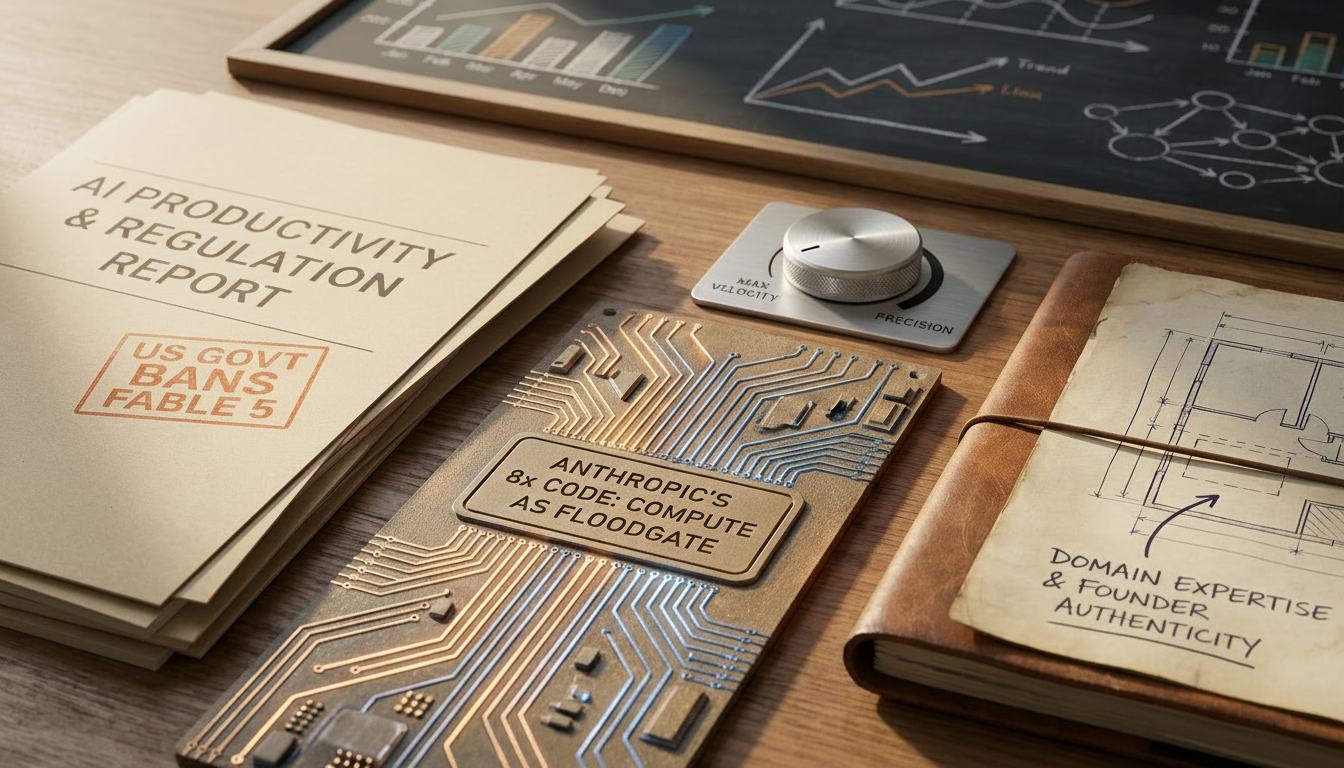
The new rules of engagement demand founders be authentic, not plastic, while the US government navigates the murky waters of AI capability regulation.
The Intake
📊 11 episodes across 7 podcasts
⏱ 748 minutes of intelligence analyzed
🎙 Featuring: Harry Stebbings (The Twenty Minute VC), Nikesh Arora (Palo Alto Networks), Rory O'Driscoll (Benchmark), Everett Randall (Benchmark)
|

The Big Shift
The venture ecosystem is recalibrating around new paradigms for company building and regulatory oversight. Founders are being pushed to redefine authenticity and leverage AI in unprecedented ways, while governments are grappling with regulating AI's rapidly advancing capabilities. This marks a significant departure from traditional playbooks, demanding more from founders and investors alike.
In the new media landscape, the concept of a corporate brand is dissolving into the 'brand as person'. As Marc Andreessen observed, the old media game of being "uninteresting" is dead. Today, direct, authentic engagement defines success, contrasting sharply with the "plastic" corporate communications of the past. This isn't just about social media; it’s about a fundamental shift in how influence is built and maintained. Companies need to tell stories that connect to global events and exhibit a genuine worldview, moving beyond mere product features.
"The brand is now the person. So it's not like were people talking about, like when every Democrat came out and was mad about SpaceX, they weren't. They were mad about Elon because he's a brand new."
— Ben Horowitz, Co-Founder and General Partner at Andreessen Horowitz
Simultaneously, the regulatory landscape for AI is entering uncharted territory, with the US government taking its first steps to regulate AI models based on their capabilities, not just their application. This critical juncture, highlighted by the ban of Anthropic's Fable 5, indicates a "Rubicon moment" for AI governance. The implications are profound, as it sets a precedent for how governments might control advanced AI and raises questions about national sovereignty and access to cutting-edge technology. Both shifts demand a new level of strategic thinking from founders and investors: how to be genuinely interesting in a digitally transparent world, and how to build in a future where your AI's capabilities might be a national security concern.
The Rundown
① AI Engineers Now Ship 8x More Code.
Anthropic engineers, leveraging AI tools like Claude, are now shipping eight times more code per quarter than they did in 2025, fundamentally shifting the bottleneck from coding velocity to ambition and verification. (Fiona Fung on Lenny's Podcast)
→ The signal: This dramatically increased output demands new management approaches and means the game for engineering teams is no longer about writing code, but about scaling creativity, validating AI-generated work, and possessing deep systems expertise.
② SpaceX's $60B Cursor Acquisition Signals Compute Monopoly Plays.
SpaceX’s acquisition of Cursor for $60 billion—at a mere 15x revenue—underscores the critical importance of compute and the growing trend of large platforms acquiring AI application layers to secure compute access and mitigate platform risk. (Jason Calacanis on This Week in Startups)
→ Why it matters: This move highlights a future where compute is the ultimate moat, with startups increasingly needing to "roll their own models" or leverage open-source alternatives to avoid vendor lock-in and unsustainable token costs.
③ Enterprise AI Adoption Requires a "Tesla Approach," Not a "Waymo".
Nikesh Arora argues that enterprise AI implementation demands a gradual, segment-by-segment automation — a "Tesla approach" — rather than a complete, all-at-once overhaul, because the complexity of enterprise workflows prevents immediate full automation. (Nikesh Arora on The Twenty Minute VC)
→ The signal: This framework suggests companies should focus on integrating AI incrementally, automating specific functions like marketing or finance, which could lead to a halving of staff in these areas within three years.
④ US Government Regulation of AI Models Sets New Precedent.
The US government's ban of Anthropic's Claude Fable model based on its capabilities, rather than its application, marks the first time it has officially regulated an AI model based on its potential power, setting a new global precedent. (Harry Stebbings on The Twenty Minute VC)
→ What to watch: This action ignites a global debate over the extent of government control over private AI companies and raises significant questions about future AI innovation and national sovereignty, especially considering the comparable capabilities of open-source models.
⑤ Domain Experts Beat Generalists in AI-Powered Verticals.
In the age of AI, domain experts are winning by building "opinionated solutions" for specific industries, leveraging AI to create highly curated, "anti-slop" products that general-purpose AI struggle to replicate. (Bryant Chou on Y Combinator Startup Podcast)
→ The signal: This underscores that deep industry knowledge combined with AI is the true competitive edge, allowing founders to democratize complex functions like marketing and accelerate product development by creating hundreds of "clones" of themselves.
Signal Board
🔥 Heating Up
• Anthropic: Despite government bans on Fable 5, its share of enterprise customers rose to 41%, surpassing OpenAI, indicating strong market demand and resilience. (Rebecca Bellan on Equity)
• Creator Economy Boom 🆕: Nano and micro-influencers now capture 49% of US creator ad spend, signifying a major shift in advertising budgets and influence. (Scott Galloway on Pivot)
• AI-Driven Marketing Efficiency 🆕: AI is poised to drastically improve marketing conversion rates, boosting efficiency and capturing transaction revenue. (Nikesh Arora on The Twenty Minute VC)
• Authenticity as a competitive advantage in new media 🆕: Founders who are genuinely interesting and authentic are gaining significant traction, defining the new media landscape. (Marc Andreessen on The a16z Show)
👀 On Watch
• Fiona Fung 🆕: As Manager of Claude Code & Cowork Teams at Anthropic, her methods for managing AI-accelerated engineering teams are setting new industry standards. (Lenny Rachitsky on Lenny's Podcast)
• Nikesh Arora 🆕: The Chairman and CEO of Palo Alto Networks is predicting a 90% collapse in AI token prices and a halving of G&A staff in companies due to AI-driven workflow changes. (Harry Stebbings on The Twenty Minute VC)
• Jake Paul 🆕: The multi-hyphenate creator's transition into venture capital with Anti Fund and investments in companies like Anduril and SpaceX represents a new type of founder/investor. (Erik Torenberg on The a16z Show)
• Memory Becomes the Biggest Moat in AI 🆕: The ability for AI applications to retain and apply context over time is emerging as a critical differentiator and source of competitive advantage. (Nikesh Arora on The Twenty Minute VC)
🧊 Cooling Off
• Wix and Adobe: Both companies have hit all-time lows, indicating market skepticism about legacy SaaS businesses in the face of rapid AI innovation and outcomes-based pricing models. (Harry Stebbings on The Twenty Minute VC)
• Traditional Media Gatekeepers 🆕: The power of old media to control narratives and funnel information is declining, as direct communication channels become paramount for founders and companies. (Marc Andreessen on The a16z Show)
• SaaS apocalypse / Trapped TVPI: Valuations for many SaaS companies remain challenging, with the market increasingly favoring AI-native solutions and outcomes-based pricing. (Jason Calacanis on This Week in Startups)
The Debate
The future profitability and valuation of Frontier AI models.
🐂 The bull case: While token costs are expected to fall dramatically, frontier AI models will sustain high prices due to "value maxing" strategies, continually enhancing capabilities to justify premium pricing. Nikesh Arora noted that "The current value maxing means that they're charging more for existing tokens, because the more you do, the more they find out that things can be done." on The Twenty Minute VC, suggesting that continued innovation will maintain value.
🐻 The bear case: The commoditization of AI tokens is inevitable, mirroring other digital utilities like bandwidth. Jason Calacanis argued on This Week in Startups that "If the open source model is a hundred times cheaper and equally good, you’ll use it for major portion of your budget." This implies that as open-source alternatives improve and token prices plummet, the current high valuations for proprietary frontier models are unsustainable.
Our read: Despite strategic pricing, the relentless downward pressure from open-source alternatives and increasing compute efficiency will likely drive down token costs significantly, making the bull case difficult to sustain long-term without continuous, radical innovation.
The Bottom Line
The smartest capital is backing domain experts harnessing AI to build opinionated solutions, as both founders and governments adjust to a new era defined by capability-based regulation and radical authenticity.
📖 Want the full episode breakdowns, guest details, and listen links?
Appendix
1. Y Combinator Startup Podcast — "Why Domain Experts Are Winning In The Age Of AI"
Runtime: 43 min | Host: Y Combinator | Guest: Bryant Chou (Co-founder and CTO, Ploy)
For the Stretched CEO: This episode provides a blueprint for how to leverage AI to democratize complex business functions and gain a competitive edge by focusing on deep domain expertise, rather than general-purpose AI applications.
This discussion highlights Ploy's innovative approach to AI-powered web design, proving that specialized, opinionated AI models are outperforming generic solutions. It underscores the competitive necessity for businesses to integrate high-quality AI tools, as those who don't will fall behind. The episode argues for a future where domain experts, amplified by AI, multiply their output and accelerate development far beyond previous capabilities.
"So many businesses, they have a great product, they have a great service, but there's just so much sort of a met opportunity for these business owners, for these founders, and I'm really just here to make it easier for them to tap into it."
— Bryant Chou, Co-founder and CTO of Ploy
2. This Week in Startups — "Why SpaceX Buying Cursor Changes Everything"
Runtime: 101 min | Host: Jason Calacanis (Host, This Week in Startups) | Guest: Turner Novak (Investor, Banana Capital)
For the Stretched CEO: Listen for critical insights into the evolving M&A landscape, the risks of AI platform dependence, and the strategic importance of owning compute to avoid vendor lock-in.
This episode breaks down SpaceX's acquisition of Cursor, revealing the growing anxieties around platform risk and token costs in the AI ecosystem. It discusses the shift towards open-source models and local AI workstations, cautioning Y Combinator founders against over-reliance on large AI providers. The conversation explores the harsh realities of venture capital, declining seed-stage graduation rates, and the critical need for startups to secure their computational future.
"If you're a Y Combinator company, do not take that deal. Do not trust OpenAI. You need to start working on Frontier model. You need to get off the Frontier models and use open source ones and own your content and not educate them to the extent you can."
— Jason Calacanis
3. The Twenty Minute VC (20VC): Venture Capital | Startup Funding | The Pitch — "20VC: Why Remote Work is White Collar Fraud | Why Revenge and Patriotism are the Best Founder Traits | Two Questions Every Founder Needs to Ask | The Wild Story of Raising $1BN from Masa Son in an Hour Long Meeting with Ryan Peterson, Founder @ Flexport"
Runtime: 79 min | Host: Harry Stebbings | Guest: Ryan Peterson (Founder & CEO, Flexport)
For the Stretched CEO: This offers a raw, contrarian perspective on remote work, founder psychology, and the strategic importance of AI model independence in large enterprises.
Ryan Peterson delves into the logistics market, Flexport's AI strategy, and his strong views on remote work, which he labels "white collar fraud." The conversation covers the complexities of fundraising, venture capital herd behavior, and the critical balance between proprietary and open-source AI models for cost and dependency mitigation. Peterson also shares insights from his angel investing career and the psychological drivers of successful founders.
"I say it's white collar fraud. I have a three year old and a five year old. The idea that I could do any work at my house is like a total fantasy."
— Ryan Peterson, Founder & CEO at Flexport
4. Equity — "The US banned Anthropic's Fable 5 release, but the numbers don't seem to care"
Runtime: 33 min | Host: Anthony Ha (Host, TechCrunch) | Guest: Sean O'Kane (Senior Reporter, TechCrunch)
For the Stretched CEO: This episode is essential for understanding the emerging regulatory landscape for AI, the interplay between national security and tech innovation, and the surprising influence of government actions on market perception.
This episode analyzes the US government's ban on Anthropic's Fable 5 model, sparking debate about whether it's a genuine security imperative or political maneuvering. It examines the potential implications for AI companies and the unexpected benefits for Anthropic. The hosts also discuss SpaceX's valuation, Jeff Bezos's new "artificial engineers" venture, and the challenges of specialized AI model training, highlighting the critical need for accuracy in fields like aerospace engineering.
"Anthropic's most recent models, like Opus 4.8, that is so popular with businesses right now. In May, Anthropic share of, you know, enterprise customers rose to 41%. That's above OpenAI is 39.5."
— Rebecca Bellan, Host at TechCrunch
5. Pivot — "Trump's Iran Deal, SpaceX’s Wild Ride, and Snap’s Specs"
Runtime: 66 min | Host: Kara Swisher (Host, New York Magazine) | Guest: Scott Galloway (Professor of Marketing, New York University Stern School of Business)
For the Stretched CEO: This provides a critical evaluation of high-profile tech valuations, geopolitical maneuvers, and the challenges faced by hardware ventures in a soft market.
Kara Swisher and Scott Galloway dissect the controversial new Iran deal, comparing its weaknesses to the original JCPOA. They discuss the overhyped valuation of SpaceX and the retail investor risks associated with meme stocks. The episode also critiques Snap's "Specs" AR smart glasses, predicting the product's failure due to high cost, poor battery life, and continued market indifference, suggesting an activist investor might force a spin-off of Snap's hardware division.
"Unfortunately, the American public rewards that doubling down as opposed to being contemplative and recognizing that a step back from the wrong direction is a step in the right direction."
— Scott Galloway, Professor of Marketing at New York University Stern School of Business
6. The Twenty Minute VC (20VC): Venture Capital | Startup Funding | The Pitch — "20VC: Nikesh Arora on the Frontier Model Problem: Breadth vs Depth | The Future of Token Costs | Memory Becoming the Moat | Where Value Accrues: Infra, Models, or Apps? | Why Enterprise AI is Not Ready & Systems of Record vs Systems of Intelligence"
Runtime: 74 min | Host: Harry Stebbings | Guest: Nikesh Arora (Chairman and CEO, Palo Alto Networks)
For the Stretched CEO: This offers a strategic roadmap for implementing AI in large organizations, anticipating the collapse of AI token prices, and preparing for significant workforce transformations in marketing, finance, and HR.
Nikesh Arora, CEO of Palo Alto Networks, explores the "breadth vs. depth" problem of frontier models, arguing for profound context in enterprise AI. He predicts a 90% decrease in AI token prices and a radical restructuring of enterprise workflows, potentially halving G&A staff. Arora emphasizes rethinking workflows with AI, comparing it to Tesla's gradual automation approach over Waymo's complete overhaul. The discussion also touches on the inefficiency of consumer goods marketing and AI's potential to capture new transaction revenue.
"I think the long term token pricing should be one tenth of what it is today."
— Nikesh Arora, Chairman and CEO of Palo Alto Networks
7. Lenny's Podcast: Product | Career | Growth — "Building the most AI-pilled engineering team in the world | Fiona Fung (Manager of the Claude Code and Cowork Teams)"
Runtime: 99 min | Host: Lenny Rachitsky | Guest: Fiona Fung (Manager of the Claude Code and Cowork Teams, Anthropic)
For the Stretched CEO: This is a masterclass in re-thinking engineering management and team structure in an AI-accelerated world, offering actionable strategies for maximizing productivity and managing growth.
Fiona Fung of Anthropic discusses how AI has enabled engineers to ship eight times more code, shifting the focus from coding to verification and ambition. She details a novel management approach using Claude for oversight and tracks progress, emphasizing the need for a growth mindset. The conversation highlights the value of "dogfooding," creative builders, deep systems experts, and the shift towards asynchronous work, providing insights into maintaining company culture and measuring productivity in an AI-first environment.
"Anthropic engineers on average have eight times as much code per quarter as they did compared to 2025. Coding is no longer the bottleneck. It's lifted the ceiling of what anyone is able to do. Everything is now possible in theory. Now it's about how ambitious can you be?"
— Fiona Fung, Manager of the Claude Code and Cowork Teams at Anthropic
8. The Twenty Minute VC (20VC): Venture Capital | Startup Funding | The Pitch — "20VC: SpaceX Soars to $2.7TRN | Anthropic's Fable Banned by US Government | Wix and Adobe Hit All-Time Lows | Mistral Raising at $20BN and The Case for Sovereign Models | Fin Acquired by Salesforce for $3.6BN"
Runtime: 85 min | Host: Harry Stebbings | Guest: Rory O'Driscoll (Partner, Benchmark)
For the Stretched CEO: This episode offers critical insights into the real forces driving high-stakes valuations like SpaceX, the global implications of AI regulation, and a successful AI-driven exit blueprint for legacy SaaS.
This discussion tackles SpaceX's $2.7 trillion IPO, analyzing its unique trading dynamics and Elon Musk's wealth surge. It delves into the unprecedented US government ban on Anthropic's Claude Fable model based on capabilities, marking a "Rubicon moment" for AI regulation. The hosts also discuss the $3.6 billion acquisition of Fin by Salesforce, highlighting Fin's successful pivot to an outcomes-based AI model and contrasting it with the struggles of legacy SaaS companies like Wix and Adobe.
"It's the first time that the US has ostensibly regulated an AI model based on capabilities... Unparalleled US Government bans it by Thursday, igniting this kind of global sovereignty argument over how far should governments reach into private companies."
— Harry Stebbings
9. The a16z Show — "Jake Paul & Anti Fund: From Creator to Investor"
Runtime: 66 min | Host: Erik Torenberg | Guest: Jake Paul (Co-founder, Anti Fund)
For the Stretched CEO: This explores a new breed of founder-investor, blending celebrity influence with serious venture capital, and offers insights into leveraging a personal brand in a crowded market.
Jake Paul and Geoff Woo unveil their $100 million Anti Fund, with investments in major tech players. They discuss Jake's entrepreneurial journey from entertainment to boxing to tech investing, emphasizing resilience, analytics, and networking. The conversation examines the evolution of the creator economy, the increasing difficulty of organic growth, and Jake's focus on educational reform and financial literacy. It delves into the concept of personal brands as "startups" that become resilient to AI-generated content and public scrutiny.
"To go from like go entertainment mode to like serious quantitative analytic mode, that broadly is very, very impressive. One, and then two, I think Jake has the one word that you mentioned is that resiliency."
— Geoff Woo
10. The a16z Show — "The New Rules of Media | Marc Andreessen & Ben Horowitz"
Runtime: 41 min | Host: Erik Torenberg | Guest: Marc Andreessen (Co-Founder and General Partner, Andreessen Horowitz)
For the Stretched CEO: This is a foundational primer on how to effectively communicate in the modern media environment, essential for any leader aiming to build an authentic brand and engage with criticism strategically.
Marc Andreessen and Ben Horowitz discuss the radical shift from traditional, centralized media to a new landscape where authenticity and direct communication are paramount. They argue that the "brand is the person," requiring founders and companies to be interesting and engage directly, rather than relying on "plastic" corporate communications. The episode covers critical strategies for media training, engaging with criticism as a brand-building opportunity, and the necessity of connecting a company narrative to global events.
"The one rule of old media is don't be interesting. Like, that's the worst thing you can do. You'll f*** everything up."
— Ben Horowitz, Co-Founder and General Partner at Andreessen Horowitz
11. Pivot — "Starmer Resigns, Reflecting Pool Fiasco, and Amazon Dumps OpenAI Movie"
Runtime: 61 min | Host: Kara Swisher (Host, New York Magazine) | Guest: Scott Galloway (Professor of Marketing, New York University Stern School of Business)
For the Stretched CEO: This episode offers insights into the shifting power dynamics between tech giants and political figures, as well as the commercial implications of AI investments in media decision-making.
Kara Swisher and Scott Galloway discuss political dramas, including Trump's claims regarding the Lincoln Memorial reflecting pool and Keir Starmer's resignation. They delve into Trump's contentious diplomatic style and the booming creator economy's impact on ad spend. The hosts also explore the complex relationship between tech billionaires and political influence, suggesting a shift from "buying influence" to a "protection racket." Amazon's cancellation of an OpenAI-related film due to its investments is also discussed, alongside the "buy, borrow, die" wealth accumulation strategy.
"If you're worth a quarter of a trillion dollars and still kissing the ass of the President, this has moved from buying influence to renting protection. This is a transition for a pay for play democracy to something even worse."
— Scott, Host of Pivot