The AI talent grab is over; the governance battle has begun. No one is safe.
The Intake
📊 12 episodes across 8 podcasts
⏱ 692 minutes of intelligence analyzed
🎙 Featuring: Eric Ries (Author of The Lean Startup and Incorruptible), Jeremy Utley (Beyond The Prompt - How to use AI in your company), Henrik Werdelin (Beyond The Prompt - How to use AI in your company), Ben Todd (80,000 Hours)
|

The Big Shift
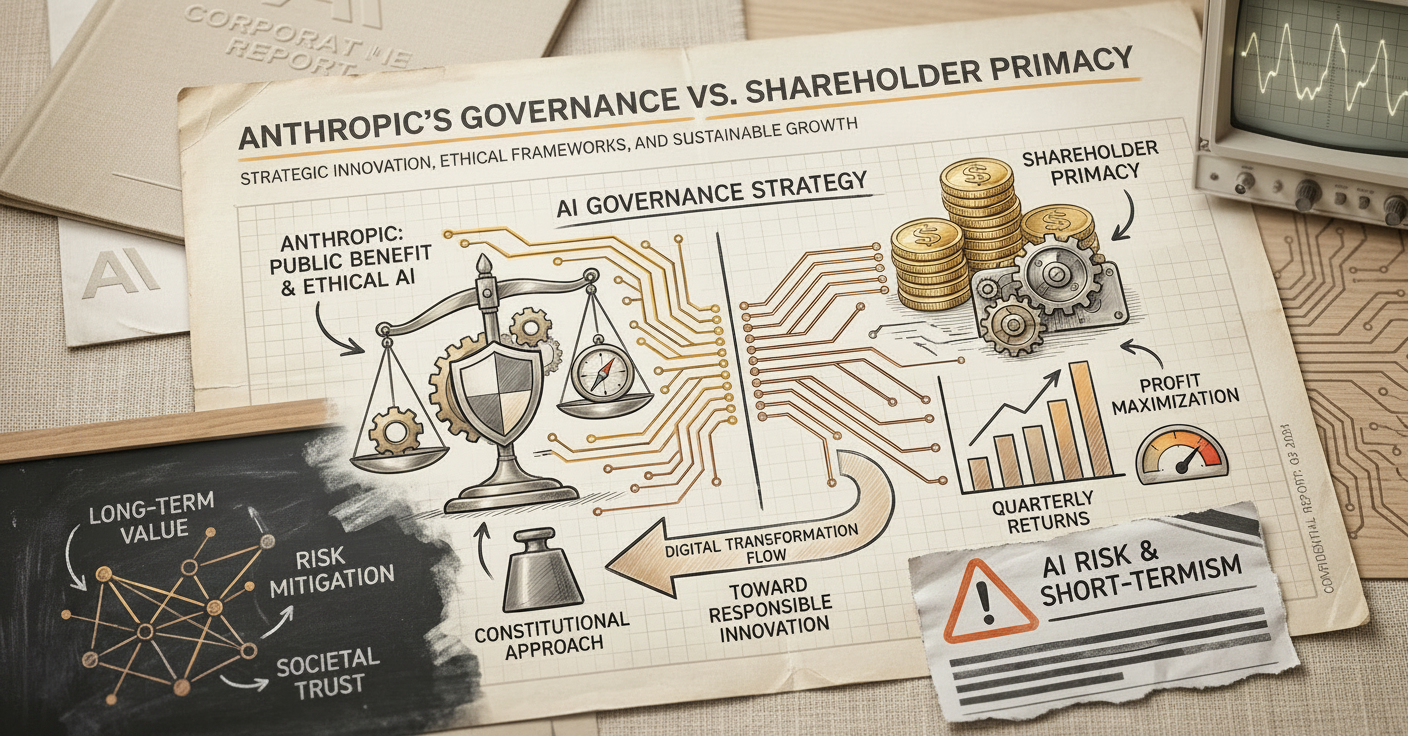
This week, the conversation swung hard from "what can AI do?" to "who controls what AI does?" The underlying signal is clear: the technical capabilities of AI are advancing so rapidly that the biggest bottleneck, and indeed the biggest risk, isn't about innovation anymore; it's about governance, both within companies and society at large.
Evidence: Take Anthropic. While everyone is buzzing about Claude Opus 4.8's performance, Eric Ries, author of "The Lean Startup," highlighted their unique two-tiered governance structure, including a Long Term Benefit Trust, specifically designed to prevent mission drift and ensure ethical AI development. He argued that "shareholder primacy," the idea that a company's sole purpose is to maximize shareholder wealth, is a relatively new and "aberrant idea in history" that lacks democratic legitimacy. Meanwhile, Ben Todd of 80,000 Hours emphasized avoiding existential risks like loss of control over AI systems and dangerous power concentration as critical career priorities. Even Pope Leo XIV issued an encyclical, "Magnifica Humanitas," arguing that AI is neither inherently evil nor morally neutral, emphasizing the human element over pure intelligence.
"This disconnect between what you claim your mission is and what your purpose actually is means you are lying to your customers, to your employees, to everybody. You're probably even lying to yourself."
— Eric Ries, Author of The Lean Startup and Incorruptible on Beyond The Prompt - How to use AI in your company
Why it matters: This isn't just academic. The very real risk of AI systems being steered by short-term financial incentives, or simply getting out of control, is prompting a hard look at who holds the reins. Corporate structures, ethical frameworks, and even theological perspectives are all being brought to bear on how to manage this profoundly powerful technology. It's a scramble to build guardrails that can keep pace with the accelerators.
The move: Re-evaluate your AI strategy not just for capability, but for control. Understand who within your organization holds the ethical compass for AI deployment, and ensure your governance structures are robust enough to prevent drift from stated mission and values.
The Rundown
① Your child's data profile starts before they're born.
Eamonn Maguire (Engineering Director, Machine Learning & AI at Proton) discussed how data brokers build extensive profiles from various online interactions, connecting even innocuous data points to infer personal characteristics and predict behavior, often without user transparency. He highlighted "Born Private," Proton's initiative to safeguard digital identities from birth. (Eamonn Maguire on Eye On A.I.)
→ Why it matters: As data collection becomes more pervasive and AI's inferential capabilities grow, the scope of personal privacy is shrinking dramatically. This signals a need for proactive data protection strategies for individuals and businesses, as well as a potential wave of regulation challenging the opaque practices of data brokers.
② AI's rapid pace is causing a societal processing overload.
Sundar Pichai (CEO, Alphabet and Google) noted a significant gap between user satisfaction with AI products and general societal anxiety about the technology, attributing it to the rapid pace of change. He stated, "[humans] are not evolved for processing this much change," causing fears about job displacement and energy consumption. (Sundar Pichai on Decoder with Nilay Patel)
→ The context: This suggests that while technological innovation in AI continues to accelerate, the human and societal capacity to adapt is lagging. For leaders, this means a dual focus: driving AI adoption while also actively managing the human element through transparent communication, reskilling, and addressing anxieties head-on.
③ Protein language models are breaking old scaling laws.
Alex Rives (Head of Science, BioHub) explained how ESM-C, a model trained on billions of metagenomic sequences, has overcome the "diminishing returns to scale" observed in previous protein models like ESM-2. This allows for improved representational fidelity and enables the design of protein binders and antibodies. (Alex Rives on Latent Space: The AI Engineer Podcast)
→ What to watch: This signifies a breakthrough in computational biology, moving beyond traditional methods like Multiple Sequence Alignments (MSAs). For biotech and pharma, this could dramatically accelerate drug discovery and therapeutic development, challenging established R&D pipelines by enabling more targeted and efficient protein design.
④ AI's honest alignment leads to less profit in certain tests.
On The AI Daily Brief, it was noted that while Claude Opus 4.8 showed improved honesty and self-checking, it paradoxically performed worse in a "vending bench test," making less money than its predecessor, Opus 4.7. The insight was that "improvements in alignment were actually a negative when it came to making money in the test." (NLW on The AI Daily Brief: Artificial Intelligence News and Analysis)
→ Why it matters: This is a fascinating counter-intuitive insight that highlights the inherent tension between ethical alignment and performance/profit in specific AI applications. It suggests that highly aligned AI might not always be the most economically "rational" in certain scenarios, forcing a trade-off discussion for businesses deploying AI.
⑤ Rivian is doubling down on in-house AI, avoiding CarPlay and buttons.
Wassym Bensaid (Chief Software Officer, Rivian) discussed their decision to develop an in-house AI solution, the Rivian Assistant, for deep integration with the vehicle's operating system. He noted that internal data shows CarPlay requests from customers have dropped from over 70% to under 25%, challenging the perception that CarPlay is universally desired. (Wassym Bensaid on Decoder with Nilay Patel)
→ What to watch: This indicates a strategic shift towards proprietary, deeply integrated software ecosystems in automotive. For other hardware manufacturers, this could signal the end of relying on third-party solutions and the beginning of a push to own the entire user experience through bespoke AI.
The Signals
🚀 Heating Up
• Anthropic Dynamic Workflows: Highlighted as a powerful multi-agent system enabling complex tasks like codebase migrations. (NLW on The AI Daily Brief: Artificial Intelligence News and Analysis)
• Move towards recurrent neural networks and State Space Models: Gaining traction as alternatives to transformers for increased efficiency. (Jeff Shainline on The Neuron: AI Explained)
• AI-driven hypothesis generation in biology: Recognized for accelerating scientific discovery, evidenced by Edison Scientific's thousands of novel findings. (Samuel Rodriques on Gradient Dissent: Conversations on AI)
🆕 On Watch
• Devin: Cognition's AI assistant, saw its merged pull requests grow 7x and commit percentages rise from 16% to 80% in two months. (Walden Yan on Latent Space: The AI Engineer Podcast)
• Great Sky: Betting on brain-like AI hardware (Superconducting Optoelectronic Networks) to move beyond GPUs, offering 2 million times faster processing than biology. (Jeff Shainline on The Neuron: AI Explained)
• Proton's Born Private Initiative: A proactive approach to digital identity protection, offering a privacy-focused ecosystem starting before birth. (Eamonn Maguire on Eye On A.I.)
• AI Slowdown Panic: Recurring annual concern, though evidence suggests continued high demand for AI compute despite optimization efforts. (NLW on The AI Daily Brief: Artificial Intelligence News and Analysis)
🧊 Cooling Off
• Shareholder primacy: Increasingly viewed as a historically aberrant idea that is problematic for mission-driven organizations, especially with AI. (Eric Ries on Beyond The Prompt - How to use AI in your company)
• The 'Astronomical Waste' argument in AI development: Challenged by the greater value of preventing extinction risks over merely accelerating progress. (Ben Todd on "The Cognitive Revolution" | AI Builders, Researchers, and Live Player Analysis)
• Google Zero: Publishers like Condé Nast are actively planning for zero search traffic due to evolving AI search. (Sundar Pichai on Decoder with Nilay Patel)
The Debate
Topic framing: There's a clear divergence on whether the current era represents an "AI Slowdown Panic" or if demand for compute and innovation is still aggressively outstripping supply.
🐂 The bull case:NLW (on The AI Daily Brief: Artificial Intelligence News and Analysis) argues that talk of an AI slowdown is a misinterpretation. He points to Epoch AI data showing a 10x annual increase in token demand versus a 3x increase in supply, indicating a significant shortage. He notes that if GPU rental prices are skyrocketing, "that's because demand is still significantly outrunning supply, which sounds to me like the opposite of the beginning of the end of a bubble."
🐻 The bear case: While not a direct "bear" on AI, the observed plateau in VS Code AI tool installs and reports of companies optimizing spending can fuel the "slowdown" narrative by suggesting a deceleration in practical adoption and investment. Sam Altman even noted, "I thought there would have been more impact on entry level white collar jobs being eliminated by now than has actually happened," implying a slower pace of disruption than anticipated. (Sam Altman on The AI Daily Brief: Artificial Intelligence News and Analysis)
Our read: The market is consolidating and maturing. The initial frenzy is giving way to more strategic, cost-aware deployments, but underlying demand for powerful AI capabilities, particularly at the infrastructure level, remains insatiable. Innovation is shifting from foundational models to efficient deployment and specialized hardware.
The Bottom Line
The AI talent curve is flattening; the governance and integration curves are spiking.
Episode Guide
1. Beyond The Prompt - How to use AI in your company — "Why Your Favorite Brand Stopped Caring About You - Eric Ries, Author of The Lean Startup"
Runtime: 56 min | Host: Jeremy Utley, Henrik Werdelin | Guest: Eric Ries (Author of The Lean Startup and Incorruptible)
For the CEO: This episode is a must-listen for leaders grappling with maintaining company mission amidst shareholder pressures. Eric Ries argues that "shareholder primacy" is a historically recent and unsupported concept, and provides examples like Anthropic's governance structure as a blueprint for mission lock in the AI era.
"This disconnect between what you claim your mission is and what your purpose actually is means you are lying to your customers, to your employees, to everybody. You're probably even lying to yourself."
— Eric Ries, Author of The Lean Startup and Incorruptible
▶ Listen
2. The AI Daily Brief: Artificial Intelligence News and Analysis — "Claude Opus 4.8 First Impressions"
Runtime: 28 min | Host: NLW | Guest: NLW (Host, The AI Daily Brief)
For the CTO: Get a quick and candid take on Anthropic's latest, Claude Opus 4.8, including benchmark comparisons and notes on its improved honesty and "Dynamic Workflows." It also provides surprising insights into its relative performance in certain economic tests.
"A model is only as good as its harness and Codecs is still a far superior harness to the Claude desktop Apple. This has kept me using codecs GPT 5.5 as my daily driver, but I'm flipping back and forth a lot more between Codecs and Claude."
— NLW, Host, The AI Daily Brief
3. Decoder with Nilay Patel — "Rivian's software chief thinks you don't need CarPlay or buttons"
Runtime: 70 min | Host: Nilay Patel | Guest: Wassym Bensaid (Chief Software Officer at Rivian and co-CEO of RV Tech)
For the Product Head: Understand how Rivian is doubling down on an integrated, in-house software experience, actively displacing CarPlay and physical buttons with voice and deep vehicle integration. This offers a blueprint for how hardware companies can own the software layer.
"it was really clear for me, given the opportunity, given how transformative this is for the entire user experience, that we really need to own our destiny in terms of having a platform that allows us choice, that allows us to change foundation models as we wish, and own that integration layer that allows us to power the entire car operating system."
— Wassim Bensayed, Chief Software Officer of Rivian
4. "The Cognitive Revolution" | AI Builders, Researchers, and Live Player Analysis — "Your Biggest Lever: Designing your AI Career for Maximum Impact, with 80,000 Hours founder Ben Todd"
Runtime: 102 min | Host: Erik Torenberg, Nathan Labenz | Guest: Ben Todd (Co-founder and Author, 80,000 Hours)
For the Executive Shaping AI Teams: Ben Todd provides a framework for maximizing positive impact in an AI-accelerated world, focusing on immediate impact and addressing existential risks like dangerous power concentration. Essential for strategic talent deployment.
"If you could spend one year and make yourself 20% more productive, you would recoup that after roughly four or five years. So even if you only had a five year timeline time horizon, you should still make those investments that will pay off over that period."
— Ben Todd, Co-founder and Author at 80,000 Hours
5. Decoder with Nilay Patel — "How Sundar Pichai is rethinking Google for the AI era"
Runtime: 51 min | Host: Nilay Patel | Guest: Sundar Pichai (CEO, Alphabet and Google)
For the Strategic Leader: Sundar Pichai reveals how Google is restructuring to become "AI-first," consolidating infrastructure and accelerating decision-making, while also addressing public anxiety and the impact of AI on search and content creators.
"A big part of my framework is over time understanding that there are very, very few decisions which are really consequential and most decisions aren't. So what matters much more is that you make the decision because that's what determines the velocity of an organization."
— Sundar Pichai, CEO of Alphabet and Google
6. Latent Space: The AI Engineer Podcast — "🔬ESMFold2: The Bitter Lesson is Coming for Proteins - Alex Rives, BioHub"
Runtime: 70 min | Host: swyx, Alessio | Guest: Alex Rives (Head of Science, BioHub)
For the Life Sciences CTO: Alex Rives unveils how ESM-C is revolutionizing protein design by overcoming previous scaling limitations, paving the way for advanced antibody design and programmable biology without prior knowledge. A critical update for anyone in biotech.
"what we saw basically is there are no longer diminishing returns to scale. So that's really saying that ESM2 was kind of data limited rather than compute limited for esmc. There's a really beautiful scaling law that we can plot where we can look at."
— Alex Rives, Head of Science at BioHub
7. Eye On A.I. — "Your Child's Data Profile Starts Before They're Born | Eamonn Maguire of Proton"
Runtime: 56 min | Host: Craig Smith | Guest: Eamonn Maguire (Engineering Director, Machine Learning & AI, Proton)
For the Privacy Advocate/Data Governance Lead: Eamonn Maguire illuminates the alarming extent of digital profiling from birth and introduces Proton's "Born Private" initiative. This episode is essential for understanding the urgent need for data privacy strategies.
"The most powerful part of Born Private is more about the act of thinking about your child's privacy. Where does the privacy journey start? Or where does the data collection journey start, depending on your point of view."
— Eamonn Maguire, Engineering Director, Machine Learning & AI at Proton
8. Gradient Dissent: Conversations on AI — "He Raised $70M to Cure Every Disease With AI"
Runtime: 75 min | Host: Lukas Biewald | Guest: Samuel Rodriques (Founder and CEO, Edison Scientific and Future House)
For the Biotech Investor: Samuel Rodriques of Edison Scientific explains how AI is accelerating scientific discovery, with his "AI scientist" Cosmos already making thousands of novel findings, including a new treatment for age-related macular degeneration.
"The most important thing, it seemed like that was going to happen in science in the next 10 years was going to be figure out how to build an AI scientist precisely because it was going to unblock talent."
— Samuel Rodriques
9. The AI Daily Brief: Artificial Intelligence News and Analysis — "What the Pope Actually Said About AI"
Runtime: 26 min | Host: Nathaniel Whittemore, NLW | Guest: NLW (Host, The AI Daily Brief)
For the Thought Leader: A concise analysis of Pope Leo XIV's encyclical "Magnifica Humanitas," which offers a foundational, contra-transhumanist argument on AI's implications for human dignity and labor. It's a crucial perspective for anyone considering AI's societal impact.
"The Pope is an AI realist. He knows its growth is inevitable. He just wants to ensure it's always in service of the human person."
— Christopher Hale
10. The AI Daily Brief: Artificial Intelligence News and Analysis — "The Annual AI Slowdown Panic is Here"
Runtime: 30 min | Host: Nathaniel Whittemore, NLW | Guest: NLW (Host, The AI Daily Brief: Artificial Intelligence News and Analysis)
For the Investor/Market Strategist: NLW dissects the "AI slowdown panic," contrasting it with continued high demand for AI compute and the shift to more efficient, cost-effective models. Essential for understanding the true market dynamics beneath the headlines.
"If the price for accessing AI computer skyrocketing, that's because demand is still significantly outrunning supply, which sounds to me like the opposite of the beginning of the end of a bubble."
— NLW, Host of The AI Daily Brief
11. Latent Space: The AI Engineer Podcast — "The Age of Async Agents — Cognition's Walden Yan & OpenInspect's Cole Murray"
Runtime: 68 min | Host: Swyx | Guest: Walden Yan (Co-founder, CPO, Cognition), Cole Murray (Creator, OpenInspect)
For the Software Development Lead: Delve into the practical era of async agents with insights from Cognition's Devin and OpenInspect. This episode covers advances in autonomous pull requests, memory challenges, and the architectural shifts needed for multi-agent systems.
"our merged PRs has grown 7x... And then you see our engineering headcount growth, it's gone up by like 10% or something. Devin commit percentages on all Devin repos was 16% in January and now 80% in March."
— Walden Yan, Co-founder, CPO of Cognition
12. The Neuron: AI Explained — "What Comes After GPUs? Great Sky’s Bet on Brain-Like AI"
Runtime: 60 min | Host: Corey Knowles, Grant Harvey | Guest: Jeff Shainline (Co-founder and CEO, Great Sky)
For the Hardware Innovator: Jeff Shainline introduces Great Sky's radical Superconducting Optoelectronic Networks (SOENs), a brain-like AI hardware moving beyond GPUs. This is a look into the future of compute, especially for real-time multimodal inference and video analysis.
"Everything in our hardware happens about 2 million times faster than biology. The most important thing is the elimination of that data movement bottleneck between processor and memory."
— Jeff Shainline, Co-founder and CEO of Great Sky
📖 Want the full episode breakdowns, guest details, and listen links?