
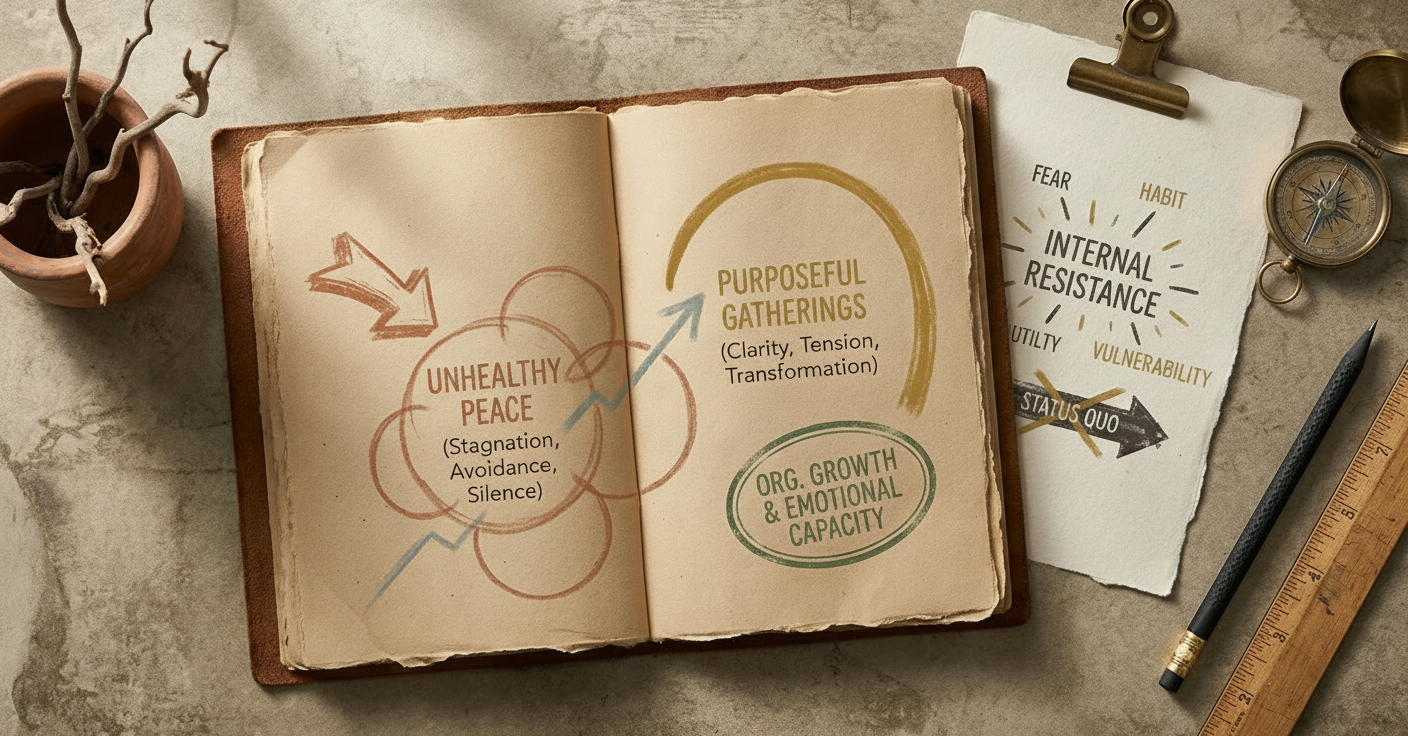
The deepest struggles — be they personal, organizational, or societal — aren't about lacking ability, but about wrestling with identity and allowing oneself to expand.
📊 12 episodes across 9 podcasts
⏱ 1009 minutes of intelligence analyzed
🎙 Featuring: Sarah Jakes Roberts, Dr. Rhonda Patrick PhD, Sonja Lyubomirsky
|

The Big Shift
This week revealed a powerful undercurrent: our biggest limitations often stem from self-imposed ceilings on what we believe we deserve and are capable of. Whether it's embracing success, accepting love, or building effective organizations, the common thread is an internal struggle with growth. The nervous system, it turns out, treats the arousal of intense pleasure from success similarly to the threat of failure, leading to subtle self-sabotage as a metabolic avoidance mechanism (Joe Hudson on The Art of Accomplishment). This isn't about external barriers; it's about the deep-seated fear of our own expansion.
The implications are profound: we often discount ourselves, as noted by Sarah Jakes Roberts on The Mel Robbins Podcast, creating an "unhealthy peace" (Priya Parker on The Mel Robbins Podcast) that prioritizes stability over genuine connection or achievement. This internal resistance manifests in how we receive affection, how we approach health, and even how organizations adapt to change. Leaders and individuals who navigate this shift successfully are those who understand that true humility isn't about keeping oneself small, but about allowing the full feeling of success and expansion into their system. It's about consciously expanding one's "window of tolerance" for emotional arousal, both positive and negative, to foster growth across all domains.
"You cannot heal while you are still punishing yourself."
— Sarah Jakes Roberts, New York Times bestselling author, pastor, speaker on The Mel Robbins Podcast
For any leader, this insight reshapes how to think about strategy. It suggests that stagnation in an organization might not be due to a lack of good ideas or market conditions, but a collective nervous system resistance to the growth, change, and "heat" required to achieve true breakthroughs. The strategy becomes not just about external execution, but internal permission for success.
The Rundown
① Your Gut Health is a Window, Not a Wall.
Dr. Giulia Enders (Physician and Microbiome Researcher) on The Knowledge Project debunks the myth of a fragile gut, emphasizing its robustness if treated correctly, and highlights stool consistency and color as essential health indicators. (Dr. Giulia Enders on The Knowledge Project)
→ The implication: Shifting focus from fragile complexity to resilient functionality informs a more proactive and less anxious approach to personal well-being, suggesting leaders can apply similar diagnostic thinking to organizational health.
② Short Bursts of Intensity Outperform Lengthy Endeavors.
The 10,000 steps a day guideline originated from a 1960s Japanese pedometer marketing campaign, not science, and is far less impactful than short, vigorous exercise. Mel Robbins and Dr. Rhonda Patrick discuss that engaging in just nine minutes a day (three minutes, three times daily) of 'breathless' vigorous activity can lead to a 40% reduction in all-cause and cancer mortality, and a 50% reduction in cardiovascular mortality (Mel Robbins on The Mel Robbins Podcast).
→ The implication: Efficiency in health directly translates to efficiency in business; targeted, high-intensity efforts often yield disproportionately better results than prolonged, low-intensity ones, particularly when scaling impact.
③ Online Profile Fatigue Creates an Opening for Virtue.
Ezra Klein (Journalist & Political Commentator) argues that the 'arms race of bullshittery' online creates public fatigue, suggesting a shift towards a 'sunny' and more 'virtuous' aesthetic will be the winning political strategy in the coming years. (Ezra Klein on Modern Wisdom)
→ The implication: As digital noise overwhelms, authenticity and principled stances will increasingly cut through, signaling a pivot point for brand and leadership messaging toward genuine presence over performative outrage.
④ Attachment Styles Aren't Fixed.
Dr. Paul Eastwick (Professor of Psychology) explains that an individual's attachment style can transform within a relationship; for example, an avoidantly attached person can become more secure over time with a supportive partner. (Dr. Paul Eastwick on Huberman Lab)
→ The implication: This challenges the notion that attachment styles are immutable, suggesting that intentional relationship dynamics can reshape fundamental behavioral patterns, a powerful insight for team building and conflict resolution.
⑤ Purpose, Not Just Presence, Defines Engagement.
Priya Parker (Author of The Art of Gathering) argues that the biggest mistake made in gatherings is skipping the definition of purpose, leading to disappointment rather than organic fun. (Priya Parker on The Mel Robbins Podcast)
→ The implication: For any meeting, event, or team gathering, a clear, even disputable, purpose must be established upfront to drive genuine engagement and avoid "unhealthy peace" where conflict is avoided at the expense of progress.
⑥ Negativity Bias Tilts Our Perception More Than We Realize.
Alison Ledgerwood (Psychologist) on Hidden Brain explains that our brains look for and hold onto negative information more strongly, making it harder to shift from a negative frame to a positive one. (Alison Ledgerwood on Hidden Brain)
→ The implication: Leaders must actively counter human cognitive defaults by consciously framing challenges and successes, recognizing that positive shifts require more deliberate effort to embed in collective perception.
Signal Board
🔥 Heating Up
• Negativity Bias 🆕: Our brains inherently gravitate towards and retain negative information more strongly, impacting perception and decision-making by making it harder to shift to positive frames. (Alison Ledgerwood on Hidden Brain)
• Feeling Loved: Connection, often through simple acts like gratitude or kindness, is the key to happiness and feeling loved, regardless of attachment styles. (Sonja Lyubomirsky on Modern Wisdom)
• Vigorous Intermittent Lifestyle Activity (VILPA) Health Benefits: Short bursts of intense, 'breathless' exercise (like 3 minutes, 3 times a day) offer disproportionately higher reductions in all-cause, cardiovascular, and cancer mortality compared to prolonged moderate activity. (Dr. Rhonda Patrick PhD on The Mel Robbins Podcast)
• Psychological Safety in Incident Response: A culture of psychological safety and intellectual honesty prevents prolonged outages and fosters a "learning culture" over a "blame culture." (Mike Schroepfer on Worklife with Adam Grant)
👀 On Watch
• Unhealthy Peace 🆕: The avoidance of conflict in relationships and teams can lead to deeper, unresolved issues, whereas "healthy heat" (structured conflict) is necessary for genuine connection and growth. (Priya Parker on The Mel Robbins Podcast)
• Gender Differences in Attractiveness and Earning Potential Preferences 🆕: While initial partner selection shows no gender differences in preferences for younger partners, financial status is equally important to men and women, challenging common stereotypes. (Dr. Paul Eastwick on Huberman Lab)
• Visualize Complete Failure and Success to Expand Identity/Emotional Capacity 🆕: Preemptively facing extreme outcomes in visualization exercises can expand one's window of tolerance for both pleasure and threat, reducing self-sabotage. (Joe Hudson on The Art of Accomplishment)
• Discrediting the 10,000 Steps A Day Myth: The widely accepted 10,000 steps per day target originated as a 1960s Japanese marketing ploy for pedometers, not scientific research, and is less effective than short, vigorous activity. (Dr. Rhonda Patrick PhD on The Mel Robbins Podcast)
🧊 Cooling Off
• Love Languages: The idea that matching "love languages" predicts relationship strength has been debunked; all individuals value words of affirmation and quality time, making universal expressions of care more important. (Sonja Lyubomirsky on Modern Wisdom)
• The "Fragile Gut" Narrative: The gut is far more robust than commonly believed and can take a lot if treated correctly, challenging the perception of its extreme delicacy. (Dr. Giulia Enders on The Knowledge Project)
The Tension
The tension lies in the nature of ambition and success: Is success about the external accumulation of achievements, or the internal capacity to handle growth?
🔵 One view: Success is an external pursuit, measured by objective achievements. This perspective drives the relentless pursuit of goals, believing that feeling good about oneself comes from reaching milestones. While not explicitly stated as a direct viewpoint, this perspective is implied by the societal framing of success that often leads to self-sabotage near the finish line.
🔴 The counter: The deeper challenge isn't acquiring success, but allowing oneself to experience it fully, which requires an expanded internal capacity. Joe Hudson (Host of The Art of Accomplishment) argues, "Humility isn't thinking less of yourself, it's thinking of yourself less. And there's a way in which allowing that feeling of success in your system actually makes you think of yourself less because you're less compulsive." This view posits that the discomfort of success often triggers the nervous system as much as failure, leading to self-sabotage borne from an inability to tolerate "too much" good feeling.
What's at stake: Leaders who don't understand this internal dynamic may push their teams and themselves to achieve externally, only to find psychological or organizational breakdowns at the cusp of breakthrough, indicating that internal "growth capacity" is as critical as external capability.
The Bookshelf
The Art of Gathering by Priya Parker
Priya Parker emphasized this book's core message: successful gatherings aren't about passive fun, but about clear purpose and intentional design. (Mentioned on The Mel Robbins Podcast)
A Phone Is a Cow: How Pioneers of the Mobile Revolution Help Millions Lift Th.emselves out of Poverty by Philip Auerswald
Philip Auerswald discusses how his book highlights the mobile phone's role as a productive asset in developing nations, akin to livestock, rather than a luxury good. (Mentioned on EconTalk)
Your Move
• Audit Your Internal Barriers: Identify where you or your team might be self-sabotaging near success due to an inability to tolerate positive emotional arousal. Use visualization techniques to mentally rehearse and expand tolerance for both extreme success and failure.
• Define Gathering Purpose: Before your next team meeting, client call, or social event, explicitly articulate its unique, disputable purpose. Distribute this purpose to attendees beforehand to set clear expectations and enhance engagement.
• Reframe Negative Feedback: Consciously practice shifting from a negative to a positive frame when receiving feedback or experiencing a setback. Recognize that the brain struggles with this, so dedicate extra mental effort to solidify the positive frame.
• Embrace "Healthy Heat": Don't shy away from constructive conflict. Instead, foster an environment where disagreement is seen as necessary for connection and progress, ensuring psychological safety allows for honest debate.
• Inject "Breathless Minutes": Encourage your team (and yourself) to integrate short, vigorous bursts of physical activity throughout the day. This isn't just for health; it improves cognitive function and stress resilience.
📖 Want the full episode breakdowns, guest details, and listen links?
Episode Guide (Web Version)
1. The Mel Robbins Podcast — "Your Body Reset: How to Eat & Exercise for a Healthier and Longer Life"
Runtime: 75 min | Host: Mel Robbins | Guest: Dr. Rhonda Patrick (Biomedical Scientist and Founder/Host of Found My Fitness, Found My Fitness)
Listen For: Leaders who understand that peak performance starts with foundational health, and want to optimize their physical engines for sustained output.
This episode simplifies health, focusing on core behaviors like daily movement (emphasizing '10 breathless minutes a day' of vigorous activity) and nutrient-rich diets over faddish hacks. Dr. Patrick debunks the 10,000 steps myth, explaining the exponential benefits of short, high-intensity exercise.
"I think that we need to replace 10,000 steps a day with 10 breathless minutes a day."
— Dr. Rhonda Patrick, Biomedical Scientist and Founder/Host of Found My Fitness on The Mel Robbins Podcast
2. The Mel Robbins Podcast — "How to Become the Most Confident Version of Yourself & Step Into Your Power"
Runtime: 85 min | Host: Mel Robbins | Guest: Sarah Jakes Roberts (New York Times bestselling author, pastor, speaker, Sarah Jakes Roberts Ministries)
Listen For: Individuals grappling with past mistakes and seeking to leverage their full history, not just achievements, to build an authentic and powerful future.
Sarah Jakes Roberts shares her journey from teen motherhood to a leadership voice, emphasizing embracing one's full truth and past challenges as ingredients for an authentic future, rather than hiding them or seeking external validation.
"You cannot heal while you are still punishing yourself."
— Sarah Jakes Roberts, New York Times bestselling author, pastor, speaker on The Mel Robbins Podcast
3. The Knowledge Project — "How to Repair and Nourish Your Gut | Dr. Giulia Enders"
Runtime: 56 min | Host: Shane Parrish | Guest: Dr. Giulia Enders (Physician and Microbiome Researcher, N/A)
Listen For: Anyone interested in the often-overlooked connection between gut health and foundational well-being, seeking actionable, science-backed strategies for physical and mental clarity.
Dr. Giulia Enders explains that a healthy gut is crucial for overall well-being, impacting mental health, sleep, and metabolism. She debunks the myth of a fragile gut and emphasizes focusing on fiber-rich foods, understanding bowel movements, and managing stress.
"If you have about 30 different types of fruit and vegetable a week, then you're really in a good window where there's so much variety of different foods that there can be a variety of different microbes eating them in your gut, which then contributes to your health."
— Dr. Giulia Enders, Physician and Microbiome Researcher on The Knowledge Project
4. Modern Wisdom — "Why You Don’t Feel Loved (even when you are) - Sonja Lyubomirsky - #1115"
Runtime: 72 min | Host: Chris Williamson | Guest: Sonja Lyubomirsky (Psychologist, Professor, and Author, University of California, Riverside)
Listen For: Individuals struggling with receiving affection or feeling unloved despite valid connections, seeking to understand the psychological underpinnings of happiness and relationships.
Sonja Lyubomirsky discusses how feelings of being unloved often stem from internal issues like anxious attachment or low self-esteem, not a lack of love. She debunks the idea that matching love languages predicts relationship strength and highlights vulnerability's paradoxical effect on likability.
"It turns out how we respond to good news is a better predictor of relationship duration than how we respond to bad news."
— Sonja Lyubomirsky, Professor of Psychology at University of California, Riverside on Modern Wisdom
5. The Jordan B. Peterson Podcast — "Lecture 01: Present or Absent We Wrestle with God"
Runtime: 106 min | Host: Dr. Jordan B. Peterson | Guest: Stephen Fry (Actor), Richard Dawkins (Evolutionary Biologist)
Listen For: Leaders and thinkers grappling with profound moral, existential, and strategic questions, and the often unconscious motivations behind human action and belief systems.
Dr. Jordan B. Peterson explores the concept of wrestling with God, even for atheists, drawing on Dostoevsky and discussions with Stephen Fry and Richard Dawkins. He connects scientific hypothesis generation to prayer, viewing both as a "reaching for revelation" and engagement with a hierarchy of value.
"Present or absent, we wrestle with God. That's human destiny."
— Dr. Jordan B. Peterson, Host of The Jordan B. Peterson Podcast on The Jordan B. Peterson Podcast
6. The Art of Accomplishment — "The Hidden Mechanics of Self-Sabotage"
Runtime: 35 min | Host: Joe Hudson, Brett Kistler | Guest: Host-led discussion
Listen For: Leaders and individuals who find themselves undermining their own success, seeking to understand the deep-seated psychological and physiological reasons behind this common pattern.
Joe Hudson and Brett Kistler explore why people self-sabotage, linking it to an identity crisis when winning. They highlight how both success and failure trigger nervous system arousal, fearing success as much as failure, and offer practices to expand emotional tolerance.
"Humility isn't thinking less of yourself, it's thinking of yourself less. And there's a way in which allowing that feeling of success in your system actually makes you think of yourself less because you're less compulsive."
— Joe Hudson, Host of The Art of Accomplishment on The Art of Accomplishment
7. Modern Wisdom — "Inside The Democratic Party Civil War - Ezra Klein - #1114"
Runtime: 129 min | Host: Chris Williamson | Guest: Ezra Klein (Journalist & Political Commentator, New York Times)
Listen For: Strategists, communicators, and leaders navigating the fractured modern public square, seeking to understand the dynamics of online discourse and its impact on policy and perception.
Ezra Klein discusses the decline of private thought due to public profiles and the 'politics of attention,' where extreme views dominate. He highlights the Democratic Party's internal conflicts, the disconnect between online discourse and real-world policy work, and the potential for a 'virtuous' aesthetic to emerge as a winning strategy.
"Once the world's idea of you gets into your head, it is poison. And I think that's true, by the way, for, you know, people get profiled or have mini, you know, moments."
— Ezra Klein, Journalist & Political Commentator at New York Times on Modern Wisdom
8. Hidden Brain — "Stepping Out of the Shadows"
Runtime: 89 min | Host: Shankar Vedantam | Guest: Alison Ledgerwood (Psychologist, University of California, Davis), Alison (Psychologist, Unknown), David Pizarro (Psychologist, Cornell University), Shankar Vedantam (Host, Hidden Brain)
Listen For: Those seeking to understand their own cognitive biases, especially the deep-seated tendency to focus on and retain negative information, and its effects on decision-making and worldview.
Shankar Vedantam introduces psychologist Alison Ledgerwood, who explains the negativity bias - our brain's tendency to focus on and retain negative information more strongly than positive. She discusses how framing affects perception and why moving from a negative to a positive frame is cognitively harder.
"The negativity bias is the tendency for our brains to look for negative information and then hold onto it once we find it. This shows up in a lot of different ways, and the version that I study is that once we think about something in negative terms, that way of thinking about it tends to stick in our minds and resist subsequent attempts to change it."
— Alison Ledgerwood, Psychologist at University of California, Davis on Hidden Brain
▶ Listen
9. Worklife with Adam Grant — "What is your company culture (and why does it matter)? with Mike Schroepfer"
Runtime: 38 min | Host: Molly Graham | Guest: Mike Schroepfer (Founder, Gigascale Capital)
Listen For: Executive leaders and founders looking to intentionally shape or evolve their organizational culture beyond mission statements, understanding the trade-offs and leadership required for scale.
Mike Schroepfer (former CTO of Facebook) and Molly Graham discuss that company culture is built through behavior and norms, not just statements. Schroepfer highlights that culture involves trade-offs and must be tailored to market and product, and emphasizes the critical role of founders in shaping it.
"Culture is the shared norms and values a group of people have when undertaking an endeavor."
— Mike Schroepfer, Founder at Gigascale Capital on Worklife with Adam Grant
10. Huberman Lab — "Science of Attraction, Compatibility & Romance | Dr. Paul Eastwick"
Runtime: 170 min | Host: Andrew Huberman | Guest: Dr. Paul Eastwick (Professor of Psychology, University of California, Davis), Paul Eastwick (Social Psychologist, UC Davis), Huberman (Host, Huberman Lab)
Listen For: Anyone interested in the nuanced science of human connection, particularly how dating dynamics and long-term relationship success challenge conventional wisdom, both personally and organizationally.
Dr. Paul Eastwick explains that while dating apps create unequal markets, regular acquaintanceship diminishes initial "mate value" biases. True attraction forms through shared experiences, challenging perceptions of fixed attraction and revealing that men are often more eager for relationship commitment than women.
"When you look at who gets the right swipes and who receives messages on the apps, it's the most popular people. I mean, folks have claimed that it's one of the most unequal markets in the world."
— Dr. Paul Eastwick, Professor of Psychology at University of California, Davis on Huberman Lab
11. EconTalk — "Can a Phone Be a Cow? (with Philip Auerswald)"
Runtime: 80 min | Host: Russ Roberts | Guest: Philip Auerswald (Economist and Author, George Mason University)
Listen For: Innovators and investors interested in the true drivers of economic development and technology adoption, particularly in emerging markets, and the overlooked pioneers of transformative inventions.
Philip Auerswald discusses his book "A Phone Is a Cow," introducing the concept that in developing countries, a mobile phone can be a productive asset, akin to livestock, rather than a luxury. He highlights Iqbal Quadir's work with Grameen Bank microloans in Bangladesh, demonstrating mobile telephony's role in economic growth and challenging narratives around entrepreneurship.
"A phone was essentially a productive item, a productive asset, and not as it really was seen in the west at the time as a consumption good, a luxury good. So that's where a phone is, a cow comes from."
— Philip Auerswald, Economist and Author at George Mason University on EconTalk
12. The Mel Robbins Podcast — "Try it For 1 Week: Small Ways to Make Your Life Fun & Exciting Again"
Runtime: 74 min | Host: Mel Robbins | Guest: Priya Parker (Author of The Art of Gathering, Conflict Resolution Facilitator, The Art of Gathering)
Listen For: Leaders and individuals seeking to revitalize connections and team dynamics, tired of ineffective meetings and social gatherings, and ready to design more intentional and engaging experiences.
Mel Robbins and Priya Parker discuss how to create more meaningful gatherings by defining a clear purpose. Parker introduces "unhealthy peace" in relationships and teams, advocating for "healthy heat" through structured conflict and creative engagement methods to foster deeper connection.
"Unhealthy peace is choosing to not touch something you care about because you're afraid of loss and you're afraid of what might happen. And our society oscillates within our friendships and our families. We oscillate between unhealthy peace and unhealthy conflict."
— Priya Parker, Bestselling Author of The Art of Gathering on The Mel Robbins Podcast