
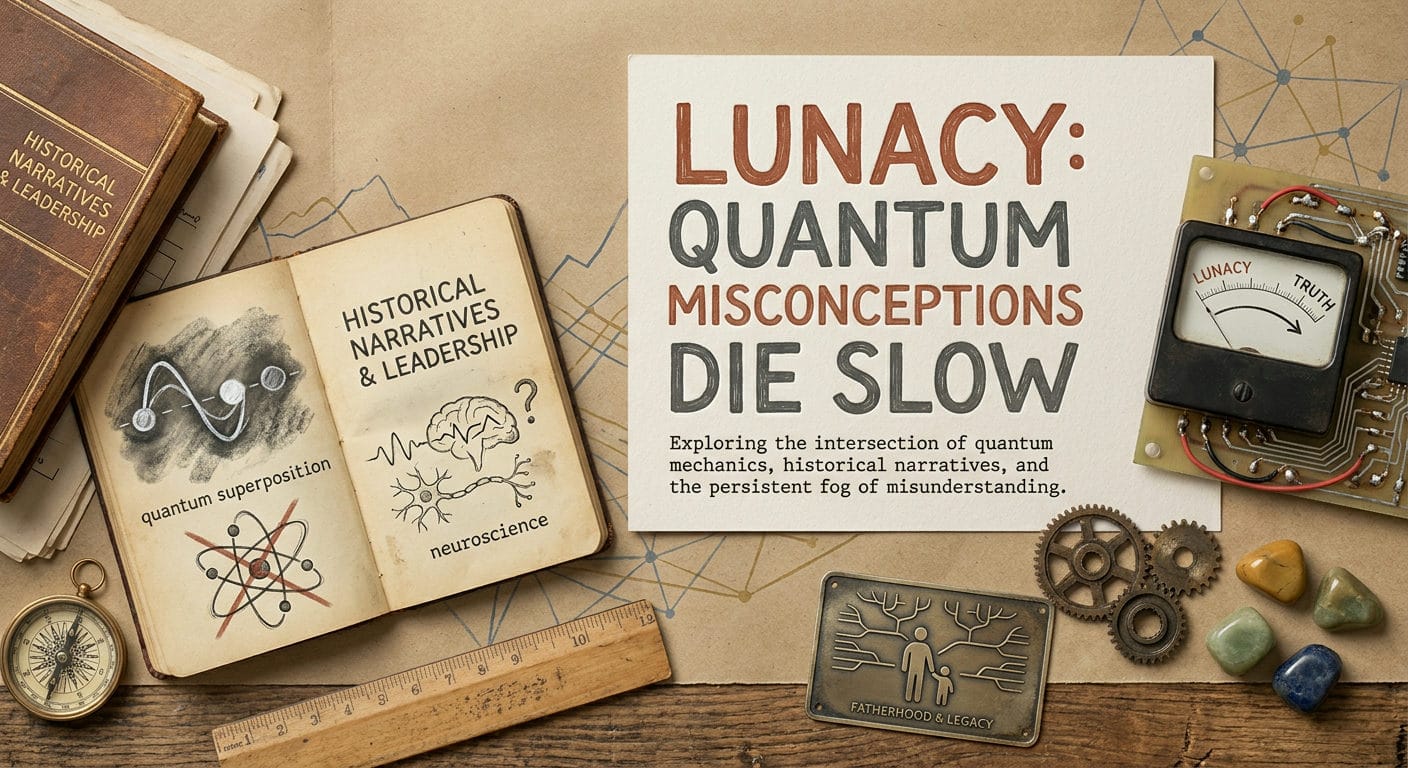
The deepest questions of science and meaning are not separate from the practicalities of leadership—they define the frameworks for understanding health, history, and human systems.
The Intake
📊 12 episodes across 11 podcasts
⏱ 1380 minutes of intelligence analyzed
🎙 Featuring: Tim Maudlin (Professor of Philosophy, New York University), Curt Jaimungal (Host, Theories of Everything), Shane Parrish (Host, The Knowledge Project), John D. Rockefeller (Co-founder, Standard Oil)
|

The Big Shift
In a world grappling with complex challenges, from personal well-being to societal divisions, a consistent thread emerges: our understanding of "ordinary" is being fundamentally challenged. This week's conversations reveal a profound re-evaluation of what constitutes normal, whether in the behavior of subatomic particles, the motivations behind historical conflicts, or the psychological landscape of fatherhood. The "ordinary" is consistently revealed as far more complex, dynamic, and often counterintuitive than common narratives suggest. For leaders, this means recognizing that the established frameworks for understanding human behavior, market dynamics, or even scientific truth are often incomplete, requiring a deeper, more nuanced investigation beneath the surface of conventional wisdom.
The Quantum Unraveling: The very definition of fundamental reality is under scrutiny. Tim Maudlin (Professor of Philosophy, New York University) highlighted on Theories of Everything that what's commonly taught about quantum mechanics—like the idea of particles switching between wave and particle states based on observation—is largely "lunacy," challenging decades of popular understanding. He clarified that Einstein, not Planck, was the true pioneer of the quantum hypothesis, underscoring how deeply entrenched misattributions can shape our worldview.
"When you really ask who really proposed quantization of a classical quantity, It's Einstein in 1905."
— Tim Maudlin, Professor of Philosophy at New York University on Theories of Everything with Curt Jaimungal
The Evolution of Fatherhood: What it means to be a father has also fundamentally shifted. Darby Saxbe (Clinical Psychologist, Professor, USC) on Modern Wisdom revealed that fathers now spend "tripled or even quadrupled" daily time parenting compared to previous generations, leading to measurable gray matter loss in the cortex—a phenomenon she calls 🆕Dad Brain. This isn't a deficiency but an adaptation, showing how deeply modern caregiving is rewiring our fundamental biological and social roles.
Revisiting History's Narratives: Even historical consensus proves more layered than often presented. Gary Gallagher (Historian of the American Civil War, University of Virginia) on Lex Fridman Podcast argued that the Civil War unfolded as a conflict between two republics, emphasizing the Confederacy's direct appropriation of the US Constitution to protect slavery, rather than a monolithic fight for its abolition. He also challenging the "Grant the Butcher" narrative, stating that Robert E. Lee was statistically "the bloodiest general." These insights force a re-examination of "ordinary" historical truths and highlight the need for leaders to question deeply held assumptions in any complex system.
Closing thought: The throughline is clear: "ordinary" is a construct, often built on historical accidents, convenient narratives, or incomplete scientific understanding. Leaders who recognize this inherent illusion are better equipped to diagnose problems, adapt strategies, and foster innovation, not by rejecting tradition outright, but by rigorously questioning its foundations.
The Rundown
① Human Connection Is a Biological Imperative.
Our physiological state dictates how we perceive and interact with the world, with social engagement being a built-in mechanism for safety and healing. (Dr. Stephen Porges on Modern Wisdom)
→ The Insight: Creating environments that signal safety and belonging isn't just "soft" leadership; it's a fundamental requirement for team performance and well-being, directly impacting perception and receptiveness.
② Optimizing Health Requires Flexibility, Not Dogma.
A "neurotic" approach to perfect health protocols leads to burnout; instead, focus on core principles like consistent sleep, morning light, and hydration, with flexible application. (Huberman Lab)
→ The Implication: For leadership, this highlights that rigid adherence to "best practices" without adaptation to individual circumstances or team dynamics can lead to counterproductive exhaustion instead of sustained high performance.
③ Foundational Principles of Fortune-Building Remain Timeless.
John D. Rockefeller's success stemmed from relentless cost optimization, meticulous accounting, and strategic leveraging of networks—lessons instilled by parents from contrasting backgrounds. (The Knowledge Project)
→ The Takeaway: Despite modern complexity, fundamental business disciplines like frugality, financial control, and strategic partnerships, honed from an early age, still form the bedrock of sustainable growth.
④ Small, Consistent Changes Yield Disproportionate Results.
Simple hacks like the 'new sleep math' (9 hours in bed for 8 hours sleep) or the 'wait a week' rule for impulse spending create significant positive shifts in energy, focus, and financial health. (The Mel Robbins Podcast)
→ The Application: Leaders can translate this into organizational change, focusing on small, actionable process improvements or habit shifts that compound over time, rather than relying solely on large, disruptive initiatives.
⑤ Narrative Shapes Reality and Resilience.
Framing one's life as a 🆕Hero's Journey (Monomyth) can enhance meaning, reduce depressive symptoms, and even improve pattern recognition in random stimuli. (Hidden Brain)
→ The Strategic Play: Leaders should consciously craft and communicate compelling narratives for their organizations and teams, helping members find purpose and resilience through shared challenges and transformative goals.
Signal Board
🔥 Heating Up
• Einstein: Re-evaluation of his foundational contributions to quantum theory, particularly his 1905 paper on the photoelectric effect, suggests he was a more significant originator of quantum hypothesis than commonly acknowledged. (Tim Maudlin on Theories of Everything with Curt Jaimungal)
• Physiological States: The profound impact of our underlying physiological state on perception, interaction, and responsiveness is increasingly recognized as central to mental health and well-being. (Dr. Stephen Porges on Modern Wisdom)
• Polyvagal Theory: Growing appreciation for its framework in understanding anxiety, depression, and chronic fatigue as manifestations of a dysregulated nervous system. (Dr. Stephen Porges on Modern Wisdom)
✨ On Watch
• 🆕Dad Brain: The emerging understanding of gray matter volume loss in new fathers' cortices as an adaptation linked to increased parenting investment. (Darby Saxbe on Modern Wisdom)
• 🆕Hero's Journey (Monomyth): Its application as a powerful framework not just for stories, but for structuring personal narratives to enhance meaning and resilience. (Ben Rogers on Hidden Brain)
• Ozempic: While effective for weight loss, its potential for rapid aging, depression, and severe gastrointestinal issues for "vanity" use is raising significant concerns. (Jillian Michaels on Conversations With Coleman)
📉 Cooling Off
• Copenhagen interpretation: Its dogmatic assertion of quantum mechanical completeness and Born's probabilistic interpretation are increasingly challenged by historical research and alternative theories. (Tim Maudlin on Theories of Everything with Curt Jaimungal)
• Metabolic Slowdown Theory: The conventional wisdom that metabolism significantly slows with age is being debunked, with emphasis on muscle mass and hormone health as primary drivers. (Jillian Michaels on Conversations With Coleman)
• Conventional Leadership: A shift away from directive, domain-expert-centric leadership towards servant leadership, humility, and emotional tone-setting, especially in high-pressure environments. (Don Faul on Worklife with Adam Grant)
The Tension
The debate around historical narratives, particularly regarding American history, continues to reveal deep-seated ideological divides.
🔵 One view: History for Shared Humanity: Jillian Michaels (Fitness Expert, Author, TV Personality) on Conversations With Coleman argued that historical narratives of atrocities, while undeniable, often omit efforts by figures like Benjamin Franklin to abolish slavery and the significant casualties incurred in the Civil War, contributing to a "victim narrative" and exacerbating racial division. She highlights the need to find "shared humanity" by acknowledging various perspectives and historical attempts at resolution.
"What happened to the part about how guys like Benjamin Franklin wanted to end this and we went to war over ending this and 350,000 white guys died to end this? So when you look at white people, yeah, there are bad ones, but there's also really good ones. And how do we find our shared humanity again?"
— Jillian Michaels, Fitness Expert and Entrepreneur on Conversations With Coleman
🔴 The counter: History as Unequivocal Truth: In contrast, Gary Gallagher (Historian of the American Civil War, University of Virginia) on Lex Fridman Podcast unequivocally stated, "If you take slavery out of the picture, there is no Civil War, period." While acknowledging the complexity of the North's motivations, he framed the Confederacy as a republic explicitly founded to protect and expand slavery, challenging any narrative that might dilute its central role or the moral clarity of the conflict's origins.
"If you take slavery out of the picture, there is no Civil War, period."
— Gary Gallagher, Historian of the American Civil War at University of Virginia on Lex Fridman Podcast
What's at stake: The way history is told directly influences contemporary cultural identity and political discourse; leaders must recognize the power of these narratives and their potential to either unify or divide stakeholders.
The Bookshelf
Polyvagal Theory by Stephen Porges
This foundational work explains how our physiological state profoundly influences our perception, interactions, and well-being, highlighting the nervous system's role in signaling safety. (Mentioned on Modern Wisdom)
"We Who Wrestle with God" by Jordan B. Peterson
Discusses moral decision-making, the shaping of perception by intent, and the concept of "aiming up" as exemplified by biblical figures like Jacob. (Mentioned on The Jordan B. Peterson Podcast)
Tarkovsky's "Solaris" (Film)
Discussed as a thematic counterpoint to Kubrick's "2001: A Space Odyssey," focusing on human isolation and connection rather than the alien itself. (Mentioned on Very Bad Wizards)
Your Move
Evaluate Narratives: Assess your organization's core narratives—how you tell your story, both internally and externally. Are they inspiring a 🆕Hero's Journey (Monomyth) for your team, or perpetuating limiting beliefs? (Ben Rogers on Hidden Brain)
Audit Signaling: Review your leadership style and organizational communications for clear signals of safety and social engagement. In an anxious environment, are you broadcasting reassurance, or just the absence of threat? (Dr. Stephen Porges on Modern Wisdom)
Champion Flexibility: Identify areas where rigid "best practices" or protocols might be causing "health optimization burnout" in your team. Can you introduce more flexibility while maintaining core outcomes? (Huberman Lab)
Question Historical Norms: Challenge assumptions about what's "ordinary" in your industry or business. What if what seems normal (like aging metabolism, or traditional leadership) is based on outdated understanding? (Jillian Michaels on Conversations With Coleman; Don Faul on Worklife with Adam Grant)
Prioritize Small Wins: Map out 3-5 small, consistent changes that could create compounding benefits for your team or processes, focusing on actionability rather than massive overhauls. (The Mel Robbins Podcast)
Episode Guide
Theories of Everything with Curt Jaimungal — "Tim Maudlin: Quantum Mechanics Explained FROM SCRATCH"
Runtime: 183 min | Host: Curt Jaimungal | Guest: Tim Maudlin (New York University)
For the intellectually curious leader who grapples with uncertainty: This deep dive into the foundations of quantum mechanics offers a masterclass in rigorous thinking, challenging common popularizations and honing your ability to dissect complex, counter-intuitive models.
Tim Maudlin meticulously deconstructs the historical evolution of quantum theory, asserting that Einstein, not Planck, truly fathered the quantum hypothesis in 1905 with his photoelectric effect paper. He clarifies that popular notions of wave-particle duality are often misleading, and traces the development through de Broglie's matter waves to Schrödinger's wave mechanics, underscoring how the Copenhagen interpretation's commitment to quantum mechanical completeness clashes with Einstein's persistent objections to non-locality.
"When you really ask who really proposed quantization of a classical quantity, It's Einstein in 1905." — Tim Maudlin
Connects to: Einstein's Real Objection: Non-Locality, Not Determinism
▶ Listen · Apple Podcasts · Apple Podcasts
Huberman Lab — "Your Top Health Questions Answered"
Runtime: 104 min | Host: Andrew Huberman | Guest: Anthony Richards (Listener), Huberman (Host), Van Spina, Josimara
For the busy executive looking for science-backed micro-optimizations: This episode provides actionable strategies to enhance daily performance and well-being, from pre-workout routines to sleep protocols, helping you avoid burnout while pursuing peak health.
Andrew Huberman tackles listener questions, offering practical, science-based tools for health optimization. He explains how Alpha-GPC can uniquely boost focus for late-day workouts and improve REM sleep, while also recommending garlic to mitigate potential cardiovascular risks. Huberman Lab emphasizes flexible health strategies over rigid adherence to prevent burnout, and offers neuroscience-backed methods for memory improvement through self-testing and deliberate sensory engagement.
"A neurotic approach to trying to get everything exactly right is going to harm our mental health. Maybe not severely in the short term, but in the long Run. It's just going to lead to a different kind of burnout, kind of health optimization burnout." — Huberman
Connects to: Alpha-GPC and TMAO
▶ Listen · Apple Podcasts · Apple Podcasts
The Mel Robbins Podcast — "9 Small Changes to Feel Better, Happier, and More Energized Starting Today"
Runtime: 44 min | Host: Mel Robbins | Guest: Mel Robbins
For the leader seeking immediate, low-effort ways to boost personal effectiveness and well-being: This episode offers nine simple, science-backed life hacks to enhance energy, sleep, confidence, and focus without requiring radical overhauls.
Mel Robbins presents nine easy-to-implement "life hacks" grounded in research, aiming for significant improvements in daily life. She covers practical advice like the "new sleep math" (nine hours in bed for eight hours of sleep), the 5-10-20 rule for morning light exposure, and the "put it where it belongs" principle for organization. Robbins also highlights the psychological benefits of smiling and the "wait a week" rule for impulse spending, all designed for immediate application and noticeable impact.
"If you want to get eight hours of sleep, spend nine hours in bed. Sleep is a process... Even a healthy sleeper with no problems should take about 15 or 20 minutes to fall asleep." — Mel Robbins
Connects to: Mel Robbins's 5-10-20 Rule
Modern Wisdom — "Polyvagal Theory: Why You Feel So Anxious All The Time - Dr Stephen Porges - #1128"
Runtime: 113 min | Host: Chris Williamson | Guest: Dr. Stephen Porges (Neuroscientist & Psychologist, developer of Polyvagal Theory)
For leaders seeking to understand the neurobiological underpinnings of human connection, safety, and resilience: This episode offers a paradigm-shifting perspective on anxiety and social engagement, crucial for fostering healthier team dynamics and personal well-being.
Dr. Stephen Porges unpacks his Polyvagal Theory, revealing how our physiological state profoundly dictates our perception and social interactions. He explains the evolutionary "social engagement system" that signals safety, and how chronic states of defense, often triggered by modern stressors or past trauma, manifest as anxiety, fatigue, and depression. Porges advocates for gently expanding nervous system flexibility rather than "hacking" it, emphasizing the bidirectional communication between body and brain in shaping our reality.
"The issue is we live in a world in which everyone thinks we can suppress our feelings or we can get over something, when in reality our body is just percolating and broadcasting signals to our awareness. And now we're being told, don't pay attention." — Dr. Stephen Porges
Connects to: Polyvagal Theory Misconceptions
▶ Listen · Apple Podcasts · Apple Podcasts
The Knowledge Project — "John D. Rockefeller: The Principles Behind The Greatest Fortune in History"
Runtime: 176 min | Host: Shane Parrish | Guest: John D. Rockefeller (Co-founder, Standard Oil), Henry Flagler (Co-founder, Standard Oil), Ida Tarbell (Journalist and Author)
For the entrepreneurial leader or investor building a legacy: This episode offers a captivating, nuanced look into the mind and methods of John D. Rockefeller, revealing the principles of relentless efficiency, strategic consolidation, and disciplined philanthropy that built an empire and reshaped American business.
Shane Parrish narrates the remarkable story of John D. Rockefeller, from his formative years shaped by a frugal mother and con-artist father, to the strategic genius behind Standard Oil. The episode details his meticulous cost-cutting, leveraging of railroad rebates, and the shrewd partnership with Henry Flagler, highlighting the "flywheel" effect that consolidated the oil industry. It also examines the public backlash, the eventual dissolution of Standard Oil under antitrust laws, and Rockefeller's profound philanthropic legacy.
"I cheat my boys every chance I get. I want to make em sharp." — Big Bill Rockefeller
Connects to: Public Backlash Against Standard Oil, The 'Flywheel' Effect
▶ Listen · Apple Podcasts · Apple Podcasts
Lex Fridman Podcast — "#499 – Gary Gallagher: American Civil War, Slavery, Lincoln, Grant & Lee"
Runtime: 233 min | Host: Lex Fridman | Guest: Gary Gallagher (Historian of the American Civil War at University of Virginia)
For the leader seeking deeper historical context and nuanced understanding of complex national divides: This episode re-examines the causes and leadership of the Civil War, challenging popular narratives and offering lessons in strategic thinking, resilience, and the long-term impact of ideological conflicts.
Gary Gallagher, a distinguished Civil War historian, offers a fresh perspective on the conflict, emphasizing that its primary cause was slavery's expansion, not its abolition. He dispels myths surrounding figures like Robert E. Lee and Ulysses S. Grant, revealing Lee as a far bloodier general and highlighting Lincoln's exceptional, adaptable leadership. Gallagher reframes the war as a clash between two republics, exploring the motivations of soldiers, the economic significance of slavery, and the enduring legacy of the "Lost Cause" narrative.
"If you take slavery out of the picture, there is no Civil War, period." — Gary Gallagher
Connects to: The Lost Cause Narrative
▶ Listen · Apple Podcasts · Apple Podcasts
Worklife with Adam Grant — "What pressure can teach you about leadership with Don Faul"
Runtime: 45 min | Host: Molly Graham | Guest: Don Faul (CEO of CrossFit)
For any leader navigating high-stakes environments or transitioning between different organizational cultures: This episode offers powerful insights on servant leadership, moral courage, and how military principles translate into effective executive performance.
Don Faul, former Marine Corps officer and tech executive (Google, Facebook), shares how extreme military pressure forged his leadership philosophy. He reveals that servant leadership and decentralized decision-making, often counter-intuitive to civilian perceptions of the military, are crucial. Faul discusses his experience navigating content moderation at Facebook, emphasizing accountability, emotional intelligence, and the transferable skills of building high-performing teams, regardless of the sector.
"Your job as a leader is to support and serve your people... and if you can do so, they can achieve great things." — Don Faul
Connects to: Moral Courage in Leadership
▶ Listen · Apple Podcasts · Apple Podcasts
Modern Wisdom — "The Painful Psychological Cost Of Becoming A Dad - Darby Saxbe - #1129"
Runtime: 94 min | Host: Chris Williamson | Guest: Darby Saxbe (Clinical Psychologist, Professor at USC)
For new or prospective fathers, and leaders interested in how life transitions impact brain function and partnerships: This episode unravels the profound, often overlooked, neurobiological and psychological changes men experience with fatherhood, offering insights vital for family well-being and personal growth.
Dr. Darby Saxbe delves into "dad brain," revealing that new fathers experience a loss of gray matter in the cerebral cortex, directly tied to their parenting investment. She highlights how modern fatherhood now demands significantly more engagement than past generations, leading to hormonal shifts and potential for paternal postpartum depression. Saxbe emphasizes the neuroprotective benefits of active caregiving and adaptability, challenging traditional masculine norms and showing how involvement transforms men both biologically and emotionally.
"New fathers lose gray matter volume across that transition to fatherhood. Dads change mostly just in the cortex, which is that sort of executive functioning, thinking and reasoning part of the brain." — Darby Saxbe
Connects to: The "Dad Brain" Phenomenon, Fatherhood and Male Hormones
▶ Listen · Apple Podcasts · Apple Podcasts
The Jordan B. Peterson Podcast — "Why Short-Term Pleasure Is Ruining Your Life"
Runtime: 111 min | Host: Jordan B. Peterson | Guest: Jordan B. Peterson
For the leader seeking to align personal intent with organizational purpose, and avoid the pitfalls of short-term gratification: This episode explores how our deepest motivations shape our perception of reality and the moral imperative of "aiming up" towards an ever-receding highest good.
Jordan Peterson argues that every action is an ethical one, and our intent profoundly shapes how reality reveals itself. Drawing from biblical narratives like Jacob and Jonah, he illustrates the transformative power of "aiming up" and sacrifice, contrasting it with self-destructive behaviors and the dangers of technology worship (e.g., phone addiction). Peterson posits that conscience acts as a transcendent guide, and that ignoring one's unique truth imperils both the individual and society.
"Every action is a directional action and every directional action is an ethical action." — Jordan B. Peterson
Connects to: Conscience as the Voice of God, Tower of Babel as an Analogy for Technology Worship
▶ Listen · Apple Podcasts · Apple Podcasts
Hidden Brain — "You Are Not Ordinary"
Runtime: 95 min | Host: Hidden Brain, Shankar Vedantam | Guest: Ben Rogers (Social Scientist at Boston College's Carroll School of Management)
For any leader looking to foster resilience and find deeper meaning in their work and life: This episode illustrates the profound psychological power of narrative, specifically how framing life experiences as a "hero's journey" can transform challenges into growth and purpose.
Shankar Vedantam and social scientist Ben Rogers explore how the human brain constructs narratives, applying the Kuleshov Effect to personal life stories. They demonstrate how framing one's life through the universal "hero's journey" model — complete with internal transformation, challenges, allies, and legacy — significantly enhances perceived meaning, boosts resilience, and reduces depressive symptoms. Rogers shares a personal journey of turning tragedy into purpose, underscoring how this narrative reframing can powerfully reshape one's worldview and cognitive processes.
"The most powerful stories are the ones that while it might be circumstances that we never actually find ourselves in it's really enjoyable to imagine what would I do in that case?" — Ben Rogers
Connects to: The Hero's Journey and Meaning-Making
▶ Listen · Apple Podcasts · Apple Podcasts
Conversations With Coleman — "The Real Reason Americans Are So Sick, with Jillian Michaels"
Runtime: 76 min | Host: Coleman | Guest: Jillian Michaels (Fitness Expert, Author, TV Personality)
For leaders interested in the intersection of public health, cultural narratives, and personal responsibility: This episode offers a forthright discussion on the roots of America's health crisis, challenging mainstream views on everything from diet to the media's influence on societal division.
Jillian Michaels and Coleman discuss the systemic causes of American illness and cultural division. Michaels critiques media narratives that exacerbate racial tensions and the "healthy at any size" movement, advocating for personal agency in health. She delves into the obesity epidemic, offering a critical perspective on GLP-1 agonists like Ozempic, warning against their use for "vanity weight loss" due to potential side effects and long-term hormonal disruption, while emphasizing the importance of muscle mass and hormone replacement therapy with proper guidance.
"What happened to the part about how guys like Benjamin Franklin wanted to end this and we went to war over ending this and 350,000 white guys died to end this? So when you look at white people, yeah, there are bad ones, but there's also really good ones. And how do we find our shared humanity again?" — Jillian Michaels
Connects to: Ozempic's Long-Term Impact, Critique of 'Healthy at Any Size'
▶ Listen · Apple Podcasts · Apple Podcasts
Very Bad Wizards — "Episode 337: First Contact? (Tarkovsky's "Solaris")"
Runtime: 106 min | Host: Tamler Sommers & David Pizarro | Guest: Tamler Sommers (Host), David Pizarro (Host)
For the thoughtful leader wrestling with the implications of AI, human connection, and the limits of understanding: This episode explores profound philosophical questions through the lens of Tarkovsky's "Solaris," prompting reflection on consciousness, meaning, and our relationship with the unknown.
David and Tamler explore the themes of Tarkovsky's "Solaris" and its contrast with Lem's original novel, highlighting Tarkovsky's focus on human isolation, emotional connection, and the nature of copies and reflections. They also touch on the ethical and existential implications of AI, debating consciousness, its impact on employment and creativity, and the environmental footprint of AI data centers, all while drawing parallels between the film's nuanced portrayal of "first contact" and our modern grappling with artificial intelligence.
"A cheap imitation that's flooding the Internet with slop." — Tamler Sommers
Connects to: AI in Healthcare: Limited Utility, AI's Impact on Employment