
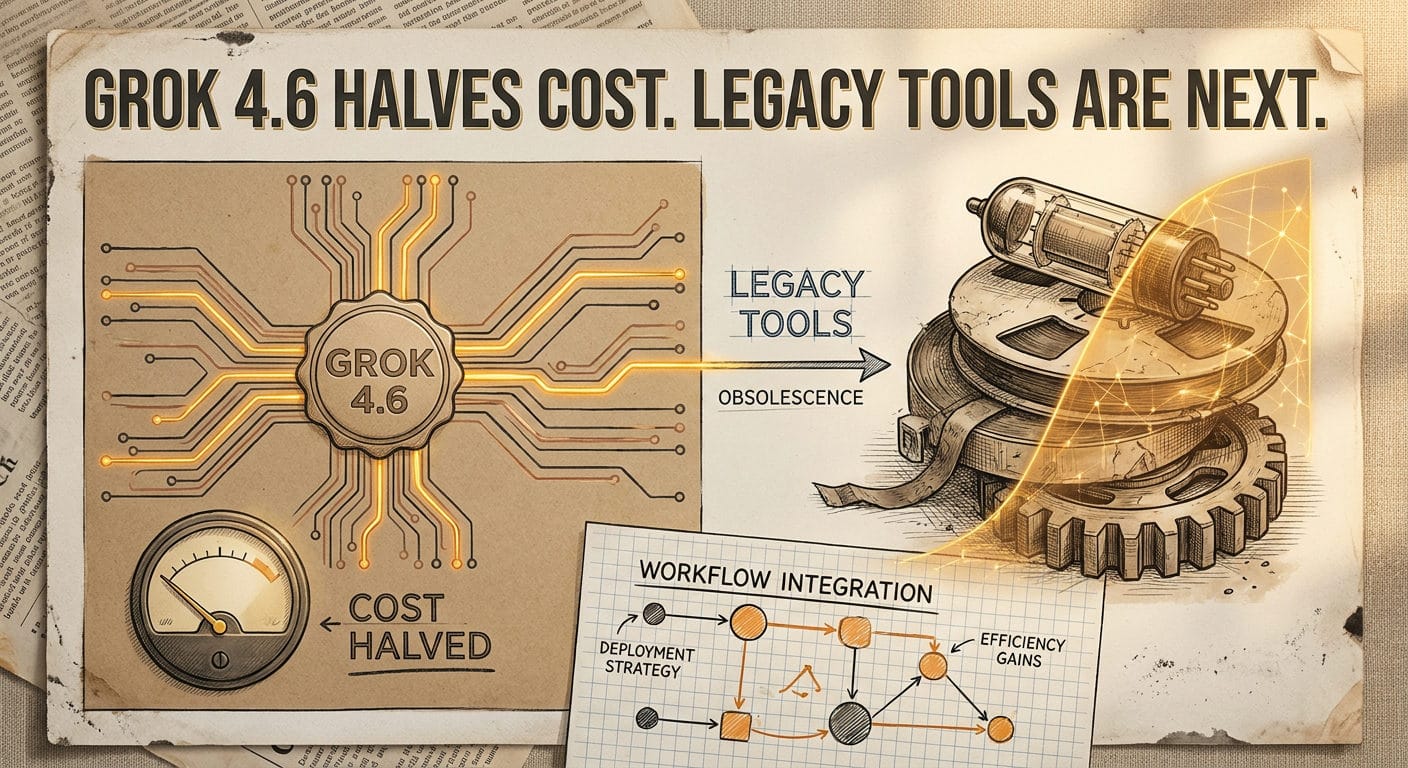
The race to build AI is no longer just about who has the biggest models. It’s about who can integrate them the fastest, most efficiently, and with the most impact on actual business workflows—even if it means giving up on legacy tools or embracing outcome-based partnerships.
📊 12 episodes across 9 podcasts
⏱ 497 minutes of intelligence analyzed
🎙 Featuring: Nathaniel Whittemore, NLW, Daniel Berkovitz, Elon Yar, Ajay Swamy, Drew Cukor, Fatih Porikli, Kevin Roos, Kasey Noon, Max Spero, Hayden Field, Erik Allebest, Paolo Ardoino
|

The Big Shift
Forget the hype about monster models. The real game-changer this week is a tactical pivot from "bigger is better" to "smarter, faster, and cheaper is critical." We're seeing a clear shift towards operationalizing AI through efficiency, targeted problem-solving, and a radical rethinking of data infrastructure. This isn't just about new models; it's about a fundamental re-evaluation of how businesses integrate AI to actually work for them, rather than just experimenting with it.
The Evidence: The newGrok 4.6is putting up numbers comparable to frontier models like GPT-5.6 and Fable 5, but at a "fraction of the cost" (NLW on The AI Daily Brief: Artificial Intelligence News and Analysis). This cost-efficiency is a significant factor in enterprise adoption, as businesses are surprisingly resistant to high-cost models, even highly capable ones like Anthropic’s Fable 5, especially if data retention policies create barriers (NLW on The AI Daily Brief: Artificial Intelligence News and Analysis). This theme echoesChris Slovak(Global Field CTO, Unframe.AI) who, on The AI in Business Podcast, discussed how a new retail AI deployment model sidesteps lengthy data centralization, reducing deployment times from nine months to two weeks. The underlying signal is that the bottleneck isn't AI's capability, but its cost-effective and agile integration into existing, often messy, business systems.
The Broader Pattern: This isn't just a technical detail; it's a strategic imperative. Organizations are realizing that raw model power means little without practical application. JPMorgan Chase'sAjay Swamy(Senior Executive Product Director for GenAI Products and Governance), on The AI in Business Podcast, drives this home, stating that "The institutions that will win over the next couple of years are the ones that have rebuilt their workflows and their governance controls to absorb all of these new capabilities." It’s about building trust through auditable processes, not just powerful models.
"The hard part is that every one of these workflows or these steps requires judgment, even when it looks routine. Right, so what do I mean by that? So first is fragmentation. Data fragmentation."
— Ajay Swamy, Senior Executive Product Director for GenAI Products and Governance at JPMorgan Chase on The AI in Business Podcast
The Move: Prioritize AI solutions that demonstrate clear ROI through efficiency and rapid deployment, even if they aren't the absolute "frontier" in terms of raw capability. Challenge your teams to evaluate AI not just on performance, but on its ability to integrate seamlessly and cost-effectively into your specific workflows, avoiding the traditional pitfalls of data consolidation.
The Rundown
① Ditch Microsoft Office for AI-Native Infrastructure.
Companies relying on legacy tools likeMicrosoft Office (PowerPoint, Excel, Word, Email)are effectively "putting a tombstone" on their data, making it inaccessible to modern AI, warnsDrew Cukor(Head of AI Transformation, TWG AI) on Eye On A.I. (Drew Cukor on Eye On A.I.)
→ Why it matters: This isn't just about software choice; it's a 36-month survival window to rebuild core workflows from scratch with AI embedded, or risk being outpaced by AI-native startups and nations.
② AI Deputization Audit: Know What to Automate.
A new framework, theAI Deputization Audit, helps individuals and businesses systematically identify tasks best suited for AI assistance, considering factors like frequency, teachability, and error stakes (NLW on The AI Daily Brief: Artificial Intelligence News and Analysis).
→ What to watch: New features like OpenAI's Computer History and Grokbot's "Teach a Task" are shifting the AI bottleneck from capability to context, enabling AI to learn user workflows through observation or demonstration.
③ AI Video Generation Is Getting Scary Fast.
TheLTX-2.5open multimodal world model can generate a 10-second video in under 7 seconds with enhanced pixel quality, showcasing significant speed improvements in AI video generation (Daniel Berkovitz on The Neuron: AI Explained).
→ The context: This speed, combined with tools like 'retake' features and fine-tuning with minimal data, is rapidly transforming creative workflows, moving sentiment in VFX studios from "absolute fear" to acceptance.
④ Rethinking Image Generation Beyond Bigger Models.
Current text-to-image models struggle with controllability and generating distinct identities; the solution isn't just bigger models, but fine-tuning existing ones with reinforcement learning likeDISCOor separating planning from rendering (Fatih Porikli on The TWIML AI Podcast (formerly This Week in Machine Learning & Artificial Intelligence)).
→ What to watch: Qualcomm's approaches, like cascaded upsampling, achieve 35x speedups for 4K/16K image generation, making high-resolution creation practical even on edge devices.
⑤ OpenAI and Nvidia Are Getting Deep in the Trenches.
OpenAIis taking ownership stakes and embedding staff directly into portfolio companies like Thrive Holdings to accelerate AI rollouts, whileNVIDIAis backstopping $500 billion in data center financing, leveraging GPU resale values as collateral (AI Breakdown on AI Breakdown).
→ Why it matters: This signals a move beyond selling software or hardware to direct, strategic involvement in AI implementation and infrastructure, indicating a long-term commitment to operationalizing AI at scale.
⑥ AI Detection Is Improving, But It's a Cat-and-Mouse Game.
Tools likePangramare evolving beyond simple perplexity metrics, using neural networks trained on vast human and AI-generated text to identify subtle signals of AI-generated content (Max Spero on Hard Fork).
→ The context: This creates a continuous arms race with "AI humanizers" and new LLM releases, highlighting the necessary role of AI detection in maintaining trust in human-created online content.
The Signals
🔥 HEATING UP
• Cost-effective AI models: New entrants like Grok 4.6 are matching frontier performance at a fraction of the cost, making advanced AI more accessible for enterprise adoption. (NLW on The AI Daily Brief: Artificial Intelligence News and Analysis)
• Outcome-aligned commercial relationships: A shift from 'buy vs. build' to 'build together' models, where AI vendors are compensated based on achieved outcomes, fundamentally altering SaaS commercial structures. (Chris Slovak on The AI in Business Podcast)
• AI for accelerated skill acquisition in games: AI is enhancing human learning, allowing players to improve much faster and making games like chess more exciting and accessible. (Erik Allebest on No Priors: Artificial Intelligence | Technology | Startups)
• Efficiency in image generation: New methods are achieving 35x speedups for 4K/16K image generation, making high-resolution visual creation practical on edge devices. (Fatih Porikli on The TWIML AI Podcast (formerly This Week in Machine Learning & Artificial Intelligence))
🆕 ON WATCH
• Non-invasive BCIs (Brain Computer Interfaces): Significant development expected in the next 5-10 years, driven by lightweight on-device AI models that can translate low-bandwidth neural signals into real-world actions. (Paolo Ardoino on The AI in Business Podcast)
• AI's role in combating cheating in online chess: Chess.com leverages machine learning and data extensively to maintain game integrity and detect cheating, a growing concern in online gaming. (Erik Allebest on No Priors: Artificial Intelligence | Technology | Startups)
• Decentralized data access for AI: AI agents operating effectively by dynamically pulling data from disparate systems, negating the traditional requirement for centralizing and cleaning all data first. (Chris Slovak on The AI in Business Podcast)
• Explainability and Traceability in AI for Regulated Environments: Essential for trustworthiness and deployment, especially for agentic systems in sectors like financial services, requiring auditable end-to-end processes. (Ajay Swamy on The AI in Business Podcast)
• Mark Zuckerberg's 'The Future Is for Everyone' essay: A lengthy manifesto pushing for widespread AI proliferation, viewed by some as a veiled set of policy requests beneficial to Meta. (Kevin Roos on Hard Fork)
❄️ COOLING OFF
• Google's strategic shift from frontier AI research to productization: A perceived decline in ambition and ethical stance, leading to a "brain drain" and fears Google may fall behind in the AI race. (Hayden Field on Decoder with Nilay Patel)
• AI Officers as a solution: The appointment of dedicated 'AI officers' is criticized as "the most destructive thing" for businesses, often blocking rather than enabling effective AI implementation. (Drew Cukor on Eye On A.I.)
• Traditional data centralization for AI: The belief that all data must be clean and centralized before AI can be deployed is increasingly seen as a "false workflow" that causes significant delays and pilot failures. (Chris Slovak on The AI in Business Podcast)
The Bottom Line
The AI battleground has shifted from raw power to ruthless efficiency and workflow integration; companies must adapt or face a rapid obsolescence clock.
|
📖 Want the full episode breakdowns, guest details, and listen links?
Episode Guide (Web Version)
1. The AI Daily Brief: Artificial Intelligence News and Analysis — "Grok 4.6 Shows How Fast Your AI Options Are Expanding"
Runtime: 29 min | Host: Host-led discussion | Guest: Nathaniel Whittemore (Host, The AI Daily Brief), NLW (Host, The AI Daily Brief)
For the Strategic Decision-Maker: This episode challenges assumptions about frontier AI, highlighting how cost-efficiency and strategic choices in data retention are impacting enterprise adoption more than raw model power.
NLW discusses Grok 4.6's competitive performance at a fraction of the cost, examining how factors beyond raw capability, such as Anthropic's data retention policy, are affecting the business adoption of even advanced models. The episode underlines the rapidly evolving AI landscape where cost and deployment practicalities are becoming paramount.
"Grok and SpaceX AI are back in the race. The just released Grok 4.6 is putting up benchmark numbers that put it in the category of a GPT 5.6 or a Fable 5 and doing so at a fraction of the cost."
— NLW, Host of The AI Daily Brief
2. The AI in Business Podcast — "The Predictive Model Reshaping Retail Operations at Scale - with Chris Slovak of Unframe.AI"
Runtime: 38 min | Host: Marilie Fouché | Guest: Chris Slovak (Global Field CTO, Unframe.AI)
For the Operational Executive: This episode provides a blueprint for bypassing traditional data hurdles in AI deployment, offering a practical, modular approach to achieve rapid, outcome-driven value in retail and beyond.
Chris Slovak reveals a new retail AI model that uses AI agents to dynamically pull context from existing systems, eliminating the need for lengthy data centralization. This approach dramatically cuts deployment times and costs, emphasizing problem-solving and outcome-based partnerships over rigid data projects.
"The biggest false workflow is to aggregate and fix and clean and create data models before you start solving problems."
— Chris Slovak, Global Field CTO of Unframe.AI
3. The Neuron: AI Explained — "BONUS: Learn Video Prompting for TOTAL Beginners w/ NEW LTX-2.5 + LTX Team"
Runtime: 59 min | Host: Corey Knowles | Guest: Daniel Berkovitz (Chief Product Officer, LTX), Elon Yar (VP of Product, LTX), Alon (Developer, LTX), Daniel (Developer, LTX)
For the Creative and Technical Innovator: This deep dive into LTX-2.5 showcases a significant leap in AI video generation speed and quality, offering practical insights for fine-tuning and diverse applications from VFX to robotics.
The LTX team discusses LTX-2.5's speed and pixel quality improvements, along with its diverse applications from VFX to robot training. They delve into advanced features like 'retake,' morph cuts, and fine-tuning with minimal data, highlighting the model's open-source nature for custom use cases.
"2.5 is actually even faster than 2.3. The most exciting thing about it is that we really pushed pixel quality forward."
— Daniel Berkovitz, Chief Product Officer at LTX
4. The AI in Business Podcast — "Managing Change Across Modern Financial Operations - with Ajay Swamy of JPMorganChase and Founder of FundLens.ai"
Runtime: 22 min | Host: Daniel Faggella | Guest: Ajay Swamy (Senior Executive Product Director for GenAI Products and Governance, JPMorgan Chase)
For the Financial Services Leader: This discussion provides a critical framework for integrating AI in regulated environments, emphasizing auditable processes and workflow rebuilding over mere model performance.
Ajay Swamy from JPMorgan Chase details the challenges of scaling financial operations due to data fragmentation and constant human judgment. He stresses the need for end-to-end auditable AI, with explainability and traceability, urging institutions to rebuild workflows and governance to effectively absorb new AI capabilities.
"Any model, whether it's machine learning or genai that sits in a business critical process, it has to be auditable end to end, from the data that it takes in, the data that it manipulates, to how it was trained, to how the outcome occurred and to the moment there's divergence in those outcomes or those results, you have to figure out, you have to be able to tell and you have to be able to explain not only to your risk committee, but also to your customers and to the regulators."
— Ajay Swamy, Senior Executive Product Director for GenAI Products and Governance at JPMorgan Chase
5. The AI Daily Brief: Artificial Intelligence News and Analysis — "How to Decide What Work AI Should Do for You: The AI Deputization Audit"
Runtime: 29 min | Host: Host-led discussion | Guest: Nathaniel Whittemore (Host, The AI Daily Brief), NLW (Host, The AI Daily Brief)
For the Team Lead and Business Owner: Learn a practical framework to identify exactly which tasks your team can offload to AI, moving beyond theoretical capabilities to concrete, actionable deputization strategies.
NLW introduces the "AI Deputization Audit," a framework to identify tasks suitable for AI automation based on frequency, teachability, and error stakes. New features like OpenAI's Computer History and Grokbot's "Teach a Task" are presented as key enablers, shifting the AI bottleneck from capability to context.
"The work best suited for AI deputization is frequent, time consuming, teachable, easily verifiable, and doesn't require you to have been the one to do it to be successful."
— Nathaniel Whittemore, Host of The AI Daily Brief
6. Eye On A.I. — "American Companies Have 36 Months to Go AI-Native or Get Left Behind | Drew Cukor, TWG AI"
Runtime: 59 min | Host: Craig S. Smith | Guest: Drew Cukor (Head of AI Transformation, TWG AI)
For the CEO and Board Member: This is a blunt, urgent warning about the critical 36-month window for American companies to re-architect their data strategy for AI or risk catastrophic competitive disadvantage.
Drew Cukor argues that American businesses are severely handicapped by outdated Microsoft products, effectively making their data inaccessible to modern AI. He stresses the 36-month urgency to become "AI-native," rebuilding workflows from scratch with AI embedded and overseen by the CEO, advocating for Palantir Foundry as the optimal platform.
"Corporate America, the East is coming for us. They didn't have these 30 years of Microsoft Office. They're going straight to platforms... and they're going to be able to reason across this far faster than we are."
— Drew Cukor, Head of AI Transformation at TWG AI
7. The TWIML AI Podcast (formerly This Week in Machine Learning & Artificial Intelligence) — "Why Image Generation Needs More Than Bigger Models with Fatih Porikli - #773"
Runtime: 57 min | Host: Sam Charrington | Guest: Fatih Porikli (Vice President of Technology, Qualcomm)
For the Product Developer and AI Researcher: Dive into the technical nuances of image generation, understanding why model size isn't the only metric and how new methods are dramatically improving control, quality, and efficiency.
Fatih Porikli discusses the limitations of current text-to-image models in controllability and identity generation. He introduces Qualcomm's DISCO, which uses reinforcement learning to fine-tune existing models for better diversity, and ARTiCAN, which separates scene planning from rendering to simplify image generation tasks.
"Instead of asking model to do everything, we separate planning from rendering, similar to how a human artist would work. So we have two components there, architect, which is it doesn't generate pixels, but instead it creates the structure or composition for the scene."
— Fatih Porikli, Vice President of Technology at Qualcomm
8. Hard Fork — "Zuckerberg’s Anti-Doom Fantasy + Finally an A.I. Detector That Works + A.I. Math"
Runtime: 63 min | Host: Kevin Roose | Guest: Kasey Noon (Journalist, Platformer), Max Spero (Chief Executive, Pangram)
For the Digital Strategist and Content Creator: Gain insight into the evolving cat-and-mouse game of AI content detection, critical for anyone navigating the integrity of online information and brand reputation.
Kevin Roos and Kasey Noon critique Mark Zuckerberg's optimistic AI manifesto, viewing it as policy requests beneficial to Meta. Max Spero, CEO of Pangram, then discusses his improved AI text detection tool, highlighting its accuracy in identifying AI-generated content through subtle signals across documents.
"Zuckerberg's essay says that the way to make us all safe is to maximally proliferate AI throughout the entire world. In my view, that is a little bit like giving a dragon to everyone."
— Kasey Noon, Journalist at Platformer
9. Decoder with Nilay Patel — "Does Google even want to win in AI?"
Runtime: 39 min | Host: Nilay Patel | Guest: Hayden Field (Senior AI Reporter, The Verge)
For the Investor and Competitor Analyst: This episode offers a sharp analysis of Google's internal struggles and strategic shifts, questioning its ability to lead in AI amidst bureaucracy and talent departures.
Nilay Patel and Hayden Field discuss Google's recent AI division reorganization and the departure of key figures, debating whether its bureaucratic culture and productization focus will hinder its AI leadership against competitors. Field notes a potential brain drain due to leadership changes and a perceived decline in Google's ethical stance.
"The issue with Google was not Jeff Dean or Noam Shazir, who we should talk about, but rather they're extremely bureaucratic, painfully slow and strategically timid culture."
— The Verge, Host of Decoder
10. AI Breakdown — "Nvidia Supports Huge Data Center Investments"
Runtime: 15 min | Host: Host-led discussion | Guest: Host-led discussion
For the Infrastructure Investor and Strategic Partner: Understand the deeper financial and strategic plays by NVIDIA and OpenAI as they move beyond product sales to direct involvement in AI infrastructure and implementation.
AI Breakdown discusses NVIDIA's $500 billion data center financing deal, where NVIDIA acts as a backstop using GPU resale values as collateral, introducing a "wrong way risk." The episode also highlights Thrive Holdings' strategy of rebuilding traditional service businesses around AI, with OpenAI taking an ownership stake and embedding staff.
"OpenAI took an ownership stake in December of 2025, and they embed staff directly into portfolio companies to help accelerate the AI rollout."
— AI Breakdown, Host of AI Breakdown
11. No Priors: Artificial Intelligence | Technology | Startups — "Building a $200M Bootstrapped Chess Empire with Chess.com CEO Erik Allebest"
Runtime: 46 min | Host: Sarah Guo | Guest: Erik Allebest (CEO, Chess.com)
For the Entrepreneur and Growth Executive: Discover how a bootstrapped company defied conventional wisdom to build a massive global platform, leveraging community and AI to enhance, not replace, human skill.
Erik Allebest, CEO of Chess.com, details the company's bootstrapped journey to a $200M empire, emphasizing user experience and community. He explains how AI, initially a concern, now enhances the game for human players and is integrated into Chess.com's product development, customer support, and future vision for faster learning and personalized coaching.
"AI has just really helped, you know, humans enjoy chess more. I'm very inspired by the idea that AI can help humans get better at things much faster than they used to."
— Erik Allebest, CEO of Chess.com
12. The AI in Business Podcast — "[AI Futures] Paolo Ardoino of Tether on Merger or Obsolescence - The Future for Humanity (Stewarding the Flame, Episode 3)"
Runtime: 41 min | Host: Daniel Faggella | Guest: Paolo Ardoino (CEO, Tether)
For the Futurist and Long-Term Strategist: Explore the philosophical and practical implications of Brain-Computer Interfaces, from technical breakthroughs in on-device AI to the existential questions of human augmentation and global competition.
Paolo Ardoino, CEO of Tether, discusses the future of Brain-Computer Interfaces, predicting significant development in non-invasive BCIs in 5-10 years, driven by efficient on-device AI models. He addresses critical security and privacy concerns around brain data and the imperative for humans to augment themselves with BCIs to remain relevant in an AI-dominated future.
"I truly believe that the huge unlock will come five years from now, up to 10 years from now, when probably with the mass adoption of this technology in 15 years from now."
— Paolo Ardoino, CEO of Tether