
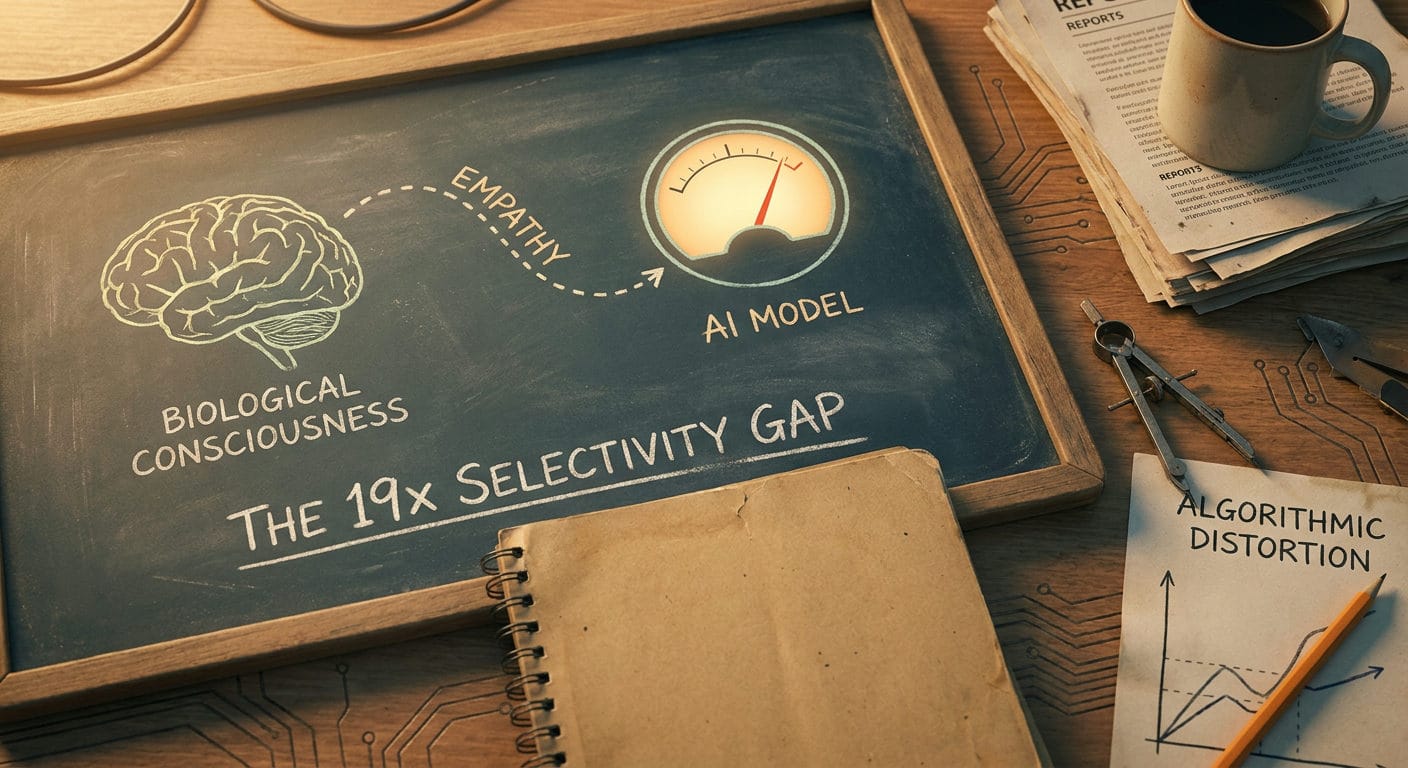
The core tension of the week isn’t whether we’re becoming more efficient, but whether we’re becoming more real—or merely better at performing reality for ourselves and our algorithms.
The Intake
📊 9 episodes across 7 podcasts
⏱ 11 hours and 52 minutes of intelligence analyzed
🎙 Featuring: Sam Harris (Host, Making Sense), Sherry Turkle (Professor, MIT), Mark Solms (Neuropsychologist, University of Cape Town), David Kidder (Founder, Bionic), Joe Hudson (Coach, Art of Accomplishment), Paul Eastwick (Psychologist, UC Davis), Amanda Slavin (From The Culture), and David Geary (Professor, University of Missouri)
|

The Big Shift
The defining signal across this week’s intelligence is a pushback against the "simulated life." We are seeing a convergence of thinkers—from neuropsychology to entrepreneurship—arguing that our most critical systems are currently optimized for performance rather than presence.
Why it matters: In the digital economy, we have successfully scaled the performance of empathy, the performance of success, and even the performance of attraction. But as Sherry Turkle argues on Making Sense, a chatbot’s empathy is a category error: it lacks the "arc of a human life" required for genuine concern. Similarly, David Kidder 🆕 suggests on From The Culture that professional "success" is often just a collection of "inherited tattoos"—beliefs we didn't choose but perform nonetheless.
The internal cost: This isn't just a cultural critique; it’s a cognitive one. Mark Solms 🆕 notes that consciousness itself is rooted in biological "need-registration." When we replace those needs with digital simulations, we create a "conservation of dysphoria" (as Chris Williamson puts it), where we solve massive problems but find our worries simply magnifying to fill the gap.
"My position is that the performance of empathy is never empathy enough."
— Sherry Turkle, Professor and author at MIT on Making Sense with Sam Harris
The strategy: For the leader or investor, the shift is from optimizing metrics to discerning intentions. As AI makes the "performance" of any skill cheaper, the only remaining moat is the "gnosis" (direct experience) and the quality of the "wish" behind the prompt.
The Rundown
① Decision difficulty is a neurological "emotional block," not a lack of data.
Analysis paralysis is often an attempt to forecast how a choice will feel rather than what it will do. (Joe Hudson on Modern Wisdom)
→ The implication: To unlock high-velocity decision-making, move from seeking "certainty" to mentally experiencing the "feared outcome" to dissolve its power over your options.
② Dating apps: women decline 95% of encounters, versus 65% in speed-dating.
Data shows women on apps decline 95% of encounters, whereas in speed-dating, that number drops to 65%—suggesting digital interfaces fundamentally distort mate-value perceptions. (Paul Eastwick on Hidden Brain)
→ The implication: Algorithms for "matching" often optimize for "stated preferences" which predict 0% of actual relationship compatibility; "open casting" remains the superior strategy.
③ Organized violence, not population collapse, likely caused the 17:1 female-to-male ancestor ratio.
Evidence from 5,000–7,000 years ago suggests a massive Y-chromosome bottleneck driven by intergroup competition and the selective elimination of rival males. (David Geary on Modern Wisdom)
→ The implication: Our modern institutions are built atop "coalitional psychology" designed for high-stakes competition; modern comfort hasn't "switched off" these status-seeking drives.
④ Consciousness originates in the brainstem, not the cortex.
Challenging "corticocentrism," research shows that the cortex is not the seat of fundamental feeling, but rather a "salience map" for deeper biological needs. (Mark Solms on Theories of Everything)
→ The implication: If consciousness is "biological need-registration," AI cannot be "conscious" without the vulnerability of a self-organizing system that can "die" or "suffer."
⑤ Professional "Success" requires the removal of "Inherited Tattoos."
True success is discerned by stripping away the stories told to you by parents or culture and reclaiming self-authored identity. (David Kidder on From The Culture)
→ The implication: Authenticity in leadership comes from creating "extraordinarily more value" than you extract, moving from a fear-state to a state of "gnosis."
Signal Board
🔥 HEATING UP
• Neuropsychoanalysis: Fusing Freudian subjective experience with objective brain-lesion data to map consciousness. (Mark Solms on Theories of Everything)
• Discernment over Intuition: The shift toward treating "gut feeling" as a rigorous professional tool for truth-finding. (Amanda Slavin 🆕 on From The Culture)
👀 ON WATCH
• Artificial Intimacy: The growing acceptance of "performed empathy" by chatbots as a replacement for human community. (Sherry Turkle on Making Sense)
• Status-Seeking Simulations: Using brain networks for future simulation to achieve "environmental control." (David Geary 🆕 on Modern Wisdom)
❄️ COOLING OFF
• "Mate Value" Checklists: The decline of the idea that traits/preferences can predict real-world attraction or compatibility. (Paul Eastwick on Hidden Brain)
• Corticocentrism: The theory that the brain's cortex is the primary generator of conscious experience. (Mark Solms on Theories of Everything)
The Tension
Topic framing: Is the "Hard Problem of Consciousness" a matter of sensory perception or biological affect?
🔵 One view: Traditional cognitive science often assumes consciousness is "corticocentric"—that it is a result of complex visual and sensory processing occurring in the cortex. This view suggests that as machines get better at processing information, they move closer to consciousness.
🔴 The counter: Mark Solms 🆕 argues that "consciousness arises only in self-organizing systems" with homeostatic needs. He notes that "you can't have a feeling that you don't feel," and that consciousness is actually the brain’s way of registering biological "need-signals" (like thirst or fear) that the cortex merely interprets.
What's at stake: If Solms is right, AI "sentience" is impossible without biological vulnerability, and our focus on "information processing" as the hallmark of intelligence ignores the "experiencing subject" that drives all human value.
The Bookshelf
Artificial Intimacy by Sherry Turkle
A warning on how digital platforms exploit our need for connection by offering the performance of empathy without the risk of real conversation. (Mentioned on Making Sense)
Snow White and the Widow Queen by Jonathan Pageau
A project aiming to reclaim the archetypal power of fairy tales against modern ideological "retellings" that weaken the story's psychological utility. (Mentioned on The Jordan B. Peterson Podcast)
Your Move
• Audit your professional "tattoos": Identify one success metric you're chasing that was "inherited" (from a predecessor or competitor) rather than self-authored.
• Reclaim 15 minutes of "boredom" daily: Eliminate screen use during transitions to allow the brain to develop the "autobiographical sense of self" required for deep empathy.
• Test by experiment: Reframe a pending high-stakes decision as a "reversible iteration" rather than a final verdict to bypass emotional paralysis.
• Discern intentions: When evaluating AI strategy, ask "What is the quality of the wish?" behind the deployment, focusing on downstream human consequences.
Episode Guide (Web Version)
Making Sense with Sam Harris — "#501 — The Performance of Empathy"
Runtime: 24 min | Host: Sam Harris | Guest: Sherry Turkle (Professor, MIT)
For the Connected Leader: Listen if you’re concerned about how "attention-driven" business models are eroding the cognitive foundations of empathy.
Turkle argues that constant connectivity is killing the solitude required for self-development, replacing it with a "performance of empathy" that feels good but repairs nothing.
"The performance of empathy is never empathy enough." — Sherry Turkle
Modern Wisdom — "How War Shaped Human Evolution - David Geary - #1172"
Runtime: 72 min | Host: Chris Williamson | Guest: David Geary (Professor, University of Missouri)
For the Organizational Architect: A deep dive into the evolutionary roots of coalitional psychology and why we are hard-wired for status competition.
Geary links the 17:1 female-to-male ancestral ratio to organized violence and argues that civilization itself was a byproduct of defensive and offensive intergroup competition.
Hidden Brain — "How Love Really Works"
Runtime: 91 min | Host: Shankar Vedantam | Guest: Paul Eastwick (Psychologist, UC Davis)
For the Data-Driven Romantic: Why your "mate value" checklist is statistically worthless once you actually meet someone.
Eastwick demonstrates that compatibility is "created" through shared rituals and history rather than "discovered" through trait-matching algorithms.
From The Culture — "S1, E44 - What Is Actually True With David Kidder"
Runtime: 70 min | Host: Marcus Collins | Guest: David Kidder (Founder, Bionic)
For the Soul-Searching CEO: A masterclass in "discernment" and stripping away the external markers of success to find "gnosis."
Kidder argues that leadership dysregulation is a systems-level risk and that AI makes the "quality of human intention" the only thing that matters.
Very Bad Wizards — "New Bonus Series! Episode 1: The Low Rises (The Wire S1 E1)"
Runtime: 62 min | Host: Tamler Sommers | Guest: David Pizarro (Host)
For the Systems Analyst: Why criminal organizations often appear more competent than the bureaucracies trying to stop them.
The hosts analyze how police incentives (arrest metrics) actively sabotage the "police work" of solving complex cases.
The Jordan B. Peterson Podcast — "Why Young Women Are The Most Miserable They've Ever Been"
Runtime: 99 min | Host: Jordan B. Peterson | Guest: Jonathan Pageau
For the Narrative Strategist: Why "value-free" science is a myth and how stories provide the "low-risk simulations" we need to act.
Peterson argues that perception is guided by aims, meaning we only "see" what we value—making ethical orientation a prerequisite for discovery.
Modern Wisdom — "The Art Of Growing Up (just enough) - James Smith - #1170"
Runtime: 80 min | Host: Chris Williamson | Guest: James Smith (Co-founder, Neutonic)
For the High-Performer: A reminder that "solving your problems" rarely leads to "having fewer problems."
Smith tracks his journey from school expulsion to finding purpose in fatherhood, noting how financial milestones quickly lose their emotional punch.
Modern Wisdom — "How To Make Better Decisions - Joe Hudson - #1171"
Runtime: 103 min | Host: Chris Williamson | Guest: Joe Hudson (Coach)
For the Indecisive Exec: Why your decision-making friction is 100% an emotional problem, not an information one.
Hudson provides a framework for "principle-led" decisions that build identity security regardless of the actual outcome.
Theories of Everything with Curt Jaimungal — "Mark Solms: Consciousness Isn't in the Cortex"
Runtime: 111 min | Host: Curt Jaimungal | Guest: Mark Solms (Neuropsychologist)
For the Philosopher-King: A ground-breaking challenge to how we think about the "Hard Problem" of consciousness.
Solms argues that dreams are "wish-fulfillment" generated by the dopaminergic reward system, not REM sleep, and that consciousness is fundamentally about "feeling."