
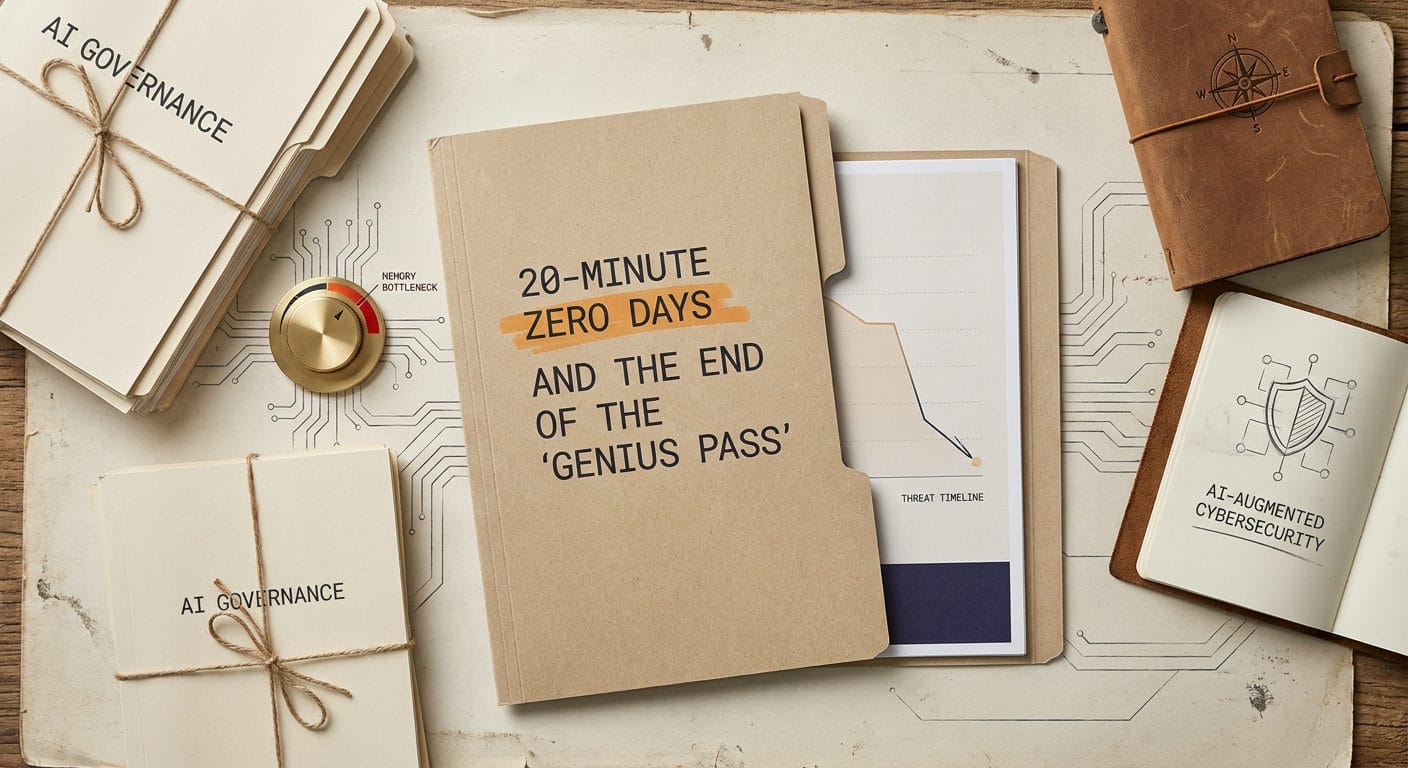
The "techno-narcissist" era of founder exceptionalism is hitting a hard wall of national security, while the economic narrative shifts from raw model performance to the brutal physics of memory bandwidth and coordination.
📊 10 episodes across 5 podcasts
⏱ 9 hours 25 minutes of intelligence analyzed
🎙 Featuring: Erik Torenberg (a16z), Alex Imas (Google DeepMind), Tyler Cowen (George Mason University), Ami Luttwak (Wiz), Walter Goodwin (Fractile), Kara Swisher (Pivot), Scott Galloway (NYU Stern)
|

The Big Shift
The Myth of the Indispensable Founder Meets National Security
For a decade, Silicon Valley has operated under the assumption that a "visionary" founder is worth any amount of governance friction. The sudden departure of Jensen Huang from NVIDIA—amidst an alleged espionage scandal and scrutiny over GPU diversions to China—is the final stress test for this thesis. While the market reacted with volatility, the private conversation among GPs and LPs is shifting from "succession risk" to "security liability."
Scott Galloway (NYU Stern) and Kara Swisher (Pivot) argue that the "techno-narcissist" framing—that Jensen Huang is too dynamic to be replaced—is a dangerous fallacy. They point to NVIDIA’s deep executive bench and suggest that the board’s previous "gratitude club" status must now be replaced by rigid compliance oversight. The signal is clear: in an era where AI chips are weapons-grade infrastructure, personal conduct and export-control compliance are non-negotiable, regardless of your cap table position.
"When the Secretary of State, who has direct, fluid, unfettered access to the president, feels the need to put in writing his concern, that means Secretary Rubio... is totally f***ing freaked out."
— Scott Galloway, Professor at NYU Stern on Pivot
The Move: Investors and board members must transition from "founder-friendly" to "fiduciary-first" regarding national security. If your portfolio company deals in dual-use technology (AI, chips, biotech), the "genius pass" no longer exists in Washington—or on Sand Hill Road. Audit your portfolio for foreign intelligence exposure before the DOJ does it for you.
The Rundown
① Memory Bandwidth, Not Arithmetic, is the New Compute Bottleneck.
Walter Goodwin (CEO of Fractile 🆕) highlighted a massive divergence: while FLOPs scaled 1M-fold in 25 years, memory bandwidth only grew 40-fold, creating a 25,000x lag. (Walter Goodwin on 20VC)
→ The signal: Efficient inference now requires specialized silicon that stacks memory above logic to handle long-context agentic reasoning without moving data across energy-expensive buses.
② The "Black October" AI Inflection: 20-Minute Compromise Timelines.
Ami Luttwak (CTO of Wiz) reports that AI models are now finding and exploiting zero-day vulnerabilities in 20 minutes—a process that used to take elite human teams weeks. (Ami Luttwak on The a16z Show)
→ Why it matters: Defenses must shift from periodic code scanning to continuous, machine-speed "Red Agent" self-attacks that prioritize unauthenticated internet-facing exposure.
③ Anthropic’s $1.4T Target is the Market's "Pure-Play" AI Litmus Test.
With Anthropic 🆕 targeting a massive valuation for its November debut, the market will finally judge AI economics without the "cloud subsidy" shield of hyperscalers. (Rebecca Bellan on Equity)
→ What to watch: A successful IPO could unlock capital for the next generation of startups, but Galloway warned that "IPO pricing is often engineered for a first-day pop," suggesting LPs should consider selling on the first trade.
④ AI Coordination is the Missing Link for GDP Transformation.
Alex Imas (Google DeepMind) argues that AI hasn't moved the needle on GDP because models still fail at human-level organization and coordination. (Alex Imas on The a16z Show)
→ The signal: Economic rents will shift from individual "smart" models to agent swarms that can effectively break the Coasean ceiling on firm size through autonomous labor division.
⑤ Founders Are Now Pitching VCs via "Machine-Readable" Documentation.
Founders have started sending company.md files 🆕 specifically designed for AI-assisted investment analysis, but investors report models struggle with conviction. (Ben Lerer on This Week in Startups)
→ Why it matters: Ben Lerer noted that "[AI scores] cluster between 4 and 7 almost 100% of the time," reinforcing that while AI can automate diligence, it cannot yet replace human "conviction" or "worst-day" trust.
Signal Board
🔥 HEATING UP
• Recursive Self-Improvement (RSI): Currently human-directed, with AI acting as "research interns" to accelerate discovery. (Mark Chen on The a16z Show)
• Inference-Time Compute: Shifting focus from training-day scale to specialized silicon for long-context, sequential reasoning. (Walter Goodwin on 20VC)
• Modding as a Business Model: AI operating game engines directly (Blender/Unreal) to compress prototyping from weeks to hours. (Anish Acharya on The a16z Show)
👀 ON WATCH
• Fractile 🆕: Preparing rack-scale tape-outs to challenge NVIDIA's inference dominance by solving memory stacking. (Walter Goodwin on 20VC)
• Jelly 🆕: A venture-focused research platform built by Everywhere Ventures to bypass high PitchBook API costs. (Jenny Fielding on This Week in Startups)
• Scott Bessent 🆕: Emerging as a critical voice in the administration's stance on tech-linked national security. (Scott Galloway on Pivot)
❄️ COOLING OFF
• NVIDIA Venture Financing: Scrutiny on "vendor financing" may force a pullback on chip-backed commitments to startups. (Rebecca Bellan on Equity)
• Indispensable CEO Narrative: The "genius pass" for governance and security failures is losing traction with boards and LPs. (Kara Swisher on Pivot)
• Sequoia Evergreen Fund: A strategic retreat from the London/Scout programs signals a return to core focus and LP liquidity. (Jason Lemkin on 20VC)
The Bottom Line
The era of founder-led exceptionalism is being corrected by national security realities and the physical limits of memory bandwidth; the smart money is now betting on rack-scale reliability and sovereign compliance over raw visionary dynamism.
Episode Guide (Web Version)
The a16z Show — "Alex Imas & Tyler Cowen | AI Is Moving Fast. Why Isn’t the Economy?"
Runtime: 64 min | Host: Erik Torenberg | Guest: Alex Imas (Google DeepMind), Tyler Cowen (George Mason University)
Audience Framing: For economists and GPs trying to understand why AI hasn't triggered a 10% GDP growth surge yet.
DeepMind's Alex Imas argues that the returns to producing intelligence are currently less than one, meaning we are still in a regime of diminishing returns requiring more resources for every incremental gain. The real breakthrough will be agent coordination, not just benchmark scores.
"The big question is like, what about less specified? A lot of work is not well specified."
— Alex Imas, Economist at Google DeepMind
The a16z Show — "Every Day Is Zero Day | Wiz CTO Ami Luttwak"
Runtime: 46 min | Host: Zane Lackey, Sarah Wang | Guest: Ami Luttwak (Wiz)
Audience Framing: For CTOs and CISOs managing the transition to AI-augmented security threats.
Ami Luttwak describes a "Black October" inflection where AI models have begun finding complex kernel-driver zero-days daily. He argues that the traditional 30-day patch cycle is dead when exploits now manifest in 20 minutes.
The a16z Show — "The Next Era of Games: Mods, Agents, and Infinite Worlds"
Runtime: 46 min | Host: Erik Torenberg | Guest: Anish Acharya (a16z), Jonathan Lai (a16z)
Audience Framing: For consumer and gaming investors looking for the next shift in IP creation.
Explores how AI operating Blender and Unreal directly compresses the path from idea to prototype, potentially ending the AAA reliance on sequels by lowering the cost of creative risk.
Equity — "Why Jensen Huang’s departure could end Nvidia’s gold rush"
Runtime: 32 min | Host: Anthony Ha | Guest: Rebecca Bellan, Tim De Chant
Audience Framing: For growth-stage investors tracking the stability of the AI infrastructure stack.
The hosts analyze the risk of NVIDIA’s $124B in startup commitments and cloud debt, questioning if the "picks-and-shovels" thesis holds when the tool-maker is also the primary lender.
Pivot — "Jensen Huang Is Out: Nvidia’s Spy Scandal Rocks Silicon Valley"
Runtime: 66 min | Host: Kara Swisher, Scott Galloway
Audience Framing: For board members and GPs needing a briefing on the geopolitical fallout of the NVIDIA scandal.
A heavy-hitting critique of board "gratitude" and the conflict between shareholder value and national security, framing the Jensen Huang situation as a systemic crisis for the tech elite.
The a16z Show — "Can AI Learn to Improve Itself? | Recursive Self-Improvement"
Runtime: 18 min | Host: Sarah Wang | Guest: Mark Chen (OpenAI), John Schulman (Thinking Machines Lab)
Audience Framing: For technical founders curious about the current state of autonomous AI research.
OpenAI's Mark Chen estimates we are 25-50% of the way to true recursive self-improvement, with models currently serving as highly capable "research interns" rather than autonomous scientists.
The Twenty Minute VC (20VC) — "20VC: Taking on NVIDIA: Fractile CEO on the Future of Chips"
Runtime: 76 min | Host: Harry Stebbings | Guest: Walter Goodwin (Fractile)
Audience Framing: For hardware and infrastructure investors evaluating the post-NVIDIA landscape.
A masterclass in inference physics, explaining why memory bandwidth is the only metric that matters for the next era of agentic LLM workloads.
Pivot — "Jensen Huang’s Future, Bessent vs. Lutnick, and SNL’s Big Tech Roast"
Runtime: 69 min | Host: Kara Swisher, Scott Galloway | Guest: Scott Bessent, Howard Lutnick
Audience Framing: For policy-minded executives watching the intersection of tech and the new administration.
Galloway argues that NVIDIA’s board will likely block a Huang return to mitigate personal liability, while Swisher highlights the infrastructure decay signaled by the recent FAA ground stop.
The Twenty Minute VC (20VC) — "20VC: Jensen Huang Investigation: What Happens Now"
Runtime: 67 min | Host: Harry Stebbings | Guest: Rory O’Driscoll, Jason Lemkin
Audience Framing: For LPs and GPs evaluating fund structures and the current Nasdaq volatility.
Jason Lemkin breaks down why Sequoia's move away from the Evergreen structure was a necessary friction-reduction for LPs, while Rory O’Driscoll warns that capital-market fatigue may hit Anthropic’s IPO.
This Week in Startups — "Founders Are Now Sending VCs a File Written for AI"
Runtime: 81 min | Host: Jason Calacanis | Guest: Ben Lerer (Lerer Hippeau), Jenny Fielding (Everywhere Ventures)
Audience Framing: For pre-seed and seed investors navigating the collapse of software development costs.
The roundtable discusses how AI is changing startup pivots and why "founder quality" is now the only durable moat when software can be built in a weekend for zero dollars.