
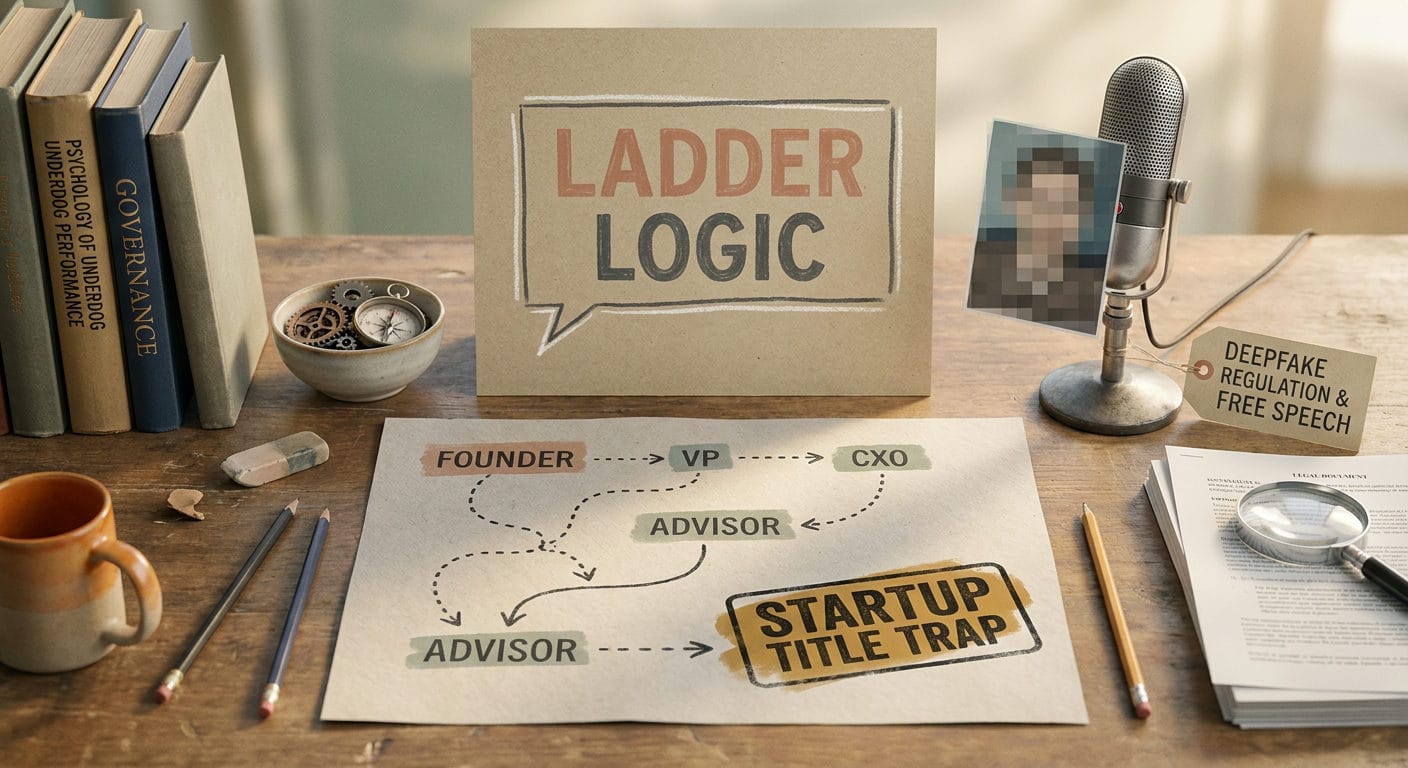
High-performance leverage this week isn't found in more effort, but in the strategic use of constraints, the counterintuitive power of being underestimated, and the "ladder logic" trap.
📊 9 episodes across 8 podcasts
⏱ 10 hours 27 minutes of intelligence analyzed
🎙 Featuring: Shankar Vedantam, Samir Nurmohamed, Tom Brady, Aly Raisman, Gokul Rajaram, Amy Wax, Ashley Walters, and Ben Shapiro
|

The Big Shift
The Strategic Pivot to Internal Validation. We are seeing a coordinated push against the "external scoreboard" across domain-leading thinkers. From high-stakes entrepreneurship to elite athletics, the signal is clear: external markers—like job titles, public polling, or even expert expectations—are increasingly viewed as "noise" that degrades high-level decision-making.
The Evidence: 🆕Gokul Rajaram (Board Member, Coinbase and Pinterest) argues that "ladder logic" and premature C-suite titles at startups actually distort incentives, pulling focus away from scope and impact. Simultaneously, Samir Nurmohamed (Wharton) reveals that the "underdog effect" only works when the doubter is seen as not credible. If you respect the person doubting you, their low expectations become a self-fulfilling prophecy of failure. If you don't, they become fuel.
"Underdogs who have a chip on their shoulder don't perform well in spite of being doubted. They perform well because they've been doubted."
— Shankar Vedantam, Host on Hidden Brain
Why it matters: For the CEO or Investor, this suggests that "Key Person Risk" isn't just about a founder leaving—it's about the founder's narrative. If your team is optimizing for the title (external) rather than the project (internal), you are building on sand. Mastery, as 🆕Ashley Walters noted, comes from the repetition and the "fear" beneath the persona, not the persona itself.
The Bottom Line: Stop managing for the LinkedIn headline. Manage for the "Underdog" credibility gap and the intrinsic scope of the work.
The Rundown
① The "Wizard Phase" of Technology Is a Governance Trap.
Media scholar Jeff Jarvis argues that we treat AI founders as "wizards," which prevents the critical questioning necessary for mature governance. (Jeff Jarvis on Open to Debate)
→ The implication: Leadership transitions at companies like Nvidia should be viewed through the lens of institutional transparency rather than just founder magic.
② Job Titles Are a Lagging (and Often False) Indicator.
🆕Gokul Rajaram argues that early-career professionals should optimize for "company trajectory" over "title," noting that "1000 out of 1000 times, always choose company." (Gokul Rajaram on Worklife with Adam Grant)
→ The Opportunity Cost: High-growth companies create more roles than they have people for; a "VP" title at a stagnant firm is a career dead-end.
③ Communication Is a Physiological Discharge.
🆕Vinh Giang suggests that "shaky voices" in high-stakes meetings are caused by adrenaline, which can be discharged via 20 "star jumps" or push-ups before a call. (Vinh Giang on The Mel Robbins Podcast)
→ The takeaway: "Clarity and conciseness and coherency. That is also a form of value," according to Giang.
④ The "Normality" Multiplier in Leadership.
🆕Ben Shapiro posits that in periods of high volatility, "the first party to normality wins," suggesting voters and employees alike are exhausted by "administrative chaos." (Ben Shapiro on Conversations With Coleman)
→ The Strategy: Predictability is currently a premium asset; leaders who provide a stable "steady state" will out-recruit those offering "disruption."
⑤ The "Liar's Dividend" in Synthetic Media.
Law Professor Ryan Calo warns that the danger of AI deepfakes isn't just deception, but the ability for leaders to dismiss authentic evidence as fabricated. (Ryan Calo on Open to Debate)
→ The Risk: We are moving toward a reality where "truth" is no longer a shared baseline but a choice of which "wizard" to believe.
Signal Board
🔥 HEATING UP
• Underdog Narratives: Using "perceived doubt" as a buffered defense against workplace discrimination and performance plateaus. (Samir Nurmohamed on Hidden Brain)
• Digital Provenance (C2PA): 🆕The technical standard for tracking image origins as a non-censorship alternative to deepfake bans. (Nina Jankowicz on Open to Debate)
👀 ON WATCH
• Arlington Heights Intent Test: 🆕A judicial framework being used to challenge "facially neutral" admissions criteria that have racial objectives. (Amy Wax on The Glenn Show)
• The Three-Two-One Framework: 🆕A speaking tool to prevent rambling by choosing 3 steps, 2 types, or 1 key point before opening your mouth. (Vinh Giang on The Mel Robbins Podcast)
❄️ COOLING OFF
• Title-Maxing: The practice of chasing C-suite titles at early-stage startups is increasingly flagged as a "negative signal" to future investors. (Gokul Rajaram on Worklife with Adam Grant)
• CGI Spectacle: 🆕The belief that high budgets yield better creative output; "constraints make for great art." (Ben Shapiro on Conversations With Coleman)
The Tension
Topic: Should AI-generated political deepfakes be treated as protected speech?
🔵 The Civil Liberties View: Robert Corn-Revere and 🆕Nina Jankowicz argue that First Amendment protection is vital to prevent government overreach. They contend that autocracies weaponize speech restrictions and that "all speech is presumptively protected... especially speech involving politics." They favor digital provenance and media literacy over bans.
🔴 The Systematic Risk View: Susan Benesch and Ryan Calo argue deepfakes move too fast for "counterspeech" to work. They cite studies where "nearly 70% of subjects... didn't notice labels" and warn that deepfakes "erode trust in news and democratic institutions." To them, the "Liar's Dividend" is a threat to the foundation of public reality.
What's at stake: The trade-off between "parody" (which requires protection) and "persuasion through fraud." The weight of evidence suggests that while labels are technically feasible, they are psychologically ignored, leaving "trust" as the only remaining, yet fragile, infrastructure.
The Bookshelf
Confession by Ben Shapiro
A Stalin-era interrogation drama discussed as a case study in how creative constraints (two rooms, minimal score) sharpen character conflict. (Mentioned on Conversations With Coleman)
The Brothers Karamazov by Fyodor Dostoevsky
Cited as a primary influence on writing antagonists who sincerely believe their own moral case. (Mentioned on Conversations With Coleman)
Your Move
• Audit your current hiring "narrative": Are you attracting people chasing a title, or people chasing the scope of the problem? If it's the former, restructure the role description by Monday.
• Deploy the "Three-Two-One" framework in your next board meeting or presentation to eliminate verbal fillers and rambling.
• Test the "Underdog Effect" internally: Identify a team that feels "underestimated" by a low-credibility competitor and lean into that narrative to boost performance.
• Implement a 5-second "strategic pause" before answering difficult questions; it signals value and prevents reactive, low-quality responses.
Episode Guide (Web Version)
Hidden Brain — "Just Watch Me!"
Runtime: 89 min | Host: Shankar Vedantam | Guest: Samir Nurmohamed, Tom Brady, Aly Raisman
For the Leader Managing Morale: Learn why low expectations from "low-credibility" sources can actually be a massive performance driver.
This episode breaks down the "underdog effect," showing how job seekers and elite athletes use remembered rejection as a chronic motivational fuel, provided they don't respect the person doing the doubting.
"Underdogs who have a chip on their shoulder don't perform well in spite of being doubted. They perform well because they've been doubted." — Shankar Vedantam
The Jordan B. Peterson Podcast — "How to Train Gratitude"
Runtime: 114 min | Host: Jordan B. Peterson | Guest: Host-led discussion
For the Strategic Thinker: A deep dive into how "prioritization" precedes "facts" and why resentment is a failure of sacrifice.
Peterson uses the Cain and Abel narrative to argue that resentment begins when we blame the world for our failures instead of correcting our "aim," linking individual truth-telling to the survival of institutions.
Open to Debate — "BONUS: Was Jensen Huang’s Exit from Nvidia the Right Move?"
Runtime: 31 min | Host: John Donvan | Guest: Isaac Stone Fish, Jeff Jarvis
For the Tech Investor: A high-speed debate on whether founder-worship or board governance should prevail in the AI era.
While discussing the hypothetical removal of Jensen Huang, the debaters explore "key person risk" and whether the public "wizard phase" of AI is blinding us to standard governance failures.
Open to Debate — "Should AI Deepfakes Be Treated as Protected Political Speech?"
Runtime: 69 min | Host: John Donvan | Guest: Nina Jankowicz, Robert Corn-Revere, Susan Benesch, Ryan Calo
For the Policy Maker: A rigorous look at the First Amendment's collision with synthetic media and election integrity.
The episode centers on whether the "liar's dividend"—the ability to claim real evidence is fake—is a greater threat than the government power required to ban deepfakes.
Modern Wisdom — "What We Get Wrong About Angry Young Men"
Runtime: 74 min | Host: Chris Williamson | Guest: Ashley Walters
For the Cultural Observer: An exploration of masculinity, mastery, and the "fear" behind the "angry" persona.
Actor Ashley Walters shares how prison and sobriety forced him to dismantle a "street persona" to find authentic confidence through earned mastery rather than performative toughness.
The Glenn Show — "Amy Wax on Affirmative Action"
Runtime: 88 min | Host: Glenn Loury | Guest: Amy Wax
For the Board Member: A controversial look at how elite universities are navigating the post-affirmative action legal landscape.
Amy Wax introduces the "Race Realism 1 vs 2" framework and argues that "facially neutral" admissions criteria are being used as proxies for racial goals, creating new legal risks for institutions.
Worklife with Adam Grant — "Does your job title even matter?"
Runtime: 52 min | Host: Molly Graham | Guest: Gokul Rajaram
For the C-Suite: Why you should stop giving out "Director" titles to early hires and how to value "scope" over "status."
Gokul Rajaram explains why he refused to know his Google retention grant size to protect his entrepreneurial drive, arguing that titles are often "external noise" that distracts from high-impact work.
Conversations With Coleman — "Ben Shapiro on the End of MAGA"
Runtime: 56 min | Host: Coleman Hughes | Guest: Ben Shapiro
For the Political Strategist: Why "normality" is the most valuable commodity in a polarized market.
Shapiro argues that MAGA is a person, not a portable ideology, and that voters are currently optimizing for "normality" over "chaos," providing a blueprint for future leadership coalitions.
The Mel Robbins Podcast — "9 Habits for Clearer Speaking"
Runtime: 54 min | Host: Mel Robbins | Guest: Vinh Giang
For the Executive Communicator: Tactical habits to turn technical expertise into visible influence.
Vinh Giang teaches the "Three-Two-One" framework and "physiological discharge" techniques to ensure your voice matches the quality of your ideas.