High-performance leadership is shifting from managing outcomes to managing the upstream conditions of decision-making—situational friction, cognitive "sandwiches," and the deliberate normalization of failure.
📊 9 episodes across 7 podcasts
⏱ 15 hours 27 minutes of intelligence analyzed
🎙 Featuring: Lex Fridman (Lex Fridman Podcast), Astro Teller (Captain of Moonshots, X), Angela Duckworth (University of Pennsylvania), Martin Seligman (University of Pennsylvania), Steven Kotler (Flow Research Collective)
|

The Big Shift
The core thesis: We are moving from an era of "brute-force willpower" to one of "architected agency." Whether in the boardroom or the research lab, the most effective leaders aren't white-knuckling their way to results; they are redesigning their environments and workflows to make excellence the path of least resistance.
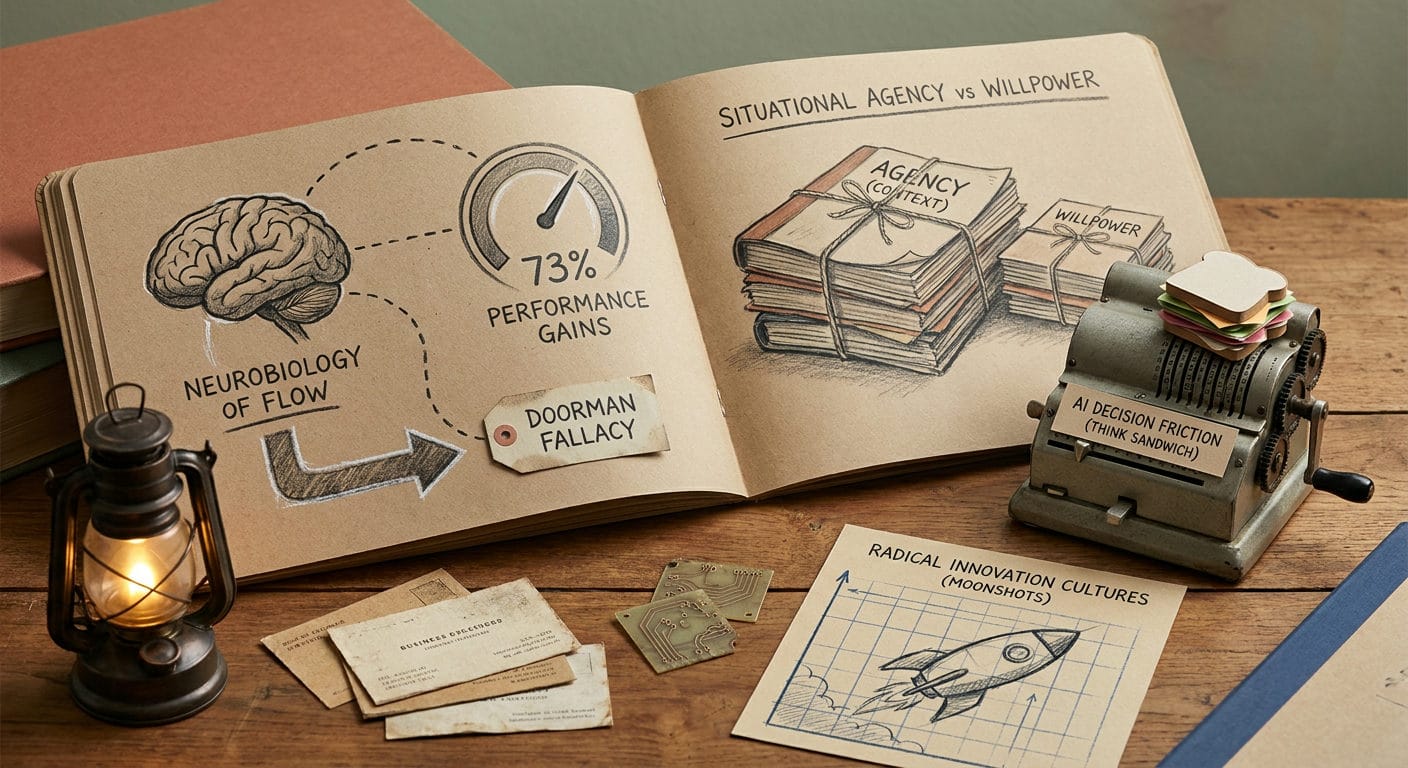
The evidence: 🆕Angela Duckworth (University of Pennsylvania) argues that agency often lies "upstream"—in choosing the situation rather than trying to control the response. Similarly, 🆕Astro Teller (Alphabet's X) describes a culture where "humility, empathy, and a growth mindset" are not values, but performance expectations supported by rituals like the "Monkey-and-Pedestal" framework, which forces teams to tackle the hardest problem first.
"The power of the situation, the forces that are exerted on you as an individual agent, are more pervasive than you think and that therefore... you should be intentional about the situations in life that you put yourself in."
— Angela Duckworth, Psychologist and author on EconTalk
Why it matters: As AI makes basic problem-solving "cheap," the premium on human judgment and question-selection rises. Ankur Moitra (MIT) suggests this creates a "doorman fallacy"—mathematicians (and by extension, executives) must realize their value isn't just in the "proof" or the "output," but in the story, the connection, and the understanding that lives only in human minds.
The Rundown
① The "Think Sandwich" Protocol for AI Integration.
Erica Dhawan argues that productivity incentives are pushing outputs toward "sameness," requiring a three-step manual override: think before the tool, use the tool, then think again to debias. (Erica Dhawan on From The Culture)
→ The implication: If you cannot explain, defend, or recall the work, it isn't yours; leaders must reward "proof of sweat" rather than just the final slide deck.
② Normalizing "Smart Failure" Through Ritualized Rule-Breaking.
Alphabet's X factory uses 🆕Failure Resumes and intentionally "bad idea" brainstorms to lower the social cost of being wrong. (Astro Teller on Worklife with Adam Grant)
→ Strategic Insight: Teller noted that "[The] tightest learning loops are the ones that have the most failures in them," suggesting high failure rates are a signal of speed, not incompetence.
③ The "Doorman Fallacy" in Knowledge Work.
As AI automates theorem-proving and code generation, the value of "well-defined problem solving" is collapsing, making "problem selection" the scarcest resource. (Ankur Moitra on Lex Fridman Podcast)
→ The implication: Shift leadership focus from finding answers to formulating sub-questions that AI can then solve, while keeping the high-level theory-building in-house.
④ Flow as a Trainable Competitive Advantage.
Flow states—marked by a 73% boost in performance after structured training—require a specific challenge-to-skill "sweet spot" and the reduction of cognitive friction. (Steven Kotler on The Knowledge Project)
→ Actionable Signal: Kotler suggests that "[You] want to stretch but not snap," utilizing frustration as a biological cue that the brain is in a necessary phase of pattern-recognition.
⑤ Narrative Bias in Professional Evaluation.
Humans consistently privilege a compelling "story" over raw data, often causing hiring managers to ignore resumes in favor of a candidate's narrative arc. (Tania Lombrozo on Hidden Brain)
→ The implication: To combat "phantom" patterns, force evaluations to separate the evidence from the explanation, as identical evidence becomes more persuasive simply by being told in temporal order.
Signal Board
🔥 HEATING UP
• Formal Verification (Lean): Mathematical research is moving toward 🆕Mathlib and 🆕Lean for "sorry-free" formal proof checking. (Alex Kontorovich on Lex Fridman Podcast)
• Prosocial Purpose: High-stakes motivation is shifting from "passion" (individual) to "purpose" (collective) to trigger neurochemical durability. (Steven Kotler on The Knowledge Project)
👀 ON WATCH
• 🆕Phantoming: The state of being physically present but mentally outsourced to AI/digital tools; a rising risk for senior leadership. (Erica Dhawan on From The Culture)
• Prediction Market Physicality: Reports of "physical interference" (e.g., heating airport sensors) to sway binary outcomes. (Chris Williamson on Modern Wisdom)
❄️ COOLING OFF
• Misery-Treatment Models: Clinical funding is slowly pivoting from solely "treating misery" to Seligman’s model of "building agency." (Martin Seligman on Modern Wisdom)
• Algorithmic Sports Betting: Professional bettors are reportedly returning to "local human information" as AI models commoditize data. (George Mack on Modern Wisdom)
The Bookshelf
Use Your Brain by Erica Dhawan
A manual for resisting "autopilot" culture and maintaining human differentiation in an automated workplace. (Mentioned on From The Culture)
Situated by Angela Duckworth
Argues that agency is the art of environmental design, moving past the "grit-only" individualist model. (Mentioned on EconTalk)
Your Move
• Audit your "monkeys": On Monday, identify the riskiest assumption in your top project and test it BEFORE building the "pedestal" (the easy support work).
• Deploy a "Think Sandwich": For your next major strategy doc, require a 15-minute "no-AI" brainstorming session before any tools are opened.
• Add friction: Move your phone to a different room during deep-work blocks to exercise "situational agency" rather than willpower.
Episode Guide (Web Version)
Modern Wisdom — "Crypto Scams, Dopamine Websites, Tasteful Slop"
Runtime: 128 min | Host: Chris Williamson | Guest: Jack Butcher, Shaan Puri, George Mack
For the Cultural Strategist: A deep dive into how "reputation honey traps" and AI slop are breaking the internet's trust mechanisms.
The panel argues that shipping work beats planning, and that in a world of AI-generated "slop," deeply specialized niche expertise becomes the only defensive moat. ▶ Listen · Apple Podcasts
Lex Fridman Podcast — "#503 – AI Crisis in Math"
Runtime: 223 min | Host: Lex Fridman | Guest: Steven Brunton, Ankur Moitra, Alex Kontorovich
For the R&D Leader: Essential listening on how AI is disrupting the fundamental incentives of "patient, incremental work."
Mathematicians debate the 🆕Unique Games Conjecture and whether AI theorem-proving destroys the "human journey" of discovery or simply forces us to ask better questions. ▶ Listen · Apple Podcasts
Worklife with Adam Grant — "Why you need to fail at work with Astro Teller"
Runtime: 47 min | Host: Molly Graham | Guest: Astro Teller (Head of X, Alphabet)
For the CEO: A masterclass in building a culture where failure is a "mechanism for updating beliefs."
Teller outlines how X uses parallel prototyping and "bad ideas" brainstorms to destigmatize the path to radical innovation. ▶ Listen · Apple Podcasts
Modern Wisdom — "Positive Psychology Founder: Martin Seligman"
Runtime: 81 min | Host: Chris Williamson | Guest: Martin Seligman (University of Pennsylvania)
For the Individual Operator: A framework for building resilience by moving from "learned helplessness" to "future-oriented agency."
Seligman discusses how AI can actually amplify human connection and why optimism is the second core component of efficacy. ▶ Listen · Apple Podcasts
EconTalk — "How Your Situation Shapes You"
Runtime: 70 min | Host: Russ Roberts | Guest: Angela Duckworth (University of Pennsylvania)
For the Board Member: Understanding why "convenience" and "situational friction" are more powerful than social norms or willpower.
Duckworth argues for a move toward "goodness and generativity" and explains the three-box model of objective situation, thought, and action. ▶ Listen · Apple Podcasts
The Knowledge Project — "The Science of Doing Your Best Work"
Runtime: 66 min | Host: Shane Parrish | Guest: Steven Kotler (Flow Research Collective)
For the High-Performer: A biological breakdown of flow states and why "deliberate play" beats "deliberate practice" in creative fields.
Kotler details the four-stage flow cycle and the importance of a "primary flow activity" to prevent executive burnout. ▶ Listen · Apple Podcasts
Hidden Brain — "The Story of Stories"
Runtime: 91 min | Host: Shankar Vedantam | Guest: Tania Lombrozo (Princeton University)
For the Hiring Manager: A warning on why our drive for "satisfying explanations" often leads to false pattern-making and bad judgment.
The episode explores "self-explanation" as a tool for revealing knowledge gaps and why mystery can be more rewarding than mundane truth. ▶ Listen · Apple Podcasts
From The Culture — "A Culture Problem Dressed As a Tech Problem"
Runtime: 73 min | Host: Marcus Collins & Amanda Slavin | Guest: Erica Dhawan
For the People Officer: How to avoid "phantoming" and ensure AI remains an amplifier of culture rather than a destroyer of original thinking.
Dhawan proposes the "Think Sandwich" and argues that if work isn't explainable or defensible, the person claiming it doesn't own it. ▶ Listen · Apple Podcasts
Modern Wisdom — "35 Emotions Explained By Evolutionary Psychology"
Runtime: 148 min | Host: Chris Williamson | Guest: Rob Kurzban
For the Product Designer: A framework for how "miscalibrated" evolved responses—like envy and anxiety—drive modern behavior.
Kurzban posits that subjective consciousness is a "common currency" for ranking competing biological needs like hunger and social safety. ▶ Listen · Apple Podcasts