
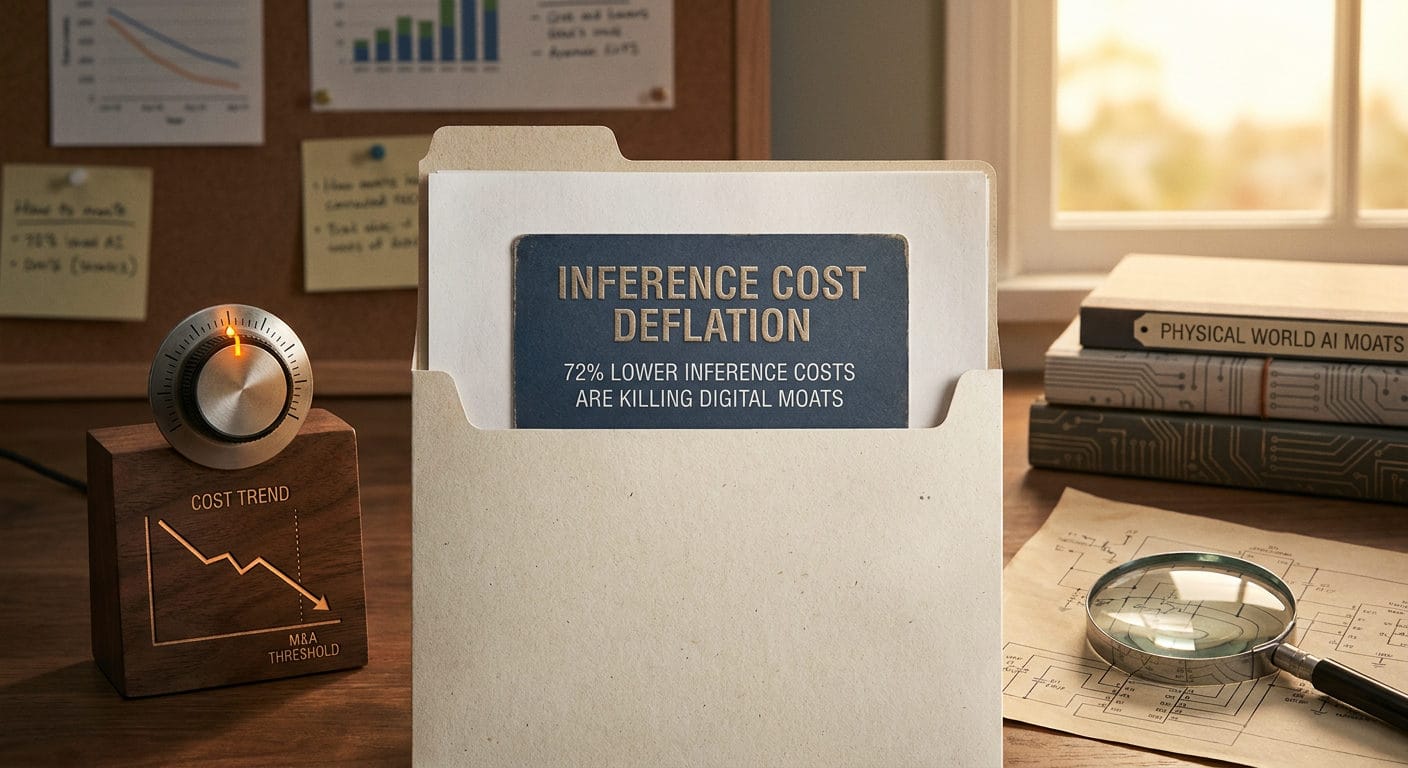
Digital content is commoditizing, inference costs are cratering by 70%, and the smart money is pivoting toward "AI in the world of things" to find durable margins.
📊 10 episodes across 5 podcasts
⏱ 9 hours 42 minutes of intelligence analyzed
🎙 Featuring: Harry Stebbings (20VC), John Somorjai (Salesforce), Dharmesh Shah (HubSpot), Scott Wilson (WashU), Arthur Mensch (Mistral), Shaan Puri (My First Million)
|

The Big Shift
The Pivot to Physical: Why "Meat" Is the New Moat
The consensus in venture is shifting away from pure-play AI SaaS toward what Shaan Puri calls "AI in the world of things." As digital content generation and basic software coding become commoditized, the "puck" is moving toward industries with structural barriers: drug discovery, factory-built modular homes, and autonomous infrastructure maintenance.
The signal is clear: digital margins are under assault from declining inference costs and agentic substitution, while physical-world applications offer "durable" moats that foundation models cannot easily disrupt. Scott Wilson (CIO, WashU) noted that while software buyers are becoming price-sensitive, the willingness to pay for physical-world breakthroughs remains high because "the future is meat."
"I think this is where the puck is going. I think AI in the world of things is where the puck is going over the next 10 years... Investors have this incredible benefit that they get to go where the action is. They move where the money is to be made."
— Shaan Puri, Co-host on My First Million
Why it matters: For the Stretched CEO, this creates a bifurcation in strategy. If you are in pure software, your terminal value is at risk unless you deeply integrate into business processes. If you are looking for new bets, the capital-intensive "un-sexy" categories—like Zuru Tech’s modular homes—suddenly look like the most defensible positions in the ecosystem.
The move: Audit your portfolio or product roadmap for "yellow brick road" features—tasks that frontier labs like OpenAI or Anthropic will naturally solve. If you can append the word "yet" to a model's current deficiency, don't build there. Focus on structural constraints like specialized robotics or regulatory-heavy compliance (Complir 🆕).
The Rundown
① The 70% Deflation: Inference Costs Are Proving the Bulls Wrong.
Jason Lemkin reported that switching a B2B workflow to Haiku cut total costs by more than 70% with equal or better quality. (Jason Lemkin on 20VC)
→ What to watch: As inference prices crater, the "SaaS margin compression" narrative may reverse for companies that can maintain their pricing power while their COGS drops.
② Salesforce’s $10 Billion "Buyer's Ceiling."
John Somorjai signaled that venture valuations exceeding $10B often outstrip the addressable M&A market, leaving IPOs as the only viable exit for late-stage founders. (John Somorjai on The a16z Show)
→ The signal: The "buyer universe" shrinks to nearly zero at these levels; Salesforce Ventures is now looking for outcomes and consumption-based pricing models like Fin, which reached 65% case resolution in 14 days.
③ The "Sovereign AI" Imperative for Europe.
Mistral 🆕 CEO Arthur Mensch argued that Europe must control its own model supply chain to avoid "enormous leverage" from centralized US providers who may eventually compete with their own enterprise customers. (Arthur Mensch on 20VC)
→ Why it matters: Mistral is positioning its "sovereignty stack" as a requirement for business continuity, suggesting that energy is only 10% of the current bottleneck—the real limit is GPU project financing.
④ Endowments Are Quietly Rebuilding the Direct-Investment Playbook.
The WashU Endowment 🆕 has grown from $8B to $19B by spending 90% of its time meeting individual companies directly, with SpaceX reaching over 20% of the total portfolio. (Scott Wilson on 20VC)
→ What to watch: LPs are no longer just passive allocators; the best teams are building internal capacity to independently underwrite deals surfaced by their trusted GPs.
⑤ Sequoia’s "Simplification" Signals a Shift in Firm Strategy.
The closure of the Sequoia London office and the legendary Scouts program was framed as an organizational cleanup rather than a loss of conviction. (Jason Calacanis on This Week in Startups)
→ The signal: Even the most successful firms are consolidating early and growth teams to gain agility as OpenAI and Anthropic begin to "come for the business" of traditional software startups.
Signal Board
🔥 HEATING UP
• Consumption-Based Pricing: Shift from seat-based licenses to measurable outcomes like Fin's resolution model. (John Somorjai on The a16z Show)
• Late-Stage C Rounds: September 2026 saw 121 major deal announcements, marking a recovery in capital-intensive rounds. (Scott Johnson on Blitzscaling Ventures)
👀 ON WATCH
• Complir 🆕: AI-driven retail compliance tools that spread virally through supplier requirements. (Chris Yeh on Blitzscaling Ventures)
• Techforce 🆕: Two-year federal placements designed to inject technical talent into the OPM 🆕. (Scott Kupor on The a16z Show)
❄️ COOLING OFF
• AI Chatbots: Enterprise teams report that simple chatbots are failing to deliver value; the market is moving to end-to-end agents. (Arthur Mensch on 20VC)
• Mega-Fund MOICs: Concentration in $1B+ funds is signaling lower potential multiples as scale dilutes returns. (Scott Wilson on 20VC)
The Debate
The OpenAI $1.25 Trillion Adjustment: Market Crash or Price Discovery?
🐂 The bull case: Rory O’Driscoll argues the valuation cut is simple "price discovery" relative to liquid public peers. If investors can buy Google or Meta at certain multiples, OpenAI must be priced competitively relative to its growth, despite massive loss-leading investments.
🐻 The bear case: Scott Wilson warns that private-market valuations for AI leaders have radically outpaced what public markets are willing to support, and the lack of distributions (DPI) suggests a "reckoning" for venture-backed AI firms when funding eventually dries up.
Our read: The weight of evidence leans toward a liquidity correction. The underlying demand for compute is so high that energy constraints won't hit until 2029—the current "melt-down" is just the private market catching up to the public market's realism.
The Bottom Line
The venture landscape is splitting: digital software is facing a margin-crushing deflationary cycle, while "physical AI" and sovereign infrastructure are becoming the new high-ground for defensible capital.
Episode Guide
Blitzscaling Ventures — "July August September Deal Review"
Runtime: 34 min | Hosts: Chris Shea, Scott Johnson, Chris Yeh
Listen if you: Need a raw look at what's actually clearing the investment committee at the seed and Series C stages.
The hosts review Q3 2026 deal flow, highlighting how AI has 10x-ed their own deal-review speed and why retail compliance AI (Complir) is their top "viral" pick. ▶ Listen · Apple Podcasts
"September is 121, which is the second highest number of deals announced in 2026... the late stage market is a lot better than it was a couple of years ago." — Scott Johnson
The a16z Show — "Inside Salesforce’s $100 Billion M&A Playbook"
Runtime: 49 min | Guest: John Somorjai (Salesforce Ventures)
Listen if you: Are planning an exit or evaluating vertical AI startups against incumbent distribution moats.
John Somorjai breaks down the build-buy-partner framework, revealing that Slack is now Salesforce's fastest-growing product and explaining why $10B+ valuations are M&A deal-killers. ▶ Listen · Apple Podcasts
"Once you get above $10 billion, for example, the buyer universe is so small." — John Somorjai
The Twenty Minute VC — "Mistral CEO on Why Energy Is Not the Bottleneck to AI"
Runtime: 50 min | Guest: Arthur Mensch (Mistral)
Listen if you: Are tracking the "Sovereign AI" movement or infra costs for the next three years.
Arthur Mensch argues that energy is only 10% of the cost of ownership for compute today, and that the real threat to enterprises is centralized AI providers using customer data to build competing systems. ▶ Listen · Apple Podcasts
"If you don't control the data supply chain, if you don't know what goes into the models, you cannot guarantee anything on the output." — Arthur Mensch
The a16z Show — "HubSpot’s Co-Founder on Finding Your Next Startup Idea"
Runtime: 59 min | Guest: Dharmesh Shah (HubSpot)
Listen if you: Are a founder struggling with distribution noise or choosing between model providers.
Dharmesh Shah explains why AI makes building easy but distribution "brutal," advising founders to stay off the "yellow brick road" of features that foundation models will eventually solve. ▶ Listen · Apple Podcasts
"If you can just append the word 'yet' to it and it still holds water, that's a problem." — Dharmesh Shah
The Twenty Minute VC — "Inside WashU's $19BN Endowment Fund"
Runtime: 58 min | Guest: Scott Wilson (WashU CIO)
Listen if you: Want to know how LPs are thinking about liquidity, secondary markets, and SpaceX.
Scott Wilson details how a concentrated, generalist team outperformed by building a "look-through" portfolio that isn't afraid to let winners like SpaceX dominate the AUM. ▶ Listen · Apple Podcasts
"When there's a free alternative, customer willingness to pay drops very, very quickly." — Scott Wilson
The a16z Show — "Scott Kupor on Rebuilding the Federal Workforce"
Runtime: 57 min | Guest: Scott Kupor (OPM Director / a16z)
Listen if you: Are interested in how Silicon Valley operational frameworks (like the "CAA model") are being applied to government reform. ▶ Listen · Apple Podcasts
Scott Kupor recounts the early days of a16z's "Capital Plus" strategy and how he is now using "permissioned risk" to modernize federal hiring and merit-based promotion.
"The job description was actually Marc and Ben said, look, we're going to invest and you need to figure out everything else we needed to build a firm." — Scott Kupor
This Week in Startups — "Why a Do-Nothing Congress could be great for markets"
Runtime: 85 min | Guests: Tomasz Tunguz, D.A. Wallach, Elana Gold
Listen if you: Need to calibrate your 2027 M&A and data-center expansion expectations post-election.
A venture roundtable debates why divided government reduces "sudden risk" for business and how GPU scarcity might fuel a return to bespoke, local inference applications. ▶ Listen · Apple Podcasts
"I think divided government... means that nothing crazy is likely to happen. And that's good for business." — D.A. Wallach
My First Million — "What I’d build if I wanted to get rich with AI"
Runtime: 41 min | Hosts: Shaan Puri, Sam Parr
Listen if you: Are looking for high-alpha opportunities outside the crowded SaaS and LLM wrapper categories.
Shaan Puri makes the case for "AI in the world of things," from modular home factories to advanced prosthetics, treating career shifts like a capital allocation problem. ▶ Listen · Apple Podcasts
"AI in the world of things is where the puck is going over the next 10 years." — Shaan Puri
This Week in Startups — "Can Nvidia Survive the Jensen Huang Spy Scandal?"
Runtime: 80 min | Hosts: Jason Calacanis, Lon Harris
Listen if you: Are tracking Nvidia leadership risk or Sequoia's recent institutional shifts.
Jason Calacanis argues that removing Jensen Huang would play into China's hands and explains why Sequoia's SpaceX board seat is a personal relationship asset, not a firm one. ▶ Listen · Apple Podcasts
"Benching him is what the Chinese want... we have to think strategically, not vindictively." — Jason Calacanis
The Twenty Minute VC — "OpenAI Cuts Valuation to $1.25TRN"
Runtime: 69 min | Guests: Jason Lemkin, Rory O’Driscoll
Listen if you: Want the "Investment Committee" view on the current public vs. private market meltdown.
The panel debates the survival of AI agents, DoorDash's purchase of Instacart, and the "dual-use" risks of AI penetration testing software. ▶ Listen · Apple Podcasts
"The only question is, can the Economics get better before the money runs out." — Harry Stebbings