
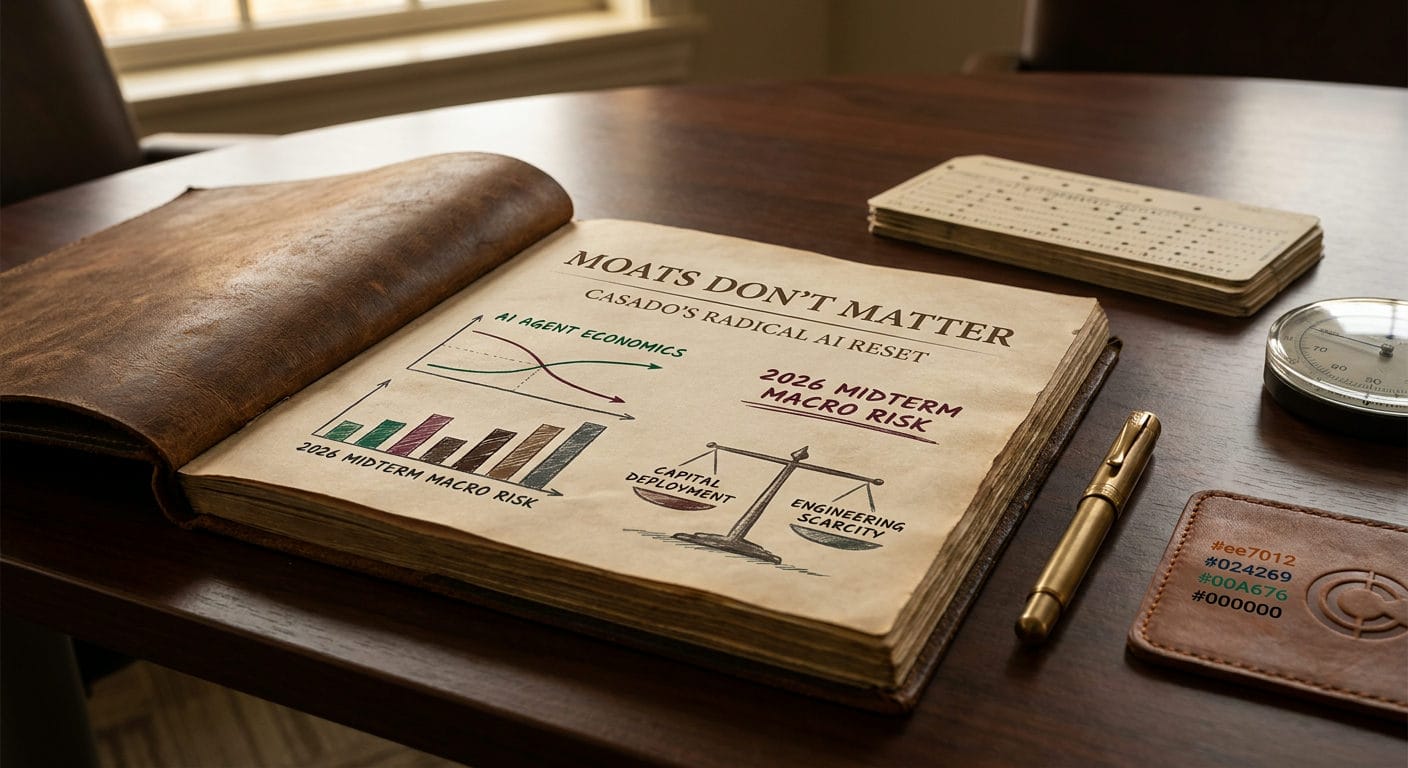
The shift in the 2026 midterm results reveals a clear rejection of the "asset-owner economy." As financial engineering loses its political and social cover, buyers now place a maximum premium on operational growth over purely ideological narratives.
📊 9 episodes across 8 podcasts
⏱ 7 hours 34 minutes of intelligence analyzed
🎙 Featuring: Martin Casado (Andreessen Horowitz), Patrick O'Shaughnessy (Invest Like the Best), Chamath Palihapitiya (All-In Podcast), Jason Calacanis (All-In Podcast), Vik Uppal (Mavik Capital), Nate Silver (Silver Bulletin), Meredith Whittaker (Signal)
|

The Big Shift
The Transition from Engineering Bottlenecks to Capital Deployment.
Capital allocation now constrains software value creation more than elite engineering talent. Martin Casado (Andreessen Horowitz) argues AI agents are driving a "broad stack reset" that separates product velocity from headcount. Frontier models with even an "epsilon" of capability lead command pricing power, and demand for intelligence still trails its potential TAM.
Why it matters: Small teams now deploy capital to build previously impractical digital experiences. The "moat" shifts from the codebase to release speed and execution in rapidly expanding markets. Casado notes that "we spend a lot of time as investors hand-wringing about defensibility when in practice it doesn't really matter, especially in growing markets."
The Macro Tension: Tech-driven wealth creation faces populist resentment. On All-In, Chamath Palihapitiya characterized the 2026 midterm results as a cross-partisan rejection of an economy rewarding asset owners over wage earners. Voters link AI gains to tech elites while paying higher prices for fuel and food during the Iran war. This frustration turns the regulatory "freeze" on data centers into a political weapon.
"The biggest disruption of AI is the fact that you can throw capital at problems... I think this is kind of the biggest refresh of computer science infrastructure we've seen, maybe since the Internet, maybe forever."
— Martin Casado, General Partner, Andreessen Horowitz on Invest Like the Best
The Move: Base diligence on "market velocity" instead of a "technical moat." Companies failing to grow at 2x GDP through vertical or horizontal expansion will see their pricing power erased by the next 90-day model update.
The Rundown
① Underwrite the CEO as a "Biological Organism."
Lower-middle market differentiation is thin, leaving the management team as the primary durable asset. On The Private Equity Podcast, Ian Reynolds (Thesis Capital) argued diligence requires "downside-first" underwriting to screen executives for behavioral traits and financial fluency. → The Signal: Walk away from a bad leadership fit regardless of multiples. Businesses operate like biological organisms.
② The "Data Center Freeze" Is the New Regulatory Capture.
Local opposition over utility bills and water use turns data center permitting into a political battleground. On All-In Podcast, David Friedberg noted that restricting compute centers for community protection lets the government dictate who accesses frontier AI. → The Signal: Incumbent hyperscalers with built capacity hold a structural advantage over neocloud renters operating effectively "short" compute.
③ Avoid the "Data Center AI Infrastructure" Crowd.
On Capital Allocators, Vik Uppal (Mavik Capital) said he avoids AI infrastructure investments. Improving technology efficiency makes it impossible to underwrite long-term fundamental value. → The Signal: Capital preservation demands patience. Mavik spent nearly a year without a deal in 2023 waiting for a "pipeline" that met its 10/10 standard for capital protection.
④ 🆕 The "One Piece" Playbook: Extreme Creative Control.
Eiichiro Oda maintains 30-year consistency with One Piece by refusing to delegate moving elements like smoke, clouds, and waves. On Founders, David Senra attributed this output to a "deadline-driven perfectionism" that frames the work as a pastime. → The Signal: Builders achieve differentiation by designing products for a "personally defined reader" (Oda's 15-year-old self) and ignoring saturated market trends.
⑤ Polling Errors Are Correlated, Not Systematic.
On Odd Lots, Nate Silver warned that the "polls miss Trump" narrative does not apply to midterms or non-Trump races. Recent gubernatorial polls in NJ and VA underestimated Democrats, showing that polling errors correlate across states but vary by election type. → The Signal: AI-generated "synthetic voters" or digital twins reproduce stereotypes while missing the variable of actual turnout.
Signal Board
🔥 HEATING UP
• India Supply Chains: Every new iPhone model sold in the U.S. is now made in India, rising from zero production three years ago. (Fareed Zakaria on The Prof G Pod)
• Vertical Integration: Scaling at 2x GDP demands credible horizontal or vertical expansion alongside pricing power. (Ian Reynolds on The Private Equity Podcast)
👀 ON WATCH
• 🆕 Eiichiro Oda/One Piece: Decades of focused repetition yield a unique "truth" and sustain long-term creative consistency. (David Senra on Founders)
• Prompt Injection: AI agent security boundaries fail in 11% of cases even at frontier labs, exposing a permanent architectural flaw. (Meredith Whittaker on Masters of Scale)
❄️ COOLING OFF
• Prediction Markets: Traders priced Bolsonaro at 87%, leading to a substantial miss. The markets operate "somewhere between smart and midwit." (James Bosworth on Odd Lots)
• GOP Midterm Coalitions: The "podcast-driven coalition" fractured under the weight of Iran war inflation and high fuel prices. (David Sacks on All-In Podcast)
The Bottom Line
Investors secure returns through rigorous leadership underwriting and the discipline to withhold capital while the broader market crowds into the "next big thing."
Episode Guide
The Private Equity Podcast, by Raw Selection — "Underwrite the CEO Before the Company"
Runtime: 17 min | Host: Alex Rawlings | Guest: Ian Reynolds (Founder, Thesis Capital)
For the Deal Lead: Listen to hear why Thesis Capital will kill a deal for "people reasons" even if the financials are perfect.
Ian Reynolds outlines a "downside-first" underwriting model treating businesses as biological organisms. He argues lower-middle market companies lack product differentiation, leaving the CEO’s behavioral track record as the sole lever to hit 2x GDP growth targets.
"Where are all the things that could kill the business? First let's underwrite to that and then say, okay, now, what are our upside assumptions?" — Ian Reynolds
Invest Like the Best with Patrick O'Shaughnessy — "Martin Casado on Frontier Model Economics, AI's Slowdown, and the Cursor Deal - [Invest Like the Best, EP.498]"
Runtime: 65 min | Host: Patrick O'Shaughnessy | Guest: Martin Casado (GP, Andreessen Horowitz)
For the Growth Investor: An analysis of why expanding markets dilute "moats" and how AI forces a reset of the infrastructure stack.
Capital deployment has replaced engineering constraints. Casado explains how AI agents rebuild mature categories like OLTP databases by stripping out the requirement for human-trained specialized languages.
"You would always pay 10 times more for the smartest model... Even if you're just an epsilon better than the next guy, you got tremendous pricing power." — Martin Casado
All-In with Chamath, Jason, Sacks & Friedberg — "Midterm Blood Bath, $4T AI Sell Off, Data Center Freeze, What's Next for Trump"
Runtime: 93 min | Hosts: Chamath, Jason, Sacks, Friedberg
For the Macro Strategist: Read the 2026 election results as a direct economic rejection of the "asset-owner" class.
The panel examines how fuel inflation and the Iran war fractured the Republican coalition. Friedberg and Palihapitiya frame rising data center regulation as a populist weapon designed to cap compute access and check hyperscaler dominance.
Capital Allocators – Inside the Institutional Investment Industry — "Opportunistic Real Estate and Hard Asset Credit at Mavik – Vik Uppal (EP.525)"
Runtime: 50 min | Host: Ted Seides | Guest: Vik Uppal (Founder/CIO, Mavik Capital)
For the Credit/RE Specialist: Why sitting on your hands for a year is a valid institutional strategy.
Vik Uppal details his "outsider" principal mindset and his refusal to finance AI data center infrastructure amid underwriting uncertainty. He also breaks down his method for aligning staff through organization-wide incentive sharing.
"You have to be okay sitting on your hands and not doing anything for sometimes longer periods of time." — Vik Uppal
Odd Lots — "James Bosworth on What Comes After Lula's Stunning Win"
Runtime: 32 min | Hosts: Tracy Alloway, Joe Weisenthal | Guest: James Bosworth (Stimson Center)
For the EM Allocator: A post-mortem on why prediction markets were overconfident in Bolsonaro.
Bosworth outlines the tactical shifts behind Lula's election victory and the widening evangelical-Catholic split. He notes Venezuela’s oil sector faces indefinite stagnation until courts enforce rule-of-law contracts.
The Prof G Pod with Scott Galloway — "Fareed Zakaria on the Midterms and What Comes Next"
Runtime: 54 min | Host: Scott Galloway | Guest: Fareed Zakaria (CNN)
For the Geopolitical Analyst: Assessing the peak of global right-wing populism and tracking India's rapid manufacturing ascent.
Zakaria traces the "stupidity and recklessness" dismantling the postwar U.S. alliance system. He names India as the primary beneficiary of corporate supply-chain diversification away from China.
Masters of Scale — "Open to Debate: should we trust AI agents with our information?"
Runtime: 67 min | Host: John Donvan | Guests: Meredith Whittaker (Signal), Neil Chilson (Abundance Institute)
For the CTO/CISO: A direct debate on whether AI convenience is "eating the seed corn" of cybersecurity.
Meredith Whittaker warns that OS-level agents bypass application-level encryption and remain structurally vulnerable to prompt injection. Chilson counters that these agents can automatically enforce privacy protections for end users.
Odd Lots — "An Election Day Special With Nate Silver"
Runtime: 43 min | Hosts: Joe Weisenthal, Tracy Alloway | Guest: Nate Silver (Silver Bulletin)
For the Data Scientist: Why consumer confidence surveys are failing and why AI "digital twins" are a polling dead end.
Nate Silver maps out Senate vulnerabilities and the "diminishing returns" of late-cycle political ads. He attributes the bias in prediction markets to their heavily Republican-leaning clientele.
Founders — "#439 How Eiichiro Oda Works"
Runtime: 33 min | Host: David Senra | Guest: Eiichiro Oda (One Piece)
For the Operator: The operational discipline required to sustain 30 years of top-tier creative output.
Senra maps Oda’s relentless focus and creative control to the operating principles of Jobs and Bezos. True novelty, he concludes, emerges only after creators exhaust their physical and mental limits.
"If you focus on one thing long enough, you discover truths that the distracted miss." — David Senra