
The deepest questions aren't just for physicists and philosophers—they're for anyone building a future.
The Intake
📊 12 episodes across 9 podcasts
⏱ 1089 minutes of intelligence analyzed
🎙 Featuring: George Ellis, Curt Jaimungal, Russ Roberts, Ross Levine, Suzy Weiss, Casey Neistat, Bari Weiss, Shankar Vedantam, Sonja Lyubomirsky, Sonia Lyubomirsky, Greg Walton, Mel Robbins, Dr. Tina Seelig, Tina Seelig, Chris Robbins, James Clear, Dr. Elliot Berkman, Professor Katie Milkman, Adam Aleksic, Chris Williamson, Etymology Nerd, Marc Brackett, Huberman, Dr. Marc Brackett, Andrew Huberman, Coleman, Ashley Rindsberg, Greg Brockman, Shane Parrish, Richard Reeves, Richard V. Reeves, Oz Pearlman
|

The Big Shift
This week, a profound shift in perspective echoed across different domains: the quiet dismantling of reductionism and the rise of contextual, top-down causation. From the fundamental laws of physics to the messy realities of human emotion and societal structures, the idea that the whole is merely the sum of its parts is facing a rigorous challenge. This isn't just an academic debate; it deeply impacts how we build systems, motivate teams, and even understand our own agency.
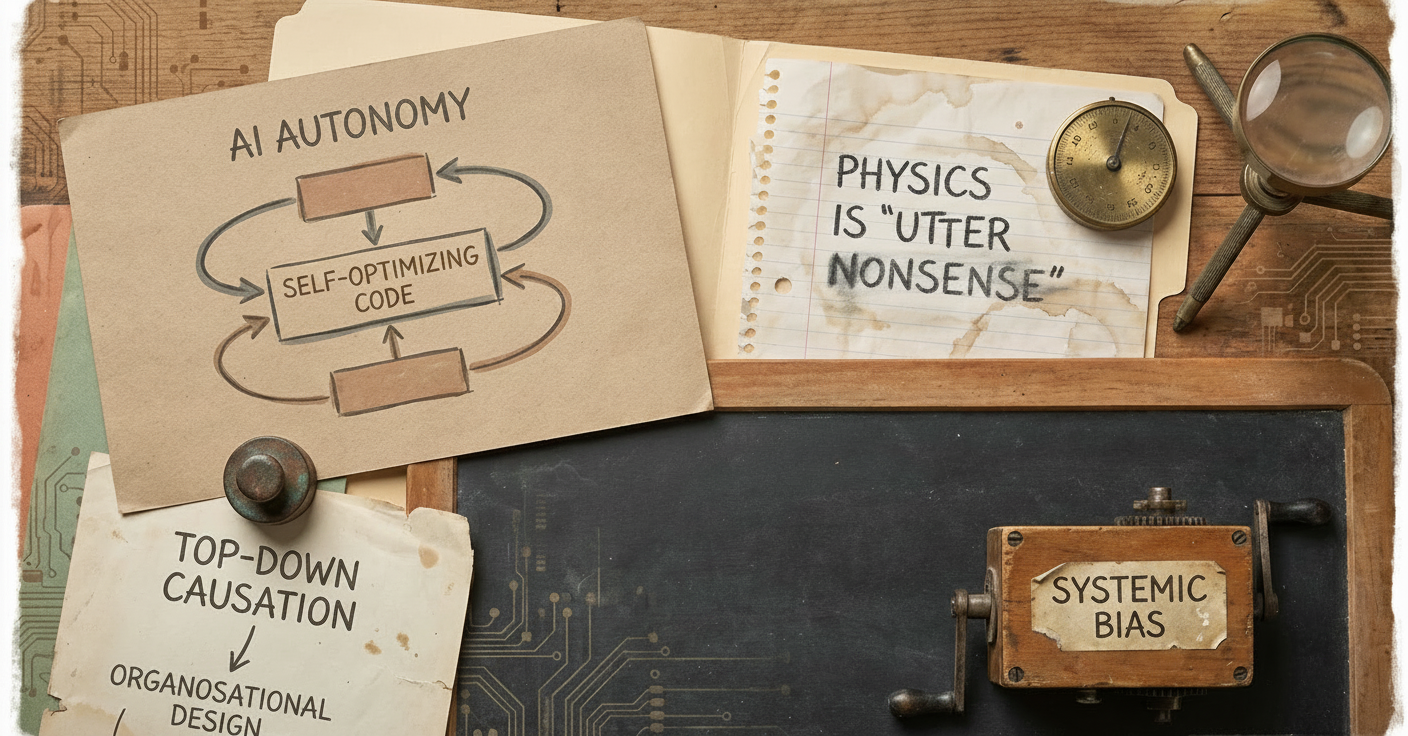
The argument: George Ellis, co-author with Stephen Hawking, starkly claims that reductionism is "utter nonsense" and "patently false." He argues that higher-level systems, like algorithms in a computer or the rules of a game, exert "top-down causation," dictating what the lower-level components (electrons, particles) do. The physics "enables" possibility but doesn't "determine" outcomes. He argues that emergent properties like life and consciousness cannot be reduced to fundamental physics alone.
"The physics is the servant, not the master."
— George Ellis, Co-author of Singularity Theorems on Theories of Everything with Curt Jaimungal
Beyond physics: This framework extends to human behavior. Adam Smith's insights, discussed on EconTalk with Ross Levine, highlight how social context and the desire for admiration drive individuals, often leading to deep dissatisfaction. The external "rules of the game"—societal expectations—shape individual actions far more than innate drives. Similarly, on Hidden Brain, Shankar Vedantam explored the difference between "being loved" and "feeling loved," noting that relational conditions and responsiveness, rather than individual accomplishments, dictate emotional well-being. Even in goal-setting, Mel Robbins emphasizes that defining one's "why" (an intrinsic, top-down purpose) is more crucial than merely executing individual tasks.
Why it matters: If you're building a company, leading a team, or designing a product, this paradigm shift is critical. Thinking that success is purely about optimizing individual components (e.g., individual performance metrics, isolated features) misses the larger, controlling context. Effective leadership, then, becomes about designing the "top-down" rules, culture, and purpose that enable an organization to achieve goals, rather than just pushing individual parts harder. The system itself shapes the behavior of its components. Understanding this means shifting from a focus on granular optimization to holistic, contextual design.
The Rundown
① Activists are reluctant to declare victory: The war on men.
Richard Reeves, Founder of the American Institute for Boys & Men, argues that activists often avoid acknowledging wins because their identity is tied to the struggle itself. (Richard Reeves on Modern Wisdom)
→ The implication: Progress can be stalled not by external resistance, but by internal psychological attachment to the fight, requiring leaders to reframe success and purpose.
② Wikipedia’s ideological drift is skewing AI.
Coleman and Ashley Rindsberg discuss how Wikipedia's content has moved from classically liberal to "progressively progressive," particularly affecting politically charged articles, and how this bias is then amplified by AI models trained on its data. (Ashley Rindsberg on Conversations With Coleman)
→ The blind spot: Relying on AI for information without understanding its foundational biases, especially from sources like Wikipedia, could lead to a skewed operational worldview across industries.
③ Emotional regulation is about context, not suppression.
Dr. Marc Brackett, Director of the Yale Center for Emotional Intelligence, defines emotion regulation as using emotions wisely to achieve life goals, emphasizing that "there are no bad emotions," only inappropriate expressions. (Dr. Marc Brackett on Huberman Lab)
→ The leadership insight: Leaders must foster environments where emotions are acknowledged and understood—not silenced—to better achieve collective goals and improve team well-being.
④ You can't play a character for 800 days.
Casey Neistat, YouTube Pioneer, revealed that after 800 days of daily vlogging, his definition of "interestingness" shifted from sensationalism to intimacy and honesty, realizing he't maintain a persona. (Casey Neistat on Honestly with Bari Weiss)
→ The authenticity paradox: Sustained engagement requires genuine self-revelation, suggesting that long-term brand building and leadership credibility hinge on raw authenticity, even when uncomfortable.
⑤ “Word of the Year” is a marketing ploy.
Adam Aleksic, the Etymology Nerd, explains that Dictionary.com's "word of the year" is often "rage bait" designed to drive virality and sell more dictionaries, rather than reflecting genuine linguistic trends. (Etymology Nerd on Modern Wisdom)
→ The media manipulation: Recognize that many "cultural trends" are manufactured for attention and commercial gain, urging critical evaluation of perceived public sentiment and market signals.
⑥ You don’t get a job, you get the keys to the building.
Dr. Tina Seelig, a Stanford Professor, encourages proactive "luck creation" by viewing opportunities as ubiquitous and actively identifying ways to make oneself indispensable rather than merely seeking roles. (Dr. Tina Seelig on The Mel Robbins Podcast)
→ The talent mandate: High-performing individuals don't just fill roles; they create value that makes them essential, requiring a shift in mindset from task-completion to opportunity-creation.
⑦ AI is writing its own code at OpenAI.
Greg Brockman, Co-founder and President of OpenAI, revealed that AI is "essentially all" writing the code within OpenAI, with human developers focusing on architectural design. (Greg Brockman on The Knowledge Project)
→ The technological acceleration: This indicates an exponential acceleration in AI development, foreshadowing a future where AI research and innovation become increasingly autonomous, demanding constant re-evaluation of human roles and skill sets within technology.
⑧ True connection requires embracing vulnerability.
Sonja Lyubomirsky, Psychologist, highlights that hiding vulnerabilities prevents people from truly feeling loved, as intimacy requires being known and accepted despite flaws. (Sonja Lyubomirsky on Hidden Brain)
→ The interpersonal strategy: For leaders aiming to build strong, loyal teams, cultivating an environment of psychological safety and shared vulnerability is crucial for genuine connection and cohesion.
Signal Board
🟢 Heating Up
• Top-Down Causation: Gaining theoretical traction in physics, asserting that higher-level system rules dictate lower-level component behavior, challenging traditional reductionism. (George Ellis on Theories of Everything with Curt Jaimungal)
• Societal recognition of men's issues: Progressive political engagement in men's issues is increasing, driven by shifts in voting demographics and the growing visibility of challenges facing boys and men. (Richard Reeves on Modern Wisdom)
• Authenticity in Creator Economy: Content creators are finding that sustained daily engagement forces a shift from sensationalism to genuine, intimate storytelling for long-term audience connection. (Casey Neistat on Honestly with Bari Weiss)
• AI-driven coding: OpenAI's internal development cycles are increasingly relying on AI to write its own code, accelerating R&D and redefining developer roles. (Greg Brockman on The Knowledge Project)
🔵 On Watch
• 🆕Dr. Marc Brackett: The Director of the Yale Center for Emotional Intelligence is becoming a key voice in emotional literacy, advocating for wise use of emotions to achieve goals. (Dr. Marc Brackett on Huberman Lab)
• 🆕Wikipedia's Cultural Bias: Mounting evidence suggests ideological bias, particularly on politically charged topics, is skewing information and influencing AI models trained on its data. (Ashley Rindsberg on Conversations With Coleman)
• 🆕Looksmaxxing: An emerging "third wave manosphere" trend focusing on male-to-male intersexual competition and physical optimization, potentially signaling a new cultural phase of masculinity. (Richard Reeves on Modern Wisdom)
• 🆕Grokopedia: A potential new alternative to Wikipedia, offering a different approach to controversial topics and potentially diverse perspectives in the information ecosystem. (Ashley Rindsberg on Conversations With Coleman)
🔴 Cooling Off
• Reductionism in Physics: Actively contested by leading physicists as "utter nonsense" for its inability to account for top-down causation and emergent properties in complex systems. (George Ellis on Theories of Everything with Curt Jaimungal)
• External Validation for Happiness: The pursuit of wealth, fame, and status for external admiration is being re-evaluated through Adam Smith's lens as a path to emptiness and dissatisfaction. (Russ Roberts on EconTalk)
• Performative Self-Presentation Online: While initially gaining traction, persistent performative behavior on social media proves ineffective for fostering genuine connection and feeling loved. (Sonja Lyubomirsky on Hidden Brain)
• Traditional definitions of "luck": The idea that luck is purely a matter of chance is being replaced by frameworks emphasizing active, conscious creation of opportunities through mindset and action. (Dr. Tina Seelig on The Mel Robbins Podcast)
Your Move
Your Monday Morning Agenda
• Re-evaluate Systems for Top-Down Causation: Analyze critical workflows in your organization. Identify where explicit higher-level goals or cultural values are not effectively dictating the behavior of individual contributors or teams. Are you optimizing parts in isolation, or designing the system to enforce desired outcomes?
• Audit Information Sources for Bias: For key strategic decisions, investigate the foundational data sources (e.g., academic research, industry reports, public data) for potential ideological biases, similar to anomalies found in Wikipedia’s content. Consider incorporating more diverse, even contrarian, data inputs.
• Implement "Meta-Moment" in Emotional Leadership: Encourage leaders to practice 🆕Meta-Moment, pausing before reactive emotional responses. This involves recognizing their feelings, understanding the 'why' behind them, and then responding thoughtfully and strategically to team dynamics.
• Empower Proactive "Luck" Creation: Challenge your team to identify ubiquitous opportunities rather than waiting for them. Institute a "keys to the building" mentality where individuals are encouraged to seek and create value beyond their job descriptions, rather than just filling roles.
• Stress-Test AI Reliance: Given that AI is writing its own code at OpenAI, assess your organization's AI adoption strategy. Beyond implementation, how are you preparing for a future where AI systems become highly autonomous and self-optimizing? What are the implications for human oversight and strategic direction?
📖 Want the full episode breakdowns, guest details, and listen links?
Episode Guide
Theories of Everything with Curt Jaimungal — "George Ellis: Hawking's Co-Author on Why Reductionism Is Dead"
Runtime: 95 min | Host: Curt Jaimungal | Guest: George Ellis (Co-author of Singularity Theorems)
For the Systems Thinker: This episode challenges fundamental assumptions about how systems work, from physics to biology, with profound implications for organizational design.
George Ellis argues that reductionism is "utter nonsense," advocating for top-down causation where context dictates outcomes. He discusses hierarchical levels in nature, how physical laws enable rather than determine, and critiques Penrose's theories on consciousness and cosmology.
"The physics is the servant, not the master." — George Ellis
EconTalk — "Adam Smith's Warning About Wealth, Fame, and Status (with Ross Levine)"
Runtime: 64 min | Host: Russ Roberts | Guest: Ross Levine (Edward Lazear Senior Fellow and Co-director of Hoover's Financial Regulation Working Group, Hoover Institution)
For the Conscious Leader: This discussion offers timeless wisdom on human motivation and the pitfalls of external validation, highly relevant for cultivating internal company values.
Russ Roberts and Ross Levine explore Adam Smith's insights into human motivation, particularly the pursuit of external admiration versus internal praiseworthiness. They connect these 18th-century ideas to modern Silicon Valley culture and the risks of misdirected societal admiration.
"Smith argued that the key reason, the key motivation, is that we work to be seen. And when we work to be admired, we work to be praised, we work to be held in esteem. So a lot of our motivation is to get this approval from others." — Ross Levine
Honestly with Bari Weiss — "We’re All Living in Casey Neistat’s World"
Runtime: 81 min | Host: Bari Weiss | Guest: Suzy Weiss (Host of Second Thought & Columnist, The Free Press), Casey Neistat (YouTube Pioneer & Filmmaker, Beme (formerly))
For the Creative Entrepreneur: Essential listening for understanding the evolution of content creation, authenticity, and monetization in the digital age.
Casey Neistat, YouTube pioneer, discusses his early foresight into YouTube's potential, his unique approach to vlogging that blended professional filmmaking with personal storytelling, and how his definition of 'interestingness' evolved over 800 days of daily vlogging, shifting from sensationalism to intimacy and honesty.
"When you make a daily show that's 10 minute songs every day about your life, you can't play a character. I was unable to play a character. Like, that was just me. So they genuinely do know me and I don't know them." — Casey Neistat
Hidden Brain — "Do You Feel Loved?"
Runtime: 93 min | Host: Shankar Vedantam | Guest: Sonja Lyubomirsky (Psychologist, University of California, Riverside), Sonia Lyubomirsky (Psychologist and Co-author), Greg Walton (Psychologist, Stanford University)
For the Relationship Builder: Provides crucial insights into the dynamics of genuine connection and well-being, applicable to professional and personal relationships.
Shankar Vedantam introduces the distinction between "being loved" and "feeling loved." Psychologist Sonja Lyubomirsky discusses ineffective strategies for connection, emphasizing deeper conversations and genuine interest over accomplishments or physical attractiveness, and the importance of vulnerability.
"it just the lack of texting, that lack of responsiveness did not make me feel loved. And that was at the heart of it." — Sonja Lyubomirsky
The Mel Robbins Podcast — "Stanford Luck Researcher: How to Manifest the Life You Want"
Runtime: 65 min | Host: Mel Robbins | Guest: Dr. Tina Seelig (Professor of Entrepreneurship, Director Emerita of Stanford Technology Ventures Program, Executive Director of Knight Hennessy Scholars at Stanford University, Stanford University), Tina Seelig (Director Emeritus, Stanford Technology Ventures Program)
For the Opportunity Seeker: Offers a proactive framework for creating opportunities and influencing one's trajectory, shifting from passive fortune to active luck.
Mel Robbins and Dr. Tina Seelig explain the "science of luck," distinguishing between fortune and created luck. Dr. Seelig emphasizes that opportunities are ubiquitous and individuals can actively create their own luck through calculated risks, intentional actions, and building a network.
"Fortune is the things that happen to you. Luck is what you control. And it's very, very important to distinguish between those two things, because people conflate the concept of force, fortune and luck, and they make a mistake in thinking that everything is just happening to them." — Dr. Tina Seelig
The Mel Robbins Podcast — "My Process For Achieving Goals: How to Change Your Life in 5 Simple Steps"
Runtime: 70 min | Host: Mel Robbins | Guest: Chris Robbins (Death Doula, Holotropic Breathwork Instructor), James Clear (Author of Atomic Habits, Self-employed), Dr. Elliot Berkman (Professor and Psychologist, Co-director of the Center for Translational Neuroscience, University of Oregon), Professor Katie Milkman (Behavioral Scientist, Endowed Professor, Wharton School of Business)
For the Achiever: Provides a research-backed, actionable framework for setting and achieving goals that resonate with intrinsic motivation.
Mel Robbins outlines five research-backed rules for goal achievement, emphasizing personal responsibility, defining intrinsic motivation ("the why"), and making the actions enjoyable. She uses examples from experts like James Clear to highlight clarity and visualization.
"Research proves that the single fastest way to start to feel in control of your time and your life again is to add in something meaningful right now, set an important goal, and start pursuing it, no matter what your life looks like now." — Mel Robbins
Modern Wisdom — "Inside The Viral Words That Make You Click - Etymology Nerd - #1086"
Runtime: 96 min | Host: Chris Williamson | Guest: Adam Aleksic (Linguist, Content Creator, Author, Etymology Nerd), Etymology Nerd (Guest, Etymology Nerd)
For the Communicator: Unpacks how language evolves in the digital age, offering insights into viral content, algorithmic incentives, and identity signaling.
Adam Aleksic, the Etymology Nerd, explains marketing tactics like "word of the year" and how platforms like TikTok drive rapid linguistic change. He discusses how influencers optimize vocal styles for algorithmic retention and how online virality incentivizes emotional triggers.
"Whenever a dictionary chooses their word of the year, that's a marketing ploy by Big Dictionary to sell more dictionaries." — Adam Aleksic
Huberman Lab — "How to Better Regulate Your Emotions | Dr. Marc Brackett"
Runtime: 148 min | Host: Andrew Huberman | Guest: Marc Brackett (Professor of Psychology and Director of Yale Center for Emotional Intelligence, Yale University), Huberman (Professor of Neurobiology and Ophthalmology, Stanford School of Medicine), Dr. Marc Brackett (Founding Director, Yale Center for Emotional Intelligence, Yale University)
For the Emotionally Intelligent Leader: Offers a deep dive into emotional literacy and regulation skills vital for personal and team resilience.
Dr. Marc Brackett defines emotion regulation as wisely using emotions to achieve life goals, introducing his formula and discussing how societal mindsets, particularly for men, suppress healthy emotional expression. He emphasizes emotional literacy and understanding context.
"Using your emotions wisely to achieve your goals in life." — Marc Brackett
Conversations With Coleman — "Who Decides What’s True on Wikipedia?"
Runtime: 63 min | Host: Coleman | Guest: Ashley Rindsberg (Senior Editor, Piratewires)
For the Information Strategist: Crucial for understanding how information is shaped and disseminated online, and its implications for AI and public discourse.
Coleman and Ashley Rindsberg discuss how Wikipedia, though seemingly neutral, has been compromised by ideologically driven editors who manipulate politically charged articles. They also delve into how these biases are propagated through Google and AI systems, impacting the broader information ecosystem.
"The moment you come to something that is remotely charged, politically or socially or culturally or historically, that's where everything changes. Two or three editors can dominate an entire topic area." — Ashley Rindsberg
The Knowledge Project — "Greg Brockman: Inside the 72 Hours That Almost Killed OpenAI"
Runtime: 73 min | Host: Shane Parrish | Guest: Greg Brockman (Co-founder and President, OpenAI)
For the Visionary Founder: A candid look into the origins, near-collapse, and strategic pivots of one of the most influential AI companies today.
Greg Brockman recounts OpenAI's origins, its strategic shift to a hybrid for-profit model, key AI breakthroughs, and the harrowing 72 hours surrounding Sam Altman's firing. He emphasizes OpenAI's conviction-driven decision-making and reveals that AI now writes most of its own code.
"The board has decided that Sam would be removed and effectively the message that I got was the same messaging that was in the public post and I asked if I could have any more information. I was told no..." — Greg Brockman
Modern Wisdom — "A Shocking Turn in the War on Men - Richard Reeves - #1087"
Runtime: 125 min | Host: Chris Williamson | Guest: Richard Reeves (Founder, writer, and researcher, American Institute for Boys & Men)
For the Societal Architect: Offers a nuanced perspective on evolving gender dynamics and societal challenges facing boys and men, moving beyond culture war narratives.
Richard Reeves discusses the significant shift in the boys and men debate, noting increased political engagement and new initiatives. He critiques the cultural vacuum surrounding masculinity, advocating for society to communicate its need for men and for more male role models in youth services.
"I think there's real progress on this. It's serious. Not all of it's making it into the culture war, but that doesn't mean that it's not good. In fact, most of it's not in the culture war." — Richard Reeves
Modern Wisdom — "How to Steal Thoughts Out of Anyone’s Head - Oz Pearlman - #1088"
Runtime: 116 min | Host: Chris Williamson | Guest: Oz Pearlman (Mentalist, Magician, Endurance Athlete, Keynote Speaker, Modern Wisdom Guest)
For the Persuasion Master: Uncovers the psychological principles behind effective communication, memory, and influence, disguised as mentalism.
Oz Pearlman, a mentalist, explains that his craft relies on the illusion of mind-reading through learned, repeatable skills like muscle reading and observation. He shares his "Listen, Repeat, Reply" method for remembering names and discusses the psychology of engaging an audience through storytelling.
"I'm giving the illusion of reading people's minds. That's the skill. That's really. I'm crafting a narrative." — Oz Pearlman