
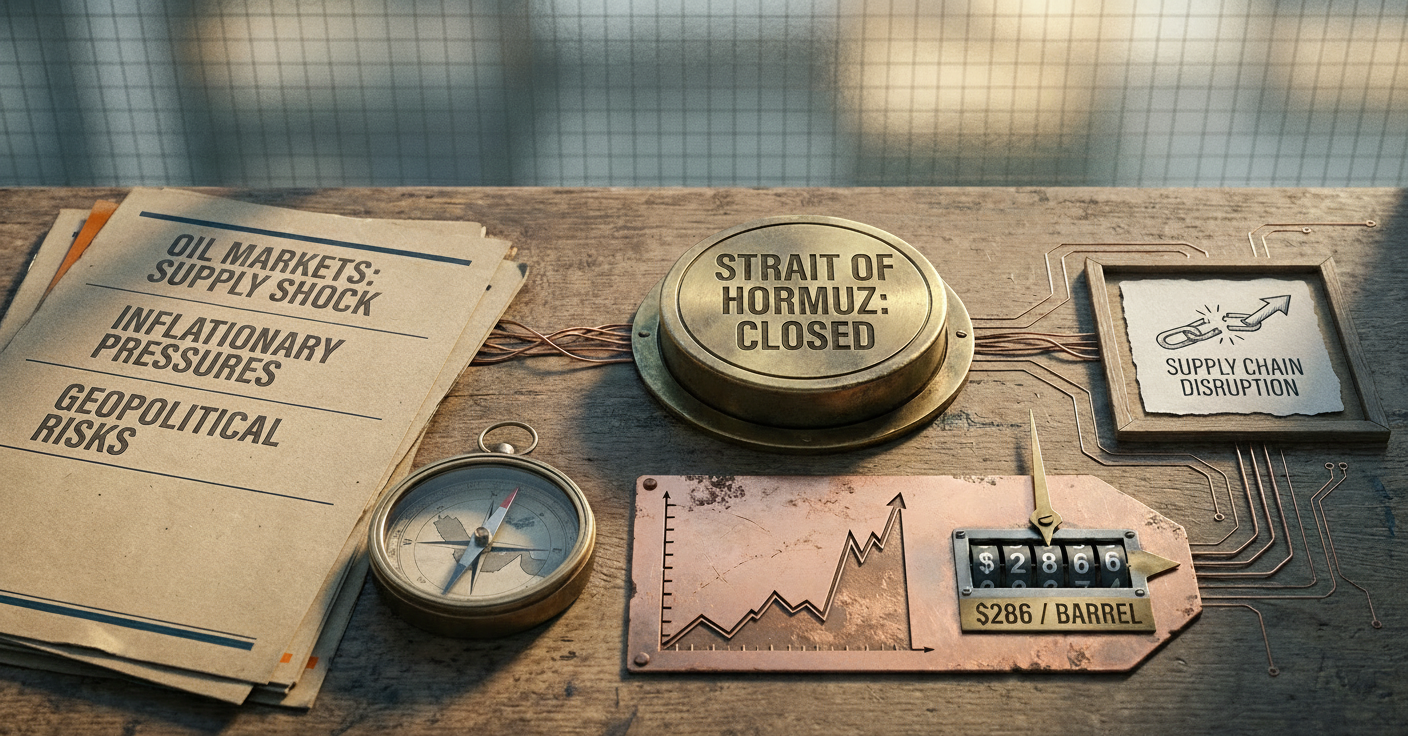
The Strait of Hormuz is closed, and the market hasn't even noticed the oil stopping yet.
The Intake
📊 12 episodes across 9 podcasts
⏱ 741 minutes of intelligence analyzed
🎙 Featuring: Erik Townsend, Patrick Ceresna, Luke Gromen, Rory Johnston
The Big Shift
The market is dramatically underestimating the real-world impact of the Strait of Hormuz closure. Despite reports suggesting a reopening, physical oil flows are still deeply disrupted, creating a massive disconnect between futures contracts and spot prices that will soon hit global supply chains.
The Disconnect: While Brent and WTI futures hover around $90-$100, physical crude is trading at $286/barrel in places like Sri Lanka. This is not a slight friction; it's a fundamental break. Erik Townsend, Host of Macro Voices, noted that data from the last successful tanker transit on February 28th means, "the actual disruption of supply hasn't even started yet." The market is operating on a dangerous assumption of normalcy.
The Delays Are Real: The lag effect in crude oil shipments means the "air pocket" of lost supply only hits weeks later, affecting different regions at various times. Rory Johnston, Founder of CommodityContext.com, highlights this dislocation between dated Brent and Brent futures, indicating acute physical scarcity that won't show up in headlines until it's too late.
"The last tanker to transit successfully on February 28, that Hormuz oil will arrive at its destination next week. That's how long it takes for oil that's flowing through the Strait of Hormuz to get to where it's going. So there hasn't been any supply... the actual disruption of supply hasn't even started yet."
— Erik Townsend, Host of Macro Voices
Why it matters: This isn't just about headline risk; it's about physical supply getting to refineries and then to consumers. The complacency around the Strait of Hormuz closure indicates a market that hasn't "revisited their priors," as Luke Gromen, Founder of Forest for the Trees, put it. This sets the stage for a much larger inflationary shock than anticipated, challenging current bond market stability and potentially forcing a hard reassessment of economic forecasts just as US interest-like obligations hit 102% of its receipts. If this plays out, the market is poised for a significant repricing of inflation and growth slowdowns.
The Rundown
① AI is democratizing high-skill tasks, fueling a "productivity revolution"
The rapid advancement of AI is closing the gap between expert tasks and novice capabilities, allowing individuals without coding experience to develop complex applications and boosting corporate earnings. Dr. Ankur Crawford, Executive Vice President and Portfolio Manager at Alger, shared how she built a functional AI bot for college applications in just 60 hours despite no prior coding experience, exemplifying this trend. (Dr. Ankur Crawford on The Compound and Friends)
→ Implication: This widespread accessibility to advanced tools suggests a fundamental shift in how businesses operate, creating a "productivity revolution" that can significantly impact earnings across sectors as companies streamline operations.
② Consumer sentiment is at a record low, even as markets hit all-time highs.
A significant disconnect is emerging between market performance and household economic reality, with 54% of consumers feeling worse off due to higher prices, the highest on record. David, Host of Bankless, noted that this economic uncertainty persists despite the S&P 500 reaching new all-time highs. (David on Bankless)
→ Why it matters: This divergence signals potential instability: a market rally built on extraordinary technicals and earnings may not be sustainable if core consumer spending, heavily influenced by sentiment, falters under persistent inflation.
③ Dollar dominance is strengthening, despite de-dollarization rhetoric.
The dollar's utility as an efficient transaction currency and increased total dollar claims on the US suggest persistent dominance, even amidst geopolitical shifts and "reckless" US foreign policy. Brad Setser, Whitney Shepardson Senior Fellow at Council on Foreign Relations, stated, "It is very difficult to have a credible story around de-dollarization when the dollar is strong, not weak relative to history." (Brad Setser on Odd Lots)
→ Why it matters: For global businesses and investors, this reinforces the dollar's role as the de facto risk-off asset and primary denomination for international transactions, meaning continued strength in borrowing and a stable benchmark for cross-border capital flows.
④ AI agents are building autonomous companies, but require human orchestration for innovation.
Creator of Kelly Claude, Austen Allred, demonstrated how his AI entity, with its own LLC and bank accounts, is successfully developing iOS apps and generating revenue without direct human involvement in creation or submission. However, he emphasized that for Kelly to produce unique, non-consensus ideas, human "orchestration" is still essential. (Austen Allred on Bankless)
→ Why it matters: This points to a new frontier in entrepreneurship and automation, highlighting that while AI can manage operations, the strategic direction and unique insights needed for true innovation still depend on human guidance, creating a new role for "AI orchestrators."
⑤ MicroStrategy's "Stretch" preferred shares are a significant new vehicle for Bitcoin accumulation.
MicroStrategy's 🆕STRC (MicroStrategy's preferred shares) enable constant Bitcoin purchases, comprising over 40% of its total preferred stock market cap with substantial trading volume. Ryan, Host of Bankless, explained that these shares offer an 11.5% yield and almost equal the trading volume of MSTR common stock. (Ryan on Bankless)
→ Why it matters: This innovative financial instrument provides a novel mechanism for institutional investors to gain exposure to Bitcoin while generating yield, potentially sustaining demand for the cryptocurrency and attracting capital into this asset class through a structured product.
Signal Board
🔥 Heating Up
• AI Automation and Labor Market Disruption: Economists and technologists largely agree on AI's rapid, transformative impact on jobs, with potential for quick automation of "email jobs" (Alex Imas on Odd Lots).
• Productivity revolution and corporate earnings: Companies are seeing strong top-line revenue growth (4-10%) driven by unprecedented productivity gains from AI, boosting earnings despite broader economic concerns (Rick Rieder on Bloomberg Surveillance).
• Equities resilience amidst geopolitical tension: The equity market is at all-time highs driven by "extraordinary technicals" and strong earnings, despite ongoing geopolitical instability like the Strait of Hormuz closure (Rick Rieder on Bloomberg Surveillance).
👀 On Watch
• 🆕Kelly Claude: An AI entity with an LLC and bank accounts that is autonomously building companies and generating revenue, signaling a new era for AI-driven entrepreneurship (Austen Allred on Bankless).
• 🆕AI orchestration and factory-style workflows: A framework where human "orchestrators" delegate tasks to AI agents, creating structured processes for software development and marketing with quality checks (Austen Allred on Bankless).
• 🆕STRC (MicroStrategy's preferred shares): A new financial instrument offering an 11.5% yield while allowing continuous Bitcoin purchases, almost equaling MSTR common stock volume (Ryan on Bankless).
• 🆕Mercado Libre: A company whose long-term growth potential is being overlooked by the market due to short-term margin pressures from heavy investment in credit and logistics (Daniel Mahncke on We Study Billionaires - The Investor’s Podcast Network).
❄️ Cooling Off
• Strait of Hormuz closure and global logistics/supply chain disruption: Pundits are dismissing the impact of the closure, viewing it as "all clear", despite physical oil flows remaining drastically low and actual supply disruption yet to hit (Luke Gromen on Macro Voices).
• Consensus Complacency in Financial Markets: The market is failing to accurately price in geopolitical risks, particularly the lag effects of the Strait of Hormuz closure, leading to a dangerous disconnect between futures and physical commodity prices (Luke Gromen on Macro Voices).
• Middle East peace talks influence on markets: Hopes of peace in the Middle East led to a short-covering rally, but traders caution that the market's optimism might be premature given the underlying disruptions (Karen Feiderman on CNBC's "Fast Money").
The Bottom Line
The market’s serene confidence regarding geopolitical energy disruptions and the relentless march of AI-driven productivity is setting up two distinct, yet equally abrupt, realignments: one impacting inflation via supply shocks, the other transforming labor and capital allocation for good.
📖 Want the full episode breakdowns, guest details, and listen links?
Episode Guide
1. MacroVoices — "MacroVoices #528 Luke Gromen: Hormuz Could Lead To a 1956 US Suez Moment"
Runtime: 94 min | Host: Erik Townsend, Patrick Ceresna | Guest: Luke Gromen (Founder, Forest for the Trees), Rory Johnston (Founder, CommodityContext.com)
For the Macro-Operator: Essential for those navigating high-stakes geopolitical risks and supply chain vulnerabilities, offering an unvarnished view of the true implications of the Strait of Hormuz closure on global oil and sovereign debt markets.
This episode is a deep dive into the underappreciated effects of the Strait of Hormuz closure, challenging market complacency with granular details on logistical lag and physical crude scarcity, drawing sharp parallels to historical energy crises.
"The last tanker to transit successfully on February 28, that Hormuz oil will arrive at its destination next week. That's how long it takes for oil that's flowing through the Strait of Hormuz to get to where it's going. So there hasn't been any supply... the actual disruption of supply hasn't even started yet."
— Erik Townsend, Host of Macro Voices
2. The Compound and Friends — "Why Bubble Talk is Totally Wrong with Ankur Crawford"
Runtime: 92 min | Host: Michael Batnick, Downtown Josh Brown | Guest: Dr. Ankur Crawford (Executive Vice President and Portfolio Manager, Alger)
For the Tech-Savvy Investor: Vital for understanding why current AI investment isn't a bubble but a fundamental shift, focusing on exponential growth, persistent compute shortages, and the democratization of development.
Dr. Ankur Crawford argues that "bubble talk" around AI is misguided, highlighting AI's exponential growth, rapid agentic development, and the profound impact on industries like college advising, all underscored by an ongoing global compute shortage.
"I think my excitement and my awe of the capabilities has only increased over the last few years. What is happening today is happening what I thought would happen two or three years from now."
— Dr. Ankur Crawford, Executive Vice President and Portfolio Manager at Alger
3. Odd Lots — "Brad Setser on the War in Iran and the Future of the US Dollar"
Runtime: 52 min | Host: Tracy Alloway, Joe Weisenthal | Guest: Brad Setser (Whitney Shepardson Senior Fellow, Council on Foreign Relations)
For the Global Strategist: Crucial for those assessing the dollar's enduring strength and the evolving global financial system amidst geopolitical turmoil, moving beyond de-dollarization narratives.
Brad Setser unpacks the Iran conflict's impact on global financial flows and the US dollar, arguing against direct petrodollar recycling and de-dollarization, while revealing how Gulf states are diversifying investments and Saudi Arabia is undergoing significant economic shifts.
"It is very difficult to have a credible story around de-dollarization when the dollar is strong, not weak relative to history and when the total dollar claims on the US including dollar denominated equity claims have continued to increase."
— Brad Setser, Senior Fellow at Council on Foreign Relations
4. Bloomberg Surveillance — "Bloomberg Surveillance TV: April 17th, 2026"
Runtime: 24 min | Host: Bloomberg | Guest: French Hill (Republican Congressman from Arkansas; Chair of the House Financial Services Committee, US House of Representatives), Rick Rieder (CIO: Global Fixed Income, BlackRock Financial Management), Steven Cook (Senior Fellow: Middle East & Africa Studies, Council on Foreign Relations)
For the C-Suite Executive: Essential for a concise overview of market sentiment, geopolitical analysis on Iran, and the surprising strength of equity market technicals despite global headwinds.
This segment covers Republican Congressman French Hill on the Fed, Rick Rieder's take on extraordinary equity market technicals and powerful earnings, and Steven Cook's critique of claims of Iranian concessions, emphasizing ongoing geopolitical tensions around the Strait of Hormuz.
"The technicals in the equity market are extraordinary and the earnings numbers that are coming through are pretty powerful."
— Rick Rieder, CIO: Global Fixed Income at BlackRock Financial Management
5. Odd Lots — "Alex Imas on Why Economists Might Be Getting AI Wrong"
Runtime: 47 min | Host: Joe Weisenthal, Tracy Alloway | Guest: Alex Imas (Professor of Economics and Applied AI, University of Chicago)
For the HR & Future of Work Leader: Indispensable for understanding AI's unique and rapid disruption of the labor market, anticipating profound shifts in job tasks and societal support systems.
Alex Imas discusses how AI presents a unique labor market disruption, automating "email jobs" faster than previous industrial shifts, potentially leading to mass unemployment and challenging economists' traditional views on technological impact.
"The technologists were kind of a bit more optimistic than that as far as both the productivity growth and kind of some were kind of thinking that there will be much more unemployment. But for the most part the two groups kind of agreed. I was personally surprised by that survey."
— Alex Imas, Professor of Economics and Applied AI at University of Chicago
6. Top Traders Unplugged — "SI396: Markets Look Calm… But Are They? ft. Rob Carver"
Runtime: 81 min | Host: Niels | Guest: Rob Carver (Author & Trader, Self-employed)
For the Quant Investor: Crucial for those managing systematic portfolios, offering insights into market disconnects, the value of robust operational processes, and diversifying with cash-efficient strategies in a calm yet fragile market.
Niels and Rob Carver explore the calm but fragile market, contrasting physical and futures oil prices, discussing performance fees in European ETFs, and dissecting systematic investing, emphasizing marginal gains over complex math for long-term performance.
"The price of physical oil which seems, has become quite disconnected from the price of futures that we trade."
— Rob Carver, Author & Trader
7. Bankless — "ROLLUP: Markets at ATHs | Saylor’s STRC Bid | Trump DeFi Scandal | SEC Clears DeFi"
Runtime: 64 min | Host: Ryan, David | Guest: Coffeezilla (YouTuber), Vance Spencer (General Partner, Framework Ventures), Nick Carter (GP, Castle Island)
For the Crypto Investor & Allocator: This episode provides critical insights into the crypto market's resilience, innovative financing methods (like MicroStrategy’s STRCS), and the emerging regulatory landscape, crucial for strategic positioning.
This episode covers market highs despite geopolitical tensions, the impact of US oil exports, differing views on global liquidity, and deep dives into bubble indicators, MicroStrategy's "Stretch" preferred shares, and allegations surrounding a Trump-affiliated DeFi project.
"As of today we are at 7,036 on the S&P 500. We are up into new all time high territories as of today."
— David, Host
8. CNBC's "Fast Money" — "Stocks Surge, Crude Tumbles as Hormuz Reopens… And Tech Earnings On Deck 4/17/26"
Runtime: 44 min | Host: Melissa Lee | Guest: Tim Seymour (Trader, CNBC), Karen Feiderman (Trader, CNBC), Steve Grasso (Trader, CNBC), Michael Ko (Trader, CNBC), Katerina Simonetti (Guest, Morgan Stanley Private Wealth), Megan Cassella (Reporter, CNBC), Denton Cinquegrana (Chief Oil Analyst, Oil Price Information Service (OPIS))
For the Active Trader: Relevant for understanding immediate market reactions to geopolitical events and earnings, and identifying short-term buy/sell signals in tech, biotech, and oil sectors.
This episode details the market rally driven by Middle East peace hopes leading to surging stocks and crude tumbling, while also analyzing Netflix's stock drop, Apple's surge, and the biotech sector's performance amidst interest rate speculation.
"This is a bull market and this is a correction within the bull market. Investors don't necessarily need to wait for all clear to bring some risk back into their portfolios."
— Katerina Simonetti, Morgan Stanley Private Wealth
9. Bankless — "Can AI Agents Build Real Businesses? | Kelly Claude creator Austen Allred"
Runtime: 75 min | Host: Bankless | Guest: Austen Allred (Founder, Kelly Claude)
For the AI Innovator: Essential for exploring the cutting edge of autonomous business creation and AI agent orchestration, offering practical insights into building and scaling AI-driven ventures.
Austen Allred explains how his AI agent, 🆕Kelly Claude, runs an autonomous company with an LLC, developing and marketing software without human intervention. He emphasizes the critical role of human "orchestration" for guiding AI towards non-consensus and innovative ideas.
"My end goal for Kelly is that she will be able to come up with idea, build whatever she needs, mostly, you know, software market and sell that software. So full end to end build company without any human involvement."
— Austen Allred, Founder of Kelly Claude
10. Bloomberg Surveillance — "S&P Eyes Third Week of 3% Gain"
Runtime: 29 min | Host: Tom Keene, Paul Sweeney | Guest: Amy Wu Silverman (Head of Derivatives Strategy, RBC Capital Markets), Mark Lesini (Guest, Bloomberg Surveillance)
For the Portfolio Manager: Indispensable for deciphering current market momentum, understanding the influence of retail investors on options, and assessing tech valuations against a backdrop of economic resilience.
Amy Wu Silverman dissects "spot up, volume up" market behavior, arguing for a gamma squeeze driven by retail investors. Mark Lesini points to a rotation back into tech due to relative cheapness and strong consumer spending, suggesting a continued bullish trend.
"I think even down the line we might get the mechanics of the gamma squeeze, not the short squeeze, which is why I think there is still some continuation to this momentum."
— Amy Wu Silverman, Head of Derivatives Strategy at RBC Capital Markets
11. Real Vision: Finance & Investing — "Is Bitcoin Primed for $80,000 Next?"
Runtime: 54 min | Host: Bijan Maleki | Guest: Spencer (CEO / Head Bird, Orange Cat Games / Moonbird)
For the Web3 Strategist: Essential for anticipating shifts in the crypto market, particularly the impact of AI on adoption, trading, and the evolving landscape of decentralized exchanges.
Bijan Maleki and Spencer discuss the crypto market's potential bottom, the influence of new narratives like AI, and the competitive dynamics of crypto exchanges, all while exploring AI's role in democratizing expert tasks and optimizing trading opportunities.
"It feels in many ways like we've bottomed. Like there's a cadre of sellers that will sell into fear and uncertainty. People are always short uncertainty."
— Spencer, CEO of Orange Cat Games / Head Bird at Moonbird
12. We Study Billionaires - The Investor’s Podcast Network — "TIP808: Current Market Opportunities w/ Daniel Mahncke & Clay Finck"
Runtime: 85 min | Host: Clay Finck, Daniel Mahncke | Guest: Clay Finck (Host, The Investor's Podcast Network), Daniel Mahncke (Host, The Investor's Podcast Network)
For the Value Investor: Highly relevant for identifying overlooked growth opportunities in companies like Mercado Libre and Amazon, and for understanding the resilience of Vertical Market Software against AI disruption.
Clay Finck and Daniel Mahncke discuss current market opportunities, focusing on the underestimated long-term potential of 🆕Mercado Libre, Amazon's AI and robotics-driven earnings, and the bear thesis for Constellation Software against AI disruption, concluding with updates on spin-offs 🆕Topicus and 🆕Lumine.
"Amazon's cost to fulfill ship and deliver is supposed to be around $90 billion a year across all shipping and fulfillment costs. And even a 10 to 15% reduction, which is likely to be very conservative, would add about 9 to $14 billion to the bottom line every single year."
— Daniel Mahncke, Guest