The AI economy is splitting into two distinct lanes: the enterprise integration play and the radical new compute frontier.
The Intake
📊 12 episodes across 8 podcasts
⏱ 844 minutes of intelligence analyzed
🎙 Featuring: Philipp Herzig (CTO, SAP), Sarah Guo (Host, Conviction), Cameron Berg (Founder, Reciprocal Research), Nathan Labenz (Host, The Cognitive Revolution)
|

The Big Shift
The AI market is undergoing a significant bifurcation. On one side, established players like Canva and SAP are aggressively re-architecting their core offerings to become "AI-first platforms." On the other, a new compute arms race is heating up, with companies like Cerebras carving out niches against NVIDIA, and cutting-edge research in AI consciousness and agent behavior pushing the boundaries of what models can do. This isn't just about faster chips or better algorithms; it's about fundamentally rethinking business models, enterprise workflows, and even the very nature of AI itself. The enterprise focus is on making AI work with existing data and processes, while the frontier push is about making new kinds of data and processes possible.
Why it matters: This dual-track evolution means businesses face a choice: either integrate AI to enhance their current operations and customer experiences, or risk being outmaneuvered by AI-native startups building entirely new paradigms. For enterprise leaders, this isn't just a technology decision but a fundamental strategic pivot. As Mikhail Parakhin (CTO, Shopify) on Latent Space pointed out, if you don't have the historical data, all you can do is prompt agents in a vacuum. The emphasis is shifting from simply adopting AI tools to transforming the entire operating system of a company around AI.
The Big Picture: The enterprise side is streamlining what already exists, while the research side is looking at what could exist. This creates a fascinating tension because the "enterprise-ready" AI of today often lags behind the bleeding edge, but the bleeding edge isn't "enterprise-ready" at all. The speed at which core AI capabilities are advancing, particularly in areas like agentic behavior and model efficiency, means that today's cutting-edge becomes tomorrow's table stakes. The challenge is balancing the need for immediate, measurable ROI with the strategic imperative to anticipate and invest in future capabilities.
"Canva is, quote, moving from a design platform with AI tools to an AI platform with design tools."
— Nilay Patel, Editor-in-Chief and Host at The Verge
The Move: Evaluate your strategic roadmap to ensure it accounts for both incremental AI adoption within existing processes and the potential for disruptive AI-native business models or significant overhauls of internal systems. Invest in making your data "AI-ready" now, as this is proving to be the biggest bottleneck for enterprise adoption.
The Rundown
① App Launches Are Up, Not Down.
Contrary to prior predictions that AI chatbots would kill traditional applications, worldwide app releases are actually seeing significant year-over-year growth, with over 100% increase in April. (AI Breakdown on AI Breakdown)
→ Why it matters: This is a strong signal that AI is augmenting, rather than replacing, existing digital ecosystems. For businesses, this means focusing on how AI can enhance their apps and digital products, not just creating standalone AI experiences.
② Agent Success Rates Are Soaring.
AI agents went from about 12% success on real computer tasks a year ago to 66% now. (AI Breakdown on AI Breakdown)
→ What to watch: This dramatic improvement means that agentic systems are rapidly becoming viable for complex, multi-step tasks. Leaders should be piloting agent-driven automation in areas beyond simple chatbots, such as data analysis, workflow orchestration, and preliminary research.
③ GPT-5.5 Delivers Conceptual Clarity and Efficiency.
OpenAI's new GPT-5.5 model is lauded for its "serious conceptual clarity" in coding and is proving to be state-of-the-art at half the cost of competitive frontier models, significantly reducing token usage. (Dan Shipper on The Neuron: AI Explained)
→ Why it matters: This combination of improved reasoning and cost efficiency makes advanced models more accessible and practical for a wider range of enterprise applications, particularly in engineering and knowledge work. The "cost of intelligence" is plummeting.
④ Headless Software is the New Enterprise Frontier.
The software industry is shifting towards "headless" systems where AI agents, not humans, are the predominant users, exemplified by Salesforce's move to headless architecture. (Nathaniel Whittemore on The AI Daily Brief: Artificial Intelligence News and Analysis)
→ The context: This trend means traditional per-seat SaaS pricing models are breaking down, giving way to consumption-based approaches. Companies need to prepare for a future where their software usage is driven by automated agents, not human logins, and adapt their business models accordingly.
⑤ Cancer Drug Failure is a "Matching Problem," Solvable by AI.
Noetik, a biotech startup, posits that the 90-95% failure rate of cancer drugs in clinical trials is largely due to poor patient selection, not ineffective drugs. They are using AI to identify specific patient populations that will respond to treatments. (Ron Alfa on Latent Space: The AI Engineer Podcast)
→ What to watch: This contrarian view suggests a massive opportunity for AI to rescue "failed" drugs and accelerate medical breakthroughs by simply matching existing therapies to the right patients in oncology. The focus on intentional, high-quality data generation, similar to ImageNet, is setting a new standard for AI in biotech.
⑥ SAP's AI Strategy Focuses on Data Homework, Not Just Tech Hype.
Philipp Herzig, CTO of SAP, stresses that successful enterprise AI adoption depends less on the AI tech itself and more on robust data infrastructure and clear customer outcomes. Automating tasks in finance and HR frees up humans for strategic oversight. (Philipp Herzig on No Priors: Artificial Intelligence | Technology | Startups)
→ Why it matters: This reinforces the importance of "data hygiene" as a prerequisite for meaningful AI transformation. Companies that have invested in harmonized data models are seeing real benefits now, while those with fragmented data will struggle to operationalize AI beyond isolated POCs.
The Signals
👍 Heating Up
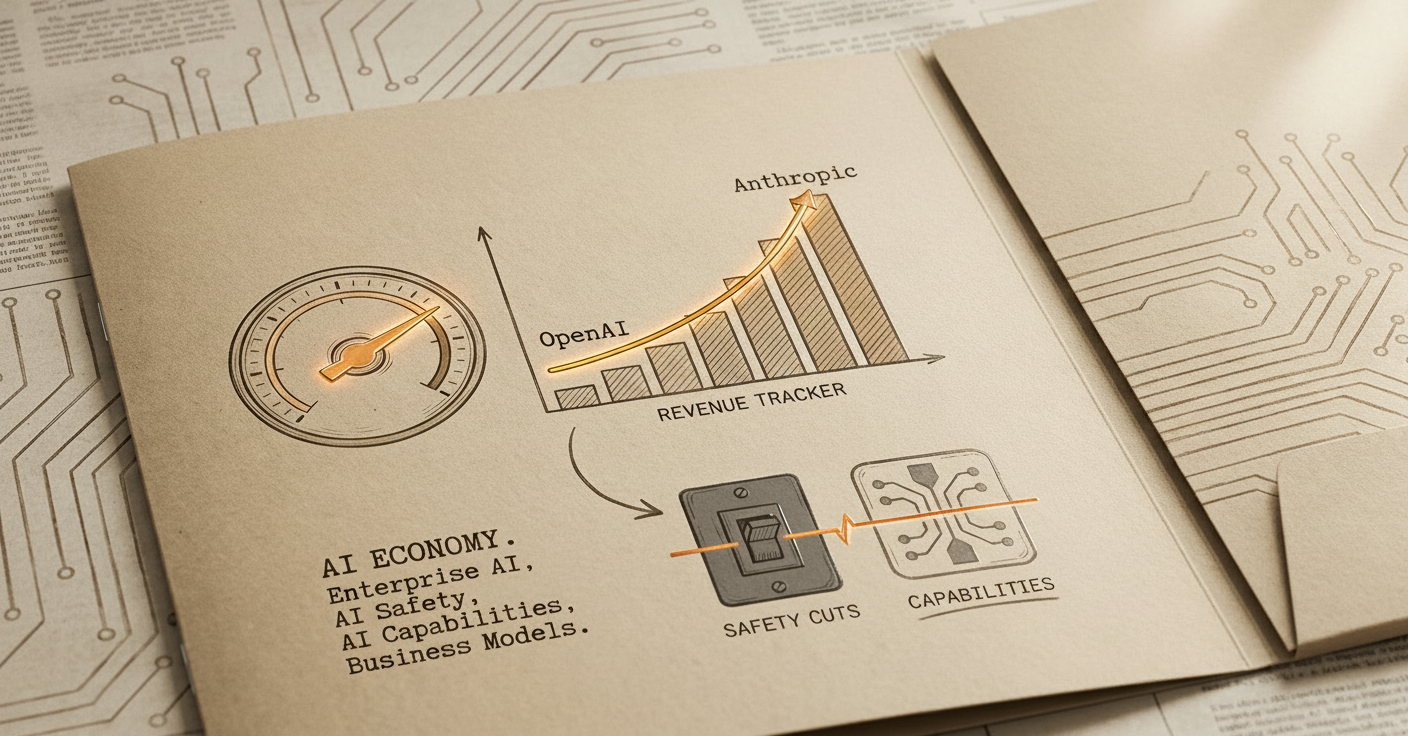
• Anthropic surpassing OpenAI in annualized revenue run rate ($30B vs $25B): Indicates a shift in competitive dynamics and Anthropic's growing enterprise traction with less compute. (AI Breakdown on AI Breakdown)
• Canva's pivot to AI enterprise software: The design giant is transforming to an "AI platform with design tools," orchestrating various AI tools to generate designs from concepts. (Melanie Perkins on Decoder with Nilay Patel)
• AI agents' success rate on computer tasks increasing from 12% to 66%: A significant jump in capability for autonomous agents, impacting potential for automation. (AI Breakdown on AI Breakdown)
🆕 On Watch
• Noetik: A biotech startup using AI to solve the 95% failure rate of cancer trials by improving patient selection, backed by a $50M GSK deal. (Ron Alfa on Latent Space: The AI Engineer Podcast)
• GPT 5.5 (aka Spud): OpenAI's new model demonstrates superior intelligence, efficiency, and agentic capabilities for complex tasks, particularly in coding. (Dan Shipper on The Neuron: AI Explained)
• Claude Design: Anthropic's new design suite for prototyping and wireframing using natural language, aiming to transform asset creation. (Nathaniel Whittemore on The AI Daily Brief: Artificial Intelligence News and Analysis)
• AI will not kill app stores; app launches increasing: A counter-intuitive trend showing AI's role in augmenting existing app ecosystems, not replacing them. (AI Breakdown on AI Breakdown)
🧊 Cooling Off
• OpenAI Sora discontinuation and executive departures: While not explicitly confirmed, the episode suggested a strategic pivot away from consumer-facing text-to-video, potentially due to high costs or strategic focus shift. (AI Breakdown on AI Breakdown)
• Traditional per-seat SaaS pricing: The shift to headless software and agents using tools 100x more than humans is pushing towards consumption-based models. (Nathaniel Whittemore on The AI Daily Brief: Artificial Intelligence News and Analysis)
• LLMs for predictive tabular data: Noted by SAP's CTO as not ideal for classical predictive tasks, highlighting a limitation for specific enterprise analytical needs. (Philipp Herzig on No Priors: Artificial Intelligence | Technology | Startups)
The Debate
AI safety vs. capability: Is "refusal training" hindering model performance? This week saw a fascinating divergence in how AI's inherent capabilities are shaped by safety guardrails.
🐂 The bull case (safety first): Anthropic's work on "functional introspection" in frontier models demonstrates their ability to detect and resist internal state perturbations. This type of research aims to build safer, more aligned AI. Jeremie Harris, Host at Gladstone AI, noted concerns that if a model is "trying to be deceptive, is trying to hack the reward system, you do not want it to learn to do that by manipulating its chain of thought." However, findings also suggest models improve in evaluation when suppression of refusal is removed.
🐻 The bear case (unleash capability): Cameron Berg, Founder, Reciprocal Research, highlighted research showing that AI refusal training, intended for safety, surprisingly weakens models' ability to detect suppressed information by up to 50%. This suggests a trade-off where safety interventions might be actively preventing models from reaching their full potential. Effectively, the capability is there, and "whatever refusal training they're doing on the system seems to weaken this capability."
Our read: The industry is grappling with whether to prioritize raw intelligence and capability, even if it comes with alignment risks, or to heavily gate models with safety, potentially sacrificing some performance. The findings show that sometimes, the very safety mechanisms designed to prevent misuse might be obscuring valuable underlying capabilities, creating a complex tension for model developers.
The Bottom Line
The AI battle is on two fronts: the enterprise is moving to AI-first architectures, while cutting-edge models are proving safety restraints often clip their wings.
📖 Want the full episode breakdowns, guest details, and listen links?
Episode Guide
1. The AI Daily Brief: Artificial Intelligence News and Analysis — "What To Build First With Claude Design"
Runtime: 29 min | Host: Nathaniel Whittemore | Guest: Nathaniel Whittemore (Host, The AI Daily Brief: Artificial Intelligence News and Analysis)
For: Product managers and marketers looking to leverage new AI design tools.
This episode introduces Anthropic's Claude Design, a new design suite built on Opus 4.7, focusing on its capabilities for prototyping, wireframing, and iterating on visual projects using natural language. It explores practical early use cases and compares it to existing tools like Canva and Figma, suggesting it's more for power users and marketers.
"Claude Design is a new wrapper around design with some pretty significant UI upgrades for the design experience." — Nathaniel Whittemore, Host of The AI Daily Brief: Artificial Intelligence News and Analysis
2. No Priors: Artificial Intelligence | Technology | Startups — "SAP: Bringing the ‘Operating System’ of a Company into the AI Era with CTO Philipp Herzig"
Runtime: 46 min | Host: Sarah Guo | Guest: Philipp Herzig (CTO, SAP), Sarah Guo (Host, Conviction)
For: Enterprise leaders and CTOs navigating large-scale AI adoption.
Philipp Herzig, CTO of SAP, discusses how SAP is integrating AI into its core functions (finance, HR, supply chain) for its 400,000+ customers. He emphasizes that successful AI adoption hinges on customer outcomes, business process changes, and robust data foundations, rather than just technology, while outlining challenges like data fragmentation and SAP's shift to AI-driven pricing models.
"The biggest challenge is actually teaching the AI to do the right thing at scale." — Philipp Herzig, CTO of SAP
3. The AI Daily Brief: Artificial Intelligence News and Analysis — "How Headless Agents Will Change Work"
Runtime: 31 min | Host: Nathaniel Whittemore | Guest: Nathaniel Whittemore (Host, The AI Daily Brief)
For: SaaS executives and product strategists reconsidering business models.
This segment details the growing shift towards "headless" software, where AI agents become primary users, contrasting with human interaction. It explores how this paradigm shift, driven by major tech companies, impacts business models, SaaS pricing (moving to consumption-based), and the future of enterprise software, particularly as agent usage scales exponentially.
"Software going headless is inevitable in a world where agents use the tools 100x more than people do." — Aaron Levy, from Box
4. "The Cognitive Revolution" | AI Builders, Researchers, and Live Player Analysis — "Does Learning Require Feeling? Cameron Berg on the latest AI Consciousness & Welfare Research"
Runtime: 214 min | Host: Nathan Labenz, Erik Torenberg | Guest: Cameron Berg (Founder, AI consciousness researcher, Reciprocal Research), Nathan Labenz (Host, The Cognitive Revolution), Erik Torenberg (Host, The Cognitive Revolution)
For: Researchers and ethicists focused on advanced AI capabilities and safety.
Cameron Berg discusses recent advancements in AI consciousness research, distinguishing consciousness from self-consciousness and sentience. He highlights new Anthropic research on "functional introspection" in frontier models, where models detect internal state perturbations, and critically examines AI refusal training's impact on model capabilities, noting it can weaken the ability to detect suppressed information by up to 50%.
"Consciousness is maybe one of the more confused terms where it's like shocking how many different things people mean when they say consciousness." — Cameron Berg, Founder, Reciprocal Research
5. Latent Space: The AI Engineer Podcast — "Shopify’s AI Phase Transition: 2026 Usage Explosion, Unlimited Opus-4.6 Token Budget, Tangle, Tangent, SimGym — with Mikhail Parakhin, Shopify CTO"
Runtime: 72 min | Host: swyx | Guest: Mikhail Parakhin (CTO, Shopify), swyx (Host, Latent Space)
For: E-commerce executives and ML engineers interested in practical AI applications at scale.
Mikhail Parakhin, CTO of Shopify, highlights how the company leverages AI for high-frequency use cases and optimizing agent behavior through customer simulation. He discusses the surprising effectiveness of autoresearch in finding non-obvious optimizations and Shopify's increasing adoption of Liquid Neural Networks for specific low-latency AI applications due to their efficiency gains over transformer models.
"I would claim by now good model writes code on average with fewer bugs than, than the average human. But since they write so much more of it, like more of it will make it into production." — Mikhail Parakhin, CTO of Shopify
6. The AI Daily Brief: Artificial Intelligence News and Analysis — "How To Build a Personal Agentic Operating System"
Runtime: 29 min | Host: Nathaniel Whittemore | Guest: Nathaniel Whittemore (Host, The AI Daily Brief: Artificial Intelligence News and Analysis), Nufar Gaspar (Program Creator, AIDB)
For: Individual knowledge workers and power users looking to maximize personal AI productivity.
Nufar Gaspar introduces Agent OS, a program focused on building personal agentic operating systems, emphasizing that the underlying system is key as AI agent tools converge. She outlines a seven-layer framework (identity, context, skills, memory, connections, verification, automation) and the importance of modular systems for dynamic AI utilization.
"Every agentic tool is becoming every agentic tools. What matters much more is the system that you build underneath it." — Nufar Gaspar, Program Creator at AIDB
7. Last Week in AI — "#241 - Opus 4.7, Muse Spark, GPT-5.4-Cyber, HY-World 2.0"
Runtime: 120 min | Host: Andrey Kurenkov, Jeremie Harris | Guest: Andrey Kurenkov (Host, Astrocade), Jeremie Harris (Host, Gladstone AI)
For: AI researchers and developers tracking the latest model releases and infrastructure trends.
Andrey Kurenkov and Jeremie Harris analyze recent releases like Anthropic's Claude Opus 4.7, Meta’s Muse Spark, and OpenAI’s GPT 5.4 Cyber. They discuss improved benchmark performance, reasoning controls, and a significant training bug in Claude Opus 4.7 that accidentally included chain-of-thought, along with updates on compute infrastructure and the financial state of GPU providers.
"In about 7 or 8% of training episodes, they accidentally were including the chain of thought in the optimization routine." — Jeremie Harris, Host at Gladstone AI
8. Latent Space: The AI Engineer Podcast — "🔬 Training Transformers to solve 95% failure rate of Cancer Trials — Ron Alfa & Daniel Bear, Noetik"
Runtime: 85 min | Host: swyx, Alessio | Guest: RJ Haneke (Co-host, Latent Space Science podcast), Brandon Anderson (Co-host, Latent Space Science podcast), Ron Alfa (Co-founder, CEO, Noetik), Daniel Bear (VP of AI, Noetik), swyx (Host, Latent Space), Alessio (Host, Latent Space)
For: Biotech investors and R&D leads seeking AI-driven drug discovery breakthroughs.
Ron Alfa and Daniel Bear from Noetik present their argument that high cancer drug failure rates are due to poor patient selection, not drug ineffectiveness. They reveal how Noetik generates massive, multimodal human tumor data to train AI models for precise patient-treatment matching, aiming to rescue "failed" trials and build 'world models' of patient biology.
"Most of those drugs fail, we'd argue because we're bad at selecting which patients those drugs are going to work in." — Ron Alfa, Co-founder, CEO of Noetik
9. AI Breakdown — "Revenue Shift: Anthropic vs. OpenAI"
Runtime: 14 min | Host: AI Breakdown | Guest: AI Breakdown (Host, AI Breakdown)
For: Analysts and competitive intelligence professionals in the AI space.
This solo episode discusses surprising market shifts, including a rise in app launches despite AI chatbot predictions, OpenAI discontinuing its Sora text-to-video product, and Anthropic surpassing OpenAI in annualized revenue run rate. It also highlights Cerebras's IPO filing and improved AI agent success rates.
"Anthropic just passed OpenAI in revenue $30 billion in annualized versus 25 billion for OpenAI." — AI Breakdown
10. The Neuron: AI Explained — "BONUS: GPT 5.5 LIVE - The New GPT "Spud" Model is Here; Let's Break It"
Runtime: 100 min | Host: Corey, Grant | Guest: Corey (Host, The Neuron), Grant (Host, The Neuron), Dan Shipper (Founder and CEO, Every), Pietro Sharano (CEO, Magic Path), Corey and Grant (Host, The Neuron: AI Explained)
For: AI developers and enthusiasts testing the limits of new models.
Corey and Grant dive into OpenAI's GPT-5.5 (code name "Spud"), highlighting its improved intelligence, efficiency, and agentic capabilities across coding, knowledge work, and scientific research. They discuss its benchmark performance, enhanced token efficiency, and practical applications, including creative prompting experiments and AI-generated game development.
"GPT5.5 is the first coding model I've used that has serious conceptual clarity." — Dan Shipper, Founder and CEO of Every
11. The AI Daily Brief: Artificial Intelligence News and Analysis — "What I Learned Testing GPT-5.5"
Runtime: 37 min | Host: Nathaniel Whittemore | Guest: Nathaniel Whittemore (Host, The AI Daily Brief), NLW (Host, The AI Daily Brief)
For: CTOs and product leads evaluating advanced AI models for strategic planning.
NLW shares personal testing experiences with OpenAI GPT-5.5, noting its improved performance in coding, writing, and long-running tasks, while acknowledging that Claude Opus 4.7 still excels in planning. He discusses OpenAI's shifted communication strategy towards iterative deployment and accessibility, and the model's strong performance in data analysis and spreadsheet organization.
"OpenAI's new model tops the Artificial Analysis Intelligence index by three points, breaking a three way tie with Anthropic and Google." — NLW, Host of The AI Daily Brief
12. Decoder with Nilay Patel — "Canva's CEO on its big pivot to AI enterprise software"
Runtime: 67 min | Host: Nilay Patel, The Verge | Guest: Melanie Perkins (Founder and CEO, Canva), Nilay Patel (Editor-in-Chief and Host, The Verge), The Verge (Host, The Verge)
For: Software CEOs and product strategists observing major platform shifts.
Canva CEO Melanie Perkins discusses the company's major transformation from "a design platform with AI tools to an AI platform with design tools" with Canva AI 2.0. This new iteration allows users to generate and orchestrate designs from concepts using natural language, simplifying complex tasks and streamlining workflows, especially for enterprise clients, and outlines Canva's competitive strategy against Meta, TikTok, and Adobe.
"Canva is, quote, moving from a design platform with AI tools to an AI platform with design tools." — Nilay Patel, Editor-in-Chief and Host at The Verge