
The New Shape of Power: Measurement, Morality, and Machines
📊 12 episodes across 11 podcasts
⏱ 965 minutes of intelligence analyzed
🎙 Featuring: Hidden Brain, Shankar Vedantam (Hidden Brain), Erica Chenoweth (Harvard University), Erika Chenoweth (Harvard University), Ranjay Gulati (Harvard Business School)
The Big Shift
The very definition of "power" is undergoing a profound re-evaluation, not just in geopolitics but across technology, social movements, and even individual behavior. This week, conversations converged on how we measure power, the moral constraints that should govern its exercise, and the unprecedented leverage offered by new tools like AI. From the granular mechanics of nonviolent resistance to the geopolitical stage, the underlying questions revolve around impact, influence, and the surprising sources from which true power emanates.
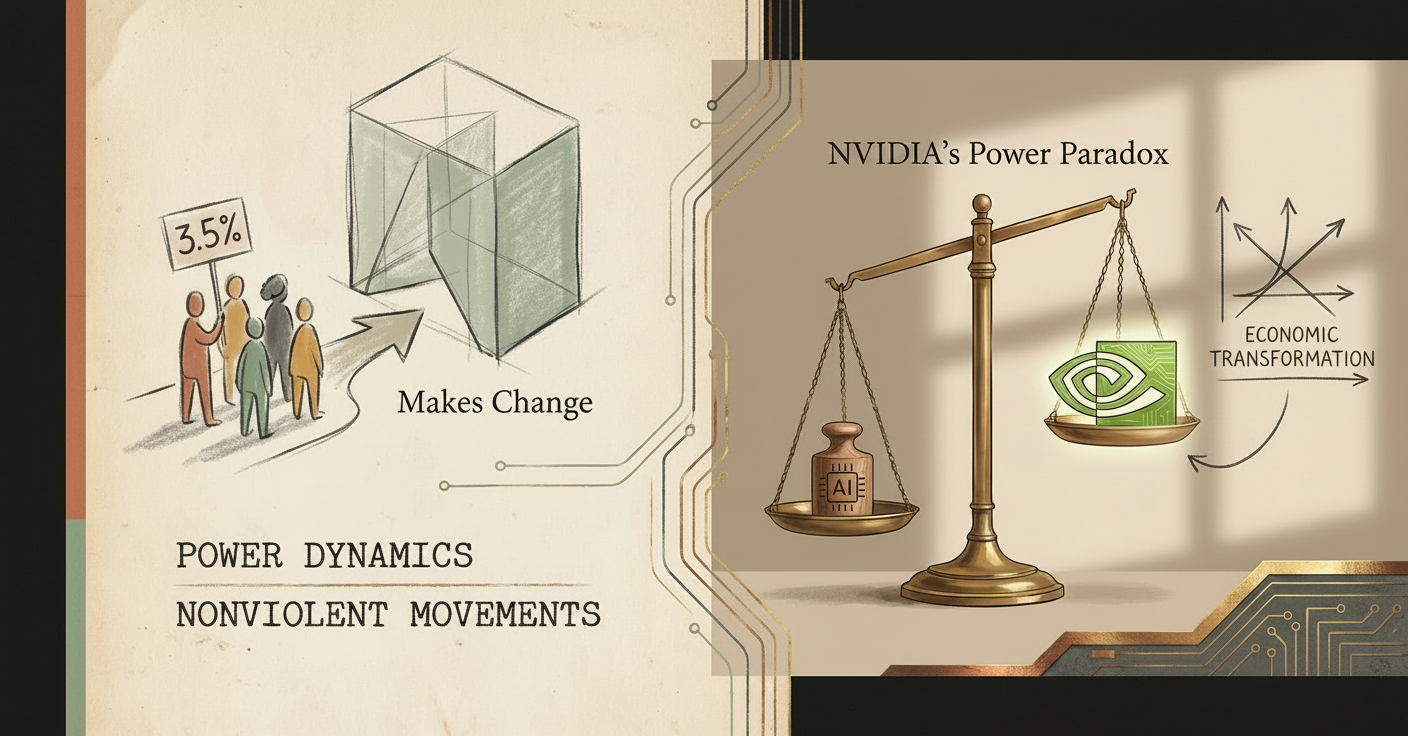
In a striking re-evaluation of historical narratives, Erica Chenoweth, Political Scientist at Harvard University, challenged the conventional wisdom that violence is the most effective path to radical change. Her research, discussed on Hidden Brain, reveals that nonviolent campaigns are "twice as likely to have succeeded as their violent counterparts." This isn't just a feel-good statistic; it reframes our understanding of where real power lies, emphasizing mass participation and organizational resilience over overt aggression. It suggests that what we've historically measured as strength might be miscalibrated.
"The basic descriptive statistic that really jumped out is that the nonviolent campaigns were twice as likely to have succeeded as their violent counterparts."
— Erika Chenoweth, Political Scientist at Harvard University on Hidden Brain
This re-calibration of power extends to the business world. Jensen Huang’s leadership at NVIDIA, chronicled on EconTalk, highlights a strategic power shift from traditional business models to one where long-term, seemingly niche investments (like the CUDA platform) can create entirely new markets and dominate industries. This is an exercise of power through foresight and architectural design, not just market share. Furthermore, the discussion on Modern Wisdom with David Friedberg introduced the idea of AI-driven robotics and fusion energy dramatically decentralizing economic and geopolitical power, potentially making the Moon “a giant, giant, giant economy”—a scale of transformation that redefines where influence and wealth will reside.
The collective insight is this: our traditional metrics for power—military might, economic size, even individual capacity—are being disrupted. New forms of leverage, from crowd mobilization to computational superiority and even self-replicating robots, are redrawing the map. For leaders, the challenge isn't just to wield power effectively, but to understand what constitutes power in a rapidly evolving landscape, and to recognize the inherent moral constraints required to prevent its destructive misuse.
The Rundown
① Nonviolent movements achieve success with surprisingly small participation.
Erica Chenoweth, Political Scientist at Harvard University, highlighted that "none of the campaigns seem to have failed after mobilizing 3.5% of the population," challenging the assumption that widespread change requires a majority. (Erika Chenoweth on Hidden Brain)
→ The takeaway: For leaders aiming for transformative change, this suggests that focusing on critical mass within influential subgroups, rather than broad consensus, might be a more effective strategy for momentum and adoption.
② Quantum experiments reveal "negative time" and challenge classical causality.
Aephraim Steinberg, Professor at University of Toronto, discussed his lab's experimental findings where photons statistically appear to arrive earlier than they departed, suggesting a deeper physical reality at odds with classical intuition. (Aephraim Steinberg on Theories of Everything with Curt Jaimungal)
→ The implication: This points to the limitations of established models in unexpected domains; for innovators, it underscpes the need to challenge intuitive assumptions even in well-understood fields, as fundamental breakthroughs can arise from counter-intuitive observations.
③ Imposter syndrome is often a structural, not personal, phenomenon in intellectual work.
Curt Jaimungal, Host of Theories of Everything, argued that "the structure of intellectual life is set up to vaporize your confidence," attributing imposter syndrome to ambiguous competence criteria, delayed feedback, and extreme social comparison. (Curt Jaimungal on Theories of Everything with Curt Jaimungal)
→ The organizational insight: Leaders can mitigate imposter syndrome within their teams by establishing clear metrics for competence, providing timely and transparent feedback, and fostering a culture that values learning over "genius" status.
④ Unconstrained power, even with good intentions, leads to destruction.
Coleman, Host of Conversations With Coleman, argued that "American power has to be constrained by our own sense of morality," emphasizing that power without moral bounds inevitably results in damage and destruction. (Coleman on Conversations With Coleman)
→ The strategic imperative: Any exercise of power, whether corporate, political, or personal, demands a clear moral framework and accountability mechanism. Without it, even well-resourced initiatives risk adverse and destructive outcomes.
⑤ Budgeting is a "say yes" plan for freedom and peace.
Tiffany Aliche emphasized that budgeting, rather than being restrictive, is a tool to provide financial freedom and peace of mind, allowing individuals to consciously allocate resources towards their desired life. (Tiffany Aliche on The Mel Robbins Podcast)
→ The leadership angle: Reframing constraints as enablers ("say yes" plans) can shift team mindset towards proactive resource management and strategic allocation, fostering greater ownership and better decision-making.
Signal Board
⚡ HEATING UP
• Fusion Energy 🆕: AI is accelerating fusion development by optimizing magnetic fields for plasma stability, bringing the dream of near-limitless, cheap energy closer to reality. (David Friedberg on Modern Wisdom)
• AMH (Anti-Müllerian Hormone) 🆕: Increasingly recognized as a crucial health marker for women, reflecting overall health and offering a proactive approach to fertility before 'failure' is defined. (Dr. Natalie Crawford on Huberman Lab)
• The Liberal Case for American Power 🆕: A growing argument for American dominance as a force for global good, citing a significant drop in battlefield deaths in the post-Cold War unipolar era. (Shadi Hamid on Conversations With Coleman)
👁️ ON WATCH
• "The Overcoat" by Nikolai Gogol 🆕: This classic novella is being revisited for its unique narrative style, absurdism, and commentary on bureaucracy, offering new insights into storytelling and socio-political critique. (David Pizarro on Very Bad Wizards)
• Moon as an economic hub with self-replicating robots 🆕: A speculative but increasingly detailed vision of the Moon becoming a manufacturing base for Mars colonization, leveraging low gravity and AI-driven automation. (David Friedberg on Modern Wisdom)
• Innovator's Dilemma 🆕: NVIDIA's playbook under Jensen Huang exemplifies how investing in low-margin, niche technologies (like CUDA) can serendipitously create massive new markets, even against initial investor skepticism. (Stephen Witt on EconTalk)
• Age Reversal Technologies 🆕: Epigenetic reprogramming (Yamanaka Factors) is an emerging area with the potential to dramatically impact healthspan and longevity, moving beyond traditional anti-aging approaches. (David Friedberg on Modern Wisdom)
🧊 COOLING OFF
• Socialism is the worst idea ever 🆕: This contrarian view emerged strongly, framing socialism as inherently flawed and less effective than other societal structures. (David Friedberg on Modern Wisdom)
• Aggressive Policing as a Sole Solution: While violent crime remains high, the efficacy of "more policing" is being questioned in favor of "effective" or "transformed" policing combined with community governance. (Robert Sampson on The Glenn Show)
The Tension
The discussion this week presented a fascinating tension around the nature of "facts" and expertise, particularly in fields that resist empirical measurement.
🔵 One view: On Very Bad Wizards, David Pizarro and Tamler Sommers dissected a philosophical paper titled "Philosophy as Fact-Based Discipline: 200 Philosophical Facts." They expressed bewilderment and amusement at the claims, with Tamler Sommers noting that the paper felt "sanctimonious and like kind of very proud of the profession of philosophy." They highlighted that many "facts" presented were either tautological, obvious, or normative advice, suggesting a misapplication of "fact-based" criteria to a discipline not designed for it.
🔴 The counter: Simultaneously, Stephen Witt, author of 'The Thinking Machine,' highlighted how NVIDIA's success was predicated on a relentless, almost scientific, pursuit of engineering facts. Their strategy involved "brain extraction" of top talent and a deep understanding of market realities, even when those realities contradicted investor sentiment, as discussed on EconTalk. Jensen Huang's approach, treating challenges as "engineering problems" with specific inputs and desired outputs, embodies a belief in verifiable, actionable facts even in complex business environments.
What's at stake: This clash highlights the fine line between rigorous, evidence-based inquiry and the temptation to force "fact-based" rhetoric onto domains where values, interpretation, and emergent properties hold greater sway. For leaders, understanding this distinction is critical for correctly framing problems and determining the appropriate methods for analysis and decision-making.
The Bookshelf
The Thinking Machine by Stephen Witt
This book was discussed in relation to NVIDIA's rise to become one of the world's most valuable companies, exploring Jensen Huang's unique leadership and strategic foresight in the AI revolution. (Mentioned on EconTalk)
"The Overcoat" by Nikolai Gogol
This classic Russian novella was analyzed for its surrealism, social commentary, and character development, particularly regarding bureaucracy and the human condition. (Mentioned on Very Bad Wizards)
Your Move
Here are three concrete actions to consider this week:
- Audit Organizational Feedback Loops: Review how competence is measured and feedback is delivered within your teams. Implement clearer criteria and more frequent, transparent feedback to combat structural imposter syndrome, as discussed by Curt Jaimungal (Theories of Everything with Curt Jaimungal).
- Re-evaluate Power Dynamics: Assess a current strategic challenge by considering non-traditional sources of power and influence. Based on Erica Chenoweth's work (Hidden Brain), ask: could a "3.5% rule" of committed stakeholders achieve desired outcomes more effectively than broad, resource-intensive campaigns?
- Apply Engineering Mindset to "Unsolvable" Problems: Identify a problem within your business or investment portfolio that seems intractable. Approach it as an "engineering problem" with definable inputs and desired outputs, like Jensen Huang (EconTalk), seeking AI-driven or architectural solutions to unlock value.
📖 Want the full episode breakdowns, guest details, and listen links?
Episode Guide
1. Hidden Brain — "How to Change the World"
Runtime: 91 min | Host: Hidden Brain, Shankar Vedantam (Host, Hidden Brain) | Guest: Erica Chenoweth (Political Scientist, Harvard University), Erika Chenoweth (Political Scientist, Harvard University), Ranjay Gulati (Behavioral Scientist, Harvard Business School)
Who should listen: Leaders and strategists interested in understanding the dynamics of social change and the often-underestimated power of nonviolent action.
This episode challenges the perception that violence is the most effective path to radical change, presenting compelling evidence that nonviolent campaigns are twice as likely to succeed and detailing the factors behind their success.
"The basic descriptive statistic that really jumped out is that the nonviolent campaigns were twice as likely to have succeeded as their violent counterparts." — Erika Chenoweth, Political Scientist at Harvard University
2. The Art of Accomplishment — "How to Change Your Patterns"
Runtime: 32 min | Host: Joe Hudson (Host, The Art of Accomplishment), Brett Kistler (Host, The Art of Accomplishment) | Guest: Host-led discussion
Who should listen: Individuals and team leaders seeking practical frameworks for rapid and lasting behavioral change, particularly in interpersonal and community contexts.
Joe Hudson outlines the "Four A's" method (Announce, Apologize, Ask, Act) for swift behavior transformation, emphasizing underlying emotions and community support, contrasting it with slower self-improvement approaches.
"If you've had that moment of, oh, I get it now. If you do the forays right afterwards, it definitely is super effective of changing that behavior and then therefore changing the pattern in your life." — Joe Hudson, Host at The Art of Accomplishment
3. Theories of Everything with Curt Jaimungal — "Curt Jaimungal: Why You Are Brighter Than You Think"
Runtime: 18 min | Host: Curt Jaimungal (Host, Theories of Everything) | Guest: Host-led discussion
Who should listen: Anyone struggling with imposter syndrome in intellectual or competitive fields, offering a structural rather than personal explanation for feelings of inadequacy.
Curt Jaimungal discusses imposter syndrome as a structural inevitability in intellectual pursuits, caused by negative feedback, opaque evaluation, social comparison, and a "genius culture," offering a reframe for self-worth.
"The structure of intellectual life is set up to vaporize your confidence." — Curt Jaimungal, Host of Theories of Everything
4. Theories of Everything with Curt Jaimungal — "Aephraim Steinberg: The Physicist Who Measured Negative Time"
Runtime: 147 min | Host: Curt Jaimungal (Host, Theories of Everything) | Guest: Aephraim Steinberg (Professor, University of Toronto)
Who should listen: Those with a keen interest in quantum physics and the philosophical implications of experimental science, especially regarding causality and time.
Professor Aephraim Steinberg details his lab's experimental findings on 'negative time' in quantum physics, where photons appear to arrive earlier than they departed, challenging classical causality and established scientific intuition.
"Sir, your lab measured negative time. What does that mean? You're really going to jump right in. That means many different things in different contexts." — Aephraim Steinberg, Professor at University of Toronto
5. Very Bad Wizards — "Episode 330: A Fact-Based Podcast (Gogol's "The Overcoat")"
Runtime: 77 min | Host: David Pizarro (Host/Psychologist, Very Bad Wizards), Tamler Sommers (Host/Philosopher, University of Houston), David (Host, Very Bad Wizards), Tamler (Host, Very Bad Wizards) | Guest: Host-led discussion
Who should listen: Anyone interested in the nature of philosophical inquiry, the definition of "facts," and a literary deep dive into Gogol's surreal narrative style.
David and Tamler critically discuss a philosophical paper claiming "200 Philosophical Facts," questioning the nature of facts in philosophy, alongside a literary analysis of Gogol's "The Overcoat" focusing on its surrealism and social commentary.
"This one though is just like, I don't even know what to say about this. Like when you put this in slack, I was like, I don't know where to begin with this. It's a paper that is sanctimonious and like kind of very proud of the profession of philosophy." — Tamler Sommers, Host/Philosopher at University of Houston
6. EconTalk — "The Man Who Built NVIDIA (with Stephen Witt)"
Runtime: 64 min | Host: Russ Roberts (Host, Shalem College and Stanford University's Hoover Institution) | Guest: Stephen Witt (Author, N/A)
Who should listen: Business leaders, investors, and technologists seeking to understand the strategic genius behind NVIDIA's rise and the profound implications of AI for industry and geopolitics.
Stephen Witt discusses Jensen Huang's journey building NVIDIA from a gaming graphics company to an AI powerhouse, highlighting his unconventional leadership, strategic bets on parallel computing, and the significance of their CUDA platform.
"The more computing power you throw at the computer, the smarter it gets. And the demand for AI is functionally unlimited." — Stephen Witt, Author
7. Modern Wisdom — "#1084 - David Friedberg - Everything You Know is About to Collapse"
Runtime: 131 min | Host: David Friedberg (Founder and CEO, The Production Board), Chris Williamson (Host, Modern Wisdom) | Guest: Host-led discussion
Who should listen: Anyone interested in future trends in AI, space colonization, energy, and genetic engineering, told from an extremely optimistic, yet grounded, perspective.
David Friedberg offers a bullish outlook on human ingenuity, arguing that AI and technology will overcome current anxieties, leading to distributed wealth, off-world economies on the Moon and Mars, and revolutionary advances in fusion energy and age reversal.
"People have had a tendency to be worried about the future because humans are programmed to be that way. We always were worried about some predator coming around the corner, eating us." — David Friedberg
8. The Mel Robbins Podcast — "The Best Money Advice You Will Ever Receive: 4 Rules From the Top Financial Minds In The World"
Runtime: 68 min | Host: Mel Robbins (Host, The Mel Robbins Podcast) | Guest: Tiffany Aliche (Author, The Budgetnista, The Budgetnista), Ramit Sethi (Author & Host of How to Get Rich on Netflix, Netflix), David Bach (Author & Financial Expert, FinishRich Media), Morgan Housel (Author, Collaborative Fund)
Who should listen: Individuals at any stage of their financial journey looking for actionable, psychologically informed strategies to improve their money management and reduce financial stress.
Mel Robbins brings together four financial experts to share essential money advice, covering budgeting as a "say yes" plan, the "four buckets" for conscious spending, the power of automation, and the long-term impact of consistent, small investments.
"If any of us say something like, I'm bad with money, I would gently encourage you to not say that. Maybe reframe it and say, gosh, I haven't learned the skills of money yet, but I'm changing that now." — Ramit Sethi
9. Conversations With Coleman — "The Liberal Case for American Power"
Runtime: 79 min | Host: Shadi Hamid (Columnist and Senior Fellow at Georgetown University's Center for Muslim Christian Understanding, Washington Post), Coleman (Host, The Free Press) | Guest: Host-led discussion
Who should listen: Policymakers, political observers, and anyone interested in the ethical and strategic dimensions of U.S. foreign policy and global leadership.
Shadi Hamid and Coleman debate the argument for American global dominance, emphasizing that power is necessary for positive change, and discussing the ethical implications of its exercise and the challenges of a multipolar world.
"If you want to change what America does, you have to be comfortable with power. Power is the only way you can get the things that you want." — Shadi Hamid, Columnist and Senior Fellow at Georgetown University's Center for Muslim Christian Understanding
▶ Listen10. The Glenn Show — "TGS Live: Jeffrey Seaman, Robert J. Sampson & Ben Peterson on Crime, Community & Policing"
Runtime: 3 min | Host: Glenn Loury (Host, Brown University) | Guest: Rob Bell (Co-author of a Fordham Urban Law Review article), Robert Sampson (Sociologist and Author, Harvard University), Ben Peterson (Political Scientist)
Who should listen: Community leaders, policymakers, and those concerned with urban crime, policing strategies, and their disproportionate impact on marginalized communities.
Rob Bell and Robert Sampson discuss persistently high violent crime rates, especially affecting Black Americans, debating whether "more policing" or "effective/transformed policing" coupled with community governance is the optimal solution."Until we bring everyone up to a baseline standard of safety and justice, we can't take our foot off the gas in terms of enforcement and really focusing on there is a problem here that needs to be solved." — Rob Bell
▶ Listen11. The Knowledge Project — "Mario Harik: Playing to Win"
Runtime: 99 min | Host: Mario Harik (CEO, XPO), Shane Parrish (Host, Farnam Street) | Guest: Host-led discussion
Who should listen: Executives, operations managers, and leaders seeking to build high-performance teams, optimize feedback loops, and strategically leverage data and AI in logistics or other complex industries.
Mario Harik, CEO of XPO, shares his engineering mindset applied to business, emphasizing data-driven strategy, fostering collegial teamwork, and real-time feedback systems leveraging AI to enhance service quality and efficiency in logistics."Engineering gives you a very good roadmap and a very good framework on of solving problems. And that discipline and rational thinking and data driven analysis actually helps you in being able to run a company." — Mario Harik, CEO of XPO
▶ Listen12. Huberman Lab — "How Women Can Improve Their Fertility & Hormone Health | Dr. Natalie Crawford"
Runtime: 156 min | Host: Huberman Lab (Host, Stanford School of Medicine) | Guest: Dr. Natalie Crawford (Double Board-Certified Physician, OB-GYN and Reproductive Endocrinologist), Natalie Crawford (Reproductive Endocrinologist, Clinic)
Who should listen: Women and healthcare professionals interested in proactive fertility management, hormone health, and the impact of environmental factors and lifestyle on reproductive well-being.
Dr. Natalie Crawford discusses fertility as a vital health marker, advocating for early AMH testing, clarifying hormone replacement therapy, and addressing the impact of environmental toxins and secondary infertility."I think it's a disservice to women to make them have no period ovarian failure for 12 months, no estrogen, feel terrible before we'll allow them to have hormone replacement therapy." — Dr. Natalie Crawford
▶ Listen