
The AI landscape just shifted from a technology race to a geopolitical and operational reckoning.
📊 10 episodes across 7 podcasts
⏱ 8 hours 58 minutes of intelligence analyzed
🎙 Featuring: Nilay Patel (The Verge), Kyle Chan (Brookings Institution), Zeno Rocha (Resend), Paul Roetzer (Marketing AI Institute), Ana Swanson (NYT)
|

The Big Shift
The "Central Bank of AI" Loses Its Governor
For years, Nvidia CEO Jensen Huang acted as the primary market maker for the entire AI ecosystem—recycling earnings into "neoclouds," providing GPU-backed financing, and using his political capital to soften U.S. export controls. His abrupt departure isn't just a corporate succession crisis; it’s a credit event for the AI infrastructure market.
The consensus across Decoder, Hard Fork, and The AI Daily Brief is that Nvidia functioned as the sector’s "central bank." Without Huang’s aggressive risk appetite and personal guarantees, the flow of compute-backed credit to startups and secondary clouds could dry up overnight. 🆕Colette Kress, the interim CEO, is a CFO by trade; expect a pivot toward risk aversion and a potential "credit squeeze" for teams relying on favorable GPU allocations.
Furthermore, the "China-hawk" faction in Washington is already moving to fill the power vacuum. Huang’s deep ties to the Trump administration previously acted as a shield against total chip embargoes. With him out, the momentum for the 🆕U.S. export controls on Nvidia chip sales to China is accelerating, shifting from a nuanced "sell them older chips" strategy to a blunt "total compute denial."
"His role as not just a technology leader, but as a market maker is really crucial... Nvidia had become the central bank of the AI industry."
— Nilay Patel on Decoder
The Move: If your infrastructure roadmap or portfolio companies are heavily leveraged against Nvidia allocations or financing, stress-test your "Plan B" providers (Broadcom, Intel, or custom silicon) immediately. The era of the "Nvidia Guarantee" is effectively over.
The Rundown
① The Data Center Backlash is Real.
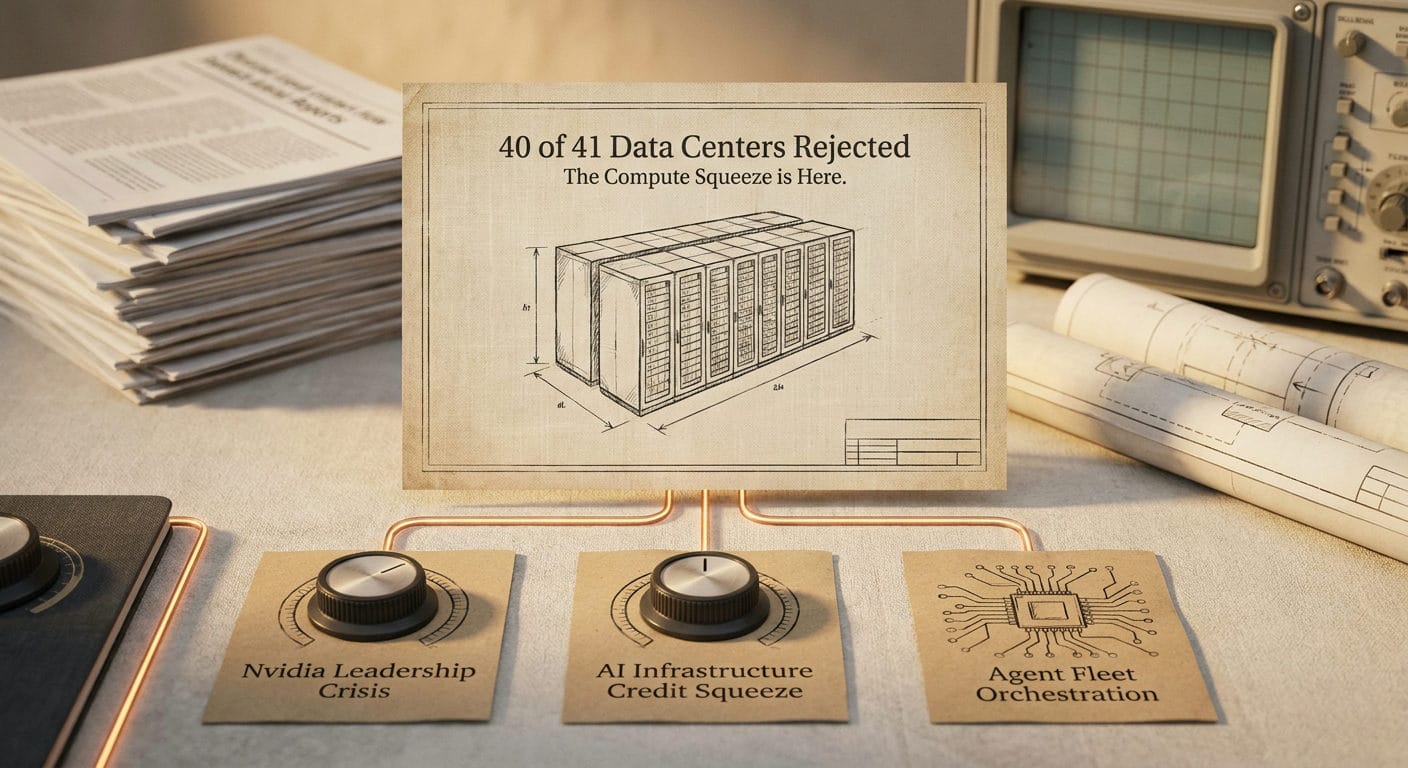
Midterm voters rejected data center expansions in 40 out of 41 local ballot measures. 🆕Paul Roetzer noted on The Artificial Intelligence Show that this political friction will inevitably constrain inference supply, likely leading to higher subscription prices or tighter token limits.
→ What to watch: A shift in AI deployment strategy from "infinite compute" to 🆕AI value engineering—selectively using expensive models only for judgment tasks while offloading routine work to deterministic code.
② "AI Teammates" are the Wrong Mental Model.
Synthesizing data from Shopify, Stripe, and Uber, The AI Daily Brief argues that successful 🆕AI-native companies are ditching the "named AI employee" concept in favor of 🆕dynamically sized agent fleets. Anthropic's internal data shows orchestrated subagents outperformed a single agent by 90%.
→ The context: Treating AI as a "teammate" reportedly reduced human scrutiny by 16% in one study, creating significant hidden risk; move toward an "orchestrator-and-evidence" model instead.
③ Design-First Models Slashing Costs by 40x.
Canva is moving away from generic frontier models for creative work. Head of AI Research 🆕Stefano Corazza explained on TWIML AI that their 🆕Canva Craft model separates "scene planning" from "pixel rendering," allowing for editability that giant models like GPT-4o or Midjourney can't match.
→ Why it matters: Vertical-specific models under 100B parameters are proving they can match frontier performance at 1/40th the cost when purpose-built for a specific UI/UX.
④ The "Shadow AI" Risk in the C-Suite.
On The Artificial Intelligence Show, Roetzer warned that even security leaders are bypassing corporate guardrails to use personal accounts for work. "If the people who know the risks are going outside the guardrails," he noted, "everyone else is too."
→ What to watch: A shift away from "block by default" policies toward "low-risk use case stacking" to bring 🆕Shadow AI back into governed environments.
⑤ Fable 5.2 and the "Human Taste" Gap.
Anthropic’s newest model, Fable 5.2, nearly doubled its contractor-level task performance (41.3% on the Remote Labor Index). However, experts like Ethan Mollick warn it still lacks "taste"—it can write a technically perfect report that is "utterly irrelevant" or tedious.
→ The Move: Reserve Fable for ambitious, open-ended project architecture; keep Opus 5.5 for routine, high-volume tasks where speed and cost-predictability matter more.
The Signals
🔥 HEATING UP
• 🆕Resend: Surpassing SendGrid in SDK downloads by prioritizing "developer experience" (DX) over legacy enterprise sales motions. (Zeno Rocha on Latent Space)
• 🆕Forward-Deployed Engineers: Currently essential for AI implementation, though Roetzer predicts business-literate "citizen builders" will replace them within 24 months. (Paul Roetzer on The AI Show)
• Independent Verification: As agent autonomy grows, "proof of work" and verification are becoming the primary bottlenecks in the enterprise. (Nathaniel Whittemore on The AI Daily Brief)
👀 ON WATCH
• 🆕Megaspeed: The firm at the center of the Nvidia "spy probe," allegedly acting as a conduit for diverted chips into China via Southeast Asian data centers. (Ana Swanson on Hard Fork)
• 🆕Canva Brush: A broad design agent that operates tools to edit compositions, moving beyond simple generation into high-level branded production. (Stefano Corazza on TWIML AI)
• Rare-earth Retaliation: Potential Chinese response to tighter U.S. chip controls, which could cripple the very hardware supply chains the U.S. is trying to protect. (Kyle Chan on Decoder)
The Bottom Line
Nvidia’s "Central Bank" era has ended, and the future of AI belongs to leaders who stop hiring "AI employees" and start building task-specific agent fleets.
Episode Guide (Web Version)
Decoder with Nilay Patel — "Jensen Huang is out. What did China want from him?"
Runtime: 42 min | Host: Nilay Patel | Guest: Kyle Chan (Brookings Institution)
Worth 5 Minutes For: Board members and policy makers trying to untangle the real risk of the Nvidia/China scandal.
Kyle Chan argues that China’s interest in Jensen Huang was less about stealing GPU blueprints and more about influencing U.S. export policy. The episode details why China’s strategy is broad "diffusion" into its economy, not winning the AGI race.
"The funny thing is China doesn't see this AI race as being so much about the frontier per se. They're really much more focused on diffusing the technology." — Kyle Chan
The Neuron: AI Explained — "AI Changed More in 4 Years Than You Remember"
Runtime: 79 min | Host: Corey | Guest: Grant Harvey
Worth 5 Minutes For: Technology strategists needing a reality-check on the pace of agentic progress.
A retrospective on the last four years that identifies December 2025 as a likely "inflection point" for practical agents. The hosts argue that "safe-by-design" architectures will soon end the trade-off between power and accessibility.
Latent Space: The AI Engineer Podcast — "Designing for Agents — Zeno Rocha, Resend"
Runtime: 86 min | Host: swyx | Guest: Zeno Rocha (Resend)
Worth 5 Minutes For: Founders and COOs looking to scale developer-led infrastructure organizations.
Rocha explains how to compete with giants (AWS, Twilio) by owning the developer experience. A fascinating look at how 🆕Resend uses agents for abuse detection while keeping their signup friction-free.
The AI Daily Brief — "Washington Is Taking Control of AI"
Runtime: 27 min | Host: Nathaniel Whittemore
Worth 5 Minutes For: Investors monitoring the geopolitical fallout of Nvidia’s leadership change.
This episode highlights the "leaky sieve" of current export controls and predicts a legislative surge toward total compute denial for China. It also flags the forensic evidence of Blackwell chips already in use by top Chinese labs.
The Artificial Intelligence Show — "#251: Forward-Deployed Engineers, Shadow AI, and Token Budgets"
Runtime: 51 min | Host: Paul Roetzer | Guest: Kathy McPhillips
Worth 5 Minutes For: Mid-market CEOs building AI adoption roadmaps for regulated industries.
Roetzer provides a framework for "autonomy-based governance" and argues that most organizations should start agents at low-autonomy levels rather than waiting for perfect systems.
The AI Daily Brief — "7 Things AI-Native Companies Do Differently"
Runtime: 23 min | Host: Nathaniel Whittemore
Worth 5 Minutes For: COOs and HR leaders redesigning workflows for an AI-first workforce.
A deep dive into why "AI teammates" fail and why "Fleets" of narrow, orchestrator-led subagents succeed at companies like Stripe and Uber.
The TWIML AI Podcast — "Canva Is Tackling AI Design’s Most Frustrating Problem"
Runtime: 58 min | Host: Sam Charrington | Guest: Stefano Corazza (Canva)
Worth 5 Minutes For: Product leaders exploring the "verticalization" of AI models.
Corazza explains why Canva built its own 🆕Canva Craft and 🆕Brush design agent to solve for human-in-the-loop editability rather than one-shot generation.
The Artificial Intelligence Show — "#250: Midterm Voters Reject Data Centers"
Runtime: 103 min | Host: Paul Roetzer | Guest: Mike Kaput
Worth 5 Minutes For: Strategy officers forecasting future compute costs and availability.
An analysis of the political backlash against the physical footprint of AI. It suggests that "Nimby-ism" is the new biggest threat to AI scaling.
Hard Fork — "Jensen Huang Is Out at Nvidia"
Runtime: 39 min | Host: Max Reed | Guest: Ana Swanson (NYT)
Worth 5 Minutes For: Anyone seeking the non-jargon, "cut-the-bullshit" story of the Nvidia board resignation.
The NYT team explores the relationship scandals and the "circular financing" risks that essentially made Nvidia the financier of its own demand.
The AI Daily Brief — "Fable 5.2 Is the Best AI Ever. So Why Am I Not Switching Yet?"
Runtime: 30 min | Host: Nathaniel Whittemore
Worth 5 Minutes For: CTOs deciding when to upgrade the company’s underlying model stack.
A balanced review of Anthropic’s latest model, explaining why technical benchmark gains don’t always translate to better "human-centric" utility.