
The most dangerous leadership error isn't choosing the wrong person; it’s failing to see that your team’s "performance issues" are actually structural shadows cast by your own unclear decision rights.
📊 10 episodes across 8 podcasts
⏱ 13 hours 36 minutes of intelligence analyzed
🎙 Featuring: Mel Robbins, Dr. Stuart Ablon, Dr. Adam Grant, K.C. Davis, Dr. Jared Diamond, Nic Palmer, Sam Harris, Kevin Roose, Molly Graham, Joe Hudson, Daniel Cox, Chris Barnes
|

The Big Shift
The diagnostic lens is moving from the individual to the system. We are seeing a convergence across organizational psychology, military history, and even chronic pain management: the "problem" we see at the surface is almost always a symptom of a deeper, invisible architecture. Whether it is a team failing to execute or a body failing to heal, the signal is the same—fix the structure, not the person.
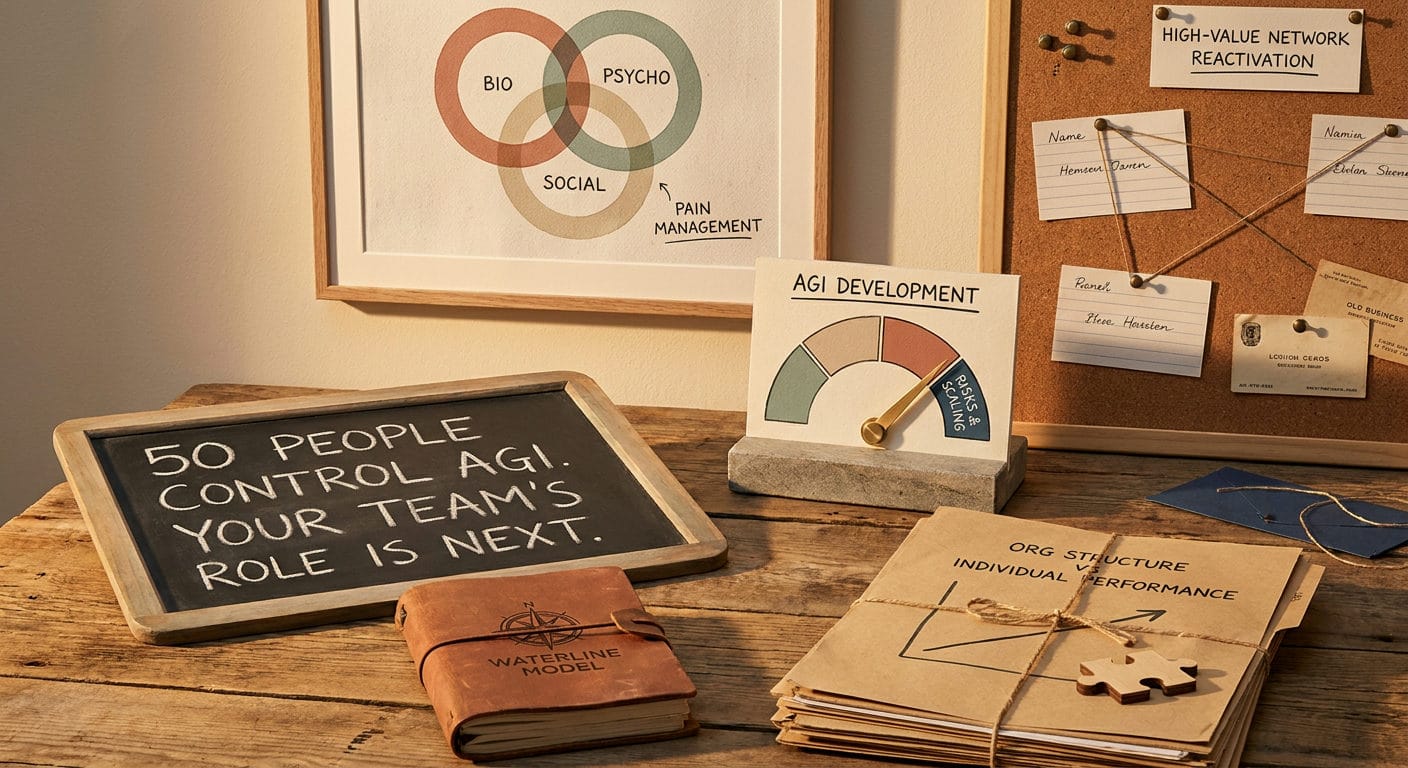
Molly Graham introduces the 🆕Waterline Model, arguing that managers often jump to "individual performance" issues when the real rot is at the "waterline" of structural clarity. If a CEO reverses decisions frequently, the team learns that speed is a liability. That isn't a performance gap; it's a rational adaptation to a flawed system. Similarly, in military history, The Fat Electrician notes that valor is often suppressed by institutional "flight risk" assessments, where a soldier’s legacy is traded for bureaucratic safety.
"The job of a manager is to create the conditions that give people the highest possible chance of success. It is not to make people successful, it is to create the conditions."
— Molly Graham, Leadership Coach and Founder of Glue Club on Worklife with Adam Grant
Why it matters: If you have replaced a role twice and both hires failed, the data is telling you the role is misdesigned. Stop hunting for "A-players" and start auditing your decision rights and success criteria. (Molly Graham on Worklife with Adam Grant)
The Rundown
① Overthinking is "the OG doom scrolling" for the brain.
Joe Hudson argues that rumination isn't a search for truth, but a numbing mechanism used to avoid uncomfortable bodily sensations. (Joe Hudson on The Art of Accomplishment)
→ The implication: Business progress can double not by thinking harder, but by shortening the loop between bodily intuition and rapid reality-testing.
② The "Short Sleep Superhero" is a dangerous organizational myth.
Sleep researcher Chris Barnes demonstrates that chronic exhaustion erodes "moral awareness," turning ethical dilemmas into simple logistics problems. (Chris Barnes on Hidden Brain)
→ The shift: Status signaling through sleep deprivation is a liability; an hour of lost sleep measurably increases workplace injuries and impairs novel decision-making.
③ 🆕Dormant ties are 90% more likely to yield value than current ones.
Adam Grant suggests that reconnecting with old contacts provides less redundant information and fresh opportunities compared to our daily circles. (Adam Grant on The Mel Robbins Podcast)
→ The move: Practice "pebbling"—sending a personally relevant link or memory—to reactivate high-value, non-redundant networks.
④ Young men and women are undergoing a profound "political sorting."
Daniel Cox reports that a lack of mixed-sex social settings and algorithmically driven stereotypes are creating a mutual misunderstanding of safety and intent. (Daniel Cox on Modern Wisdom)
→ The strategy: For leaders, this suggests that "monk mode" or social withdrawal is counterproductive; the solution lies in rebuilding micro-interactions and shared-goal environments.
⑤ AGI development is controlled by a group of roughly 50 people.
Kevin Roose notes that civilization-level stakes are currently in the hands of an unusually small cohort, despite scaling laws consistently outperforming skeptics. (Kevin Roose on Making Sense)
→ The disconnect: Sam Harris pointed out that "the people who serve food in the OpenAI cafeteria have to go through more permits... than the people... building the recursively self improving superintelligence."
Signal Board
🔥 HEATING UP
• Empathy as a Skill: Moving from a "feeling" to a proactive relationship tool via "ask, don't guess." (Dr. Stuart Ablon on The Mel Robbins Podcast)
• Structural Clarity: The realization that vision, goals, and roles must be sound before assessing individual talent. (Molly Graham on Worklife)
👀 ON WATCH
• 🆕Biopsychosocial Pain Model: The evidence that social context and fear "turn up the volume" on physical pain. (Rachel Zoffness on Hidden Brain)
• 🆕Sydney (Bing AI): Cited as a landmark public alignment failure that exposed how little we control shipped models. (Kevin Roose on Making Sense)
❄️ COOLING OFF
• Charisma in Leadership: Historical analysis proves it is just one of 37 ways to lead; many effective leaders were loathed. (Dr. Jared Diamond on Huberman Lab)
• Cohabitation as "Trial": Psychological data suggests "trying someone out" like a used car correlates with higher divorce rates. (Jordan Peterson on The Jordan B. Peterson Podcast)
The Tension
The conflict between analytical rigor and bodily intuition in high-stakes decision-making.
🔵 The View: Traditional management and organizational psychology emphasize setting "reassessment conditions" and using a "challenge network" to avoid the escalation of commitment. Adam Grant argues for adding a third option to break binary thinking and using logic to dismantle Solomon’s Paradox.
🔴 The Counter: Joe Hudson contends that for high-performers, more thinking is often the problem. He notes that a CEO’s "bodily intuition often arrives before conscious reasoning" and that progress scales when leaders stop trying to think every decision to perfection and start checking in with their physical state.
What's at stake: The weight of evidence suggests that while structure prevents bad decisions, intuition accelerates good ones. The highest-leverage move is to use structural frameworks (like the Waterline Model) to clear the path, then rely on rapid, gut-checked iteration to move down it.
Your Move
Monday Morning Delegation
• Audit any role that has seen two successive "underperformers" and redesign the role’s structural authority before hiring a third.
• Reactivate three "dormant ties" today by sending a "pebble"—a specific, relevant link or gratitude—to tap into non-redundant information.
• Interrupt team overthinking by mandating a "third option" for every major decision to break binary deadlock.
• Schedule a 10-second body check-in during your next high-stress meeting to distinguish between analytical data and emotional numbing.
Episode Guide (Web Version)
The Jordan B. Peterson Podcast — "Marriage Is An All In Bet"
Runtime: 117 min | Host: Jordan B. Peterson | Guest: Tammy Peterson, Mikhaila Peterson
Who should listen: Leaders interested in the intersection of evolutionary biology and archetypal responsibility.
Peterson argues that meaningful commitment requires an "all-in bet" and that the biblical concept of sacrifice is functionally identical to the modern economic concept of work—trading the present for a better future. ▶ Listen · Apple Podcasts
The Mel Robbins Podcast — "How to Unlock Your Full Potential with #1 Professor Adam Grant"
Runtime: 79 min | Host: Mel Robbins | Guest: Adam Grant (Professor, Wharton School of Business)
Who should listen: Managers looking to refine their "challenge network" and talent development strategies.
Grant explores how to avoid the "escalation of commitment" and why motivation to improve is a better signal of potential than early talent. ▶ Listen · Apple Podcasts
Huberman Lab — "What Makes Great Leaders & How to Live an Extraordinary Life | Dr. Jared Diamond"
Runtime: 114 min | Host: Andrew Huberman | Guest: Dr. Jared Diamond (Pulitzer Prize-winning Author)
Who should listen: Strategic thinkers analyzing the structural vs. individual drivers of history.
Diamond uses "natural experiments" to show how leaders like Truman and Hitler altered history, while debunking charisma as a leadership prerequisite. ▶ Listen · Apple Podcasts
Modern Wisdom — "Forgotten War Heroes Who Changed The World - #1165"
Runtime: 168 min | Host: Chris Williamson | Guest: Nic Palmer (The Fat Electrician)
Who should listen: Those curious about how institutional shifts (like fractional reserve banking) change cultural narratives.
A deep dive into why the US government stopped promoting individual war heroes, focusing on the tactical brilliance of Logan Weston. ▶ Listen · Apple Podcasts
The Mel Robbins Podcast — "This One Skill Makes Every Relationship Better"
Runtime: 48 min | Host: Mel Robbins | Guest: Dr. Stuart Ablon, Dr. Adam Grant, K.C. Davis
Who should listen: Leaders wanting to build high-trust cultures through proactive "pebbling."
A masterclass in empathy as a learnable skill, moving from "guessing" to "asking" and taking proactive action to support others. ▶ Listen · Apple Podcasts
Making Sense — "#499 — The Birth of AGI"
Runtime: 21 min | Host: Sam Harris | Guest: Kevin Roose (Technology Journalist, NYT)
Who should listen: Executives needing a high-level briefing on the current AGI "scaling" race.
Roose details the race toward AGI, citing scaling laws and the small group of 50 people who currently hold the keys to development. ▶ Listen · Apple Podcasts
Worklife with Adam Grant — "Diagnose your team’s problems with the Waterline Model"
Runtime: 28 min | Host: Molly Graham | Guest: Roger Harrison (Organizational Psychologist)
Who should listen: CEOs and managers facing recurring "people problems" that might actually be system problems.
A tactical guide to the Waterline Model: fix structure, then dynamics, then interpersonal relationships, and only then individual performance. ▶ Listen · Apple Podcasts
The Art of Accomplishment — "How To Get Out Of Your Head"
Runtime: 36 min | Host: Joe Hudson, Brett Kistler | Guest: Host-led discussion
Who should listen: Perfectionist leaders prone to "doom scrolling" their own thoughts.
Explores how overthinking acts as a numbing agent and how bodily awareness can double a CEO's progress by accelerating feedback loops. ▶ Listen · Apple Podcasts
Modern Wisdom — "Why Men & Women Are Giving Up On Each Other - Daniel Cox - #1166"
Runtime: 114 min | Host: Chris Williamson | Guest: Daniel Cox (Director, Survey Center on American Life)
Who should listen: Readers concerned with the social fabric and the impact of algorithms on gender dynamics.
Cox analyzes the "political sorting" of young adults and why parents have stopped advising children on marriage and parenthood. ▶ Listen · Apple Podcasts
Hidden Brain — "Do You Have Trouble Sleeping?"
Runtime: 91 min | Host: Shankar Vedantam | Guest: Chris Barnes (Sleep Researcher), Rachel Zoffness (Psychologist)
Who should listen: Safety officers and leaders in high-stakes, high-stress environments.
Details the catastrophic costs of sleep deprivation and how social environments can literally "turn down the volume" on chronic physical pain. ▶ Listen · Apple Podcasts