
The soft landing consensus is cracking, with market volatility on the rise and new geopolitical realities creating significant ripple effects across energy, crypto, and traditional finance.
The Intake
📊 12 episodes across 9 podcasts
⏱ 650 minutes of intelligence analyzed
🎙 Featuring: Niels Kaastrup-Larsen, Katy Kaminski, Harry Moore
The Big Shift
Geopolitics and Quantum Threats Are Reshaping Capital Markets
The market's initial complacency toward escalating Mideast tensions is giving way to a more sober reality, while a silent, existential threat looms over digital assets. This week's conversations reveal a critical disconnect: the market continues to "fade the bounce" on geopolitical crises, yet the fundamental conditions—like oil prices and supply chain vulnerabilities—are deteriorating. Simultaneously, groundbreaking advancements in quantum computing are accelerating the timeline for breaking core cryptographic security, posing an unprecedented challenge for Bitcoin and Ethereum.
The Strait of Hormuz is at the nexus of the immediate geopolitical risk, impacting crude oil supply and triggering global energy shortages, particularly in Asia and Africa. Malcolm Moore, Energy Editor at Financial Times, highlighted the severity, stating, "Oil X reckons that in this month, in April, the amount of oil the world has is going to fall by seven and a half million barrels a day. That is the oil that's trapped inside the Gulf that cannot get out." This mechanical disruption promises continued price hikes and demand destruction, a stark contrast to the stock market's "naive response" to overly optimistic peace talks (Katie Martin, Markets Columnist and Host at Financial Times).
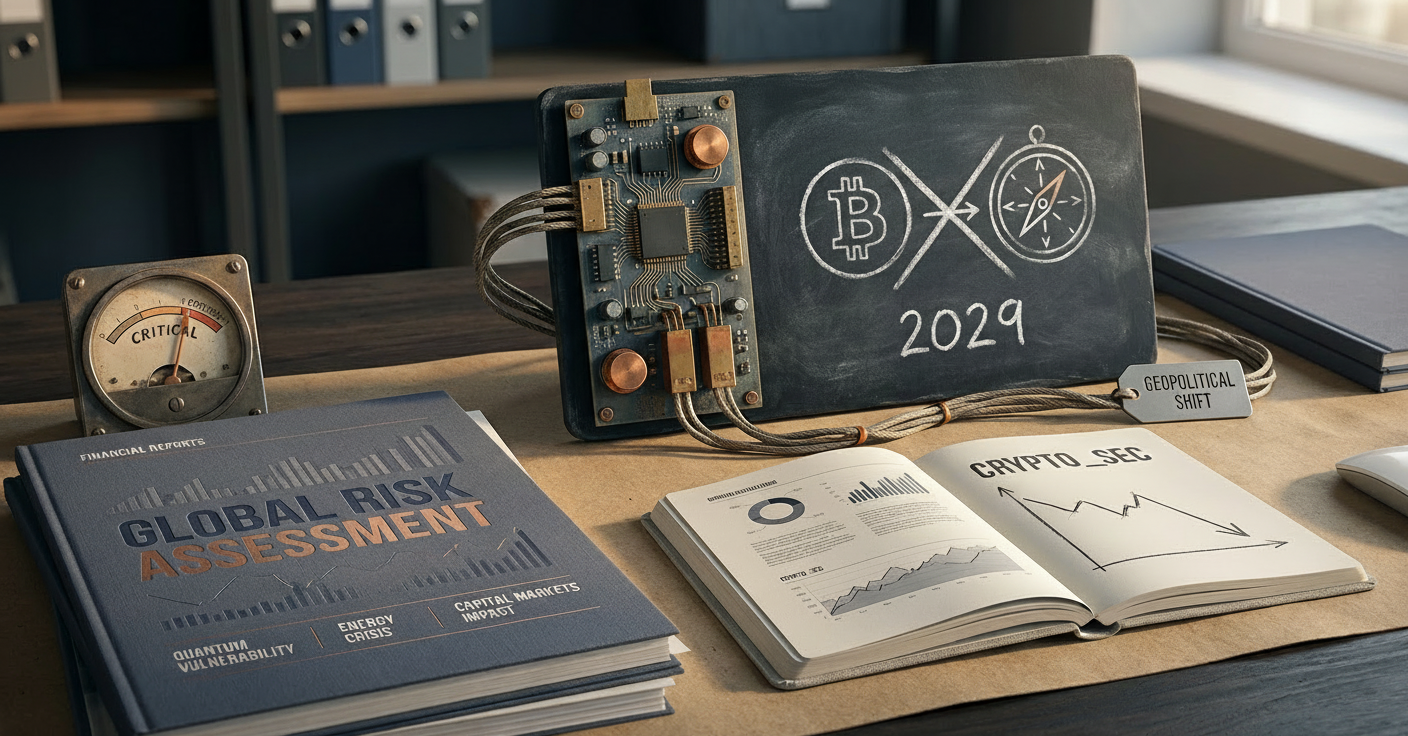
Compounding this immediate concern, a more insidious, long-term threat is crystallizing in the crypto world. New quantum computing papers indicate a 20x to 50x reduction in the qubits needed for Shor's algorithm, pushing Bitcoin's quantum vulnerability significantly closer. Nic Carter, Partner at Monalisa Capital, issued a stark warning: "We will not get significant prior notice before a CRQC [cryptographically relevant quantum computer] exists. We will not get significant prior notice, it’ll just happen. So this is the notice, actually this paper is the notice. This is our last warning shot." This accelerates the need for post-quantum cryptography adoption by 2029, a timeline Google is strongly recommending.
Taken together, these two forces—geopolitical fragility and quantum advancements—are creating a new regime of risk and opportunity for capital allocators. The immediate focus is on managing supply chain and energy cost volatility, while the long-term imperative shifts towards securing digital assets before the window closes.
"We will not get significant prior notice before a CRQC [cryptographically relevant quantum computer] exists. We will not get significant prior notice, it’ll just happen. So this is the notice, actually this paper is the notice. This is our last warning shot."
— Nic Carter, Partner at Monalisa Capital on Bankless
The Rundown
① Trend Following Strategies Provide Critical Diversification Amid Volatile Markets.
Despite Q1 2026 being a challenging quarter with sharp reversals, trend following provided valuable diversification and outperformed equities and bonds. (Harry Moore on Top Traders Unplugged)
→ Why it matters: In an environment of increased market chop and uncertainty, pure divergent strategies like trend following can deliver essential crisis alpha and help stabilize overall portfolio returns by offsetting losses in traditional assets.
② SpaceX's Growth and IPO Prospects Overshadow Tesla's Narrative.
While Tesla struggles with disappointing Q1 deliveries, analysts increasingly view SpaceX as a more compelling long-term investment, with a potential IPO valuing it at $1.75 trillion, surpassing Tesla. (Karen Finerman on CNBC's "Fast Money")
→ Why it matters: For investors tied to Elon Musk's ventures, the capital allocation narrative appears to be shifting, suggesting SpaceX could soon become the primary vehicle for capturing high-growth, innovative aerospace opportunities.
③ Private Equity "Volatility Laundering" Skews Perceived Returns.
The supposed lower volatility and outperformance of private equity relative to public markets are heavily influenced by return smoothing and valuation discrepancies, rather than pure alpha. (Owen Lamont on The Meb Faber Show - Better Investing)
→ Why it matters: Executives and investors evaluating capital sources should critically scrutinize private market performance data, understanding that reported results may not accurately reflect true volatility or illiquidity premiums, potentially understating real risk.
④ The IPO Market Drought is a "Historically Dire" Signal.
Despite an AI revolution, significant IPO activity remains subdued, a situation Randy Cohen, Professor of Finance and Entrepreneurship at Harvard Business School, calls comparable to the 1930s or 1970s, challenging the notion of a robust market. (Randy Cohen on The Meb Faber Show - Better Investing)
→ Why it matters: A lack of strong IPO volume signals caution for early-stage companies and their investors, indicating a less liquid exit environment and potentially longer holding periods for private assets.
⑤ Top Investors Succeed Not by High Hit Rates, But by Payoff Ratios.
Elite fund managers achieve outperformance with a median win rate of only 49%, but earn significantly more on winning investments than they lose on unsuccessful ones, with an average payoff ratio of 182%. (Kyle Grieve on We Study Billionaires - The Investor’s Podcast Network)
→ Why it matters: For operators and investors, this reinforces that disciplined position sizing and allowing winners to run, while aggressively cutting losers, is more critical to long-term success than being right most of the time.
Signal Board
🔥 Heating Up
• Oil Price Spike and Middle East Conflict: Concerns about supply disruptions in the Strait of Hormuz are driving prices above $100, with analysts predicting elevated levels through at least Q1 2027. (Denton Cinquerano on CNBC's "Fast Money")
• Portable Alpha: Strategies like trend following are gaining attention for their ability to decouple alpha and beta, providing efficient diversification to equity portfolios. (Harry Moore on Top Traders Unplugged)
• Wealth Inequality: The concentration of wealth in ultra-high-net-worth households is growing, with AI predicted to exacerbate this trend. (Michael Batnick on Animal Spirits Podcast)
👀 On Watch
• Google's Quantum Warning for Crypto 🆕: Google is strongly recommending that the crypto industry upgrade to post-quantum cryptography by 2029 due to accelerated quantum computing advancements. (Nic Carter on Bankless)
• Trump's 3-week Iran conflict timeline 🆕: President Trump indicated three more weeks of intense action in the Iran conflict, influencing initial market volatility before a quick rebound. (Ryan on Bankless)
• Ethereum Economic Zones (EEZ) 🆕: The concept of EEZ is emerging as a potential solution to unify Layer 2s, signaling a future "Ethereum 3.0" vision. (Ryan on Bankless)
• Strait of Hormuz closure leading to global weakness: The prolonged closure of this critical shipping lane is anticipated to weigh heavily on the global economy. (Karen Finerman on CNBC's "Fast Money")
🧊 Cooling Off
• Microsoft's AI product development challenges: Despite being an iconic software company, Microsoft's AI products like Copilot are deemed only marginally useful, contributing to underperformance. (Gene Munster on CNBC's "Fast Money")
• Q1 2024 Market Volatility and Trend Following Performance: Despite challenges, trend following provided diversification during a quarter marked by sharp market reversals. (Katy Kaminski on Top Traders Unplugged)
• Active managers underperform the index (90-95%): The vast majority of actively managed funds consistently fail to beat their benchmark indices, reinforcing the efficacy of passive investing. (Ben Carlson on Animal Spirits Podcast)
The Debate
The Market's Read on Geopolitical Risk: Complacency vs. Fundamental Impact
The market is grappling with how to interpret ongoing geopolitical tensions, particularly regarding the Mideast conflict.
🐂 The bull case: Despite initial sell-offs, the market quickly "pares" losses and rallies, suggesting a belief that the conflict will be contained or that long-term economic fundamentals will prevail. Karen Finerman, Analyst at CNBC, noted the surprising lack of VIX volatility: "The market is looking past conflict and saying, okay, oil is telling us that, that prices are going to stay higher." This perspective implies that market participants are either desensitized to geopolitical shocks or see them as temporary disruptions.
🐻 The bear case: Analyst Guy Adami, Panelist at CNBC, views the rallies as "fading the bounce," indicating skepticism about their sustainability due to the fundamental impacts of rising oil prices and supply chain disruptions. Malcolm Moore, Energy Editor at Financial Times, is more direct, stating, "The market has consistently priced this as being a short term event and is still hoping against all hope that it's a short term event. But if we grind forward month by month, there's basically a mechanical line that goes up and prices will just continue to rise and there'll be more disruption and more shortages." This side argues that the current valuations are not reflecting the underlying economic damage being accrued.
Our read: While markets can shrug off short-term noise, the physical flow of oil and goods through critical chokepoints like the Strait of Hormuz dictates real economic costs. The current rallies look more like technical bounces than a fundamental reassessment of risk, suggesting increased inflation and demand destruction are yet to be fully priced in.
The Bottom Line
The honeymoon for easy money and predictable peace is over; prepare for an era where quantum computing and geopolitical flashpoints directly hit your balance sheet.
📖 Want the full episode breakdowns, guest details, and listen links?
Appendix: This Week's Intelligence Briefings
Animal Spirits Podcast — "Home Buyer's Remorse (EP. 458)"
Runtime: 77 min | Host: Michael Batnick | Guest: Ben Carlson
Context for Operators: This episode provides critical perspective on market sentiment versus economic reality, reminding executives to not overreact to stock market volatility as a recession predictor. It also offers insight into the long-term trends of wealth concentration and the underperformance of active management, useful context for capital allocation decisions.
Michael Batnick and Ben Carlson discuss the current market sell-off as orderly, not a sign of recession, noting that corporate earnings are still rising. They highlight that the stock market has historically been inaccurate in predicting recessions and touch on wealth inequality, AI's potential impact, and active managers' underperformance.
"This is a classic case of the stock market predicting nine of the last five recessions."
— Michael Batnick, Host at Ritholtz Wealth Management
CNBC's "Fast Money" — "Stocks Wrap Up A Volatile Week… And Playing Defense Amid The Market Swings 4/2/26"
Runtime: 43 min | Host: Frank Holland | Guest: Denton Cinquerano (Chief Oil Analyst, Opus Denton)
Context for Operators: This segment provides immediate insight on critical geopolitical impacts on energy prices and supply chains, particularly relevant for CFOs managing logistics and anticipating cost increases. It also covers shifts in investor sentiment around tech giants and defensive investment strategies.
This CNBC's "Fast Money" segment covers market reactions to President Trump's statements on the Iran War, surging oil prices due to Strait of Hormuz concerns, and Tesla's disappointing Q1 deliveries. It also discusses Microsoft's AI product challenges, teen sports betting, and defensive investment strategies during market volatility.
"I think there's still going to be a risk premium out there. We're just having gotten through missiles being fired back at one another, so there's always that risk. But you're going to have a backlog of ships that need to clear through the Strait of Hormuz."
— Denton Cinquerano, Chief Oil Analyst at Opus Denton
Top Traders Unplugged — "SI394: The Quarter That Tested Every Trend Follower ft. Katy Kaminski & Harry Moore"
Runtime: 74 min | Host: Niels Kaastrup-Larsen | Guest: Katy Kaminski (Guest, AlphaSimplex Group)
Context for Operators: For those managing diversified portfolios or capital allocation decisions, this episode provides deep insights into the value of trend following as a diversifier, especially during periods of market stress and sharp reversals. It highlights the importance of market mix and trading speed in achieving crisis alpha.
Niels, Katy Kaminski, and Harry Moore discuss the performance of trend following in Q1 2026, highlighting its diversification benefits as it outperformed equities and bonds during volatile market reversals. They delve into manager performance differences based on market mix and trading speed, and introduce research on portable alpha and managing drawdowns.
"Trend is getting a bit more attention, especially those looking for sort of more defensive allocations."
— Harry Moore, Partner and Senior Client Portfolio Manager at Manhlan
Motley Fool Money — "The Secret to Out-Innovating the Competition: Inside the Tesla Playbook"
Runtime: 26 min | Host: Rachel Warren | Guest: Jon McNeill (Former President at Tesla, CEO and Co-founder at DVX Ventures)
Context for Operators: This episode offers a powerful framework for operational excellence and competitive advantage. Business leaders can apply Jon McNeill's hypergrowth algorithm to question assumptions, simplify processes, and emphasize 'cash velocity' in their own organizations.
Jon McNeill, former Tesla President and author of 'The Algorithm,' discusses his five-step hypergrowth formula emphasizing questioning assumptions, ruthless simplification, manual process testing before automation, and speeding up cycle times. He illustrates this with Tesla's Model 3 production and mobile service, introducing 'cash velocity' as a critical metric.
"When you automate a bad process, all you do is speed up the time to a bad answer or a bad outcome."
— Jon McNeill, Former President at Tesla, CEO and Co-founder at DVX Ventures
CNBC's "Fast Money" — "Markets Rally Ahead of Trump’s Iran Address… And Fading The Bounce 4/1/26"
Runtime: 44 min | Host: Melissa Lee | Guest: Guy Adami (Panelist, CNBC)
Context for Operators: This discussion is crucial for anyone assessing market sentiment and potential future inflation. The skepticism around the market rally provides a counterpoint for executives making financing decisions or assessing M&A timing, urging caution despite temporary rebounds.
This segment discusses the market rally with skepticism due to geopolitical tensions and economic issues. It covers President Trump's Iran address, rising crude oil prices, concerns about the Strait of Hormuz, a deteriorating housing market, and Nike's stock drop. It also features analysis on inflation and SpaceX's potential IPO.
"If there's no real new news, I suspect that you'll see crude oil stay bid in and around 100 bucks."
— Guy Adami, Panelist at CNBC
Bankless — "Bitcoin Has 3 Years to Survive | Nic Carter on Bitcoin’s Quantum Vulnerability"
Runtime: 74 min | Host: Ryan | Guest: Nic Carter (Partner, Monalisa Capital)
Context for Operators: This is a must-listen for any executive or investor with exposure to cryptocurrencies. Nic Carter's urgent warning about quantum vulnerability and the unsuitability of Bitcoin's governance model presents a significant, potentially existential, risk that demands immediate attention for long-term digital asset strategy.
Nic Carter discusses Bitcoin's updated quantum threat model, emphasizing that "Q-Day" could arrive abruptly due to new quantum papers and that Bitcoin’s governance is ill-equipped for the necessary "total mobilization." He delves into "on-spend attacks" and the urgent need for a full network post-quantum transition before quantum computers are built.
"We will not get significant prior notice before a CRQC [cryptographically relevant quantum computer] exists. We will not get significant prior notice, it’ll just happen. So this is the notice, actually this paper is the notice. This is our last warning shot."
— Nic Carter, Partner at Monalisa Capital
Motley Fool Money — "Which Types of Investments Should You Own and Where Should You Own Them"
Runtime: 33 min | Host: Robert Brokamp | Guest: Stephanie Marini (Guest, CFP®, CRPC®, The Motley Fool)
Context for Operators: This episode offers practical advice on tax-efficient investing and portfolio review that individuals and small business owners can apply. The two key questions for portfolio review are essential for optimal wealth management and capital allocation.
Robert Brokamp and Stephanie Marini discuss investment types and account options, emphasizing tax efficiency and control. Marini advises aligning investment choices with risk tolerance and future needs, particularly for cash and bonds. They conclude with critical questions for portfolio review: "If I didn’t own it, would I buy it today?" and "Is it in the right account?"
"I would say your highest growth potential asset should go in Roth. So things you plan on keeping forever those high if you're going to invest in individual stocks, any type of high growth, that could be a perfect option for a Roth IRA."
— Stephanie, Guest at Motley Fool
Unhedged — "How an energy crisis unfolds"
Runtime: 17 min | Host: Katie Martin | Guest: Malcolm Moore (Energy Editor, Financial Times)
Context for Operators: This concise episode is essential for any business leader whose operations are sensitive to energy costs. It provides a sobering outlook on the current energy crisis, emphasizing that even a "best-case" scenario means sustained high prices and warns against market complacency.
Katie Martin and Malcolm Moore discuss the global energy crisis stemming from the Iran war, highlighting how oil traders misjudged the market. Moore explains that even immediate peace would mean high energy prices, while the "worst-case" involves rising prices, increased demand destruction, inflation, and economic disruption. Martin criticizes the stock market's naive reaction to optimistic geopolitical statements.
"The market has consistently priced this as being a short term event and is still hoping against all hope that it's a short term event. But if we grind forward month by month, there's basically a mechanical line that goes up and prices will just continue to rise and there'll be more disruption and more shortages and some countries will absolutely run out of various types of fuel and then we'll see a lot of demand destruction, some of which you've already mentioned."
— Malcolm Moore, Energy Editor at Financial Times
The Meb Faber Show - Better Investing — "Liquid Private Equity & Volatility Laundering (Owen Lamont & Randy Cohen) | #625"
Runtime: 80 min | Host: Meb Faber | Guest: Owen Lamont (Portfolio Manager, Acadian Asset Management)
Context for Operators: For PE investors and CFOs considering private market financing, this conversation is essential. It exposes the "volatility laundering" of private equity and delves into the impact of interest rates and AI on valuations, providing a more realistic lens for deal assessment and capital allocation.
This segment delves into private equity's perceived outperformance and lower volatility, while questioning its reported valuations. Randy Cohen argues for "liquid private equity" replication in public markets, while Owen Lamont challenges smoothed private equity returns. The discussion also covers the IPO drought, interest rate impacts on valuations, and global diversification.
"The reported volatility of private equity has been significantly lower than the public markets. Now, the concern... is that there is smoothing in these returns, since nobody knows exactly what a private company is worth."
— Randy Cohen, Professor of Finance and Entrepreneurship at Harvard Business School
Odd Lots — "Scott Bok Explains What Investment Bankers Actually Do All Day"
Runtime: 54 min | Host: Joe Weisenthal | Guest: Scott Bok (Former CEO, Greenhill)
Context for Operators: For those engaging with investment banks or considering M&A, Scott Bok's insights into the evolution of investment banking offer a valuable perspective. Understanding the shift from capital raising to liquidity provision in IPOs, and the rise of private equity as a key client, can inform negotiation strategies and deal timing.
Scott Bok, former CEO of Greenhill, describes the evolution of investment banking, highlighting growth, the shift to maximizing shareholder value, and the intense work culture. He discusses how private equity transformed the industry, technology's impact on automation, and how AI will shift the banker's role toward human interaction. The conversation also touches on diminishing information asymmetry and changing banking culture.
"Private equity really became the biggest client base for the whole industry. The rise of the private equity industry created a client that was kind of permanently in the transaction business."
— Scott Bok, Former CEO of Greenhill
Bankless — "ROLLUP: Google’s Quantum Warning | Trump’s Iran Speech | Ethereum Economic Zones | Drift Hack"
Runtime: 64 min | Host: Ryan | Guest: David (Host, Bankless)
Context for Operators: This episode is critical for anyone managing or investing in digital assets, sounding an alarm on quantum threats and outlining concrete actions needed. It also offers insights into the evolving crypto ecosystem with "Ethereum Economic Zones" and the potential of crypto wallets as "super apps," informing future tech and financial services strategies.
Google warns the crypto industry about quantum computing advancements, urging post-quantum cryptography by 2029. Donald Trump addressed the Iran conflict, influencing market volatility. A major hack on Solana's Drift Protocol highlighted vulnerabilities. The concept of Ethereum Economic Zones and crypto wallets as "super apps" are noted, alongside other crypto developments.
"Google in this paper is strongly recommending that all of crypto take notice and be on notice and to upgrade to post quantum by the year 2029."
— Ryan, Host at Bankless
We Study Billionaires - The Investor’s Podcast Network — "TIP805: Stock Market Maestros w/ Kyle Grieve"
Runtime: 64 min | Host: Kyle Grieve | Guest: John (Investor)
Context for Operators: For investors and business leaders managing capital, this episode provides a crucial lesson on investment psychology and portfolio construction: success comes from asymmetrical payoffs, not perfect predictions. The strategies for managing winners and losers are directly applicable to capital allocation within a business, reinforcing discipline over sentiment.
Kyle Grieve discusses insights from 'Stock Market Maestros,' revealing that elite fund managers achieve outperformance through high payoff ratios (182% median) rather than high hit rates (49% median). He details strategies for position sizing, letting winners run, and managing losers effectively, with examples from investors like Josh Goldberg and Greg Padilla.
"The payoff ratio is the strongest stat for differentiating skilled investors from average or below average investors. All of the maestros chosen for the book had payoff ratios well in excess of 100% with a median score of 182%."
— Kyle Grieve, Host at The Investor's Podcast Network