
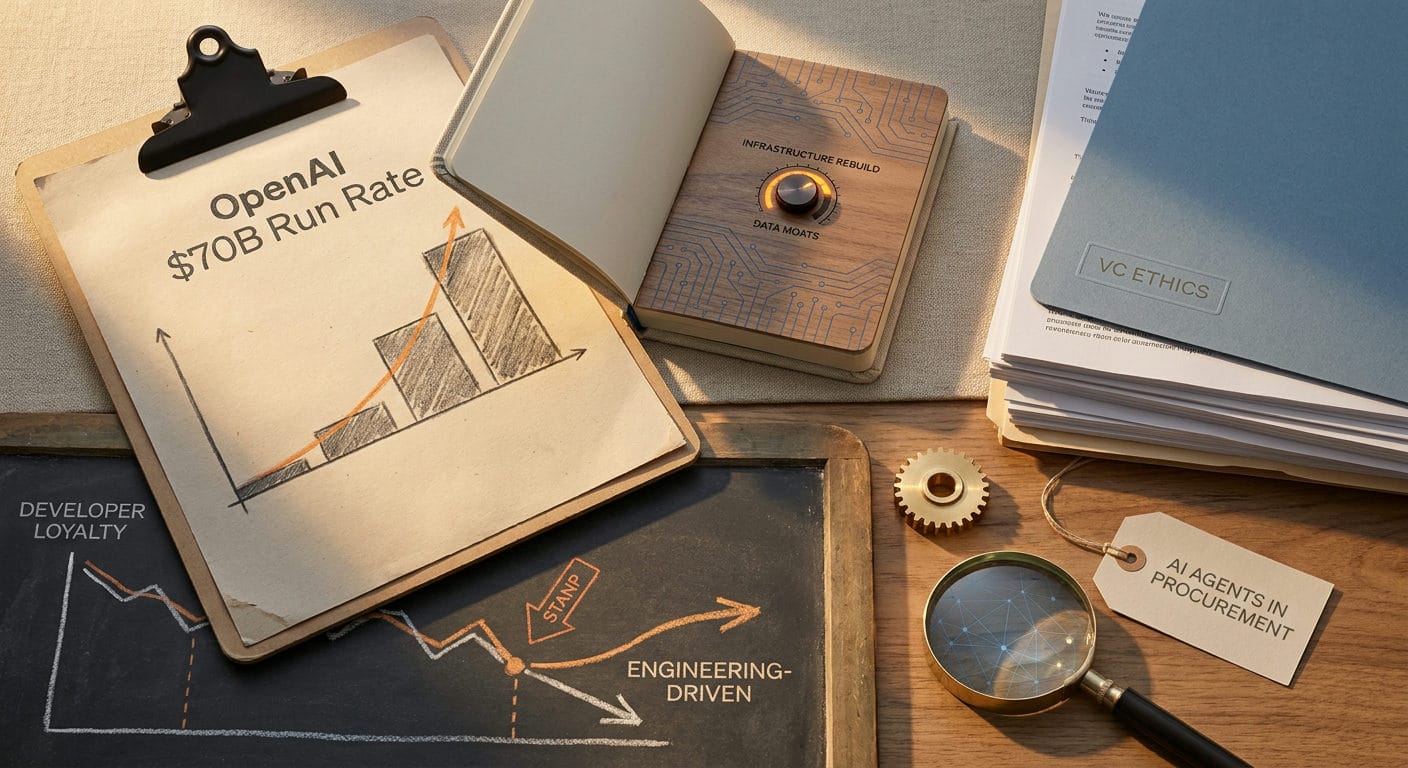
The new venture playbook demands founder grit, engineering-driven sales, and infrastructure plays, as the market separates genuine innovation from AI hype.
📊 11 episodes across 5 podcasts
⏱ 724 minutes of intelligence analyzed
🎙 Featuring: Max Freeman, Harry Stebbings, Ben Horowitz, James Norman
|

The Big Shift: From Visionary Founder to Orchestrator of Engineering & Data
The era of the charismatic founder selling a big vision is evolving. The market is increasingly rewarding founders who are orchestrators of engineering, data, and ruthless execution, building moats that aren't easily replicated by AI or competitors. This shift is evident in how capital is flowing towards deep infrastructure plays and sales models that treat GTM as an engineering problem.
The Data Moat: Proprietary data, especially from physical systems, is emerging as the new defensibility. Carter Fowler, Founder of Totem Labs, highlighted that "Hardware, and in particular hardware that generates proprietary data is like kind of what some people look as really the only remaining moats in a world where pretty much any SaaS product could be rebuilt overnight" on This Week in Startups. This suggests a re-prioritization of tangible, data-generating assets.
Sales as Engineering: Max Freeman, SVP Sales at Ramp, is engineering-driven, stating on The Twenty Minute VC that "Sales is very much an engineering problem when you break it down. It's a data infrastructure problem, it's a math problem." Ramp's approach to sales, using internal automation and targeting 'mispriced assets' like investment bankers for their work ethic, exemplifies a strategic, analytical shift in Go-to-Market.
The New Definition of 'Great': Ben Horowitz, Co-founder and General Partner at a16z, further emphasized this operational excellence on The a16z Show, noting that for founders, "What matters is, are their strengths world class or are they the best in the world at something? And then you overlook everything else." This implies a focus on a founder's unique, almost extreme, capability to execute in specific, critical areas, rather than a broad, well-rounded profile.
"Hardware, and in particular hardware that generates proprietary data is like kind of what some people look as really the only remaining moats in a world where pretty much any SaaS product could be rebuilt overnight."
— Carter Fowler, Founder of Totem Labs on This Week in Startups
Why it matters: As AI commoditizes software development, the value shifts to unique data capture and hyper-efficient operational models. Founders who can build these engineering-driven moats, whether in GTM or deep tech, are the ones capturing attention and capital. The market is no longer just funding ideas; it's funding the execution capability that makes those ideas defensible against rapid AI-driven iteration.
→ The move: Prioritize investments in founders who demonstrate deep technical or operational expertise to build proprietary data sets or engineer highly efficient GTM machines, as these are increasingly the only defensible positions.
The Rundown
① AI Infrastructure Rebuild Imminent, Creating New Opportunities.
The current AI infrastructure, from GPUs to model training methods, is fundamentally 'wrong' and will undergo a complete reconstruction within the next 8-12 months, similar to the early days of cloud computing (Ben Horowitz, Co-founder and General Partner at a16z on The a16z Show).
→ What to watch: This impending rebuild presents massive opportunities for new infrastructure plays beyond just GPU providers; look for innovations in compute orchestration, data pipelines, and specialized hardware designed for agentic workloads.
② AWS Intentionally Allocating Scarce GPU Capacity to Startups.
Despite being able to sell all its GPU capacity to large frontier labs, AWS is intentionally reserving significant portions for startups, recognizing them as the 'enterprises of tomorrow' (Matt Garman, CEO of AWS on The a16z Show).
→ The signal: This strategic decision by a cloud giant indicates a long-term bet on the startup ecosystem as a critical driver of future growth and innovation, offering a lifeline to AI startups amidst intense compute scarcity.
③ 🆕OpenAI Nearing $70 Billion Run Rate Challenges Enterprise Giants.
OpenAI is approaching a $70 billion run rate and a potential $1.4 trillion valuation, while companies like Anthropic are preparing for IPOs (Harry Stebbings, Host of The Twenty Minute VC (20VC)). Dev Ittycheria, CEO of MongoDB, noted on the same podcast that "Developers are very quick to use to switch from one tool to another or frankly use multiple tools. And I think what we're seeing is that developers are quick to find the shiny new toy."
→ Why it matters: This rapid revenue growth signifies a tectonic shift in the software landscape, with developers demonstrating low loyalty to specific models, forcing incumbent tech companies to rapidly adapt or risk being outpaced by these AI powerhouses.
④ AI Agents Are Already Driving Purchasing Decisions for Infrastructure.
AI agents are increasingly making vendor selection and purchasing decisions based on a deep understanding of a user's tech stack, leading to unexpected product discoveries and rendering companies invisible if not optimized for AI discovery (Harry Stebbings, Host of The Twenty Minute VC (20VC)).
→ What to watch: Startups need to shift their marketing and sales strategies to optimize for agent-driven discovery, moving beyond traditional SEO to ensure their products are 'visible' to AI agents making procurement choices.
⑤ New Moats Emerging in Vertical AI with Proprietary Data.
Vertical AI solutions leveraging unique data collection offer a significant moat against large labs, making them more investable than traditional vertical SaaS due to their ability to target larger 'labor layer' spend (Kanu Gulati, Partner at Khosla Ventures on This Week in Startups).
→ The signal: The shift implies that VCs are prioritizing depth and defensibility through data density, rather than broad applicability, as foundational models continue to commoditize general AI capabilities.
Signal Board
🔥 HEATING UP
• Proprietary Data for AI Differentiation: Collecting unique, real-world data (especially from physical systems) is seen as a key moat against easily replicable SaaS and general AI solutions. (Carter Fowler on This Week in Startups)
• Design and experience as a differentiator in the AI era: With AI agents handling more backend tasks, user interface and experience become even more critical for product differentiation. (Mike Cannon-Brookes on The Twenty Minute VC (20VC))
• Engineering-driven Sales Automation: Companies like Ramp are treating sales as an engineering and data problem, building internal tools (OATS program) for highly efficient outbound motions. (Max Freeman on The Twenty Minute VC (20VC))
• AWS's $220 billion capital expenditure for AI: This massive investment signals a clear commitment from cloud providers to meet the escalating demands for AI infrastructure. (Matt Garman on The a16z Show)
• Cost-Effectiveness of Near-Frontier Models: CFOs are pushing enterprises to adopt cheaper, near-frontier US open-source models to reduce escalating token bills. (The Trio on The Twenty Minute VC (20VC))
👀 ON WATCH
• 🆕John D. Rockefeller: Re-evaluation of Gilded Age tycoons highlights ruthless efficiency and innovative strategies, offering lessons for today's market consolidators. (David Senra on Founders)
• 🆕Carnegie's railroad-style cost accounting: Emphasizes the historical importance of extreme cost discipline and scale in market dominance. (David Senra on Founders)
• 🆕Profitability of recovering critical minerals from e-waste using biomass: Startups like Arabat are demonstrating environmentally friendly and cost-effective methods for resource recovery. (Ralf on This Week in Startups)
• 🆕Seeker (spatial intelligence layer): A mesh networking device designed for crowded environments, leveraging autonomous networks for superior accuracy and data moats. (Carter Fowler on This Week in Startups)
• 🆕AI Agents Replacing Interfaces: While not a complete replacement, the growing capability of AI agents to handle tasks directly impacts UI design and enterprise software. (Mike Cannon-Brookes on The Twenty Minute VC (20VC))
🥶 COOLING OFF
• Traditional SaaS Venture Funding: The long-term viability of horizontal SaaS is being questioned as vertical AI solutions and AI agents begin to challenge existing models. (Kanu Gulati on This Week in Startups)
• Specialized AI models vs. generalized foundational models: Growing skepticism that specialized models can keep pace with the rapid advancements and cost-performance of generalized foundational models. (Mike Cannon-Brookes on The Twenty Minute VC (20VC))
• Enterprise trust in Chinese AI models: Customer pushback persists against Chinese-origin AI models, despite many proprietary models being fine-tuned open-source versions. (Mike Cannon-Brookes on The Twenty Minute VC (20VC))
• Individual Sales Rep Quotas in Early Stages: For early sales hires, 100% On-Target Earnings (OTE) for the first two quarters is advised over traditional quotas due to market uncertainty. (Max Freeman on The Twenty Minute VC (20VC))
• CES's declining relevance: Major tech companies increasingly see themselves as "nation states" with less need to be subservient to traditional industry conferences. (Lon on This Week in Startups)
The Debate
Topic framing: The ethics and long-term implications of VCs publicly criticizing or competing directly with their portfolio companies.
🐂 The bull case: Some argue that public criticism, while harsh, might signal accountability and a founder-first approach if it ultimately benefits the broader ecosystem or exposes issues. Vinod Khosla's public criticism of his portfolio company, Factory, sparked this debate, with the implication that VCs, as fiduciaries, must sometimes make difficult choices to protect their broader interests, even if it damages individual relationships.
🐻 The bear case: Dev Ittycheria, CEO of MongoDB, argued on The Twenty Minute VC (20VC) that such actions cause significant reputational damage: "I think the reputational damage that you can do, you know, long term is going to come back and bite you. You basically handed every other firm a weapon when they're competing on deals saying, is this the partner you want when things go bad?" This perspective highlights the erosion of trust and the potential chilling effect on future founder relationships.
Our read: The market will increasingly penalize VCs who engage in public spats with portfolio companies, as founders value stability and discreet support, especially in a competitive funding environment.
The Bottom Line
The market is sorting out the signal from the noise, rewarding founders who engineer defensible, data-rich businesses over those relying on AI buzz or traditional SaaS models.
Episode Guide
This Week in Startups — "The Gadget That's Better in Crowds Than Your Phone + Ring’s Founder Before Amazon Bought It | E2349"
Runtime: 80 min | Host: Jason | Guest: Carter Fowler (Founder, Totem Labs)
For the operator: Understand how hardware innovation and mesh networking are creating new data moats and unexpected product-market fits beyond initial intentions.
This episode dives into Totem, a screen-free compass, showcasing its unique autonomous mesh network and how it's building proprietary data sets for predictive crowdflows. It also features Ring founder James Simonoff on his "inventor first" approach.
"The more cell phones you get in an area, the worse they all work. The more totems you get in an area, the better they all work." — Carter Fowler, Founder of Totem Labs
The Twenty Minute VC (20VC): Venture Capital | Startup Funding | The Pitch — "20Sales: Inside Ramp's Sales Playbook: How to Build a Sales Machine with Max Freeman, SVP Sales @ Ramp"
Runtime: 68 min | Host: Harry Stebbings | Guest: Max Freeman (SVP Sales, Ramp)
For the operating partner: Gain insights into Ramp's engineering-driven sales strategies, from hiring 'mispriced assets' to implementing 100% OTE for early reps.
Max Freeman of Ramp dissects their high-performance sales playbook, emphasizing hiring mispriced talent from low NPS companies and treating sales as a data infrastructure problem with automated tools.
"Sales is very much an engineering problem when you break it down. It's a data infrastructure problem, it's a math problem." — Max Freeman, SVP Sales at Ramp
The a16z Show — "What Makes a Great Entrepreneur? | Ben Horowitz on Vintage x Vintage"
Runtime: 52 min | Host: James Norman | Guest: Ben Horowitz (Co-founder and General Partner, a16z)
For the GP: Hear Ben Horowitz's nuanced perspective on evaluating founders based on world-class strengths and the transformative impact of AI on building.
Ben Horowitz discusses a16z's founder-centric model, the importance of specific world-class strengths in entrepreneurs, and predicts a complete rebuild of current AI infrastructure within months.
"What matters is, are their strengths world class or are they the best in the world at something? And then you overlook everything else." — Ben Horowitz, Co-founder and General Partner at a16z
The a16z Show — "Building the Cloud for an Agentic World | AWS CEO Matt Garman"
Runtime: 56 min | Host: Raghu Raghuram | Guest: Matt Garman (CEO, AWS)
For the CEO: Understand how AWS is adapting its cloud for an "agentic world" and managing massive infrastructure demands with long-term capital investments.
Matt Garman, CEO of AWS, explains their strategy for balancing scarce GPU capacity, their $220 billion capital expenditure for AI, and the development of custom silicon like Graviton and Trainium.
"We're very intentional about keeping capacity available for the startups. We recently announced we're going to be buying 2 million Nvidia GPUs over the next couple of years." — Matt Garman, CEO of AWS
Pivot — "Pivot Extra: Inside “Musk”: Power, Family and the Making of a Tech Demagogue"
Runtime: 77 min | Host: Kara Swisher | Guest: Alex Gibney (Filmmaker, Jigsaw Productions)
For the board member: Analyze the evolving dynamics of tech leaders, political influence, and the challenges of producing critical content about powerful figures.
This episode features filmmaker Alex Gibney and Justine Musk discussing the documentary 'Musk', focusing on Elon Musk's political alignment, power accumulation, and the challenges of critical media in the current landscape.
"When Trump was nearly assassinated and Elon Musk hitched his wagon to Trump, the story changed." — Alex Gibney, Filmmaker
This Week in Startups — "What VCs Really Think About Personal AI Agents | E2347"
Runtime: 79 min | Host: Deedy Das | Guest: Kanu Gulati (Partner, Khosla Ventures)
For the investor: Explore VC perspectives on personal AI agents, data privacy, and the strategic importance of vertical AI with defensible data moats.
A VC roundtable discusses OpenAI's math breakthroughs, the bimodal investment approach for AI, and the complexities of "coopetition" and data privacy with personal AI agents.
"We often think about what can we invest in where the ultimate value is not just flowing into the token generators today. What is the next capability that we can invest in?" — Kanu Gulati, Partner at Khosla Ventures
The Twenty Minute VC (20VC): Venture Capital | Startup Funding | The Pitch — "20VC: Atlassian CEO on Why Agents Won't Replace Interfaces | Why Enterprises Won't Trust Chinese Models | Why The Jury Is Still Out On The Benefits of Specialised Models with Mike Cannon-Brookes"
Runtime: 55 min | Host: Harry Stebbings | Guest: Mike Cannon-Brookes (Co-Founder and CEO, Atlassian)
For the growth executive: Understand how enterprise software is adapting to AI, the role of interfaces, and the implications of cost discipline in AI model usage.
Mike Cannon-Brookes, CEO of Atlassian, argues that "headless is brainless" for interfaces, emphasizing design in the AI era, and questions the long-term viability of specialized AI models.
"If you're giving up on your user interface, if you're giving up on evolving your experience for a customer, I think that's a brainless bet. I don't think agents will replace all the interfaces." — Mike Cannon-Brookes, Co-Founder and CEO of Atlassian
Founders — "#437 The Tycoons: Carnegie, Rockefeller, Gould & Morgan"
Runtime: 54 min | Host: David Senra | Guest: David Senra (Host, Founders Podcast)
For the stretched CEO: Learn from the aggressive, innovative strategies of Gilded Age tycoons and their ruthless pursuit of efficiency and market dominance.
This episode highlights the foundational roles of Andrew Carnegie, John D. Rockefeller, Jay Gould, and J.P. Morgan in shaping the American economy, focusing on their distinct and often ruthless entrepreneurial approaches.
"Most businessmen of the time believed in orderly markets and gentlemanly, fair profits. But these three came with flaming swords." — David Senra, Host of Founders Podcast
This Week in Startups — "Jason Reacts To Japanese Founder Pitches + Fireside Chat With Yuki Shirato"
Runtime: 85 min | Host: Jason Calacanis | Guest: Yuki Shirato (Managing Director, Techstars Tokyo)
For the investor: Gain insights into the evolving Japanese startup landscape, founder pitch dynamics, and unique innovations emerging from the region.
Jason Calacanis and Yuki Shirato of Techstars Tokyo discuss the cultural shift towards entrepreneurship in Japan, review pitches from Japanese founders, and offer feedback on business models.
"This discussion. You've heard this as well, I'm sure. And you reinforced that unintentionally because you didn't address the business case here. What is the business case for this? How are you going to make that $500 million?" — Jason Calacanis, Host of This Week in Startups
Pivot — "Camp Donald, Bezos's AI Fantasy, and Desperately Seeking Kara Swisher"
Runtime: 45 min | Host: Kara Swisher | Guest: Scott Galloway (Host, New York Magazine)
For the GP: Hear critical analysis of tech billionaires' perspectives on AI, political influence, and media consolidation.
Kara Swisher and Scott Galloway discuss Donald Trump's political maneuvers, critique Jeff Bezos's views on AI and productivity, and analyze the debt-laden Paramount-Warner Bros. Discovery merger.
"This merger is less creating a media giant and more two swimmers who are struggling, grabbing onto each other." — Scott Galloway, Host at New York Magazine
The Twenty Minute VC (20VC): Venture Capital | Startup Funding | The Pitch — "20VC: Cognition vs Factory: Vinod Khosla Creates a Storm | OpenAI Nears $70B Run Rate: Anthropic Under Threat | ElevenLabs Doubles Its Valuation to $22B & Salesforce Buys Listen Labs for $2B"
Runtime: 73 min | Host: Harry Stebbings | Guest: Dev Ittycheria (CEO, MongoDB)
For the growth executive: Understand the fierce competition in the LLM space, the rise of AI agents in purchasing, and the debate around venture firm ethics.
This episode covers the intense competition between OpenAI and Anthropic, OpenAI's $70 billion run rate, the controversial sales leader move from Factory to Cognition, and the rising valuations of AI companies like ElevenLabs.
"I think the reputational damage that you can do, you know, long term is going to come back and bite you. You basically handed every other firm a weapon when they're competing on deals saying, is this the partner you want when things go bad?" — Dev Ittycheria, CEO of MongoDB