
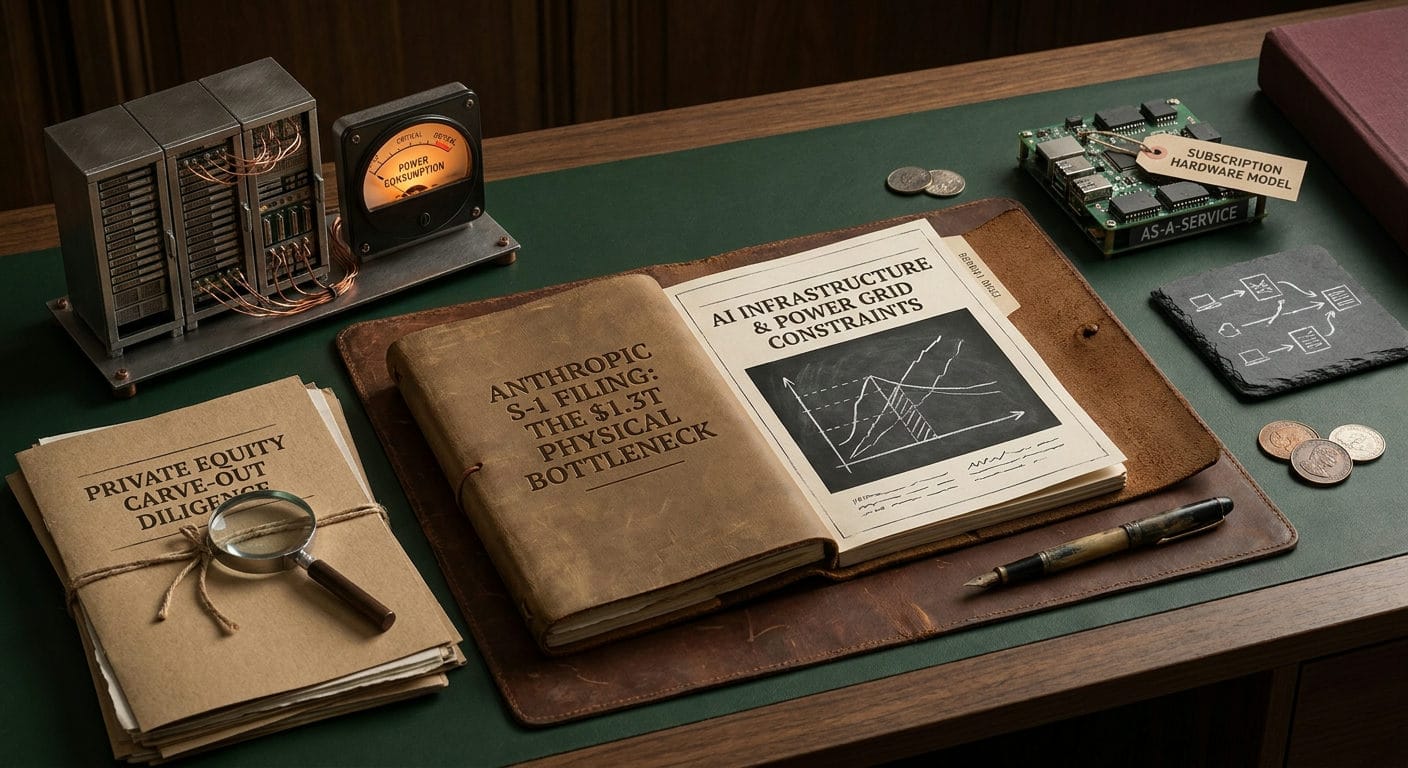
The era of paying a premium for pure "intelligence" is closing as frontier-model capabilities commoditize, shifting the alpha to the physical and proprietary complements that AI cannot replicate.
📊 9 episodes across 8 podcasts
⏱ 6 hours 52 minutes of intelligence analyzed
🎙 Featuring: Tracy Alloway (Bloomberg), Joe Weisenthal (Bloomberg), Anuj Ranjan (Brookfield), Will Ahmed (WHOOP), Reed Hastings (Netflix), Cliff Sosin (CAS Investment Partners)
|

The Big Shift
Intelligence is Abundant; Reality is the Bottleneck.
The private equity and growth equity consensus is shifting from "who builds the best model" to "who owns the physical world the model needs to interact with." As intelligence becomes a cheap, ubiquitous commodity, the value is accruing to the "complements"—the data moats, the power infrastructure, and the physical laboratory capacity that bound the speed of progress.
The Constraints are Physical: While AI can synthesize millions of research papers in seconds, it cannot bypass biological or physical timelines. Cliff Sosin (Founder, CAS Investment Partners) notes that intelligence hits a ceiling in dynamic systems: "If that experiment requires breeding mice and mice need a year to grow up and die, that experiment is gonna take time."
Infrastructure as Systemic Risk: This physical demand is so intense that it is moving from a sector trend to a macro-financial risk. Anthropic’s S-1 risk factors show where the pressure sits. Chamath Palihapitiya noted on All-In that "the single biggest risk to the Ant business is compute," and that the AI complex’s borrowing needs through 2027 equal about 30% of U.S. Treasury issuance, which could push borrowing costs higher for the entire economy.
The Move: Look past the LLMs to the "ancillary tailwinds." Anuj Ranjan (CEO, Brookfield Private Equity) highlighted a pipe-protection business, Chemalex, that became a high-growth asset solely by protecting data center infrastructure. The playbook now is to own the "un-digitized" industrials that the digital revolution cannot exist without.
"I think the world is still underestimating the amount of infrastructure and power required to do all of this."
— Anuj Ranjan, CEO, Global Private Equity at Brookfield on Dry Powder
The Rundown
① The "Minus One Day" Vulnerability Window.
AI is collapsing the time between a patch being disclosed and a working exploit being built. Thai Duong (CEO, Calif) demonstrated how his team used AI to weaponize a two-year-old PHP flaw that maintainers had deferred fixing due to cost. (Thai Duong on Odd Lots)
→ Why it matters: Conventional "detection and response" timelines are obsolete; attackers now move at "machine speed," compromising networks within 24 hours of initial entry.
② Subscription Models Solve the Hardware Upgrade Trap.
Will Ahmed (CEO, WHOOP) 🆕 argues that switching from a $500 device sale to a $30/month membership aligns incentives with retention rather than forced obsolescence. This model allowed WHOOP to build a 50-billion-hour physiological data moat. (Will Ahmed on All-In)
→ Your Move: Evaluate hardware portcos for recurring service transitions; WHOOP’s 23.6-hour daily wear-time is a high-water mark for "data-as-a-moat" strategies.
③ The Carve-Out "Invisible Expense" Risk.
In corporate carve-outs, the greatest risk isn't revenue verification—it's identifying the unbooked dependencies hidden in the parent's P&L. Kevin Gorman noted that "the puzzle you have to figure out is how much less of a company is it?" (Kevin Gorman on Private Equity Funcast)
→ Diligence Signal: If the parent's staff, rather than the target's management, answers most operational questions, the asset likely lacks the "muscle memory" to survive post-close without a heavy TSA.
④ Decarbonization as Infrastructure, Not Venture.
Ara Partners 🆕 is underwriting industrial decarbonization on unit economics, not green premiums. Partner Cory Steffek warned that "moving fast without discipline means you break your balance sheet and concrete is painfully expensive to pour twice." (Cory Steffek on The Private Equity Podcast)
→ The Standard: If a deal requires a "green premium" to pencil, it’s a venture bet. Growth infrastructure requires long-term feedstock and offtake agreements to de-risk the "first-of-a-kind" plant risk.
⑤ Netflix’s Counter-Strategy to YouTube.
Reed Hastings 🆕 (Co-founder, Netflix) argues that the answer to short-form creator content isn't copying TikTok, but leaning into higher creative bars and live sports. He cited missing the ad-supported OS model (Roku/Android) as a key strategic error. (Reed Hastings on Masters of Scale)
→ Why it matters: High-end long-form remains the "durable bottleneck" in an era where AI-generated short-form content is about to reach infinite supply.
Signal Board
🔥 HEATING UP
• Heart Rate Variability (HRV): Emerging as the primary individualized health and longevity signal for the "Quantified Self" movement. (Will Ahmed on All-In)
• Reshoring/Supply-Chain Relocation: Driving 8.5x entry multiples for dominant cross-border industrial manufacturers. (Anuj Ranjan on Dry Powder)
👀 ON WATCH
• Anthropic S-1 🆕: Raised roughly $110B but spent only $9–10B, leaving about $100B in cash, per David Sacks. Chamath Palihapitiya expects the IPO to price at $1.3T–$1.7T. (All-In)
• U.S. FDA 🆕: Recent guidance updates now recognize wellness applications for blood-pressure measurement, easing the regulatory path for wearables. (Will Ahmed on All-In)
❄️ COOLING OFF
• AI-Generated Diligence 🆕: Practitioners warn that AI is creating "information sprawl" in carve-outs, requiring more human hours to condense for legal drafting. (Ryan Milligan on PE Funcast)
• Search-Ranking Moats: Cliff Sosin argues AI agents will make consumer switching frictionless, eroding the value of being #1 on Google. (Cliff Sosin on Invest Like the Best)
The Bottom Line
The "smart money" is exiting the hype cycle of model-building to capture the un-digitized industrial and data-rich bottlenecks that AI can augment but never replace.
Episode Guide (Web Version)
Odd Lots — "PHP2Shell Won't Be the Last Big AI Cybersecurity Risk"
Runtime: 49 min | Host: Tracy Alloway, Joe Weisenthal | Guest: Thai Duong (CEO, Calif), Bruce Dang (Engineer, Calif)
Listen if: You are responsible for portfolio cybersecurity or infrastructure resilience.
A chilling look at "minus-one-day" vulnerabilities where AI turns disclosed patches into working exploits before IT teams can deploy them. The gap between defense and attack is widening.
"They came in, they broke inside the network on Monday. By Tuesday they're everywhere. Everywhere. It's like cancer." — Thai Duong, CEO of Calif
Dry Powder — "The AI Tailwind Nobody Expected w/ Brookfield’s Anuj Ranjan"
Runtime: 19 min | Host: Hugh MacArthur | Guest: Anuj Ranjan (CEO, Brookfield Private Equity)
Listen if: You are looking for non-obvious ways to play the AI infrastructure buildout.
Ranjan explains why Brookfield is leaning into "boring" industrials that support data centers and why fundraising is consolidating around the top 50 global relationships.
Invest Like the Best — "Cliff Sosin - Owning the Complements to Intelligence"
Runtime: 61 min | Host: Patrick O'Shaughnessy | Guest: Cliff Sosin (Founder, CAS Investment Partners)
Listen if: You want a 30,000-foot view of how AI breaks traditional business models.
Sosin argues that in a world of infinite intelligence, the value flows to the "non-intellectual" assets: data, power, and human attention.
All-In — "Anthropic S-1 Shocker, Google's $500B Wipeout"
Runtime: 86 min | Hosts: Chamath Palihapitiya, Jason Calacanis, David Sacks, David Friedberg
Listen if: You need to understand the capital markets' capacity to fund the AI revolution.
A deep dive into Anthropic's financials and the potential for "systemic capital risk" as AI firms compete with the U.S. Treasury for debt funding.
The Private Equity Podcast — "The Investment Strategy Behind Ara Partners"
Runtime: 23 min | Host: Alex Rawlings | Guest: Cory Steffek (Partner, Ara Partners)
Listen if: You are underwriting decarbonization or industrial infrastructure.
A masterclass in "techno-economic" diligence. Steffek explains why decarbonization must win on the P&L, not on subsidies or ESG mandates.
The Prof G Pod — "No Mercy / No Malice: Criminal"
Runtime: 16 min | Host: Scott Galloway
Listen if: You are assessing U.S. sovereign risk and regulatory stability.
Galloway argues that the erosion of impartial regulation and property rights in the U.S. could lead to "politically set valuations" similar to Russian corporate raiding.
Masters of Scale — "Reed Hastings on Hollywood’s Future"
Runtime: 52 min | Host: Kara Swisher | Guest: Reed Hastings (Netflix co-founder), with a question from Michael Moritz (Sequoia)
Listen if: You are navigating digital disruption in a legacy content or services industry.
Hastings discusses the transition from founder to chairman and the strategic importance of knowing when to pivot to "on-demand" models.
All-In — "WHOOP CEO Will Ahmed: 50B Hours of Health Data"
Runtime: 56 min | Host-led discussion | Guest: Will Ahmed (CEO, WHOOP)
Listen if: You are tracking the "Quantified Self" or healthcare data platforms.
Ahmed explains how WHOOP used a massive dataset to fight the FDA and why subscription hardware is the only way to build a long-term data moat.
Private Equity Funcast — "How Private Equity Carves a Business Out"
Runtime: 50 min | Host: Ryan Milligan | Guest: Kevin Gorman (ParkerGale)
Listen if: You are doing middle-market carve-outs or divesting noncore assets.
A tactical guide to TSA negotiations and the specific diligence questions that reveal unbooked operating expenses in a parent-subsidiary relationship.