
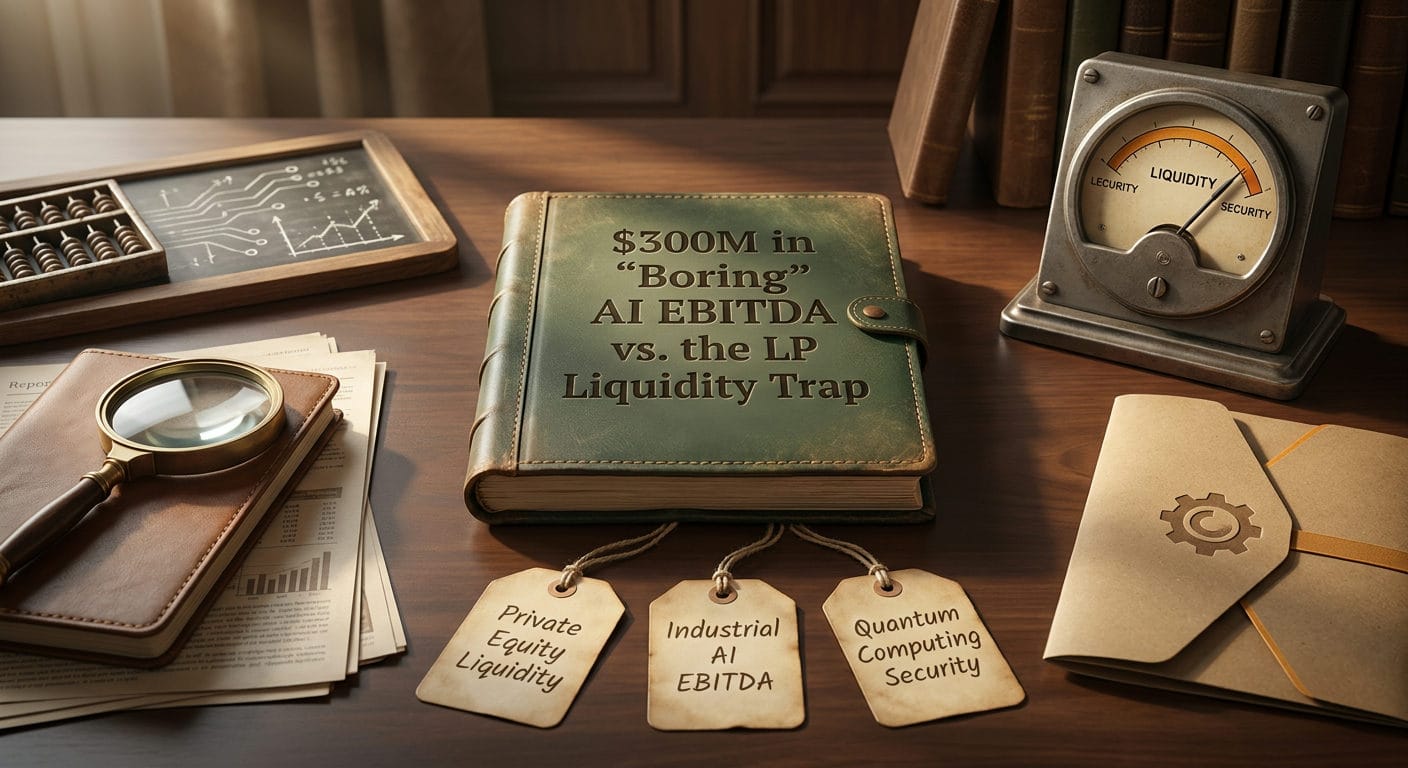
Continuation vehicles are failing to solve the industry's liquidity backlog, while industrial operators are quietly mining hundreds of millions in EBITDA from boring AI applications.
📊 10 episodes across 8 podcasts
⏱ 8 hours 45 minutes of intelligence analyzed
🎙 Featuring: Scott Ramsower (Teacher Retirement System of Texas), Ted Seides (Capital Allocators), Fraser Christie (Sandstone Global Investment), Nikesh Arora (Palo Alto Networks), Arvind Krishna (IBM), Ethan Mollick (Wharton), Anuj Ranjan (Brookfield)
|

The Big Shift
The private equity narrative is splitting. While LPs voice escalating frustration over conflicted GP-led continuation vehicles (CVs), a parallel value-creation story is emerging in the most unlikely of places: the under-digitized industrial middle market. We are seeing a hard pivot away from "frontier model hype" toward high-yield, task-specific engineering deployments.
Scott Ramsower of Teacher Retirement System of Texas (TRS) and ILPA chair, laid out a blunt warning to GPs: the "liquidity" provided by CVs often comes at the cost of alignment, moving the best "right-tail" assets out of legacy funds and into vehicles with higher cost bases. Meanwhile, operators like Anuj Ranjan at Brookfield are proving that the real AI alpha isn't in Silicon Valley—it’s in billion-dollar "boring" businesses that lack basic ERPs.
"Just across Brookfield, we probably got about 1200 different use cases under active deployment right now across the portfolio that are about $300 million of EBITDA, which is real value creation."
— Anuj Ranjan, CEO of Global Private Equity, Brookfield on Dry Powder
Why it matters: The "exit bottleneck" is real, but CVs are a selective surgical tool, not a market-wide cure. The move for GPs is to stop waiting for the exit window and start aggressive, IT-led margin expansion. As Nikesh Arora noted, the winners in this cycle will be those who prioritize capital investment over labor-heavy legacy processes.
The Rundown
① The Conflict Scorecard for GP-Led Secondaries.
LPs are increasingly wary of "synthetic" DPI generated by rolling assets into new vehicles with higher fees on a stepped-up cost basis. (Scott Ramsower on Capital Allocators)
→ The Move: If proposing a CV, ensure third-party valuation and a clear "status quo" option for LPs; Scott Ramsower notes that TRS rolls on only about 1 out of 10 opportunities.
② Tech Diligence Moves Pre-LOI to Combat "Dashboard Theater."
Technical checks are shifting earlier in the deal cycle to verify if AI "visions" have real usage and scalable unit economics before multiples are paid. (Dan Bender and Kirby Montgomery on Private Equity Funcast)
"And we said to the investors, they've got a great vision, but do not pay them a multiple for that thing. Pay them for the software they have today." — Jim Milbery, Host and Technical Partner, Parker Gale
→ Why it matters: Investors must audit whether engineering dashboards are internal operating tools or "one-off artifacts" created specifically for the sale process.
③ 🆕 Affirm as the Verticalized "Internet’s American Express."
Affirm is transitioning from a lender to a vertically integrated payment network, with 95% of transactions now coming from existing customers. (Fraser Christie on Business Breakdowns)
→ Signal: The Affirm Card is growing 100% YoY, proving that merchant-integrated flywheel effects can survive even when a major partner like Walmart exits the checkout flow.
④ 🆕 The "Quantum 2030" Cryptography Deadline.
Practical quantum computers could break current public-key cryptography by 2030, making data stolen today vulnerable to future decryption. (Arvind Krishna and Nikesh Arora on All-In)
→ Why it matters: Infrastructure migration is a 5-year project; boards must prioritize "quantum-safe" transitions now to protect long-term intellectual property.
⑤ 🆕 24/7 Markets Face a "Banking Latency" Bottleneck.
While 23.5-hour equity trading is inevitable, the lack of a true 24/7 global banking system prevents real-time funding for weekend liquidity. (Terry Duffy on Odd Lots)
→ Context:CME Group Chairman Terry Duffy notes that pre-funding a $76 trillion market over a weekend is impossible under current banking constraints.
Signal Board
🔥 HEATING UP
• Open-Weight Models: Enterprises are favoring open-weights (Llama, etc.) for explainability and 40x lower inference costs vs. frontier models. (Arvind Krishna on All-In)
• Industrial AI EBITDA: Predictive maintenance and dynamic pricing are generating $300M+ in real EBITDA at scale. (Anuj Ranjan on Dry Powder)
👀 ON WATCH
• 🆕 Intapp / DealCloud: Using institutional memory to build "Firm AI" that automates LP onboarding and deal sourcing. (Ben Harrison on Capital Allocators)
• 🆕 Agentic Commerce: AI agents negotiating deals on behalf of consumers, potentially eroding banking "stickiness" and low-yield deposit margins. (Ethan Mollick on Prof G Pod)
❄️ COOLING OFF
• Conflicted CVs: LP patience for "fee-on-fee" continuation vehicles is thinning; transparency expectations are rising. (Scott Ramsower on Capital Allocators)
• DORA Metrics in Isolation: Deployment frequency is being rejected as a standalone metric in favor of revenue and stability outcomes. (Dan Bender on PE Funcast)
The Debate
The Battle for Enterprise AI: Frontier vs. Open-Weight Models
🐂 The Bull Case:Ethan Mollick argues that frontier models (GPT-4, Claude 3.5) offer a "jagged frontier" of capability that small models can't touch, especially as the single-prompt work horizon expands to weeks of autonomous effort.
🐻 The Bear Case:Arvind Krishna and Nikesh Arora contend that regulated enterprises will never accept the "black box" of frontier models for production. They argue for open-weight models that allow for weight modification, interrogation of the "chain of thought," and significant cost savings.
Our Read: The market is bifurcating: Frontier models are for R&D and "agentic" breakthroughs; open-weight models are for the high-volume, audited production workloads that actually drive EBITDA.
The Bottom Line
Stop buying AI hype and start auditing IT debt; the next turn of multiple comes from infrastructure, not just innovation.
Episode Guide (Web Version)
Private Equity Funcast — "Measure Engineering Like You Measure Sales"
Runtime: 60 min | Host: Jim Milbery | Guest: Dan Bender (Code & Co.), Kirby Montgomery (Code & Co.)
For the Technical Partner: A deep dive into moving tech diligence pre-LOI to smoke out gameable engineering metrics.
Engineering performance must be measured against business outcomes—like feature adoption and system stability—rather than "vanity" metrics like lines of code or story points.
"So if you look at the metric of lines of code, that's just, you know, a BS metric and also not a good, you know, proxy for progress." — Dan Bender
Capital Allocators — "Continuation Vehicles from the LP Seat – Scott Ramsower"
Runtime: 48 min | Host: Ted Seides | Guest: Scott Ramsower (TRS/ILPA)
For the GP/Managing Director: An unfiltered look at why your LPs are frustrated with your next continuation vehicle proposal.
Ramsower outlines ten core LP concerns regarding CVs, focusing on conflicted price discovery and the potential for "zombie fund" extension.
"There's far more stranded assets than there is capital for CVs." — Scott Ramsower
Business Breakdowns — "Affirm: The Internet’s American Express"
Runtime: 79 min | Host: Colossus | Guest: Fraser Christie (Sandstone Global)
For the Growth Investor: A masterclass in how vertical integration and transaction-specific underwriting create a sustainable network effect.
Detailed analysis of Affirm's unit economics, comparing 1-3% margins on Pay-in-4 versus 4-6% on interest-bearing loans.
"In any given quarter, about 95% of transactions are from existing customers." — Fraser Christie
All-In — "AI Cyber Panic, Ken Griffin's Bubble Warning, The Fall of France?"
Runtime: 103 min | Host: Jason Calacanis | Guest: Nikesh Arora (Palo Alto Networks)
For the C-Suite: A sober warning on how AI is weaponizing technical debt and reverse-engineering software patches.
Arora and the panel discuss the concentration of AI spend and why "defensive swarms" are currently impossible due to disparate legacy architectures.
"1% of companies represent 90% of AI spending." — Chamath Palihapitiya
Odd Lots — "CME's Terry Duffy on the Disconcerting State of Finance Regulation"
Runtime: 30 min | Host: Tracy Alloway & Joe Weisenthal | Guest: Terry Duffy (CME Group)
For the Macro Trader: A critical view of the current regulatory environment and the inevitable push toward 24/7 trading.
Duffy argues that "perpetual futures" are effectively swaps and calls for tighter regulation on prediction markets and offshore leverage platforms.
"The GPU market will be multiples of the size of crypto by 2030 for sure." — Terry Duffy
Dry Powder — "The AI Opportunity in 'Boring' Businesses"
Runtime: 21 min | Host: Hugh MacArthur | Guest: Anuj Ranjan (Brookfield)
For the Operating Partner: Evidence that the biggest AI gains come from applying basic tech to un-digitized industrial companies.
Brookfield reports $300M in EBITDA from 1,200 AI use cases, focusing on predictive maintenance and automated pricing.
"The real bottleneck to AI actually isn't the technology. It's the deployment of IT in enterprise at scale." — Anuj Ranjan
Capital Allocators — "AI Tools for the Investment Firm – Ben Harrison"
Runtime: 40 min | Host: Ted Seides | Guest: Ben Harrison (Intapp)
For the Deal Team: How "Firm AI" is moving beyond research assistance to institutional memory and workflow automation.
Harrison discusses the importance of governance and information barriers when deploying AI across professional services verticals.
"Is the investment committee going to be an AI agent? I don't think so. But are they going to use it to help? For sure." — Ben Harrison
The Prof G Pod — "Can We Coexist With AI? — with Ethan Mollick"
Runtime: 60 min | Host: Scott Galloway | Guest: Ethan Mollick (Wharton)
For the Strategist: A forward-looking view on agentic commerce and the "jagged frontier" of human-AI collaboration.
Mollick predicts that agent-to-agent negotiations will soon replace traditional customer service and banking friction.
"There are now 180 models that are better than GPT4. 19 of them can run on your phone." — Ethan Mollick
All-In — "Arvind Krishna & Nikesh Arora: Quantum Threat, AI Cyber Warfare"
Runtime: 40 min | Host: Jason Calacanis | Guest: Arvind Krishna (IBM), Nikesh Arora (Palo Alto Networks)
For the Board: A strategic overview of the quantum computing threat to encryption and the coming geographic divide in compute access.
The guests emphasize the need for quantum-proof infrastructure and the shift toward specialized, small language models for cost efficiency.
"You should be replacing your IT stack today with quantum safe or quantum proof infrastructure right now." — Nikesh Arora
How I Built This — "Advice Line with Seth Berkowitz of Insomnia Cookies"
Runtime: 44 min | Host: Guy Raz | Guest: Seth Berkowitz (Insomnia Cookies)
For the Consumer Founder: Practical advice on earning the right to grow through brand awareness and "consumer love."
Berkowitz argues against rapid expansion in favor of proving demand and quality in existing bakeries first.
"I believe you earn growth. I think you earn the right to grow. Consumer love gives you license." — Seth Berkowitz