
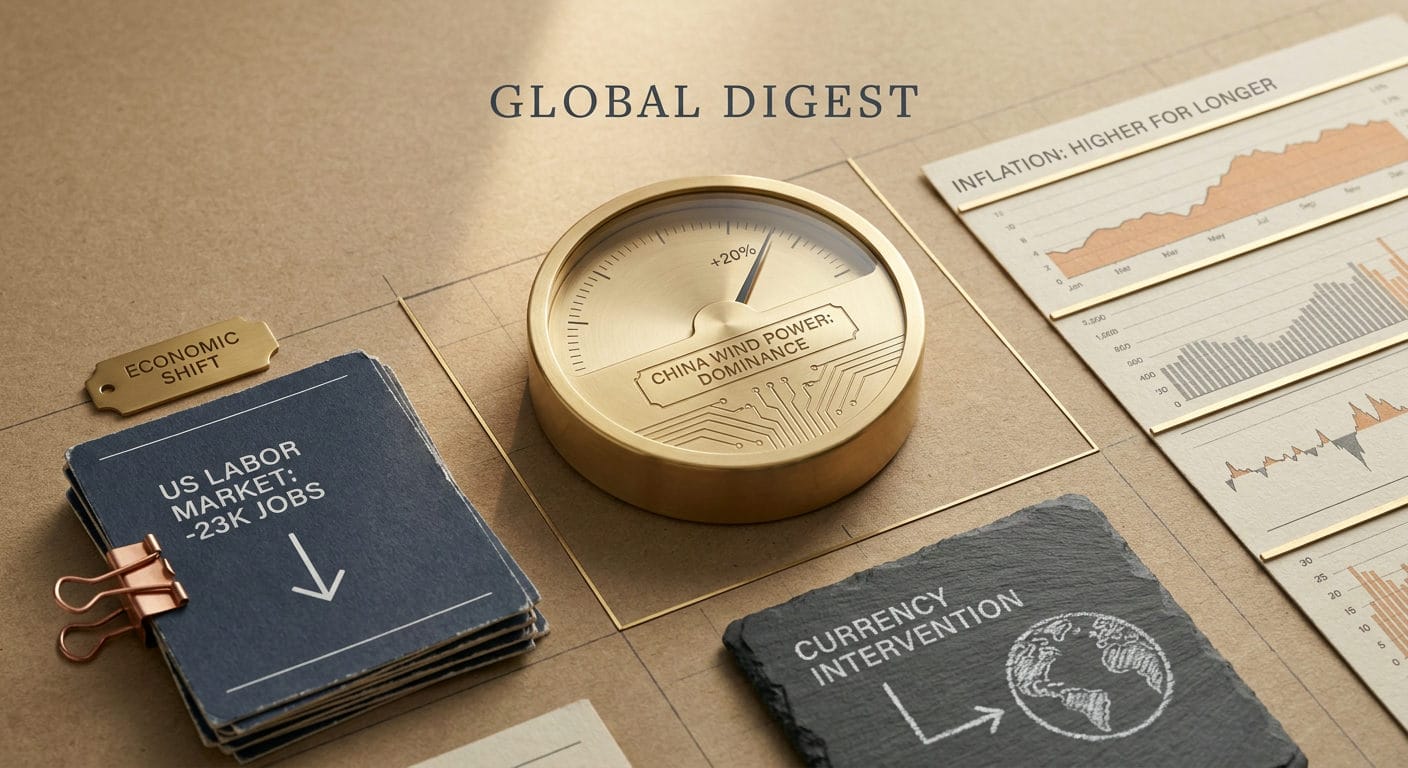
=The market’s unexpected resilience and disinflationary signals are hiding underlying shifts in global capital and technological power that will redefine where value is created and captured.
📊 12 episodes across 10 podcasts
⏱ 649 minutes of intelligence analyzed
🎙 Featuring: Victor Haghani (Founder & CIO, Elm Wealth), Viktor Shvets (Global Strategist, Macquarie Capital), Ed Yardeni (President, Yardeni Research), Brad Setser (Senior Fellow, Council on Foreign Relations), Meredith Whitney (CEO, Meredith Whitney Advisory Group), Mike McCann (Markets Reporter, Bloomberg), Brian Rolapp (CEO, PGA Tour), Claudia Sahm (Chief Economist, New Century Advisors), Constance Hunter (Chief Economist, EIU), Kristina Campmany (Senior Portfolio Manager, Invesco), Nicole Bachaud (Chief Economist, ZipRecruiter), Gene Seroka (Executive Director, Port of Los Angeles), Bruce Wolf (CF Wolf Associates), John Minnich (Assistant Professor of International Relations, LSE), Halima Croft (Global Head of Commodity Strategy, RBC Capital Markets), Kayvon Mohajer (CEO, Soundhound AI), Meb Faber (Co-founder and Chief Investment Officer, Cambria Investment Management), Jim Caron (CIO of Cross Asset Solutions, Morgan Stanley Investment Management), Jonathan Golub (Chief Equity Strategist, Seaport Advisors), Heather Rice (US Products Line of Business Leader, KPMG), Steve Odland (CEO, The Conference Board), Harry Moore (Quantitative Researcher, Man Group)
|

The Big Shift
The global economic playing field is undergoing a significant re-alignment, with long-held assumptions about technology leadership and market dynamics being upended. While Western markets grapple with disinflationary forces and an evolving labor landscape, a fundamental power shift is underway in technology and trade, evidenced by China's strategic advancements and the US's proactive currency interventions.
Why it's happening: China, once a recipient of Western technology, has leveraged strategies like joint ventures and its massive domestic market to become a formidable high-tech leader, fundamentally changing the global bargaining power in critical sectors like high-speed rail and automotive. John Minnich (Assistant Professor of International Relations, LSE) noted that while "Technology transfer policy alone is seldom the only or decisive factor that's going to get you from 0 to 1, but an 8 or a 9? Because I think that this should absolutely be an integral part of any policy package that European or the American government in the future pursue if they want to get technology transfer from China." This approach allowed China to build up its own capabilities, shifting from reliance to competition.
"Between 2004 and 2005, China goes from having something like 1% of global installed wind power capacity to something like 20 or 30%. And at the same time we also see that over that same period, the share of foreign firms in supplying that wind power capacity declines from about 90% to about 10%."
— John Minnich, Assistant Professor of International Relations at LSE
Concurrently, the US is engaging in unusual currency interventions, as seen with the Japanese Yen, actively managing its economic position in this shifting landscape. This proactive stance, combined with China's tech ascendancy, signifies a new era where national industrial policies and strategic capital flows will increasingly dictate global economic outcomes. This is not just about competition; it's about a redefinition of economic sovereignty and the mechanisms by which countries secure their technological and financial futures.
The level to watch: The efficacy of these strategic interventions will be measured by their impact on trade balances and capital flows, particularly how they influence the valuation of key currencies and the resilience of domestic supply chains. The success of national industrial policies in the West will hinge on their ability to centralize regulatory authority and effectively leverage large domestic markets, mirroring China's playbook.
The Rundown
① July Jobs Report Signals Unexpected Labor Market Softness.
The US economy surprisingly lost 23,000 jobs in July, against an expected gain of 80,000, with average hourly earnings increasing by only 0.1%. (Paul Sweeney on Bloomberg Surveillance)
→ Why it matters: This significantly softer-than-expected labor data could provide the Federal Reserve with a strong rationale to pause interest rate hikes, impacting the cost of capital and future refinancing timelines for businesses.
② Persistent 'Higher for Longer' Inflation Implies Equities Outperformance.
A "higher for longer" inflation environment, coupled with sustained nominal GDP growth, is projected to drive higher corporate earnings, favoring equities over fixed income. (Jim Caron, CIO of Cross Asset Solutions at Morgan Stanley Investment Management, on Bloomberg Surveillance)
→ Investment Signal: Operators should evaluate their capital structures for resilience in a prolonged higher-rate environment, while investors might find continued opportunity in growth-oriented equities despite rising capital costs.
③ China's Strategic Tech Ascendancy Challenges Western Dominance.
China has effectively used its large market and policy tools like joint ventures to shift from absorbing Western technology to becoming a global high-tech leader, exemplified by its rapid progress in sectors like high-speed rail and wind power. (John Minnich, Assistant Professor of International Relations at LSE, on Unhedged)
→ Strategic Implication: Western companies and policymakers must recognize this shift in bargaining power; M&A and market entry strategies into China require re-evaluation given Beijing's focus on domestic technological independence and now, its own tech export controls.
④ Consumer Credit Indicators Point to Deepening Precarity.
The fastest-growing segment in fintech is advanced wage pay, reflecting a widespread trend of individuals living "payday to payday" rather than "paycheck to paycheck." (Meredith Whitney, CEO of Meredith Whitney Advisory Group, on Bloomberg Surveillance)
→ Operational Insight: Businesses catering to the consumer sector should anticipate tighter discretionary spending and increasing demand for flexible payment solutions like BNPL, which itself is replacing traditional credit cards for younger demographics.
⑤ Portable Alpha Strategies Demand Robust Cash Buffers.
Portable alpha strategies require a significant cash buffer, potentially up to 40%, to withstand severe market drawdowns, rather than the commonly assumed 20%. (Harry Moore, Quantitative Researcher at Man Group, on Top Traders Unplugged)
→ Risk Management: Investors and portfolio managers utilizing portable alpha should re-evaluate their cash allocation to ensure true resilience against "left tail" events, particularly when traditional asset correlations surge during crises.
Signal Board
🔥 Heating Up
• Higher Nominal GDP and Earnings: Expected to drive strong corporate performance in a sustained "higher for longer" inflation environment. (Jim Caron on Bloomberg Surveillance)
• AI creating net jobs, changing workflows for higher-order work: CEOs increasingly view AI as a tool for operational efficiency and net job creation, improving the quality of work. (Paul Sweeney on Bloomberg Surveillance)
• Valuation Disparity Between US and International Markets: The gap between US and international market valuations is near historic highs, suggesting opportunities in less favored global markets. (Meb Faber on The Meb Faber Show - Better Investing)
❄️ Cooling Off
• US economy lost 23,000 jobs in July: A significant miss on expectations for job growth, indicating unexpected labor market deceleration. (Paul Sweeney on Bloomberg Surveillance)
• Semiconductor stock volatility and momentum unwinding: Daily 8-10% swings in semiconductor stocks are attributed to the unwinding of crowded momentum trades, signaling a more fundamental shift. (Mike Wilson on CNBC's "Fast Money")
• The Trade Desk CEO Jeff Green's macro blame as 'excuses': Repeatedly blaming macro conditions for revenue declines is seen by some as an execution issue, rather than a genuine external challenge. (Lou Whiteman on Motley Fool Money)
👀 On Watch
• John Minnich 🆕: Assistant Professor of International Relations at LSE, providing deep insights on China's technology transfer strategies and geopolitical shifts. (Soumaya Keynes on Unhedged)
• Cambria Global Value ETF (GVAL) 🆕: An ETF designed to identify undervalued global opportunities using long-term valuation metrics, amidst concentration risk in US-heavy portfolios. (Meb Faber on The Meb Faber Show - Better Investing)
• Soundhound AI's foundational models and data security 🆕: Highlighting AI agents as revenue-generating tools for businesses and the ability to run foundational models locally for enhanced data security. (Kayvon Mohajer on CNBC's "Fast Money")
The Bottom Line
Beneath the surface of a surprisingly resilient economy and AI narratives, strategic shifts in global tech leadership and monetary policy are actively reshaping the landscape for capital and competition.
📖 Want the full episode breakdowns, guest details, and listen links?
Episode Guide (Web Version)
1. We Study Billionaires - The Investor’s Podcast Network — "RWH071: Risk, Ruin, Reinvention & Resilience w/ Victor Haghani"
Runtime: 120 min | Host: William Green | Guest: Victor Haghani (Founder & CIO, Elm Wealth)
For the Strategic Investor: This episode offers profound lessons on risk management, diversification, and resilience from a co-founder of LTCM, crucial for navigating complex market environments.
Victor Haghani shares how his tumultuous family history and early career shaped his approach to risk, offering a unique perspective on the collapse of Long-Term Capital Management and refuting common narratives about its hubris.
"The book was written shortly after 1998. He didn't talk to any of us. I don't know who he talked to, but he didn't talk to any of the, you know, he didn't talk to me. He didn't talk to any of, you know, my. My partners that I. That I know of. And one of the things about LTCM is we operated on a consensus basis, you know, in. We had A portfolio management committee, a risk management committee, an executive committee. We had these committees and basically John would only approve things where there was a plurality of people that were in favor of different things."
— Victor Haghani, Co-founder of Long Term Capital Management
2. Macro Voices — "MacroVoices #544 Viktor Shvets: How Markets Survive Disruption"
Runtime: 62 min | Host: Erik Townsend, Patrick Ceresna | Guest: Viktor Shvets (Global Strategist, Macquarie Capital), Misel Begnan (Analyst, Big Picture Trading)
For the Macro Strategist: Essential listening for understanding the interplay between geopolitics, technology (especially AI), and their long-term impact on inflation, market polarization, and capital flows.
Viktor Shvets dissects the current economic landscape, challenging conventional inflation narratives, examining the politicization of the Fed, and offering a contrarian view on geopolitical conflicts and their market implications, including the concept of "rolling bubbles" driven by disruptive technologies.
"If you create too many transient inflationary periods, it becomes part of the natural operation of how people and businesses think about the business. So suddenly for them it's no longer transient, it's permanent, even though it is transient. But for them it's permanent."
— Viktor Shvets, Global Strategist at Macquarie Capital
3. The Compound and Friends — "The Man Who Called the Roaring 2020s with Ed Yardeni"
Runtime: 76 min | Host: Downtown Josh Brown, Michael Batnick | Guest: Ed Yardeni (President, Yardeni Research)
For the Equity Investor: A must-listen for anyone seeking a bullish, earnings-driven perspective on the market, with insights on AI's evolutionary role and generational wealth transfer.
Ed Yardeni discusses his "Roaring 2020s" prediction, arguing that the current market strength is driven by robust earnings and productivity gains, not speculative bubbles, and forecasts significant S&P 500 growth.
"The G shaped economy, which stands for generational, is the baby boomers. They have $100 trillion of net worth. It is the richest retiring generation ever and everybody's ignoring it."
— Ed Yardeni, President of Yardeni Research
4. Odd Lots — "Brad Setser on the US's Unusual Japanese Yen Intervention"
Runtime: 42 min | Host: Bloomberg, Tracy Alloway, Joe Weisenthal | Guest: Brad Setser (Senior Fellow, Council on Foreign Relations)
For the Global CFO: Critical for understanding complex currency interventions and their broader implications for international trade, treasury markets, and central bank policy.
Brad Setser details the US's unusual intervention to support the Japanese yen, explaining the mechanics and implications of using the Fed's repo facility and why the Bank of Japan has been hesitant to raise rates despite inflation.
"The basic idea is that central banks have a lot of really good collateral. And if they need cash, they don't actually have to go and sell the Treasuries into the cash bond market. They can just repo them at the Fed, get dollars and then intervene that way."
— Brad Setser, Senior Fellow at Council on Foreign Relations
5. Bloomberg Surveillance — "Bloomberg Money: Credit Card Indicators and Golf's Changing Fanbase"
Runtime: 43 min | Host: Tom Keene, Scarlet Fu | Guest: Meredith Whitney (CEO, Meredith Whitney Advisory Group), Mike McCann (Markets Reporter, Bloomberg), Randall Williams (Senior Business of Sports Reporter, Bloomberg), Brian Rolapp (CEO, PGA Tour)
For the Consumer Business Executive: Provides essential insights into evolving consumer financial habits, credit usage shifts, and the underlying precarity driving trends like advanced wage pay.
Meredith Whitney highlights the shift in credit card usage and the rise of advanced wage pay services, while the PGA Tour's Brian Rolapp discusses the modernization of golf and its changing fanbase.
"I say that people aren't living paycheck to paycheck but payday to payday. So the fastest growing industry within fintech and financial services is advanced wage pay."
— Meredith Whitney, CEO of Meredith Whitney Advisory Group
6. Bloomberg Surveillance — "July Jobs Report"
Runtime: 58 min | Host: Tom Keene, Paul Sweeney | Guest: Claudia Sahm (Chief Economist, New Century Advisors), Constance Hunter (Chief Economist, EIU), Kristina Campmany (Senior Portfolio Manager, Invesco), Christina Campmany (Yield Specialist, Invesco), Nicole Bachaud (Chief Economist, ZipRecruiter), Gene Seroka (Executive Director, Port of Los Angeles), Bruce Wolf (CF Wolf Associates)
For the Operating Executive: Crucial for understanding the true state of the labor market, potential Fed actions, and emerging challenges in retirement planning and supply chain resilience.
This segment analyzes the surprising July jobs report, discussing its implications for the Fed's rate policy, the impact on fixed income markets, labor market volatility, and the evolving landscape of retirement planning.
"The US economy actually lost 23,000 jobs in the month of July. This is a lot less than the 80,000 we were expecting to be added."
— Paul Sweeney
7. Unhedged — "The Economics Show: China wanted western tech. Now, the tables have turned."
Runtime: 44 min | Host: Soumaya Keynes, John Minnich | Guest: John Minnich (Assistant Professor of International Relations, LSE)
For the Global Business Strategist: Essential for understanding the profound shift in global technological power dynamics and its implications for international business and industrial policy.
Soumaya Keynes and John Minnich discuss China's strategic journey from tech absorption to global leadership, exploring how joint ventures and market leverage enabled this shift and what lessons Western governments can draw.
"I think a big part of the reason that industrial policy is now back on the agenda in all of these countries is because we can observe that although these policies have not necessarily been particularly efficient in the Chinese context, they've been very, very effective in many cases."
— John Minnich, Assistant Professor of International Relations at LSE
8. Motley Fool Money — "The Trade Desk’s Woes & A New AI Donut?"
Runtime: 41 min | Host: Travis Hoium | Guest: Lou Whiteman, Jon Quast, Lou (Motley Fool Money), John (Motley Fool Money), Dan Boyd (Motley Fool Money)
For the Tech Investor & Executive: Provides a candid look at earnings reactions, AI's disruptive influence on traditional software, and the perils of blaming macro factors for company-specific issues.
This episode delves into the July jobs report's market impact, the peculiar reaction to S&P 500 earnings, challenges faced by Salesforce and Adobe due to AI, and the execution issues at The Trade Desk.
"The story of the quarter is resilience. 45 companies that from the S&P 500 raised full year guidance in this quarter. Analyst estimates for S&P 500 earnings per share. So kind of a wider index, not company specific. They're up 3% since late June. Just the consensus estimate. Things are doing okay."
— Lou Whiteman, Guest
9. CNBC's "Fast Money" — "U.S. Treasury's Surge… And Oil Prices Sink on Potential Iran Peace Deal 8/6/26"
Runtime: 41 min | Host: Melissa Lee | Guest: Karen Finerman (Panelist, CNBC), Dan Nathan (Panelist, CNBC), Guy Adami (Panelist, CNBC), Mike Wilson (CIO and Chief U.S. Equity Strategist, Morgan Stanley), Steve Leeson (Reporter, CNBC), MacKenzie Sigalos (Reporter, CNBC), Halima Croft (Global Head of Commodity Strategy, RBC Capital Markets), Kayvon Mohajer (CEO, Soundhound AI), CNBC (Host, CNBC)
For the Capital Markets Professional: Offers an immediate read on market reactions to earnings, geopolitical events impacting oil, and the evolving landscape of AI agents as revenue generators.
This segment covers potential Fed rate hikes, concerns about the bond market's fragility, NVIDIA's strategic supply chain adjustments, and the burgeoning role of AI agents in business efficiency and revenue generation, alongside geopolitical impacts on oil prices.
"We're definitely in the hyperscaler over semi trade, but it is up 35% in the last month. So maybe we had the move. Now we're going to settle out a little bit."
— Mike Wilson, CIO and Chief U.S. Equity Strategist at Morgan Stanley
10. The Meb Faber Show - Better Investing — "Cambria Fund Profile – Cambria Global Value ETF (GVAL)"
Runtime: 13 min | Host: Meb Faber | Guest: Meb Faber (Co-founder and Chief Investment Officer, Cambria Investment Management)
For the Portfolio Manager: A concise guide to understanding the benefits of global diversification, particularly in less-favored markets, and challenging the dogma of US-centric portfolios.
Meb Faber introduces the Cambria Global Value ETF (GVAL), advocating for global diversification to counter concentration risks in US-heavy portfolios and identifying undervalued opportunities using long-term valuation metrics.
"As of 2026, the valuation differential between the US stock market and the rest of the world is at one of the widest points in history. And if you're willing to go where most investors aren't looking, you might just find some excellent out of favor opportunities just waiting to be discovered."
— Meb Faber, Co-founder and Chief Investment Officer at Cambria Investment Management
11. Bloomberg Surveillance — "Sustaining S&P Rally amid Market Pressures"
Runtime: 29 min | Host: Tom Keene, Paul Sweeney | Guest: Jim Caron (CIO of Cross Asset Solutions, Morgan Stanley Investment Management), Jonathan Golub (Chief Equity Strategist, Seaport Advisors), Heather Rice (US Products Line of Business Leader, KPMG), Steve Odland (CEO, The Conference Board)
For the Senior Executive: Crucial for understanding the true drivers of the S&P rally, AI's role in operational efficiency, and the shifting landscape of corporate risks and pricing power.
This segment examines how a "higher for longer" inflation environment can fuel corporate earnings and equity performance, highlights underestimated S&P earnings growth, and discusses AI's impact on operational efficiency and job creation.
"The analysts are underestimating the power of these earnings. Earnings are growing 50% this quarter compared to a year ago. That just doesn't happen."
— Jonathan Golub, Chief Equity Strategist at Seaport Advisors
12. Top Traders Unplugged — "SI412: Portable Alpha: Asking the Questions That Matter ft. Harry Moore"
Runtime: 80 min | Host: Niels Kaastrup-Larsen | Guest: Harry Moore (Quantitative Researcher, Man Group)
For the Quantitative Investor: Deep dive into advanced portfolio construction, including portable alpha strategies, the nuances of trend-following, and AI's transformative impact on quant research.
Niels Kaastrup-Larsen and Harry Moore discuss the dispersion among trend-following managers, the importance of market universe selection, and the critical questions surrounding portable alpha strategies like rebalancing and cash buffers.
"If you could split that 50, 50 and make it more like 9010 so that your top researchers have plenty more time to think and be creative, I think that's a big, big AI enabler."
— Harry Moore, Guest