
Welcome
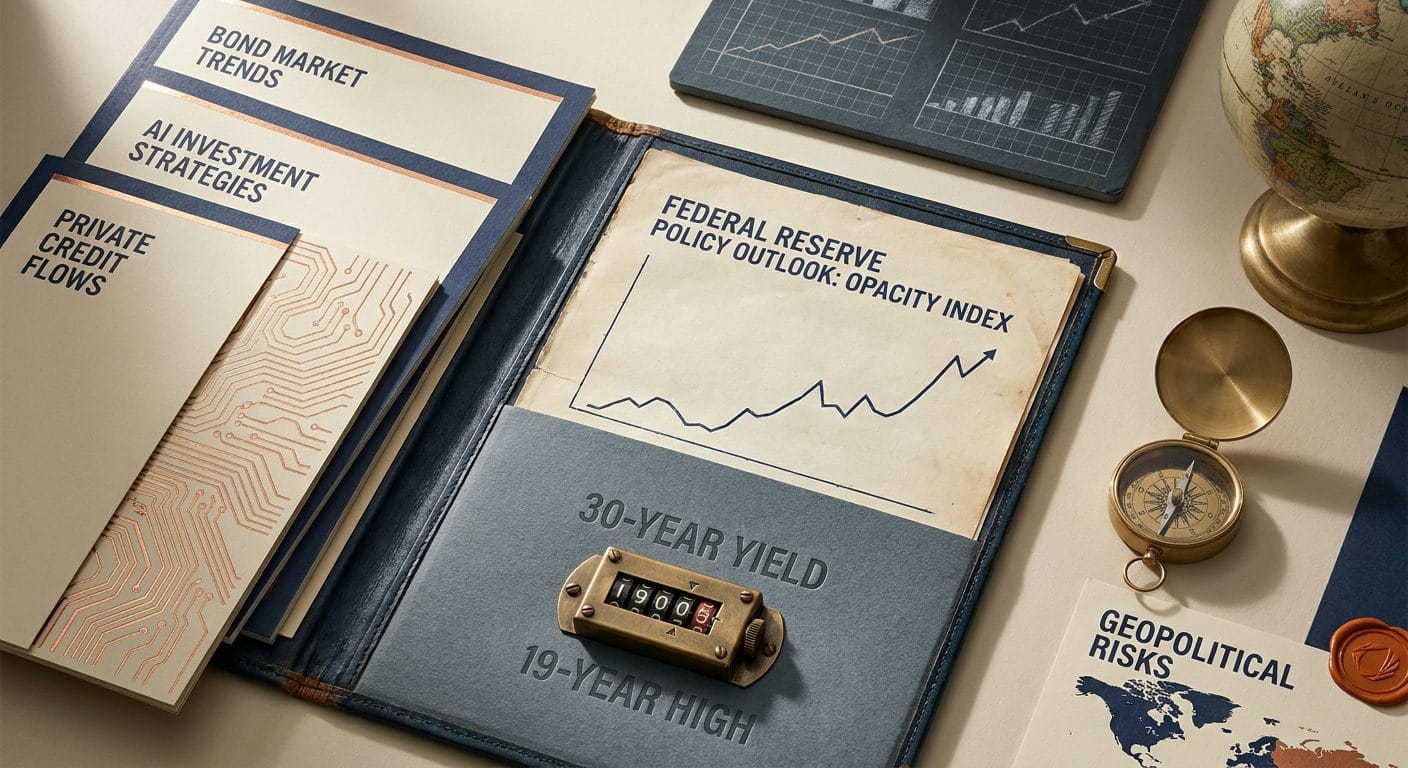
The market is increasingly pricing in a hard landing as the Fed signals a return to opacity, forcing investors and operators alike to reconsider risk and capital allocation.
The Intake
📊 12 episodes across 7 podcasts
⏱ 596 minutes of intelligence analyzed
🎙 Featuring: Jim Bianco, Patrick Ceresna, Dave Dredge, Kevin Warsh, Leopold Aschenbrenner, Tanya Fukui, Niels Kaastrup-Larsen, Warsh
|

The Big Shift
The Federal Reserve, under Kevin Warsh, is deliberately stepping back from explicit forward guidance, compelling markets to function with less hand-holding and embrace genuine price discovery. This represents a fundamental regime change from the post-2008 era, pushing the bond market to independently steepen the yield curve and price in higher rates without the comfort of Fed signals. For executives, this means increased volatility in capital costs and a necessity to factor in a wider range of interest rate outcomes for financing and M&A.
"What Kevin is doing right now is he's trying to get the market off. The addiction of me, the Fed chairman of the Fed board, having to tell you what we're going to do and you, the market and you protect participants. You should go and participate however you think it makes sense for you and wherever you think the opportunities are."
— Gary Cohn, Vice Chairman at IBM on Bloomberg Surveillance TV: August 3rd, 2026
This new era of Fed opacity requires businesses to strengthen their own balance sheets and stress-test their debt structures against more unpredictable capital costs. The market is being forced to internalize risk previously externalized to the central bank. As Bloomberg (Host, Bloomberg) noted on Bloomberg Surveillance TV: August 3rd, 2026, "Prior to 2008, when I was trading for a living and running begging trading desks, we did not know when the Fed was going to move. There were surprise meetings after surprise meeting after surprise meeting." This return to historical norms will likely lead to more disciplined market behavior, but also greater short-term uncertainty for those accustomed to clear Fed signaling.
The Rundown
① Tungsten is a "prediction market for war."
The market for tungsten, a critical material for military manufacturing, is flashing warning signs, with historically significant mines reopening, signaling escalating global tensions. (David Fickling on Odd Lots)
→ The Signal: Geopolitical risks are translating directly into critical commodity markets, impacting supply chains and costs for industries reliant on specialty metals.
② Fed credibility is being questioned by the bond market.
Despite the Fed holding rates, the bond market is independently driving the 30-year Treasury yield to a 19-year high, signaling a profound loss of confidence in the Fed's inflation-fighting ability. (Jim Bianco on Macro Voices #543 Jim Bianco: Who Solves Inflation The FED or The Market?)
→ Why it matters: This disconnect implies that future rate hikes may be driven more by market pressure than explicit Fed policy, directly impacting refinancing costs and capital availability for businesses.
③ Apple's AI 'wait and see' approach now looks genius.
While other tech giants poured billions into AI CapEx, Apple's cautious strategy, initially seen as a weakness, is now lauded given the uncertain ROI and high costs in the AI race. (Gil Luria on Reacting to PCE, GDP, and Kevin Warsh)
→ Your Move: Evaluate your own AI investments for clear ROI. The market is punishing spending without tangible returns, making capital efficiency paramount.
④ South Korea's stock market is an early warning for AI trade unwinding.
The KOSPI experienced a 40% drop, leading to liquidations in leveraged single-stock ETFs heavily invested in memory, suggesting a potential "micro-bubble pop" within the broader AI trade. (David on Bankless)
→ Why it matters: This indicates that the AI trade, while still robust, is showing signs of frothing, prompting a reassessment of valuations and leverage in the sector.
⑤ Memory chips are now more valuable than GPUs for hyperscalers.
By 2027, 75% of hyperscaler CapEx is projected to go towards memory chips, a significant shift from the current market focus on GPUs. (Andreas Steno Larsen on U.S. Rescues The Yen | Macro Mondays: August 3, 2026)
→ The Signal: Businesses in the AI infrastructure space should re-evaluate their investment strategies, focusing on memory and data storage solutions, as the bottleneck shifts.
Signal Board
🔥 Heating Up
• Federal Reserve credibility loss: The bond market is openly questioning the Fed's ability to manage inflation, leading to independent yield movements. (Jim Bianco on Macro Voices #543 Jim Bianco: Who Solves Inflation The FED or The Market?)
• Private credit market performance: Despite bearish narratives, Ares Management reports non-accruals inside 2% and accelerating institutional demand, indicating robust health. (Mike Arougheti on Bloomberg Surveillance TV: July 31st, 2026)
• Crypto acting as a hedge against monetary inflation/debasement: Bitcoin and Ethereum showed resilience during traditional market turmoil, suggesting a flight to hard assets. (Michael Howell on ROLLUP: Korea Gets Liquidated | The AI Trade Unwinds | Crypto Holds Firm | Warsh Holds Rates)
👀 On Watch
• 🆕 Private Credit Opportunities for UHNW: Ultra-high-net-worth investors are increasingly turning to private credit for diversification and yield in current market conditions. (RaeAnn Mitrione on Yen Intervention and Market Drivers)
• 🆕 vaults: DeFi vaults are evolving to aggregate liquidity and manage risk, with potential to compete with traditional financial instruments like ETFs. (Adrian Cachinero on What's Next for Vaults? | Steakhouse Co-Founder, Adrian Cachinero)
• 🆕 Principal-Agent Problem in Vaults: The inherent conflict between vault curators and depositors over risk and loss bearing remains a critical challenge. (Adrian Cachinero on What's Next for Vaults? | Steakhouse Co-Founder, Adrian Cachinero)
🧊 Cooling Off
• AI trade unwinding and crypto strength: The Korean stock market’s collapse, driven by leveraged AI plays, suggests a re-evaluation of AI valuations. (David on ROLLUP: Korea Gets Liquidated | The AI Trade Unwinds | Crypto Holds Firm | Warsh Holds Rates)
• AI Bust (Noahpinion's Airline scenario): Skepticism is growing about the sustainability of current AI valuations, particularly for companies with high CapEx and unclear ROI. (Andreas Steno Larsen on U.S. Rescues The Yen | Macro Mondays: August 3, 2026)
• Leveraged single stock ETFs liquidation: The dramatic downturn in South Korea, driven by these instruments, highlights the extreme risks of highly leveraged retail investment products. (Ryan on ROLLUP: Korea Gets Liquidated | The AI Trade Unwinds | Crypto Holds Firm | Warsh Holds Rates)
The Debate
The market is currently grappling with whether the responsibility for solving inflation lies with the Federal Reserve or if market forces are already taking the lead.
🐂 The bull case: Jim Bianco, President at Bianco Research, argues that "bond traders can stop panicking when the Fed starts panicking. Well, the Fed didn't panic today, so bond traders panicked." He believes the Fed's inaction is forcing the market to price in the necessary adjustments, as seen in the 30-year Treasury yield's surge. The market, through its independent movement, is effectively doing the Fed's job.
🐻 The bear case: Seema Shah, Chief Global Strategist at Principal Asset Management, counters that the market's questioning of Fed credibility "raises the prospect of head of Fed hikes later down the line." This view suggests that the market's skepticism could force the Fed to become more aggressive, indicating that the problem is not yet resolved by market forces alone but requires eventual central bank intervention to restore confidence.
Our read: While the market is certainly reacting to persistent inflation, the Fed's deliberate withdrawal of forward guidance means the market is now playing a more active role in price discovery, but this also increases the probability of more pronounced, and potentially surprising, Fed actions down the road.
The Bottom Line
The Fed’s shift to opacity means capital costs are now truly market-driven, demanding sharper risk management and a forensic focus on capital efficiency.
Episode Guide (Web Version)
1. Top Traders Unplugged — "SI411: Why the Best Portfolios Are Built to Be Wrong ft. David Dredge & Richard Brennan"
Runtime: 120 min | Host: Niels Kaastrup-Larsen | Guest: David Dredge (Chief Investment Officer, Convex Strategies), Richard Brennan (Contributor, Systematic Investor)
For the Capital Allocator: Understand how market fragility and hidden risks are baked into complex systems, challenging traditional risk models and demanding a re-evaluation of portfolio construction.
This episode unpacks how financial markets are complex adaptive systems, not simple statistical distributions, and critiques the overreliance on traditional metrics like Sharpe ratio. It highlights the dangers of leverage and simplistic optimal betting strategies in non-ergodic environments, advocating for a deeper understanding of endogenous risk.
"Finance is 100 years behind where science is today in their understanding of what these systems are... It's a maths, that's, it's a correct form of maths, but it's not a maths to apply to this domain we call the reality."
— Richard Brennan, Contributor at Systematic Investor
2. CNBC's "Fast Money" — "Apple and Amazon Earnings… And What’s Next for Global Markets 7/30/26"
Runtime: 44 min | Host: Melissa Lee | Guest: MacKenzie Segalis (Correspondent, CNBC), Dan Nathan (Trader, CNBC), Gai Adami (Trader, CNBC), Tim Seymour (Trader, CNBC), Karen Feiderman (Trader, CNBC), Timothy Stanley (Analyst, CNBC), Kate Rooney (Correspondent, CNBC), Patrick Moorhead (CEO, Moor Insights & Strategy), Julia Boorstin (Host, CNBC), Peter Boockvar (Chief Investment Officer, BFG Wealth Partners), Mackenzie Sagalas (Reporter, CNBC), Pippa Stevens (Reporter, CNBC)
For the CEO/CFO: Gain insights into how corporate giants like Apple and Amazon are navigating rising costs and CapEx, and the potential ripple effects of central bank interventions on global interest rates.
This segment analyzes recent earnings from Apple and Amazon, focusing on supply chain challenges, rising memory costs, and CapEx guidance. It also touches on the Bank of Japan's yen intervention and its potential to impact global interest rates and the Japanese carry trade.
"Apple's the safe bet when it comes to tech. How are they going to deal with memory? Rising interest rate environment can't be good for Apple. Everything Tim Cook says on the call will be scrutinized."
— Patrick Moorhead, CEO at Moor Insights & Strategy
3. Bankless — "ROLLUP: Korea Gets Liquidated | The AI Trade Unwinds | Crypto Holds Firm | Warsh Holds Rates"
Runtime: 54 min | Guest: Ryan (Host, Bankless), David (Host, Bankless), Michael Howell (CEO & Author of Global Liquidity Index, CrossBorder Capital), Michael Nadeau (Analyst, The DeFi Report), Paul Atkins (Former SEC Chair, SEC), Pascal Cavarsakio (Board Member / Co-founder, Ethereum Foundation / Seal911), Aya Miyaguchi (Board Member, Ethereum Foundation), Vitalik Buterin (Co-founder / Board Member, Ethereum Foundation), Hayden Adams (Founder, Uniswap), Balaji Srinivasan (Entrepreneur, Former CTO Coinbase)
For the Venture Investor: Understand how traditional market volatility is impacting AI valuations and the surprising resilience of crypto as a "hard asset," signaling potential shifts in capital flows.
This episode covers the South Korean stock market's collapse due to leveraged AI ETFs, contrasting it with Bitcoin and Ethereum's unexpected strength. It discusses global liquidity's impact on crypto, regulatory challenges, and emerging innovations in tokenized assets.
"A 1% move up in global liquidity yields an 11% up move in crypto. So crypto is a fantastic hedge against monetary inflation, monetary debasement."
— Michael Howell, CEO & Author of Global Liquidity Index at CrossBorder Capital
4. Bloomberg Surveillance — "Bloomberg Surveillance TV: July 31st, 2026"
Runtime: 22 min | Guest: Jonathan Ferro (Host, Bloomberg), Lisa Abramowicz (Host, Bloomberg), Annmarie Horden (Host, Bloomberg), Mike Arougheti (Partner/Director/Co-Founder/CEO, Ares Management), William Dudley (Columnist, Bloomberg Opinion), Robert S Walsh (Lt Gen, Board Member, Navy Mutual Aid Association), Bloomberg (Host, Bloomberg)
For the Private Equity / Credit Manager: Learn how Ares Management is deploying AI for margin expansion and navigating the private credit landscape amidst geopolitical tensions and overwhelming hyperscaler CapEx demand.
This segment features Mike Arougheti discussing Ares Management's record fundraising, AI deployment across its enterprise, and diversified digital infrastructure investments. It also addresses the robust performance of private credit despite skepticism and geopolitical tensions in the Middle East.
"Our non accruals across the direct lending business right now are inside of 2%. That is well below the historical averages."
— Mike Arougheti, Partner/Director/Co-Founder/CEO at Ares Management
5. Odd Lots — "The Tungsten Market Is Warning of an Upcoming War"
Runtime: 44 min | Guest: David Fickling (Columnist, Bloomberg Opinion), Joe Weisenthal (Host, Bloomberg), Tracy Alloway (Host, Bloomberg)
For the Supply Chain Executive: Get a deep dive into the tungsten market as a geopolitical indicator and its implications for critical mineral supply chains, especially with China's dominance.
David Fickling explains tungsten's role as a "century-old prediction market for war" due to its military applications and China's 80% market share. The discussion covers supply chain vulnerabilities, the lack of a futures market, and the need for government intervention in critical mineral markets.
"Tungsten, you can look at it as a bit like a sort of century old missing prediction market for war."
— David Fickling, Columnist at Bloomberg Opinion
6. Bloomberg Surveillance — "Yen Intervention and Market Drivers"
Runtime: 28 min | Guest: Sonja Marten (Chief Economist, DZ Bank), RaeAnn Mitrione (Partner, Callan Family Office), Sarah Hunt (Chief Market Strategist, Alpine Saxon Woods), Joanna Gallegos (Co-founder, BondBloxx), Tom Keene (Host, Bloomberg), Paul Sweeney (Host, Bloomberg)
For the Institutional Investor: Understand the mechanics and implications of recent yen intervention, the demand for ROI on AI spending, and how bonds are regaining appeal for income and stability.
This episode covers the US-Japan yen intervention, underlying inflationary pressures, and the shift in investor demand for tangible ROI from AI spending. It also highlights the re-emerging attractiveness of bonds for income and diversification, and private credit CLO ETFs.
"Equities are expensive. Right now they're pricing 21 to 22 times their earnings. It's a moment for you to acknowledge... when things have reset to their traditional levels, you should be using bonds in a traditional way."
— Joanna Gallegos, Co-founder at Bond Blocks
7. Macro Voices — "MacroVoices #543 Jim Bianco: Who Solves Inflation The FED or The Market?"
Runtime: 67 min | Guest: Jim Bianco (President, Bianco Research), Erik Townsend (Hedge Fund Manager and Host, MacroVoices), Patrick Ceresna (Host, MacroVoices)
For the Macro Strategist: Dive into the evolving Fed independence, the bond market's reaction to inflation, and the disruptive impact of cheap, iterative unmanned systems on modern warfare.
Jim Bianco discusses the Fed's shifting independence and the bond market's response to persistent inflation, particularly the 30-year Treasury yield's surge. He also explores the transformative nature of AI and the strategic implications of drone warfare.
"If you're complaining about yields going up... the thing that would stop that is the Federal Reserve raising rates and showing a little bit of panic and everybody calming down."
— Jim Bianco, President at Bianco Research
8. Bankless — "What's Next for Vaults? | Steakhouse Co-Founder, Adrian Cachinero"
Runtime: 65 min | Guest: Adrian Cachinero (Co-Founder, Steakhouse Financial), David (Host, Bankless)
For the DeFi Operator: Explore the future of DeFi vaults, how they address the principal-agent problem, and their potential to compete with traditional financial instruments like ETFs while navigating regulation.
Adrian Cachinero delves into the evolving landscape of DeFi vaults, discussing how they aggregate liquidity, manage risk, and address the principal-agent problem. The conversation also covers regulatory challenges and the potential for massive growth in low-risk, on-chain repo markets.
"You can imagine a world where some types of vaults are replacing or competing with ETFs or take custody for example."
— Adrian Cachinero, Co-Founder of Steakhouse Financial
9. Real Vision: Finance & Investing — "U.S. Rescues The Yen | Macro Mondays: August 3, 2026"
Runtime: 33 min | Guest: Andreas Steno Larsen (Host, Real Vision), Mikkel Rosenvold (Host, Real Vision)
For the Portfolio Manager: Get insights on the yen intervention, the changing AI investment landscape (memory vs. GPUs), and the implications of falling inflation on real rates and market momentum.
Andreas Steno Larsen and Mikkel Rosenvold discuss the US-Japan yen intervention, Trump’s Iran negotiations, and the implosion of an AI hedge fund. They highlight the undervalued role of memory chips over GPUs in AI and the impact of disinflation on real rates.
"Next year, 2027, to the best of my assumptions, of the more than a trillion spent in CapEx, the projected spend in CapEx from the hyperscalers, around 75% of that will go to memory chips."
— Andreas Steno Larsen, Host at Real Vision
10. Odd Lots — "Why Private Credit Got Entangled With Insurance"
Runtime: 52 min | Guest: Tracy Alloway (Host, Bloomberg), Joe Weisenthal (Host, Bloomberg), Andrew Granato (Assistant Professor of Law, UT Austin Law School), Pranjal Drall (JD-PhD Student in Financial Economics, Yale University), Bloomberg (Host, Bloomberg), Pral (Guest), Andrew (Guest)
For the Insurance Executive: Examine the complex and often opaque relationship between private credit and the insurance industry, focusing on regulatory flaws, valuation risks, and the potential for taxpayer-backed liabilities.
This episode explores the intricate link between private credit and the insurance industry, highlighting concerns about opacity, non-transparent fees, and the ultimate bearer of risk. It delves into structural flaws in state-based insurance regulation and potential reforms to address the "stealth taxpayer bailout" mechanism.
"All the insurer regulator sees is the value reported to them, which is usually outsourced to a third party rating agency. And then they give you a notch on a scale of 1 to 10."
— Pranjal Drall, JD-PhD Student in Financial Economics at Yale University
11. Bloomberg Surveillance — "Bloomberg Surveillance TV: August 3rd, 2026"
Runtime: 25 min | Guest: Jeremy Stretch (Chief International Strategist, CIBC), Sarah Kunst (Managing Director & General Partner, Cleo Capital), Gary Cohn (Vice Chairman, IBM), Jonathan Ferro (Host, Bloomberg), Lisa Abramowicz (Host, Bloomberg), Annmarie Hordern (Host, Bloomberg), Bloomberg (Host, Bloomberg)
For the Corporate Strategist: Understand how the Fed's return to less guidance is reshaping market discipline, the impact on IPOs like SpaceX and OpenAI, and the challenges of bifurcated consumer spending.
This segment discusses the Bank of Japan's yen intervention and the Fed's strategic move towards less forward guidance, forcing markets to price in risk independently. It also analyzes the implications of SpaceX's IPO for AI company valuations and the competitive landscape for capital.
"What Kevin is doing right now is he's trying to get the market off. The addiction of me, the Fed chairman of the Fed board, having to tell you what we're going to do and you, the market and you protect participants. You should go and participate however you think it makes sense for you and wherever you think the opportunities are."
— Gary Cohn, Vice Chairman at IBM
12. Bloomberg Surveillance — "Reacting to PCE, GDP, and Kevin Warsh"
Runtime: 42 min | Guest: Tani Fukui (Senior Director of Economic & Market Strategy, MetLife Investment Management), Andrew Szczurowski (Senior Fixed Income Portfolio Manager, Morgan Stanley Investment Management), Seema Shah (Chief Global Strategist, Principal Asset Management), Paul Sankey (Oil Analyst, Paul Sankey (his own shop)), Sophia Drossos (Analyst, Point72), Tom Keene (Host, Bloomberg), Paul Sweeney (Host, Bloomberg)
For the Fixed Income Investor: Gauge the Fed's communication challenges, the bond market's reaction to policy uncertainty, and the increasing vulnerability of energy infrastructure to drone attacks.
This episode discusses the Fed's communication issues, advising against long-end bonds due to uncertainty. It highlights market confusion over Fed credibility, the increased probability of rate hikes, and the vulnerability of energy infrastructure to modern warfare tactics.
"The probability of hikes is actually increased over the next 12 months off the back of yesterday. Because the bond market is really questioning that credibility, it raises the prospect of head of Fed hikes later down the line."
— Seema Shah, Chief Global Strategist at Principal Asset Management