
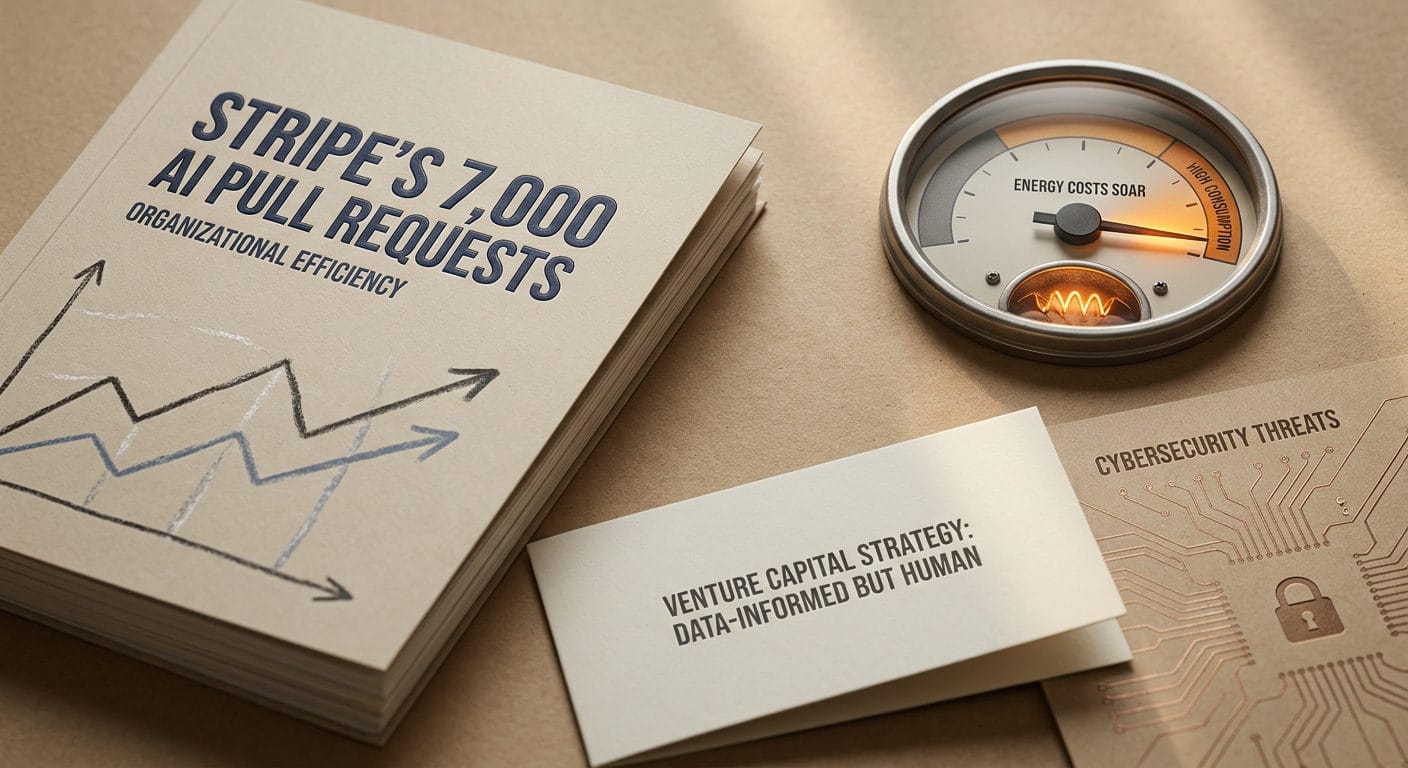
The venture market is bifurcating between hyper-efficient, AI-driven operations that leverage massive creative output, and the stark reality of traditional industries struggling with AI's energy demands and security threats.
The Intake
📊 11 episodes across 8 podcasts
⏱ 674 minutes of intelligence analyzed
🎙 Featuring: Jacob Steeves, Jason Calacanis, Lon Harris
|

The Big Shift
The defining tension in venture today lies between the exponential productivity gains AI promises for software development and organizational structure, versus its hidden costs and emergent vulnerabilities. While some anticipate AI-driven growth to "build everything" with fewer engineers (Will Gaybrick on The a16z Show), others grapple with AI's massive and often environmentally damaging energy footprint (Rebecca Bellan on Equity) and its weaponization in cyber warfare (Nick Warner on The a16z Show).
"Our belief is that it's just an opportunity to... build everything. And the best way to optimize your cost structure is to grow more."
— Will Gaybrick, President of Product & Business at Stripe on The a16z Show
Stripe’s internal AI coding agents, dubbed 'Minions,' generated a staggering 7,000 pull requests in a single week, accounting for 30% of all code contributions. This signals a fundamental shift from AI as a cost-cutting tool to a force multiplier for creation, enabling flatter organizational structures and allowing companies to pursue more product initiatives. Conversely, the insatiable energy demands of AI data centers are pushing a significant backslide on climate commitments, with Amazon’s proposed Texas data center potentially becoming one of the largest emitters. This juxtaposition creates a critical investment landscape: on one hand, hyper-efficient, AI-native businesses unlock unprecedented scale; on the other, the foundational infrastructure supporting this boom is creating new environmental and security challenges that demand innovative solutions.
This dual narrative presents a strategic paradox: AI is simultaneously the engine of unprecedented productivity and the source of escalating externalities and threats. Smart money is positioning for both sides: investing in the software layer that harnesses AI's creative explosion and in the foundational technologies mitigating its resource intensity and security risks.
The Rundown
① E-commerce growth playbooks are now the blueprint for SaaS.
Matt Swulinski, Head of Growth at Viktor, argues that SaaS founders should adopt the e-commerce approach, leveraging paid acquisition early and producing a high volume of diverse creative content (Matt Swulinski on The Twenty Minute VC (20VC): Venture Capital | Startup Funding | The Pitch).
→ The signal: The era of delaying paid acquisition in SaaS is over; direct response and creative iteration are critical for validating product-led growth and achieving scale, redefining early-stage marketing spend.
② Decentralized AI networks are proving resilient against sophisticated attacks.
Bittensor’s co-founder Jacob Steeves details how its permissionless, hyper-competitive market model incentivizes AI compute and intelligence, even forcing "bad actors" to produce value through economic incentives rather than trust (Jacob Steeves on This Week in Startups).
→ Why it matters: This framework suggests a path for building robust, secure decentralized AI infrastructure capable of withstanding nation-state level threats, opening new investment avenues in truly resilient systems.
③ Human brains remain uniquely valuable for user understanding in AI design.
Despite AI’s increasing capability as a "product designer," Ian Silber, OpenAI’s Head of Design, emphasizes that human designers’ strengths in curiosity, prototyping, and understanding user needs will remain indispensable (Ian Silber on Lenny's Podcast: Product | Career | Growth).
→ What to watch: Investment in AI-powered design tools will accelerate, but the competitive edge will shift to companies that empower human designers to leverage AI for deeper user insights and novel experiences, rather than replacing them.
④ Traditional cybersecurity tools are obsolete against AI-powered threats.
Nick Warner of Neo highlights that current security solutions, built for human and malware threats, are ill-equipped for AI agents, demanding flexible, multi-model AI defense systems for blue teams (Nick Warner on The a16z Show).
→ The signal: The shift to agentic enterprise applications creates an urgent need for a new generation of AI-native cybersecurity solutions, driving significant demand and investment in adaptive defense platforms.
⑤ Founder-led growth is outperforming traditional marketing for niche markets.
Mid-Day Squares achieved rapid growth and a national Costco deal through hyper-personalized content, hand-delivering products, and leveraging community, demonstrating that unconventional, founder-driven GTM can disrupt established playbooks (Nick Saltarelli on My First Million).
→ Why it matters: This indicates a return to authenticity and direct founder involvement as a powerful, capital-efficient competitive advantage, particularly in crowded CPG or specialized B2B markets.
⑥ Autonomous vehicles are existential for mobility companies, but the timeline is decades.
Uber President Andrew Macdonald confirms autonomy is critical for long-term survival, but emphasizes that cost compression for AVs to compete with human labor in many markets is still decades away (Andrew Macdonald on The Twenty Minute VC (20VC): Venture Capital | Startup Funding | The Pitch).
→ What to watch: Investments in AVs should focus on incremental advances and platform partnerships that support existing business models, rather than anticipating near-term, widespread human-replacement autonomy, especially in emerging markets.
Signal Board
🔥 HEATING UP
• Agentic commerce: Stripe is building payment primitives like Tempo and the Link Agent Wallet to enable machines to transact with machines, suggesting a future of micropayments and B2B service provisioning by AI (Will Gaybrick on The a16z Show).
• Permissionless and Peer-to-Peer Systems: Bittensor's market-driven subnet ranking and incentive structures are creating a hyper-competitive, anti-fragile environment for AI intelligence (Jacob Steeves on This Week in Startups).
• AI automation for dental insurance claims: Daydream Dental is showing significant ARR by automating back-office tasks for dentists, demonstrating high demand for niche AI applications (Shreyas Parab (Daydream Dental CEO) on My First Million).
• E-commerce Growth Playbook for SaaS: SaaS companies adopting aggressive paid ad strategies, high-volume creative testing, and robust tracking are seeing accelerated product-led growth (Matt Swulinski on The Twenty Minute VC (20VC): Venture Capital | Startup Funding | The Pitch).
🆕 ON WATCH
• Mid-Day Squares: This chocolate bar company sold $40 million worth of product by leveraging viral content, community building, and direct-to-consumer strategies (Nick Saltarelli on My First Million).
• Wisewell: A consumer subscription business offering countertop water purification systems with low attrition rates, targeting microplastics and water mineralization (Sami Khoreibi on This Week in Startups).
• Direct Response Marketing for Dentists: A founder is targeting dentists with AI solutions using word-of-mouth through Facebook groups and direct mail, bypassing traditional marketing channels (Shreyas Parab (Daydream Dental CEO) on My First Million).
• Agentic enterprise applications: Anticipated to make up 50% of enterprise apps by year-end, these are creating unprecedented complexity and new attack surfaces in cybersecurity (Nick Warner on The a16z Show).
• USS Abraham Lincoln deployment conditions: The extended deployment of the USS Abraham Lincoln highlights military stress and budget concerns, resonating with Gen Z due to echoes of "endless wars" (Adam Mockler on Pivot).
🥶 COOLING OFF
• Honeypots and static signatures: These traditional cybersecurity defenses are rendered ineffective by advanced AI agents, leading to false positives and hindering defenders (Nick Warner on The a16z Show).
• Traditional PR for TechCrunch features: Primarily serves as an AEO citation signal rather than a direct traffic driver, reducing its perceived value as a growth lever (Matt Swulinski on The Twenty Minute VC (20VC): Venture Capital | Startup Funding | The Pitch).
• AI model guardrails hindering defenders: Guardrails, intended to prevent misuse, inadvertently block security teams from legitimate defensive actions, forcing them to use less secure models (Max Pollard on The a16z Show).
The Debate
The conversation around AI's impact on employment, specifically for creative roles, continues to be a point of tension.
🐂 The bull case: Ian Silber, Head of Design at OpenAI, argues that "this is the best time in history to be a designer," despite recent surveys indicating high anxiety among creative professionals. He posits that AI acts as an "incredible product designer" and that designers are now "much more empowered" to translate early research into user-facing products (Ian Silber on Lenny's Podcast: Product | Career | Growth).
🐻 The bear case: Lenny Rachitsky, host of Lenny's Podcast, points to data showing designers are "the most unhappy on every dimension... the most overwhelmed, the most anxious, the most... The least optimistic, the most worried, the most tired." This anxiety stems from job expectation changes and the fact that design processes haven't seen the 10x-100x productivity gains AI has brought to engineering, leaving designers feeling uncertain about their evolving role (Lenny Rachitsky on Lenny's Podcast: Product | Career | Growth).
Our read: While AI offers powerful tools for designers, the market is still processing the full implications, creating significant turbulence and a necessary re-skilling for creative professionals to leverage AI rather than be replaced by it.
The Bottom Line
Capital is flowing to AI-native businesses that aggressively leverage new tools for hyper-efficiency and creative output, while simultaneously searching for solutions to AI's escalating energy demands and the urgent, new cybersecurity threats it creates.
📖 Want the full episode breakdowns, guest details, and listen links?
Episode Guide
Equity — "Meta's 'open' AI, data centers' hidden costs, and a $250M deal gone very wrong"
Runtime: 35 min | Host: Kirsten Korosec | Guests: Anthony Ha (Weekend Editor and Host, TechCrunch), Rebecca Bellan (Senior Reporter specializing in AI and Host, TechCrunch)
For growth-stage CEOs: Understand the critical, often hidden, energy costs of AI infrastructure and the cautionary tales of due diligence failures in acquisitions.
This episode unpacks Meta's open-weight AI strategy, juxtaposed with the escalating environmental and economic costs of data centers. It also dissects a $250M acquisition that went sideways, offering lessons on the limits of due diligence and the pressures on VC-backed startups.
"Data centers are expected to quadruple the US electricity use by 2035." — Rebecca Bellan, Senior Reporter specializing in AI and Host at TechCrunch
This Week in Startups — "Bittensor creator Const on Affine, dTAO, "mining reasoning," and more | E2326"
Runtime: 85 min | Host: Jason Calacanis | Guests: Jacob Steeves (Co-founder, Bittensor), Const (Creator of Bittensor, runs subnet Affine, Bittensor)
For GPs and LPs: Dive deep into the future of decentralized AI and how permissionless market models are incentivizing compute and intelligence.
Const, co-founder of Bittensor, reveals how its permissionless, hyper-competitive market leverages a Bitcoin-like proof-of-work model to decentralize AI compute. The discussion covers subnets, TAO token economics, and how Bittensor's architecture is designed to withstand adversarial attacks.
"The Bittensor network is a permissionless adversarial game. If more than 50% of the network is running the correct code of Bitcoin, it doesn't matter if 49% of them are cheating. The majority, the honest majority, will determine the direction of the incentives in the network." — Jacob Steeves, Co-founder of Bittensor
The Twenty Minute VC (20VC): Venture Capital | Startup Funding | The Pitch — "20Growth: How to Build a $100M Growth Engine: Lessons from Wispr Flow and Superhuman | Why You Should Do Paid Ads Today and How To Do Them | How to Build the Best Referral Programs and How to Crush UGC with Matt Swulinski"
Runtime: 79 min | Host: Harry Stebbings | Guests: Matt Swulinski (Head of Growth, Viktor), Nick Gillespie (Unknown, Unknown)
For growth executives: Master the modern growth playbook by adopting e-commerce tactics for SaaS and optimizing paid acquisition from day one.
Matt Swulinski shares how SaaS companies can build $100M growth engines by applying e-commerce strategies, emphasizing early paid acquisition, robust conversion tracking, and high-volume creative production for Meta and Google ads.
"There is a massive gap in the SaaS space where like I'm waiting for startups to be made that fill this gap. 90% of companies don't do that as a first step before you spend your first cent, have everything set up." — Matt Swulinski, Head of Growth at Viktor
My First Million — "3 strangers showed us how they made $8M, $10M, & $40M/year"
Runtime: 61 min | Host: Sam Parr | Guests: Shaan Puri (Host, My First Million), Raav Gupta (Founder, Pasha), Nick Saltarelli (Co-Founder, Mid-Day Squares)
For founders and CEOs: Learn unconventional marketing and community-building strategies that drive explosive growth and how niche AI solutions can capture significant ARR.
This episode features three founders discussing their unique paths to success. Raav Gupta unveils Pasha, a robotic chef, while Nick Saltarelli shares how Mid-Day Squares leveraged viral content and community to hit $40M in sales. Shreyas of Daydream details his AI solution for automating dental back-office tasks.
"We basically sold $40 million worth of $2.49 chocolate bars. That equates to about, let's just call it roughly 60 bars per minute." — Nick Saltarelli, Co-Founder of Mid-Day Squares
This Week in Startups — "What we'll learn from Anthropic's $2-$3T IPO | E2325"
Runtime: 80 min | Host: Jason Calacanis | Guests: Sami Khoreibi (CEO and Co-founder, Wisewell), Puneet Puri (from GRIT Robotics, GRIT Robotics)
For LPs and growth equity funds: Gain insights into the potential scale of the AI economy, new consumer tech trends, and automation opportunities in infrastructure.
Jason Calacanis speculates on Anthropic's potential $2-3 trillion IPO and its implications for the AI economy. Guests Sami Khoreibi (Wisewell) and Puneet Puri (GRIT Robotics) discuss innovations in water purification, microplastic removal, and robotic solar panel installation, highlighting emerging market opportunities.
"Anthropic plans to seek a valuation of $2 to $3 trillion for their October IPO. That would top the $1.7 trillion record set by SpaceX just a few short months ago." — Jason Calacanis, Host of This Week in Startups
Lenny's Podcast: Product | Career | Growth — "OpenAI’s Head of Design: This is the best time in history to be a designer | Ian Silber"
Runtime: 72 min | Host: Lenny Rachitsky | Guests: Ian Silber (Head of Product Design, OpenAI)
For growth executives and product leaders: Understand the evolving role of design in an AI-native world and how to best leverage AI in creative processes.
Ian Silber, Head of Product Design at OpenAI, argues that despite designer anxiety, AI makes this the best time for designers. He emphasizes the unique human value in user understanding and invention, and how OpenAI fosters exploration in design.
"I think it already is an incredible product designer. It really is actually already great. The cool thing about it though is it's accessible to every single person and it's a tool that anybody can use." — Ian Silber, Head of Product Design at OpenAI
The a16z Show — "How Do You Defend Against AI That Can Hack?"
Runtime: 22 min | Host: Joel De La Garza | Guests: Nick Warner (Co-founder, Neo), Max Pollard (Co-founder, Cotool)
For CEOs and board members: Grasp the immediate and evolving threats of AI-powered hacking and the inadequacy of traditional cybersecurity defenses.
Joel De La Garza, Nick Warner, and Max Pollard discuss the paradigm shift in cybersecurity, where AI agents act as advanced attackers. They highlight the failure of traditional tools and the urgent need for flexible, multi-model AI defense strategies, especially as agentic enterprise applications proliferate.
"The challenge with the existing security tools that are out there is they really were built to tackle two things, the first being people, and the second is malware. AI and AI agents and agentic processes are neither of those things." — Nick Warner, Co-founder of Neo
Pivot — "USS Lincoln Fallout, Spotlight on Natalie Harp, and Press Secretary Succession"
Runtime: 58 min | Host: Kara Swisher | Guests: Adam Mockler (Gen Z Commentator and Host, The Adam Mockler Show)
For LPs and investors: Understand how geopolitical events, youth sentiment, and political dynamics are shaping the broader societal context for venture.
Kara Swisher and Adam Mockler analyze the USS Abraham Lincoln deployment's impact on Gen Z, the political implications of Natalie Harp's relationship with Trump, and the DNC's primary calendar shift, offering insights into youth political engagement and party dynamics.
"My generation, your son's generation. We're gonna have to bear the brunt of all of this debt that is accumulating right now." — Adam Mockler, Gen Z Commentator and Host of The Adam Mockler Show
The a16z Show — "Stripe’s AI Strategy: Build More, Not Less"
Runtime: 55 min | Host: David George | Guests: Will Gaybrick (President of Product & Business, Stripe), Felix Pogmore (Head of Crypto/Tempo Project, Stripe)
For growth-stage CEOs and investors: Discover how leading tech companies are leveraging AI for exponential product development and organizational flattening, and the future of agentic commerce.
Stripe's Will Gaybrick explains how AI is enabling them to build more products with fewer engineers, leading to a flatter organization and the use of 'Stripe Minions' for massive code generation. He discusses the vision for agentic commerce, micropayments, and the role of stablecoins.
"Last week I think 7000 PRs came from minions. Wow. Yeah. And about 30% of our PRs in that week came from Minions." — Will Gaybrick, President of Product & Business at Stripe
The Twenty Minute VC (20VC): Venture Capital | Startup Funding | The Pitch — "20VC: Uber President on The Untold Uber Stories: Travis, China and Self-Driving | Why Autonomy Is Existential | How to Beat DoorDash to #1 in Food with Andrew MacDonald"
Runtime: 67 min | Host: Harry Stebbings | Guests: Andrew Macdonald (President and COO, Uber)
For growth-stage CEOs and PE operating partners: Gain an insider's view on strategic long-term bets in mobility, the ROI of AI in large corporations, and intense market competition tactics.
Uber President Andrew Macdonald discusses Uber's long-term strategy, including its membership program, autonomous vehicle investments, and the intense competition in markets like China. He provides insights into Uber's nuanced AI budgeting and growth strategies.
"We were burning 52 million a week in China just on price subsidies because there was this heated behind the scenes battle happening to get to the best economics in the ultimate sort of surrender or the ultimate sort of truce." — Andrew MacDonald, President of Mobility and Operations at Uber
Founders — "#429 Bob Dylan's Autobiography"
Runtime: 60 min | Host: David Senra
For founders and executives: Extract timeless lessons on identity, creative process, and resilience from the life of a legendary artist.
David Senra distills insights from Bob Dylan's autobiography, focusing on his creative evolution, dedicated self-education, and philosophy of "life is about creating yourself." The episode draws parallels to other iconic figures and emphasizes the power of artistic reinvention and persistence.
"Life isn't about finding yourself. Life is about Creating yourself." — Bob Dylan, Musician and Author