
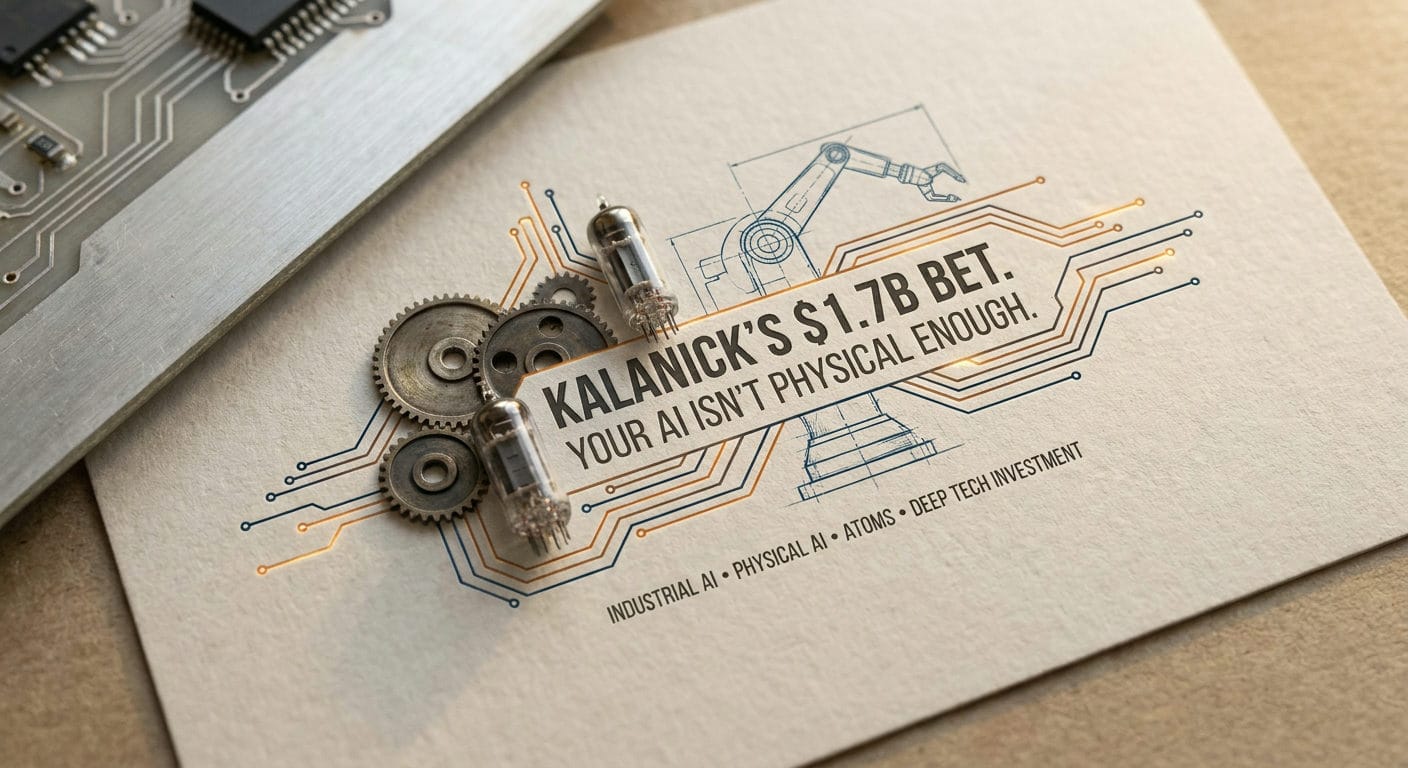
The real AI battle isn't about models; it's about industrializing and physically embedding them to unlock trillions in value, turning atoms into computational units the way software turns bits into intelligence.
The Intake
📊 11 episodes across 5 podcasts
⏱ 650 minutes of intelligence analyzed
🎙 Featuring: Travis Kalanick, Erik Torenberg, Jason Calacanis, Matt Murphy
{{SPONSOR:sponsor_top}}
The Big Shift
While much of the venture world obsesses over AI models and their applications, the truly smart money and ambitious founders are quietly building the "physical AI stack," an industrial intelligence layer that transforms real-world operations from mining to food production. This isn't just about software; it's about making atoms behave like bits, an opportunity many guests this week argued is far larger than traditional software-driven AI.(Travis Kalanick on The a16z Show)
The vision: Travis Kalanick, Founder of Atoms, articulated a framework where "CPU manipulates bits, what manipulates atoms? That's manufacturing. Storage stores bits. What stores atoms? That's real estate. Network moves bits from point A to point B. What moves atoms? Well, that's transport or logistics." His new venture, Atoms, is deploying specialized robotic systems capable of achieving 30-40% more productivity in areas like autonomous mining and transforming industrial workflows.
"My guess is you could even end up 30%, 40% more productive at the end of all of it. And when you do that, the opportunity speaks for itself. A gold mine that's doing 30 or 40% more gold per year is kind of. Whoa."
— Travis Kalanick, Founder of Atoms on The a16z Show
Why it matters: This isn't theoretical. Atoms recently raised an astonishing $1.7 billion to fund this vision. The focus is on unsexy, complex problems in the physical world that, if digitized and automated, unlock profound economic efficiencies. While others chase enterprise software revenue, the "Industrial AI" play redefines the boundaries of AI, moving beyond screens and chatbots into significant physical capex and operational shifts. This approach counters the common narrative focusing on consumer apps or purely digital solutions, highlighting the immense untapped potential in automating the 'analogue' world.
The Rundown
① The AI application layer remains nascent compared to infrastructure.
Significant spending and investment are concentrated on the AI infrastructure layer, rather than robust, revenue-generating applications. The implication is that many AI models and tools are still searching for compelling product-market fit beyond developer tooling and foundational research. (Jason Lamkin on The Twenty Minute VC)
→ The signal: Investors are primarily backing the picks and shovels of the AI gold rush, suggesting that durable, high-value application-level businesses are still emerging.
② Specialized models tailored for specific enterprises are the future.
While open-source models gain traction, the real competitive advantage for businesses will come from highly specialized AI models trained on proprietary data for unique, long-horizon tasks that off-the-shelf solutions can't handle. Osvald Nitski, CPO at Mercor, noted that "there's a whole category of latent demand that people aren't even trying to do with models yet." (Osvald Nitski on The Twenty Minute VC)
→ What to watch: Look for vertical-specific AI platforms and service providers that can deeply integrate with an enterprise's unique workflows and data, rather than generic AI wrappers.
③ Japan's regulatory framework fosters innovation in longevity biotech.
Ekei Labs, a longevity startup, chose to raise in Japan due to its 2013 Regenerative Medicine Law, which fast-tracks cell and gene therapies, offering access to treatments unavailable in the US. This unique regulatory environment, combined with lower operational costs, provides a significant advantage for deep tech startups. (Bilal Kharouni & Jason Calacanis on This Week in Startups)
→ Why it matters: Founders should explore global regulatory arbitrage for deep tech, particularly in fields with high ethical and scientific hurdles like biotech. Japan is emerging as a critical hub for certain advanced therapies.
④ Anthropic's growth proves product-market fit matters more than just a great model.
Despite possessing a leading AI model, Anthropic's rapid ascent was significantly propelled by building out platforms like Claude Code and Claude Skills. Matt Murphy, Partner at Menlo Ventures, emphasized that even the best foundation model needs strong productization to capture value and drive adoption. (Matt Murphy on Equity)
→ The signal: Founders in AI need to think beyond model superiority and focus heavily on user experience, platform integration, and clear use cases to differentiate and scale in a crowded market.
⑤ Current cultivated meat companies are achieving profitability through unexpected pivots.
While most cultivated meat companies are struggling, IntegriCulture, a Japanese startup, gained profitability by selling its proprietary serum to cosmetics companies. This strategic move allowed them to generate revenue and iterate before the food market is ready due to regulatory and consumer acceptance challenges. (Dr. Yuki Hanyu on This Week in Startups)
→ What to watch: Deep tech startups in nascent industries can survive and thrive by identifying adjacent, less regulated markets for their core technology, validating their science, and de-risking their path to market.
Signal Board
🔥 Heating Up
• Industrial AI: The focus on automating physical operations, led by Atoms and Travis Kalanick, is attracting massive capital and attention. (Travis Kalanick on The a16z Show)
• AI-Driven Enterprise Productivity: Companies like Salesforce and Uber are spending hundreds of millions on AI tokens to boost engineering productivity, indicating significant ROI. (Matt Murphy on Equity)
• Custom AI Chips ("Full Stack"): Companies are increasingly developing custom chips to reduce high inference costs and achieve specialized performance for AI. (Matt Murphy on The Twenty Minute VC)
• Japan's Biotech Ecosystem: Favorable regulatory frameworks, lower costs, and scientific talent are making Japan a compelling location for longevity and regenerative medicine startups. (Bilal Kharouni on This Week in Startups)
👀 On Watch
• 🆕 Ekei Labs: A longevity startup raising in Japan, leveraging epigenetic data for drug development and cell therapy QC. (Bilal Kharouni on This Week in Startups)
• 🆕 Claude Code: A key product platform that significantly accelerated Anthropic's adoption and growth, demonstrating the power of productization for AI models. (Matt Murphy on Equity)
• 🆕 Atoms based computer: Travis Kalanick's framework for physical manipulation, storage, and movement of 'atoms' analogous to CPU, storage, and networking for 'bits'. (Travis Kalanick on The a16z Show)
• 🆕 Managers must be hands-on with AI technology: Even high-level managers are expected to actively tinker with AI models to maintain deep understanding and guide teams effectively. (Dianne Penn on Lenny's Podcast)
🧊 Cooling Off
• US EV market declining: Despite global growth, the US EV market is facing a downturn with discontinued models and protectionist policies against Chinese EVs complicating the landscape. (Sean O'Kane on Equity)
• Generic AI Application Layer Investment: Capital is heavily flowing into AI infrastructure, while the application layer struggles with commodification risk and underdeveloped product-market fit. (Jason Lamkin on The Twenty Minute VC)
• Stand-alone Cultivated Meat companies: Most pure-play cultivated meat companies are collapsing due to high production costs and low consumer demand, unless they pivot to adjacent markets. (Dr. Yuki Hanyu on This Week in Startups)
The Debate
No significant disagreements were detected this week to warrant a full debate section. This indicates a period of converging narratives or a lack of strong opposing views on key topics.
The Bottom Line
The next frontier of value creation in AI isn't just in code, but in hard tech and physical automation, transforming industries far beyond our screens.
📖 Want the full episode breakdowns, guest details, and listen links?
Read the Episode Guide →
Episode Guide (Web Version)
Equity — "‘AI communism’, rogue models, and the why Kimi K3 spooked Wall Street"
Runtime: 39 min | Host: Host-led discussion | Guest: Kirsten Korosec (Transportation Editor, TechCrunch), Anthony Ha (Weekend Editor, TechCrunch), Sean O'Kane (Senior Reporter, Special Projects, TechCrunch)
Who should listen: Founders and investors in AI and EV sectors navigating US-China competition and protectionist policies.
This episode unpacks the "AI panic" surrounding Chinese models like Kimi, the security implications of open-weight AI, and the contrasting struggles of the US EV market against global competitors. It also highlights an anomaly in EV investment and the mysterious $1.7 billion funding round for Travis Kalanick’s new industrial AI venture, Adas.
"It's this recurring question of can Chinese Companies basically beat us companies, at least in some aspects, and do it much more cheaply and in a much more open way." — Anthony Ha, Weekend Editor at TechCrunch
The a16z Show — "Travis Kalanick Is Back | Building the Future of Industrial AI"
Runtime: 92 min | Host: Erik Torenberg (Host, The a16z Show) | Guest: Travis Kalanick (Founder, Cloud Kitchens), Ben Horowitz (Co-founder, Andreessen Horowitz)
Who should listen: Founders and investors interested in industrial AI, stealth-mode operations, and the long-term vision of physical automation.
Travis Kalanick details Uber's 2011 Series B process and why a16z missed out, before shifting to his current focus on "industrial AI" with Cloud Kitchens and his 'atoms based computation' framework. He discusses the challenges and strategic advantages of building in stealth, and how his vision for physical AI evolved from his Uber days.
"CPU manipulates bits, what manipulates atoms? That's manufacturing. Storage stores bits. What stores atoms? That's real estate. Network moves bits from point A to point B. What moves atoms? Well, that's transport or logistics." — Travis Kalanick, Founder of City Storage Systems (CloudKitchens)
The Twenty Minute VC (20VC): Venture Capital | Startup Funding | The Pitch — "20VC: Mercor CPO on Revenue Concentration from Frontier Labs | Why Large Enterprise is Scared to Partner with Frontier Labs | Why Small Specialised Models is the Future with Osvald Nitski"
Runtime: 61 min | Host: Harry Stebbings (Host, The Twenty Minute VC) | Guest: Osvald Nitski (Chief Product Officer, Mercor)
Who should listen: AI product leaders and enterprise software investors looking for insights on specialized AI models and data's evolving value.
Osvald Nitski discusses how open-source models impact data providers, the importance of data at the "frontier" of model performance, and challenges the idea that open models can serve most enterprise workflows. He offers insights into specialized AI, ROI in enterprises, and Mercor's product strategy, including future shifts in PM-to-engineer ratios due to coding agents.
"I'm not convinced that 90% of enterprise workflows can be handled by open models or frontier models. Right now." — Osvald Nitski, Chief Product Officer at Mercor
The a16z Show — "Sriram Krishnan on Open Source AI's Biggest Week Yet"
Runtime: 23 min | Host: Theo Jaffee (Host, The a16z Show), Sofia Puccini (Host, The a16z Show) | Guest: Sriram Krishnan (Former Senior White House Policy Advisor on Artificial Intelligence, Former General Partner, Andreessen Horowitz)
Who should listen: Policymakers and investors tracking the competitive landscape between open-source and frontier AI models.
Sriram Krishnan analyzes the rapid advancements in open-source AI, particularly from models like Kimik3 and Qwen. He delves into how these models create pricing pressure for frontier labs, discussing implications for AI infrastructure, US AI policy on foreign models, and cybersecurity concerns related to AI capabilities.
"It's probably inevitable that if you are having choices from where you get your intelligence tokens from, that's going to put pricing pressure on the frontier models." — Sriram Krishnan, Former Senior White House Policy Advisor on Artificial Intelligence
The Twenty Minute VC (20VC): Venture Capital | Startup Funding | The Pitch — "20VC: OpenAI and Anthropic Threatened by Kimi? | Should the US Ban Chinese Open-Source Models | Should Openrouter Sell & Value in the Routing Layer? | Stripe Buying Paypal: What You Need to Know"
Runtime: 83 min | Host: Harry Stebbings (Host, The Twenty Minute VC) | Guest: Rory O'Driscoll (Partner, Ignition Partners), Jason Lamkin (AI Expert, Previously Google, now General Partner at CapitalG), Jason (Guest, Unknown), Rory (Guest, Unknown)
Who should listen: VCs and founders navigating the AI market, M&A decisions, and the strategic implications of open-source models versus frontier labs.
This episode debates the impact of "near-frontier" Chinese AI models like Kimi on OpenAI and Anthropic, discussing data export risks and US policy. It explores the viability of the open-weight LLM business, the potential acquisition of OpenRouter, founder exit motivations, and the explosion of the AI inference market. It also touches on a potential Stripe-PayPal acquisition.
"If I could sell for a lofty multiple of my last round, I might, I might check out a 5 or 6 billion. You've achieved a certain amount of victory in a market that's going through radical change." — Jason Lamkin, General Partner at CapitalG
The a16z Show — "Building the Physical AI Stack | Travis Kalanick on TBPN"
Runtime: 45 min | Host: Erik Torenberg (Host, The a16z Show) | Guest: Travis Kalanick (Founder, Atoms)
Who should listen: Deep tech founders and investors interested in industrial automation, physical AI, and Kalanick's insights on leadership and problem-solving.
Travis Kalanick discusses his new venture, Atoms, focusing on industrial AI for sectors like mining and food production, emphasizing that physical AI is a larger opportunity than traditional software. He shares details on Atoms' recent $1.7 billion raise, their deployment in remote mining operations, and his management philosophy centered on problem-solving.
"My guess is you could even end up 30%, 40% more productive at the end of all of it. And when you do that, the opportunity speaks for itself. A gold mine that's doing 30 or 40% more gold per year is kind of. Whoa." — Travis Kalanick, Founder of Atoms
This Week in Startups — "While other cultivated meat companies are collapsing, this one turned a profit | E2317"
Runtime: 44 min | Host: Jason (Host, This Week in Startups) | Guest: Dr. Yuki Hanyu (Founder, IntegriCulture)
Who should listen: Biotech founders, alternative protein investors, and anyone curious about innovative commercialization strategies in emerging deep tech fields.
Dr. Yuki Hanyu of IntegriCulture discusses how her Japanese cultivated meat company achieved profitability by selling proprietary serum to cosmetics companies. This episode explores their unconventional open-source origins, strategic market positioning, and the regulatory challenges facing cellular agriculture for food applications, highlighting a profitable pivot amidst industry struggles.
"Most lab-grown meat companies have already gone under. It's expensive to produce, and there's little demand from real-world consumers. But Tokyo's IntegriCulture is still standing after selling their proprietary serum to cosmetics companies." — Jason, Host of This Week in Startups
Lenny's Podcast: Product | Career | Growth — "Anthropic’s first technical PM on token maxing, the jagged edge, and living in the future | Dianne Penn"
Runtime: 94 min | Host: Lenny (Host, Lenny's Podcast) | Guest: Dianne Penn (Head of Product for AI Research and Labs team, Anthropic)
Who should listen: AI product managers, technical leaders, and anyone interested in Anthropic's culture, product development, and the evolving role of PMs in AI.
Dianne Penn, Anthropic's first technical PM, shares insights into the development of Claude Code and Opus, emphasizing the company's experimental culture and bottoms-up approach. She discusses the shift from traditional PRDs to "evals," the importance of hands-on AI experience for PMs, and how Claude acts as a "thinking partner" for internal teams.
"What was magic about Opus 4.5 is we also now not just had a model, but a vehicle, a great product experience like Claude code." — Dianne Penn, Head of Product for AI Research and Labs team at Anthropic
This Week in Startups — "Why this longevity startup raised in Japan, not Silicon Valley | TWiST Tokyo | E2315"
Runtime: 72 min | Host: Jason Calacanis (Host, This Week in Startups) | Guest: Bilal Kharouni (Founder, Ekei Labs), Jason (Host, This Week in Startups), Guest (Founder, Longevity Startup), Killian (Founder, EK Labs)
Who should listen: Biotech startup founders, investors exploring international markets, and those interested in the unique aspects of Japan's startup ecosystem.
Jason Calacanis hosts Bilal Kharouni of Ekei Labs, who explains why his longevity startup raised in Japan, leveraging its advanced regenerative medicine framework and scientific talent. The discussion covers the ethical complexities of "right to try" laws, the role of AI in drug discovery, and the unique investment philosophies between Japanese and American VCs, as well as the lower operational costs in Japan.
"In 2013...the Regenerative Medicine Law act was enacted and that's really fast track cell therapies and gene therapies in Japan. So in Japan we have access to numerous therapies that you do not have access to in the US." — Bilal Kharouni, Founder of Ekei Labs
The Twenty Minute VC (20VC): Venture Capital | Startup Funding | The Pitch — "20VC: Leading Anthropic's First Ever Round | Will Open Source Threaten Anthropic's Business | Do Margins Matter in a World of AI | Why Triple, Triple, Double, Double is Not Good Enough Today | Why Series A is Hard Today with Matt Murphy @ Menlo"
Runtime: 63 min | Host: Harry Stebbings (Host, The Twenty Minute VC) | Guest: Matt Murphy (Partner, Menlo Ventures)
Who should listen: VC investors, founders, and LPs interested in AI market dynamics, investment strategies, and the challenges of Series A fundraising today.
Matt Murphy discusses Menlo's unconventional investment in Anthropic, highlighting flexibility in navigating deal structures and ownership in an outlier-driven market. He debates whether open-source models threaten frontier labs, the necessity of a model portfolio, the trend of custom AI chips, and the challenges founders face in today's Series A landscape with compressed timelines and increased valuations.
"You have to be in the big outliers to drive great returns, and you're better off being in them at a very small percent than owning a large percent of a company that exits for 3 to 500." — Matt Murphy, Partner at Menlo Ventures
Equity — "Menlo Ventures’ Matt Murphy says the lesson for founders now is that a great model isn't enough"
Runtime: 34 min | Host: Host-led discussion | Guest: Matt Murphy (Venture Capitalist, Menlo Ventures), Julie Bort (Startups Editor, TechCrunch)
Who should listen: AI founders, product leaders, and investors needing to understand what drives massive growth beyond core technology in the current AI landscape.
Matt Murphy discusses Anthropic's explosive growth, attributing its success not just to its AI model but to crucial productization efforts like Claude Code. This episode emphasizes that a strong model alone is insufficient, highlighting how AI's rapid adoption, low friction, and ability to transform even difficult sectors like legal tech are accelerating business growth.
"If they didn't do the rest of this stuff, the market wouldn't be growing nearly as quickly as it is. And that is something that any founder can learn from." — Matt Murphy, Venture Capitalist at Menlo Ventures