
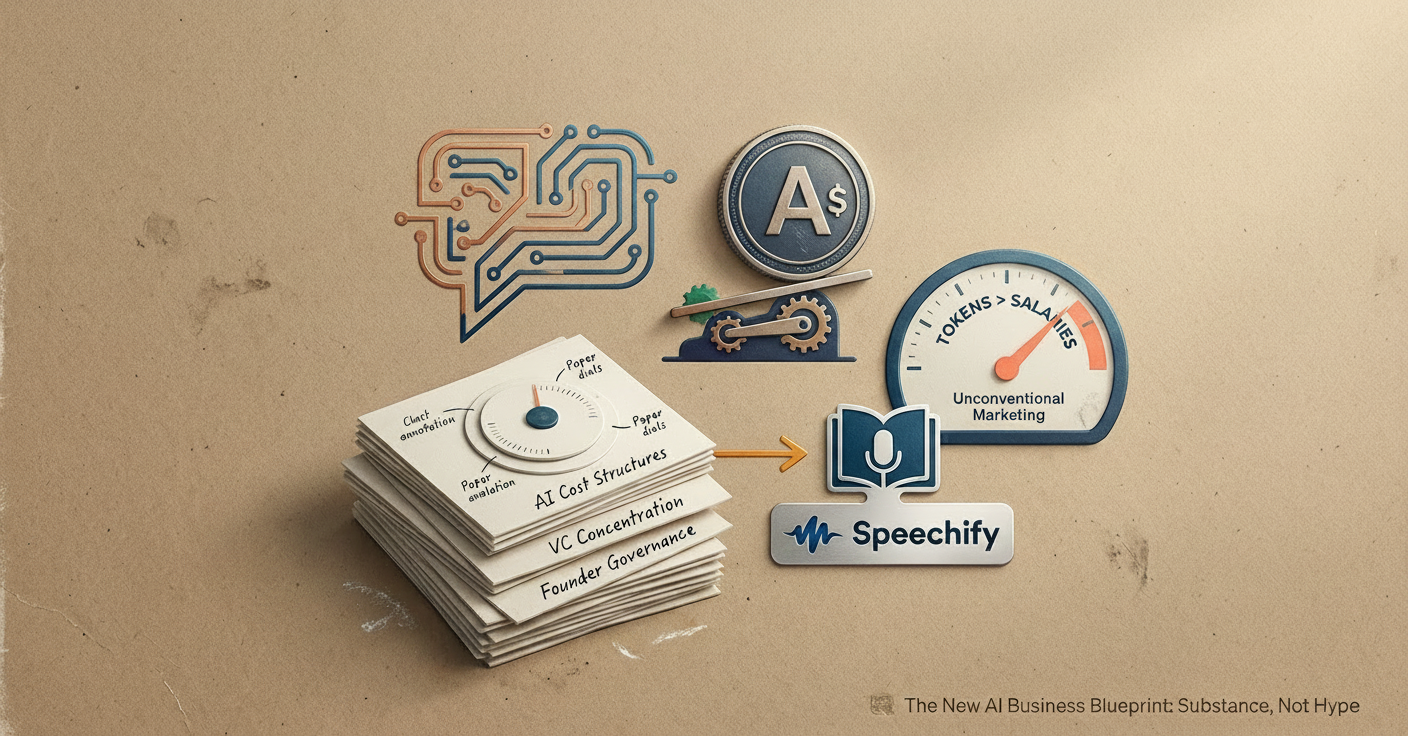
More AI Tokens Than Salaries: The New Productivity Frontier
The next frontier in startup efficiency and venture returns isn't just about AI integration; it's about fundamentally reshaping operational costs. Companies are rapidly approaching a point where they'll spend more on AI tokens than human salaries, radically redefining scaling potential. This shift is already exemplified by pioneers like Speechify and Block, signaling a new era of lean productivity.
The Intake
📊 11 episodes across 8 podcasts
⏱ 822 minutes of intelligence analyzed
🎙 Featuring: David Senra, Phil Knight, Bill Bowerman, Jeff Johnson, Gary Tan, Patrick Forquer, Robert Hackett, Chris Dixon, Ali Yahya, Eddy Lazzarin, Guy Wuollet, Michael Eisenberg, Mike Granoff, Larry Covert, Kara Swisher, Scott Galloway, Rory O'Driscoll, Jason Lemkin, David Moscatelli, Jose Caldera, Jason Calacanis, Alex, Eric Ries, Lenny Rachitsky, Sam Parr, Shaan Puri, Howard Marks, Jack Dorsey, Cliff Weitzman
|

The Big Shift in Venture & AI-Driven Productivity
The traditional venture capital landscape is bifurcating, creating distinct asset classes for a new era of capital allocation. What was once a "craft business" is now splitting into what some are calling "Consensus VC" and "Traditional VC," driven by an unprecedented concentration of capital in a few large firms. This shift is not merely about size but about a fundamental redefinition of how returns are generated and what attributes truly define successful ventures, often influenced by the efficiencies AI brings.
This dynamic means that the same influx of capital that fuels mega-rounds might paradoxically dilute overall industry returns for the broader ecosystem. As Michael Eisenberg, General Partner at Aleph VC, articulated on This Week in Startups, "The more capital that comes into the system, there's more competition... So actually the increase in capital will reduce overall returns for the industry." This challenges the long-held belief that more capital inherently leads to more innovation and better outcomes across the board.
The implication is clear: founders and LPs alike must recalibrate their strategies. For founders, access to "Consensus VC" means playing a different game, potentially sacrificing ownership for scale. For LPs, understanding the bifurcation means making nuanced allocation decisions, deciding whether to back the concentrated power of the mega-funds or seek out the niche, craft-oriented firms that still operate with a "Traditional VC" ethos. These decisions are increasingly shaped by how effectively startups can leverage AI for unparalleled efficiency.
"It's become two asset classes. One would be consensus vc, cvc, and then tvc traditional venture capital."
— Larry Covert, General Partner at Oxcart Ventures on This Week in Startups
This evolving structure signals a critical moment for the venture ecosystem, demanding a closer look at whether the increasing capital concentration is truly benefiting innovation or simply rerouting returns to a select few, while transforming the core nature of startup financing itself. The move is towards strategic positioning within this new two-tiered market, where AI-driven productivity is a key differentiator.
The Rundown: AI's Impact on Business & Venture
① AI's Cost-of-Compute vs. Human Capital.
Speechify, an AI-powered text-to-speech platform, anticipates spending more on AI tokens than human salaries within the next year. Similarly, Block reported a 2.5x increase in production code changes per engineer after layoffs and AI tool adoption, simultaneously raising full-year guidance. These cases reflect an accelerating shift in operational cost structures driven by generative AI. (Cliff Weitzman on The Twenty Minute VC and David Moscatelli on This Week in Startups)
→ The signal: These are tangible indicators of AI's transformative impact on business economics, where AI-driven productivity gains can quickly outpace labor costs, fundamentally altering how startups scale and allocate resources.
② $50M in Pipeline from Unconventional Marketing.
Legora generated over $50 million of qualified sales pipeline through a Jude Law ad campaign, demonstrating the power of consumer-facing, unhinged marketing to cut through noise and drive enterprise leads. This creative strategy, while seemingly unrelated to AI, underscores the innovative approaches needed to thrive in a rapidly changing, AI-influenced market. (Patrick Forquer on The Twenty Minute VC)
→ Why it matters: This highlights a contrarian but effective approach to B2B lead generation, leveraging celebrity endorsements and humor to gain significant market attention and pipeline, challenging traditional enterprise marketing playbooks often dictated by more data-driven, AI-enabled targeting.
③ 80% of Founders Ousted Post-IPO.
Eric Ries, author of "The Lean Startup," shared that 80% of venture-backed founders are no longer CEO three years after their company goes public, underscoring the fragility of founder control. This risk can even be amplified by the shifting power dynamics within VC as capital centralizes, as discussed earlier. (Eric Ries on Lenny's Podcast)
→ What to watch: This statistic emphasizes the critical importance of governance structures (like Public Benefit Corporations) early in a company's life to protect mission and founder intent against the "financial gravity" of public markets or later-stage investors, especially as VC dynamics shift.
④ Privacy Demands Drive On-Prem AI Solutions.
Go Abacus is targeting regulated industries like banking and healthcare with on-premise AI infrastructure, satisfying stringent data privacy requirements that prevent adoption of public AI providers. This demonstrates a crucial market segment where even powerful, generalized AI cannot fully penetrate due to specific compliance needs. (David Moscatelli on This Week in Startups)
→ The signal: This indicates a growing market for specialized, secure AI deployments where data sovereignty is paramount, revealing a crucial niche for privacy-first AI solutions as mainstream adoption accelerates in sensitive sectors.
⑤ Early Nike's "Impossible" CRM Tactics.
Jeff Johnson, Nike's first employee, built a customer database using index cards, maintaining personal relationships through birthday cards and home visits, a pioneering form of CRM in the 1960s when "running for pleasure" was unheard of. While seemingly low-tech, this principle holds true even in an AI-driven world, where customer insight can be amplified but not replaced by automation. (David Senra on Founders)
→ The signal: This historical case study highlights that customer obsession and deep personal relationships have always been foundational to building enduring brands, regardless of technological advancements, providing a timeless lesson for today's founders even amidst advanced AI tools.
Signal Board: The Shifting Landscape
🔥 Heating Up
• AI agents as economic actors: The majority of future transactions (99%+) could be executed by AI agents, transforming global finance and requiring crypto-native financial systems. (Ali Yahya on The a16z Show)
• AI-driven productivity increase: Block reported a 2.5x increase in production code changes per engineer after layoffs and AI tool adoption, simultaneously raising full-year guidance. (David Moscatelli on This Week in Startups)
• On-prem AI for regulated industries 🆕: Regulated sectors like banks and hospitals require on-premise AI solutions to alleviate data privacy concerns that prevent sending data to public AI providers. (David Moscatelli on This Week in Startups)
⏳ On Watch
• Venture Capital Concentration: The VC industry is splitting into distinct asset classes, with massive capital concentration in a few large firms, impacting startup dynamics. (Michael Eisenberg on This Week in Startups)
• Tech Layoffs driven by AI adoption 🆕: Layoffs are linked to AI-driven productivity, as companies achieve more with fewer human resources, signaling ongoing workforce restructuring. (David Moscatelli on This Week in Startups)
• Public Benefit Corporation (PBC) 🆕: Governance structures like PBCs are critical for protecting founder interest and mission post-IPO, preventing the common trend of founder ousting. (Eric Ries on Lenny's Podcast)
❄️ Cooling Off
• SaaS apocalypse concerns: While some tech giants falter, firms like Atlassian and Twilio are showing accelerated growth, driven by AI companies using APIs. (Rory O'Driscoll on The Twenty Minute VC)
• Software is Dead vs. LLMs Eating Software: The debate over whether LLMs are fully replacing software or just enhancing it, with strong arguments for both sides. (Jason Lemkin on The Twenty Minute VC)
• lines of code as productivity measure: Gary Tan discusses how AI's output is not optimized for lines of code, challenging traditional metrics of developer productivity. (Gary Tan on Y Combinator Startup Podcast)
The Debate: AI & the Future of Work
This week, a key debate emerged around the long-term future of AI in the workplace: will AI lead to widespread job displacement or act as a force multiplier for a leaner, more efficient workforce?
🐂 The bull case: Cliff Weitzman, Founder & CEO of Speechify, made a bold prediction on The Twenty Minute VC: "Soon we're going to spend more in tokens than we spend on actual salaries." This perspective suggests that AI, particularly through "tokenmaxxing," will enable unprecedented productivity, allowing companies to achieve 400x the coding output and shift significant operational costs from human capital to AI resources. This could lead to a highly efficient "revenge startup" era of smaller, more productive teams.
🐻 The bear case: While acknowledging productivity gains, the discussion around tech layoffs on This Week in Startups painted a starker picture. David Moscatelli highlighted that 5,000+ tech workers were laid off in a single week, attributing this to AI adoption. This implies that while AI boosts efficiency, it also leads to significant job displacement, creating a lean workforce but potentially at the cost of widespread unemployment and the "end of the venture capital industry" as a whole. Michael Eisenberg on This Week in Startups, emphasized that "Ownership matters in asymmetric businesses. If you can't maintain the ownership, it's going to be a problem," suggesting that the power dynamics could shift dramatically.
Our read: The weight of evidence leans towards AI acting as a radical force multiplier that compresses hiring needs, making a smaller, highly efficient team the new benchmark, though with clear implications for labor market shifts.
The Bottom Line
The new venture game is being played with a changing deck: AI redefines cost structures (AI tokens > salaries), capital centralizes, and founders must meticulously guard their mission against an ecosystem increasingly built for financial gravity and unprecedented productivity shifts.
📖 Want the full episode breakdowns, guest details, and listen links?
Episode Guide (Web Version)
Founders — "#418 Phil Knight: Founder of Nike"
Runtime: 63 min | Host: David Senra | Guest: Phil Knight (Founder, Nike), Bill Bowerman (Co-founder, Nike), Jeff Johnson (First Full-Time Employee, Blue Ribbon Sports (Nike))
For the Builder: This episode is for founders obsessed with customer-centric product development and navigating constant financial peril in hyper-growth.
Senra uncovers Phil Knight's relentless drive and the unexpected strategies that built Nike from the ground up, battling financial precarity and even his own aversion to taking Nike public. It illuminates the power of customer obsession, highlighted by Jeff Johnson's pioneering CRM tactics in the 1960s.
"Belief is irresistible." — Phil Knight, Founder of Nike
Y Combinator Startup Podcast — "Tokenmaxxing: How Top Builders Use AI To Do The Work Of 400 Engineers"
Runtime: 41 min | Host: | Guest: Gary Tan (CEO, Y Combinator)
For the CTO or Product Lead: Listen to understand how AI agents are fundamentally changing developer productivity and the build-vs-buy decision for software.
Gary Tan demonstrates how "tokenmaxxing" with AI agents like Claude Code enables single individuals to achieve the output of hundreds of engineers, challenging traditional software development costs and timelines. He distinguishes between human and AI-written code, emphasizing that AI optimizes for correctness over lines of code.
"I'm coding at like 100x the rate that I was in 2013... 400x the amount of code. But, you know, obviously I wasn't writing it. I was directing, you know, 15 agents at a time to do so." — Gary Tan, CEO of Y Combinator
The Twenty Minute VC (20VC): Venture Capital | Startup Funding | The Pitch — "20VC: Inside Legora: $100M ARR in 18 Months | Jude Law Generated $50M in Sales Pipeline: The Economics Broken Down | Competing Against Harvey, the 800 Pound Gorilla | Why Legora is Undervalued at $5.5BN with Patrick Forquer, CRO @ Legora"
Runtime: 74 min | Host: Harry Stebbings | Guest: Patrick Forquer (CRO, Legora)
For the CRO or Sales Executive: Learn how a generative AI company achieved explosive growth with unconventional sales and marketing tactics, and what it means for enterprise GTM.
Patrick Forquer details Legora's rapid ascent to $100M ARR, crediting unique strategies like a Jude Law ad campaign that generated $50M in pipeline. He emphasizes transparent sales, immersive training, and the necessity of "insane and unhinged" pace to compete in the AI era.
"We generated over $50 million of qualified pipe. We had so many leads that we weren't able to follow up with them." — Patrick Forquer, CRO at Legora
The a16z Show — "Crypto Fund 5: We Raised $2.2B. Here’s Why."
Runtime: 62 min | Host: Robert Hackett | Guest: Chris Dixon (Founder and Managing Partner, a16z crypto), Ali Yahya (General Partner, a16z crypto), Eddy Lazzarin (Chief Technology Officer, General Partner, a16z crypto), Guy Wuollet (General Partner, a16z crypto)
For the Investor or Tech Strategist: Understand the shift in crypto's narrative from ideological to pragmatic, and its convergence with AI for mainstream adoption.
The a16z team discusses their new $2.2B crypto fund, highlighting the increasing regulatory clarity and the transformative potential of AI agents driving transactions on-chain. They forecast a future where AI and programmable money will drive mainstream adoption in financial markets.
"I strongly believe that in the near future the majority of transactions that happen in the world are actually going to be done by AI agents as opposed to humans." — Ali Yahya, General Partner at a16z crypto
This Week in Startups — "The end of Venture Capital? (VC Roundtable) | E2285"
Runtime: 84 min | Host: Jason | Guest: Michael Eisenberg (General Partner, Aleph VC), Mike Granoff (General Partner, Maniv), Larry Covert (General Partner, Oxcart Ventures)
For the GP or Managing Partner: This roundtable offers critical insights into the changing structure of the VC industry and the impact of capital concentration.
This episode dissects the potential "end of venture capital as a craft business," with VCs debating the rise of "Consensus VC" versus "Traditional VC." They explore how concentrated capital might paradoxically reduce overall industry returns due to increased competition and diluted ownership.
"We may be at the end of the venture capital industry." — Michael Eisenberg, General Partner at Aleph VC
Pivot — "Midterm Map Wars, AirPods Revamp, and Trump Phone Grift"
Runtime: 65 min | Host: Kara Swisher | Guest: Scott Galloway (Professor, New York University)
For the Technology Analyst: Gain insights into Apple's rumored AI strategy, the broader implications of tech on society, and global economic shifts.
Kara Swisher and Scott Galloway discuss Apple's potential AI advancements with new AirPods, questioning Siri's shortcomings and pondering Apple's AI licensing strategy. They also touch on broader societal impacts of tech, tax policy debates, and global political shifts.
"Apple has the world's best supply chain and the world's most embarrassing AI assistant." — Scott Galloway, Professor at New York University
The Twenty Minute VC (20VC): Venture Capital | Startup Funding | The Pitch — "20VC: Mag7 Earnings: Google & Amazon Win - Meta and Microsoft Falter | Anthropic's $50BN Raise & What it Means for a Potential IPO | Atlassian, Twilio and Five9 Beat: The SaaS Apocalypse Over? | Sierra's $15B Valuation: Peak or Potential"
Runtime: 91 min | Host: Harry Stebbings | Guest: Rory O'Driscoll (Guest Analyst), Jason Lemkin (Guest Analyst)
For the PE Operating Partner: Analyze Q1 tech earnings, the impact of AI investments on revenue, and the state of major SaaS companies.
This episode breaks down Q1 earnings for tech giants, revealing Google and Amazon's AI-driven success versus Meta and Microsoft's challenges. It highlights Palantir's strong enterprise AI position and debates whether the "SaaS apocalypse" is truly over, with some companies showing renewed growth.
"Without the AI initiative, Microsoft, the corporation is flat revenue." — Rory O'Driscoll, Guest Analyst
This Week in Startups — "5,000+ Tech Workers Laid Off This Week. It's Just The Beginning. | E2286"
Runtime: 72 min | Host: Jason Calacanis | Guest: David Moscatelli (Founder, Go Abacus), Jose Caldera (Founder, Yanez)
For the CEO or Decision-Maker: Explore the rise of on-prem AI for regulated industries and the implications of AI-driven workforce restructuring.
David Moscatelli introduces Go Abacus, providing on-prem AI infrastructure for regulated industries, ensuring data privacy. The episode emphasizes the "agentic AI era corporate restructuring" and the potential for a "cambric explosion of startups and independent contractors" as AI reshapes the labor market.
"You have banks, credit unions, hospitals that want to use AI, but they are not interested in sending their data to any of the public AI providers." — David Moscatelli, Founder of Go Abacus
Lenny's Podcast: Product | Career | Growth — "How to build a company that withstands any era | Eric Ries, Lean Startup author"
Runtime: 99 min | Host: Lenny Rachitsky | Guest: Eric Ries (Author, Incorruptible)
For the Founder or Board Member: This is a must-listen for understanding the importance of governance and long-term mission protection beyond product market fit.
Eric Ries discusses his new book "Incorruptible," focusing on governance structures that protect a company's mission from "financial gravity." He argues that robust governance is essential to prevent founders from being ousted and to ensure long-term integrity, highlighting examples like Anthropic and Novo Nordisk.
"It is always too early until it's too late." — Eric Ries, Author of Incorruptible
My First Million — "I put 80% of my money in the S&P"
Runtime: 66 min | Host: Sam Parr | Guest: Shaan Puri (Host, My First Million), Howard Marks (Co-Founder, Oaktree Capital Management), Jack Dorsey (Co-founder & CEO, Block)
For the Investor or Personal Finance Enthusiast: Gain perspective on investment philosophies, AI's societal impact, and the psychological aspects of financial decisions.
Sam Parr and Shaan Puri delve into investment psychology, personal finance, and the future role of AI. They debate investing strategies, the societal backlash against AI, and the concept of AI as a "company brain," guiding decisions while humans provide context and execution.
"Investing is far less about strategy and far more about behavior. And it's your own poor behavior that leads to poor financial results, not poor strategy." — Sam Parr, Host of My First Million
The Twenty Minute VC (20VC): Venture Capital | Startup Funding | The Pitch — "20VC: What I Learned from 100 of the Best CEOs in the World | What I Learned from Staying with Mr Beast for 3 Weeks | How We Will Spend More on Tokens than Salaries with Cliff Weitzman, Speechify"
Runtime: 105 min | Host: Harry Stebbings | Guest: Cliff Weitzman (Founder & CEO, Speechify)
For the CEO or Growth Marketer: Discover unconventional growth strategies, the future of AI in operations, and unique hiring insights from a high-growth founder.
Cliff Weitzman shares Speechify's "bulking and cutting" growth cycles, arguing that they will soon spend more on AI tokens than salaries. He champions relentless testing in performance marketing, Meta as an underrated investment, and Adversity Quotient (AQ) as a critical hiring metric.
"Soon we're going to spend more in tokens than we spend on actual salaries." — Cliff Weitzman, Founder & CEO of Speechify