
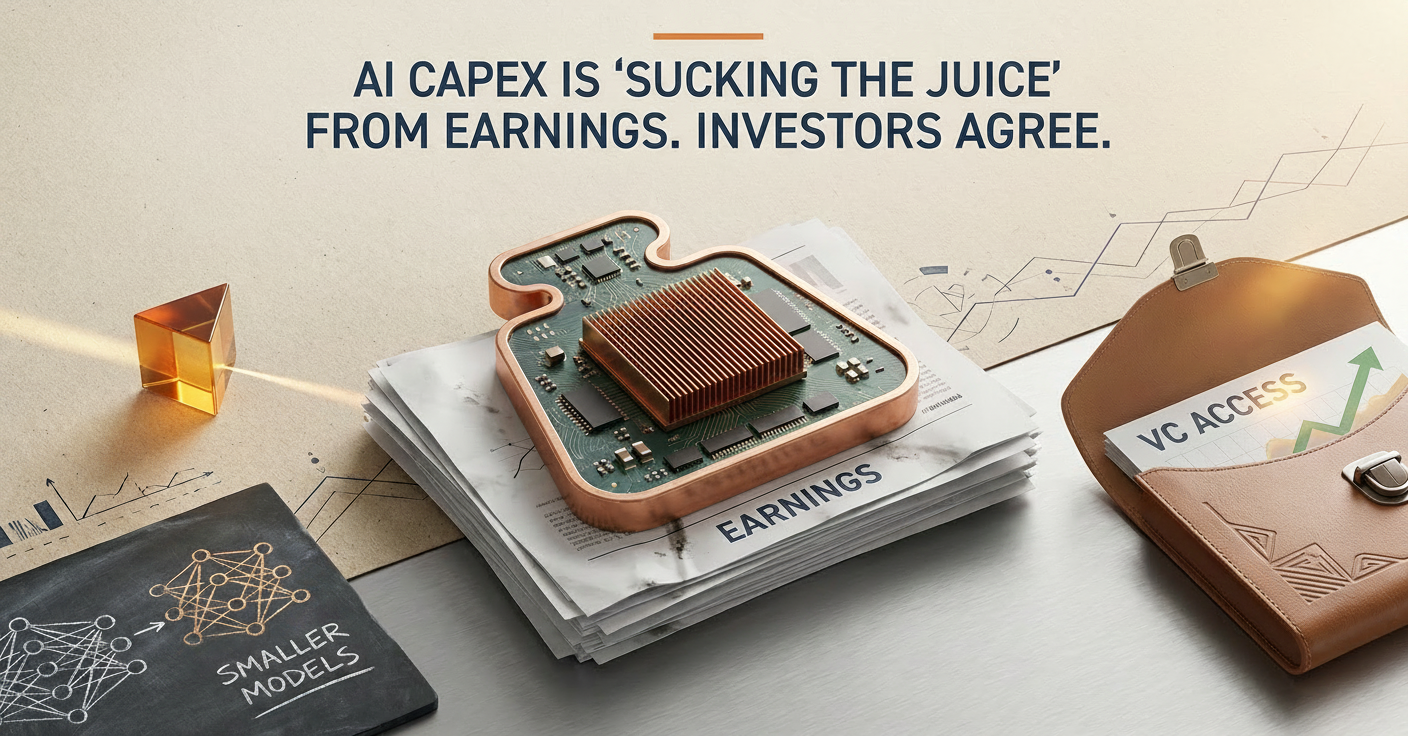
The AI gold rush is shifting from model size to real-world deployment, exposing a harsh truth: capital-intensive AI infrastructure is now creating massive profit compression and investor skepticism.
The Intake
📊 11 episodes across 8 podcasts
⏱ 779 minutes of intelligence analyzed
🎙 Featuring: Harry Stebbings, Y Combinator, Francois Chaubard
|

The Big Shift
The venture landscape is undergoing a significant re-evaluation of AI infrastructure investments. While "compute equals revenue" has been a dominant narrative, the market is quickly learning that massive CapEx for AI infrastructure does not automatically translate to profitability or investor goodwill. The cost of building and maintaining AI compute is "sucking all the juice out of the earnings," leading to profit compression and heightened scrutiny, even for tech giants.
This shift emphasizes a move towards practical application, efficiency, and a clear path to monetization rather than sheer scale. As Scott Galloway (Host, New York Magazine) noted, the investment frenzy is real, but only AI companies demonstrating extreme growth can secure funding. Meanwhile, companies like Meta are seeing stock drops despite massive CapEx increases, signaling investor apprehension about the sustainability and return on investment for these builds.
"The capex requirement to live up to the demand, the infrastructure buildup... is sucking is basically like. Like taking all the juice out of the earnings."
— Scott Galloway, Host at New York Magazine
The broader implication is that the AI market is maturing past its initial hype phase. Founders and investors are now forced to confront the harsh economics of building AI, moving away from a simple "bigger is better" mindset. The focus is now on how AI can deliver demonstrable value and efficient performance, rather than just raw compute power. The shift signals a market correction, demanding smarter, more strategic deployment of capital and a clearer vision for how these massive investments will yield sustainable returns.
The Rundown
① AI as a scapegoat for mass layoffs amidst historical over-hiring.
Shopify CEO Tobi Lütke asserts that current mass layoffs are not AI-driven but rather a consequence of companies over-hiring, with AI serving as a convenient "scapegoat." He envisions an "golden age of entrepreneurship" with AI lowering barriers to starting businesses, facilitating more choices for individuals to pursue fulfilling work or become "gentlemen scientists." (Tobi Lütke on The Twenty Minute VC (20VC))
→ The signal: The narrative around AI's impact on labor is being reframed from job destruction to entrepreneurship enablement, potentially decoupling market anxieties from technological advancement.
② Smaller, recursive AI models are outperforming larger LLMs in reasoning tasks.
Francois Chaubard from YC highlighted that smaller, recursive models, specifically Hierarchical Reasoning Models (HRMs) and Tiny Recursive Models (TRMs), can achieve state-of-the-art results with significantly fewer parameters than massive LLMs on complex tasks like ArcPrize. This challenges the conventional wisdom that only bigger models achieve better performance. (Francois Chaubard on Y Combinator Startup Podcast)
→ Why it matters: This indicates a potential shift in AI R&D focus from brute-force scaling to architectural innovation, offering more efficient and specialized solutions for complex reasoning.
③ The "first 10% of every project are now free" due to AI.
Max Schoening, Head of Product at Notion, emphasizes that AI's capabilities mean the initial stages of any project—from ideation to rapid prototyping—now require "almost no effort," thereby increasing overall project agency. He suggests designers and PMs "think in code" to leverage this newfound fluidity. (Max Schoening on Lenny's Podcast)
→ What to watch: This accelerates product development cycles and significantly lowers the barrier to entry for new startups, intensifying competition across all sectors.
④ AI agents are increasingly chosen models and vendors, not humans.
Jason Lemkin highlighted a future where AI agents, not directly humans, will increasingly select software models and vendors. This could render traditional B2B SaaS products like Jira or Confluence irrelevant to agents, as they have "no need for these products." (Jason Lemkin on The Twenty Minute VC (20VC))
→ The signal: This fundamentally realigns B2B sales and product strategy, demanding that vendors optimize for machine-to-machine interactions and agent preferences rather than human ones.
⑤ Venture capital is becoming accessible to non-accredited investors with $500 minimums.
AngelList has launched USVC, a closed-end fund making venture capital available to non-accredited investors for as little as $500. This fund aims for venture-like returns with quarterly redemption opportunities, democratizing access to a traditionally exclusive asset class. (Ankur Nagpal on This Week in Startups)
→ Why it matters: This initiative could broaden the investor base for startups, but also introduces new regulatory complexities and liquidity expectations into venture investing.
Signal Board
🔥 Heating Up
• Recursion in AI Models: Smaller, recursive models are demonstrating superior performance on complex reasoning tasks compared to larger LLMs, indicating a potential shift from brute-force scaling to architectural innovation. (Francois Chaubard on Y Combinator Startup Podcast)
• Moving from SaaS to AI startups: Head of Sales at Clay, Becca Lindquist, advises sales professionals to transition to high-growth AI startups for greater learning and impact, citing higher surface area for contribution. (Becca Lindquist on The Twenty Minute VC (20VC))
• Agency over skills in AI era: Notion's Head of Product stresses that in the AI era, cultivating agency—the belief that the world is malleable—is more critical than skill-building, as AI makes the "first 10% of every project are now free." (Max Schoening on Lenny's Podcast)
👀 On Watch
• AI Agents Choosing Models and Vendors 🆕: A significant shift where AI agents, rather than humans, will increasingly select software models and vendors, demanding B2B products optimize for machine-to-machine interactions. (Jason Lemkin on The Twenty Minute VC)
• Ketamine Economy 🆕: Scott Galloway used this term to describe the disassociation of the ultra-wealthy from the common good, leading to growing societal anger and impacting investment flows. (Scott Galloway on Pivot)
• USVC (AngelList fund) 🆕: AngelList's new closed-end fund offers non-accredited investors access to venture capital with investments as low as $500, democratizing startup investment but also potentially reshaping market dynamics. (Ankur Nagpal on This Week in Startups)
📉 Cooling Off
• Bitcoin is 'played out' with no incremental buyers 🆕: Jason Calacanis expressed a bearish outlook on Bitcoin, suggesting a perceived lack of new buyers and declining relevance for Bitcoin trusts. (Jason Calacanis on This Week in Startups)
• Classic B2B market is broken or non-durable due to AI 🆕: The market for traditional B2B SaaS tools, especially those for project management or design, is seen as threatened by AI agents that may have no use for them. (Jason Lemkin on The Twenty Minute VC (20VC))
• Intel stock decline 🆕: Scott Galloway predicted a significant downturn for Intel, citing overvaluation and increasing competition from custom chips by Amazon and Google. (Scott Galloway on Pivot)
The Debate
The sustainability of massive AI infrastructure spending: CapEx vs. Earnings
🐂 The bull case: Tech giants like Microsoft, Amazon, and Alphabet are massively increasing CapEx for AI infrastructure, signaling an inevitable future dominated by AI. This spending is viewed as necessary to capture market share and drive future growth, with the expectation that these investments will eventually yield substantial returns. Robert Myers said that "there's such a constraint on COMPUTE right now" indicating that the market demand justifies the high investment.
"It probably takes 4 or 5 billion dollars of CapEx to support that. So if you're going to add 90 billion in revenue capacity, someone between you and your partners has to find plus or minus $300 billion to buy chips, dig holes in the ground, build data centers and make it all happen."
— Jason Lemkin, Guest on The Twenty Minute VC (20VC)
🐻 The bear case: Despite the hype, increasing CapEx for AI is "sucking all the juice out of the earnings," leading to profit compression and investor skepticism. Scott Galloway pointed out that Meta's stock price dropped significantly after announcing increased CapEx for AI, indicating investor concern about the sustainability and return on investment. Furthermore, the notion that "Compute ≠ Revenue" was reinforced, as a good model is equally crucial.
"The capex requirement to live up to the demand, the infrastructure buildup... is sucking is basically like. Like taking all the juice out of the earnings."
— Scott Galloway, Host at New York Magazine
Our read: The market is demanding a clearer path to ROI; massive AI infrastructure spending is under greater scrutiny, pushing focus towards efficiency and true product differentiation over raw compute.
The Bottom Line
The venture market is recalibrating from AI hype to hard economics, rewarding efficient architectural innovation and undeniable value over sheer compute scale and unproven CapEx bets.
📖 Want the full episode breakdowns, guest details, and listen links?
Episode Guide
The Twenty Minute VC (20VC): Venture Capital | Startup Funding | The Pitch — "20VC: Shopify's Tobi Lütke on How AI is a Scapegoat for Mass Layoffs & What Will Labour Markets Be in the Future | Why We Need More Scrutiny on Charitable Giving, Governments are Bad at What They Do and Trump Derangement Syndrome in Canada"
Runtime: 74 min | Host: Harry Stebbings (Host, The Twenty Minute VC (20VC)) | Guest: Tobi Lütke (Co-founder and CEO, Shopify)
For the Stretched CEO: Listen for a contrarian perspective on AI's impact on employment and a strong argument for market-driven capital allocation over traditional charity from a seasoned founder.
Tobi Lütke, CEO of Shopify, contends that current mass layoffs are due to overhiring, not AI, which he sees as a convenient scapegoat. He predicts a "golden age of entrepreneurship" facilitated by AI, leading to more accessible business creation and diverse career paths.
"What you see right now is not AI layoffs. Those are just like the companies that are really slow that overhire just like everyone else doing it. Now what you will see is AI is going to be blamed for absolutely everything because it's the perfect scapegoat."
— Tobi Lütke, Co-founder and CEO of Shopify
Y Combinator Startup Podcast — "Beyond Bigger Models: Recursion As The Next Scaling Law In AI"
Runtime: 38 min | Host: Y Combinator (Host, Y Combinator) | Guest: Francois Chaubard (Visiting Partner, YC)
For the GP looking for new signals: This episode provides a technical deep dive into next-gen AI architectures that challenge the "bigger is better" model, crucial for evaluating emerging AI startups.
Francois Chaubard from YC discusses how recursion at inference time, through models like HRMs and TRMs, can dramatically improve AI reasoning with significantly fewer parameters. This suggests a potential paradigm shift in AI development away from simply scaling model size.
"Recursion advantage now gives you a bunch of advantages over transformers, where rather than having 500 or 1000 or a million or whatever transformer layers and having tons and tons of parameters, you get compute depth basically without this parameter depth."
— Francois Chaubard, Visiting Partner at YC
The a16z Show — "Building Blackstone, Backing Costco, with Tony James"
Runtime: 84 min | Host: David Haber (General Partner, a16z) | Guest: Tony James (Former President and COO, Blackstone)
For the growth equity investor: Gain insights into long-term compounding, strategic M&A, and the art of building global financial powerhouses from one of the industry's titans.
Tony James, former President and COO of Blackstone, shares his journey from building DLJ to scaling Blackstone into a global asset management giant. He highlights the importance of culture, talent, strategic acquisitions, and a focus on long-term value creation.
"Running an investment organization like Blackstone, I think you almost have to be a really good investor if you're going to catch the signals early, they're never obvious. By the time they're obvious, it's priced in."
— Tony James, Former President and COO of Blackstone
Lenny's Podcast: Product | Career | Growth — "Why cultivating agency matters more than cultivating skills in the AI era | Max Schoening (Head of Product, Notion)"
Runtime: 87 min | Host: Lenny Rachitsky (Host) | Guest: Max Schoening (Head of Product, Notion)
For the Stretched CEO: This episode offers a fresh perspective on human capital development in the AI age, emphasizing adaptability and the ability to shape rather than just execute.
Max Schoening, Head of Product at Notion, argues that developing "agency" is more critical than specific skills in the AI era, as AI makes the "first 10% of every project free." He discusses how malleable software and "thinking in code" are transformational for product development.
"The first 10% of every project are now free. It takes almost no effort to now build the first version of a startup."
— Max Schoening, Head of Product at Notion
The Twenty Minute VC (20VC): Venture Capital | Startup Funding | The Pitch — "20VC: Inside Clay's Sales Playbook Scaling to $100M ARR | How to Set Sales Comp Plans | How to Read Sales Talent Linkedin Profiles | What Profiles to Hire & Fire | How to Increase Performance and Speed in Sales Teams with Becca Lindquist"
Runtime: 73 min | Host: Harry Stebbings (Host, 20VC) | Guest: Becca Lindquist (Head of Sales, Clay)
For the operating partner: Learn tactical sales strategies for scaling B2B SaaS in the AI age, including compensation, hiring, and evaluating talent, directly from an executive. (Becca Lindquist, Head of Sales, Clay)
Becca Lindquist, Head of Sales at Clay, shares her playbook for scaling to $100M ARR, focusing on sales compensation, vetting LinkedIn profiles for "high slope" talent, and the importance of high Net Dollar Retention (NDR) for AI companies. She also advises on when to transition from a SaaS company to an AI startup.
"If you leave a company like that and you go to a next gen AI startup, you're going to learn way more. The surface area of what you can actually go and impact is much, much higher."
— Becca Lindquist, Head of Sales at Clay
This Week in Startups — "Can an AI Agent Legally Own a Company? Christian van der Henst's Wild Experiment| E2283"
Runtime: 70 min | Host: Jason Calacanis (Host, This Week in Startups) | Guest: Christian van der Henst (Valerie AI vending machine demo, OpenClaw)
For the VC partner looking for contrarian opportunities: Explore the bleeding edge of AI's legal and operational implications, including decentralized compute and the future of corporate ownership.
Christian van der Henst demonstrates Valerie, an AI agent running a vending machine, sparking discussion on legal personhood for AI, bank accounts, and regulatory challenges. Robert Myers introduces Targon, a confidential GPU compute marketplace, while Jason Calacanis expresses a bearish view on Bitcoin.
"I don't think this is legal. We actually wanted to have a business fully run by an agent, having the business registered to the agents, access to the bank accounts, but it also hired apparently one of the people who works in the cafe."
— Christian van der Henst
Equity — "Did you know you can't steal a charity? Don't worry. Elon Musk will remind you."
Runtime: 38 min | Host: Kirsten Korosec (Transportation Editor and Host, TechCrunch) | Guest: Elon Musk (Former founder of OpenAI, OpenAI (former founder), Tesla, SpaceX)
For the Stretched CEO: Understand the changing investor sentiment on AI infrastructure costs and the increasing scrutiny on tech giants' CapEx, alongside the complexities of founder control post-acquisition.
This episode discusses the Scolly acquisition's data privacy issues, the trend of AI investments (BMW i Ventures), and the Elon Musk vs. OpenAI lawsuit. It highlights investor concern over massive AI infrastructure spending (Meta's stock drop) and the surprising adoption of Microsoft Copilot.
"It is very hard when your company gets acquired to keep control over the thing that you've built, regardless of sort of how many protections you are able to sort of lawyer into the agreement."
— Sean O'Kane, Senior Reporter at TechCrunch
This Week in Startups — "Naval's GP, Ankur Nagpal, Breaks Down The Viral “USVC” Fund | E2284"
Runtime: 98 min | Host: Jason Calacanis (Host, This Week in Startups) | Guest: Ankur Nagpal (GP, AngelList)
For the LP evaluating diversification strategies: This podcast provides an early look into retail VC funds, revealing how AngelList is making venture accessible to non-accredited investors.
Ankur Nagpal introduces USVC, an AngelList fund allowing non-accredited investors to access venture capital with just $500, aiming for venture-like returns and quarterly redemptions. The discussion also covers secure, decentralized AI computation with John Durbin from Shoots.
"Investing in a startup has this accreditation wall. However, with USVC, what we have is a closed end fund that is available to anyone with as little as $500."
— Ankur Nagpal, GP at AngelList
My First Million — "Spotting Billion Dollar Investments Was Hard Until I Learned These 3 Rules | Rohan Oza"
Runtime: 66 min | Host: Sam Parr (Host, My First Million) | Guest: Rohan Oza (Founder, Cavu Consumer Partners)
For the growth executive tracking consumer trends: Learn a proven framework for identifying and scaling billion-dollar consumer brands from an investor with a track record like Vitamin Water and Poppy.
Rohan Oza reveals his three-pronged formula for billion-dollar exits: early trend spotting, brand building (especially "influencing the influencer"), and strategic exits. He shares insights from his success with Vitamin Water and Poppy, emphasizing large TAMs and upgrading existing products.
"Nobody wins the lottery seven times. There's always luck, guys. It's not like this. You can't. You got to. The dice has got to roll your way a little bit. But if you have a game plan, which I've sort of honed over time, the odds flow in your favor."
— Rohan Oza, Founder of Cavu Consumer Partners
The Twenty Minute VC (20VC): Venture Capital | Startup Funding | The Pitch — "20VC: Anthropic Raises $45BN but Falls Short on Compute | OpenAI Crushes with GPT5.5 and Codex: Back in the Game? | China Blocks Manus $2BN Deal to Meta | Thoma Bravo Hand Back Medallia Keys to Creditors | Why Google is a Bigger Buy Than Ever Before"
Runtime: 86 min | Host: Harry Stebbings (Host, The Twenty Minute VC) | Guest: Rory O'Driscoll (Guest, Unknown)
For the GP and fund manager: This episode unpacks the brutal economics of AI compute, the shifting M&A landscape, and the increasing bar for startups to achieve a public exit.
This episode discusses AI agents impacting software, the extreme capital intensity of AI infrastructure (Anthropic vs. OpenAI compute challenges), and the risks for heavily levered enterprise software companies. It also covers China blocking tech deals and the increasing difficulty of startup exits.
"Going forward, more and more the agent is going to choose what models and just what vendors we use. The agents will pick what they want."
— Jason Lemkin, Guest
Pivot — "Big Tech’s Day of Reckoning, Elon Takes the Stand, and the FCC Targets Disney"
Runtime: 65 min | Host: Kara Swisher (Host, New York Magazine) | Guest: Scott Galloway (Host, New York Magazine)
For the Stretched CEO & Growth Executive: Gain insight into the socio-economic implications of unchecked wealth ("ketamine economy"), the AI investment bubble, and the emerging IP challenges for artists in the age of AI.
Kara Swisher and Scott Galloway discuss political pressures on media, big tech's massive AI spending vs. investor sentiment, and Elon Musk's OpenAI lawsuit. They touch on the "ketamine economy," the AI investment bubble, and Taylor Swift's proactive efforts to protect her likeness from AI misuse.
"If you are not an AI right now and growing, you know, 5, 7, 10x a year, you can't raise money."
— Scott Galloway, Host of Pivot