
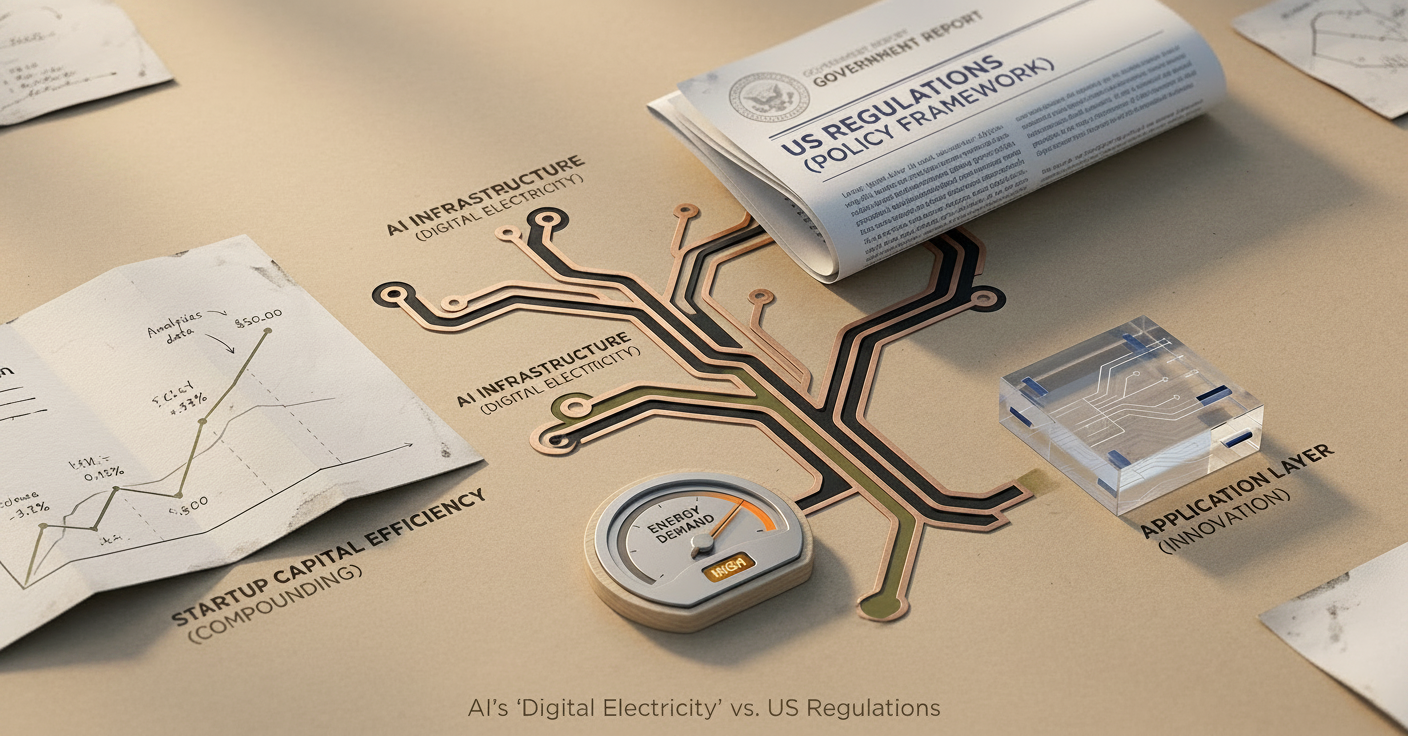
The AI race will be won not in the cloud, but in the trenches of energy infrastructure and application layers, as internal US regulatory friction creates more headwinds than external threats.
📊 11 episodes across 6 podcasts
⏱ 677 minutes of intelligence analyzed
🎙 Featuring: Marc Andreessen (Andreessen Horowitz), Navin Girishankar (CSIS), Brynn Putnam (Board), Jason Calacanis (Host)
|

The Big Shift
While the market narrative often fixates on breakthroughs in AI models and chips, this week’s discussions signal a deeper, more fundamental shift: the battle for AI dominance is moving from algorithm development to the gritty realities of energy, infrastructure, and application-layer innovation. Marc Andreessen, Co-founder and General Partner at Andreessen Horowitz, forcefully argues that internal US regulatory hurdles and supply chain bottlenecks are far greater impediments to AI's full economic impact than external tariffs or competitive threats. Rather than a "capex bubble" in AI infrastructure, we're witnessing an unprecedented demand for "digital electricity" and specialized compute. Companies like Bloom Energy are positioning modular power solutions to meet this demand, understanding that "electricity, not AI models, will decide the winners of the AI race" (KR Sridhar on The Twenty Minute VC). This focus on foundational resources and practical deployment over pure model advancement suggests a market maturing beyond the initial hype cycle.
"99% of the practical restrictions and constraints are not the tariffs. 99% are on the things we do to ourselves inside our own country."
— Marc Andreessen, Venture Capitalist and Co-founder at Andreessen Horowitz
This internal friction creates a unique landscape. As US-based OpenAI builds its own custom 'Jalapeño' chip and Chinese deep tech startups like DeepSeek raise colossal rounds with state backing, the game is clearly about control over the entire vertical stack—from power generation to silicon. The commoditization of foundational AI models is already underway, as Google drops prices for its subscription AI products, pushing the real value towards specialized applications and efficient, localized infrastructure. This dynamic underscores that while AI's intelligence might seem boundless, its real-world impact remains constrained by the terrestrial challenges of power, regulation, and practical application. The smart money is positioning for the infrastructure wars, not just the model wars.
The Rundown
① AI startups are disrupting traditional economics with unprecedented capital efficiency.
New AI companies are achieving '$10, 15, $20 million of revenue per employee', a metric that was "unimaginable" even five years ago, indicating a fundamental shift in how businesses can scale and generate value. (Chi-Hua Chien on Equity)
→ The signal: This level of revenue per employee resets expectations for capital efficiency in software, allowing leaner teams to generate significant revenue and potentially command higher valuations with less dilutive fundraising.
② Internal US regulatory hurdles are AI's biggest bottleneck, not external competition.
Marc Andreessen highlighted that "99% of the practical restrictions and constraints are not the tariffs. 99% are on the things we do to ourselves inside our own country," citing issues like data center permitting and local opposition as primary inhibitors to AI infrastructure growth. (Marc Andreessen on The a16z Show)
→ What to watch: Policymakers and investors should focus on streamlining domestic permitting and regulatory frameworks to accelerate AI infrastructure, as these internal factors are more impactful than geopolitical competition in the immediate term.
③ Hardware startups are getting funded by validating experience, not just finished products.
Board's CEO, Brynn Putnam, successfully raised capital for a tabletop gaming console by "showing off what it was to sit around a shared experience playing with physical pieces as the controller" through "hacky, hacky ways" rather than presenting a fully polished product. (Brynn Putnam on This Week in Startups)
→ Why it matters: This demonstrates a shift in venture appetite for hardware, where compelling user experience and market validation can de-risk early-stage investment, even without a complete product, especially for new categories like gaming consoles.
④ Power, not models, will decide the AI race, accelerating a shift to "digital electricity."
KR Sridhar, Founder and CEO of Bloom Energy, stated that "electricity becomes the key factor" for AI and predicted a new construct: "digital electricity as opposed to the mechanical age electricity," emphasizing efficient, modular, and distributed power solutions. (KR Sridhar on The Twenty Minute VC (20VC))
→ The signal: Energy infrastructure companies with scalable and responsive power solutions are emerging as critical enablers for AI, presenting a massive investment opportunity beyond traditional compute and model development.
⑤ Off-the-shelf software is "pure waste"; AI enables custom enterprise solutions at scale.
Chamath Palihapitiya argued that $4 trillion of the $5 trillion software market is "pure waste" due to maintenance and migration costs, and that AI can now allow every enterprise to have custom software, akin to how Facebook and Tesla built their own. (Chamath Palihapitiya on This Week in Startups)
→ What to watch: This signals a disruption in the enterprise software market, with AI-driven platforms like 8090 allowing customization and efficiency previously only accessible to tech giants, potentially unbundling large incumbents like Oracle and SAP.
⑥ The 'number three' closed-source LLM is the most vulnerable position in the market.
Jason Miller noted that "If you're number three as the closed source LLM, that's where you're going to hit the most pressure from open source," suggesting a market dynamic where the middle ground for proprietary models is unsustainable against open-source advancements. (Jason Miller on The Twenty Minute VC (20VC))
→ Why it matters: Incumbent AI model providers outside the top two need to aggressively differentiate or risk commoditization from open-source alternatives, which are often subsidized or backed by national interests, as seen with China's DeepSeek.
Signal Board
🔥 Heating Up
• Application Layer Wins in AI: Predictions suggest the long-term winners in the AI era will be application companies, much like in previous tech cycles. (Chi-Hua Chien on Equity) 🆕
• US-China AI Race: China's strategic national push for AI sovereignty is evident through massive state-backed funding rounds, like DeepSeek's $50B Series A, indicating intense competition for global dominance. (Harry Stebbings on The Twenty Minute VC (20VC))
• Israel's Consumer Tech Boom: Israel continues to produce billion-dollar consumer companies due to a focus on unit economics and direct US market entry. (Danny Cohen on Consumer VC)
• Electricity as key factor for AI: The massive demand for AI infrastructure is making digital electricity and efficient power solutions a critical determinant of success. (KR Sridhar on The Twenty Minute VC (20VC))
👀 On Watch
• FOMO: A social trading app that raised a $75M Series B at a $550M valuation with an unconventional, hierarchy-free team structure. (Paul Erlanger on The Twenty Minute VC (20VC)) 🆕
• 8090: Chamath Palihapitiya’s new venture aiming to transform the $5 trillion software market by providing an "omnipotent co-founder" for every human using AI. (Chamath Palihapitiya on This Week in Startups) 🆕
• Software Factory concept (8090): This framework allows enterprises to define intentions and automate software development through AI, dramatically improving efficiency and customization. (Chamath Palihapitiya on This Week in Startups) 🆕
• System on a Chip org model: An organizational design inspired by the iPhone's architecture, pushing for efficient, independent functional units over traditional hierarchies. (Chamath Palihapitiya on This Week in Startups) 🆕
❄️ Cooling Off
• Robinhood's Strategy: Criticized for its broad, less-focused approach, especially when compared to social trading apps prioritizing native creators and social feedback loops. (Paul Erlanger on The Twenty Minute VC (20VC))
• Horizontal scaling products: Firms focusing on horizontally scaling all products may face challenges against more intentional, niche-focused competitors. (Paul Erlanger on The Twenty Minute VC (20VC))
• Traditional org charts: AI's ability to automate and streamline tasks challenges the need for traditional hierarchical structures within companies. (Paul Erlanger on The Twenty Minute VC (20VC))
The Debate
This week saw a divergence in views on whether AI makes intelligence cheaper or more expensive in the long run.
🐂 The bull case: Chi-Hua Chien, Co-founder at Goodwater Capital, presented a strong case for the commoditization of AI, noting that "Google announced that their Google product...is dropping price from $7.99 a month to $4.99 a month and is doubling the amount of storage that they're offering." This rapid price reduction points to AI making intelligence more accessible and affordable, democratizing access to powerful tools. 🐻 The bear case: Conversely, Marc Andreessen, Co-founder and General Partner at Andreessen Horowitz, argued that "I think the price declines in intelligence are going to stop. And in fact it may be that actually intelligence is going to start getting more expensive because of such a great insight." He attributed this to significant supply chain bottlenecks in energy, physical infrastructure, and chips, which are pushing costs up despite technological advancements.
Our read: While foundational AI models will continue to see commoditization and price drops, the underlying infrastructure, particularly power and specialized hardware, will likely become a major cost center, leading to a net increase in the "all-in" cost of advanced intelligence for end-users or enterprises.
The Bottom Line
The real AI battleground shifts from algorithms to raw power and the tactical execution of application-layer value, testing the resilience of infrastructure against regulatory friction.
📖 Want the full episode breakdowns, guest details, and listen links?
Episode Guide
The a16z Show — "Beyond P(doom): Marc Andreessen - Betting on America"
Runtime: 65 min | Host: Navin Girishankar | Guest: Marc Andreessen (Co-founder and General Partner, Member of the President's Council of Advisors on Science and Technology, Andreessen Horowitz)
For the Policy-Minded VC: Understand how internal US regulatory challenges, not just tariffs, impede AI development and economic growth.
Marc Andreessen discusses AI's potential to revolutionize sectors like healthcare and education, but highlights institutional and regulatory barriers, particularly within the US, as hindrances to its full economic impact, potentially driving up the cost of intelligence. He also critiques conflicting US policy goals regarding AI export vs. control.
"99% of the practical restrictions and constraints are not the tariffs. 99% are on the things we do to ourselves inside our own country."
— Marc Andreessen, Venture Capitalist and Co-founder at Andreessen Horowitz
The Twenty Minute VC (20VC): Venture Capital | Startup Funding | The Pitch — "20VC: Leo Aschenbrenner's Largest Holding: Inside the $90BN Bloom Energy | Why Electricity, Not AI Models, Will Decide the Winners of the AI Race | Why We Are Not in an AI Capex Bubble | Energy Sovereignty and The Future of Power with KR Sridhar"
Runtime: 61 min | Host: Leo Aschenbrenner | Guest: KR Sridhar (Founder and CEO, Bloom Energy)
For the Infrastructure Investor: Dive into why power, not AI models, is the ultimate determinant of AI success and how Bloom Energy is addressing this fundamental need.
KR Sridhar of Bloom Energy posits that "digital electricity" is the crucial input for AI, predicting a new era of efficient, accessible power. He refutes the idea of an AI infrastructure bubble, seeing it as a "hockey stick on a hockey stick" of growth due to intelligence manufacturing, and highlights modular power solutions for data centers.
"Clearly electricity becomes the key factor. So herein I see it slightly differently. I believe the fact that electricity became so important for this critical industry that knows how to move at speed and scale is going to mean that Since Edison, almost 150 years later, we are going to create a new construct for electricity in the world that's more digital electricity as opposed to the mechanical age electricity."
— KR Sridhar, Founder and CEO of Bloom Energy
This Week in Startups — "Why the Future of Video Games is Moving Back to the Dinner Table"
Runtime: 69 min | Host: Jason Calacanis | Guest: Brynn Putnam (CEO and Founder, Board)
For the Consumer Hardware Founder: Learn how to validate user experience and secure funding for hardware without a finished product by focusing on core interaction.
Brynn Putnam discusses Board, a tabletop gaming console blending physical and digital play. She shares how she raised capital by validating the user experience without a finished product and strategically leveraged manufacturing in Mexico and Thailand. The episode also touches on Hermeus's hypersonic aircraft development.
"I've always focused on trying to validate the experience for investors. And so really we built early days a product where the technology wasn't fully there, but it really showed off what it was to sit around a shared experience playing with physical pieces as the controller. And we did that through a series of hacky, hacky ways and that's how we raised our first round."
— Brynn Putnam, CEO and Founder at Board
Consumer VC: Venture Capital I B2C Startups I Commerce | Early-Stage Investing I Brands | Technology — "Why Israel Keeps Producing Billion-Dollar Consumer Companies with Danny Cohen and Oren Charnoff"
Runtime: 52 min | Host: Mike Gelb | Guest: Danny Cohen (Co-founder, Sticker Ventures), Oren Charnoff (Co-founder, Sticker Ventures)
For the Retail & Consumer Investor: Explore the unique factors driving Israel's success in consumer startups, from military innovation to unit economics.
Danny Cohen and Oren Charnoff explain how Israel's culture of innovation and focus on unit economics from day one are creating successful consumer startups. They highlight the preference for US market entry for fast feedback and AI's role in fueling vertical consumer opportunities, attracting significant investment.
"We deeply believe the best distribution tends to win, not necessarily the best product and consumer. So we look for those types of entrepreneurs."
— Oren Charnoff, Co-founder at Sticker Ventures
Founders — "#423 Soichiro Honda"
Runtime: 48 min | Host: David Senra | Guest: Soichiro Honda (Founder, Honda)
For the Visionary Entrepreneur: Gain insights into Honda's philosophy of relentless product improvement, risk-taking, and technology subservient to humanity.
David Senra delves into the life of Soichiro Honda, emphasizing his dedication to improving existing products, his maverick spirit, and his relentless focus on engines, all against a backdrop of repeated failures. The episode covers Honda's innovative R&D approach and commitment to quality.
"Success can only be achieved through repeated failure. In fact, success represents 1% of your work, which results only from the 99% that is called failure."
— David Senra, Host of Founders Podcast
The Twenty Minute VC (20VC): Venture Capital | Startup Funding | The Pitch — "20VC: How We Got Fred Wilson, Benchmark and Index to Invest $94M | Why Robinhood's Strategy is Wrong | Why 1-1s are BS and What Every Founder Gets Wrong About Equity | Why Taste Beats AI But How AI Kills Org Charts with Paul Erlanger, CEO @ fomo"
Runtime: 57 min | Host: Harry Stebbings | Guest: Paul Erlanger (Co-Founder and CEO, FOMO)
For the Innovative Founder & Operator: Discover unconventional strategies for team structure, fundraising, and product development in high-growth startups.
Paul Erlanger, CEO of FOMO, discusses his company's unique approach: eschewing traditional hierarchies and 1-on-1 meetings, offering founder-level equity, and securing a $75M Series B with a lean team. He emphasizes the power of user feedback and rapid iteration, and how AI accelerates engineering productivity.
"If you're trying to raise another round, wait to announce your last round. Everything is about momentum."
— Paul Erlanger, Co-Founder and CEO of FOMO
Equity — "OpenAI's Jalapeño chip is Big Tech's spiciest move away from Nvidia yet"
Runtime: 36 min | Guest: Kirsten Korosec (Transportation Editor, TechCrunch), Anthony Ha (Weekend Editor, TechCrunch), Sean O'Kane (Senior Reporter Special Projects, TechCrunch)
For the Cloud & AI Executive: Understand the strategic implications of custom AI chip development and the rising costs of memory chips on the industry landscape.
OpenAI's "Jalapeño" chip, developed with Broadcom, signifies a broader trend of tech giants creating in-house silicon to reduce reliance on Nvidia and control costs. The discussion also covers the impact of booming memory chip demand, the resurgence of SPACs for mature companies, and the debate around AI in creative industries.
"I think anything that companies like OpenAI can do to lower prices at any point of the process in the world, the vast world of chips, I think it's going to be super important."
— Kirsten Korosec, Transportation Editor at TechCrunch
This Week in Startups — "Why F1 Teams are Replacing Wind Tunnels with Smart Tape | E2305"
Runtime: 90 min | Host: Jason Calacanis | Guest: Lyall Davenport (Founder, SKN Systems)
For the Deep Tech & Manufacturing Innovator: Observe how advanced sensor technology is radically cutting costs and improving data collection in traditional engineering fields.
SKN Systems' sensor-embedded tape replaces expensive F1 wind tunnels, generating 420 million data points per hour from real-world conditions at a 95% cost reduction. Lyall Davenport discusses applications extending to defense and automotive. The episode also touches on government AI intervention, OpenAI's hardware expansion, and data center impact on communities.
"If you compare that to a wind tunnel, we are in the order of 95% cheaper than the operating cost of turning that fan on."
— Lyall Davenport, Founder of SKN Systems
Equity — "What if the AI giants are building the roads, not the destinations? Chi-Hua Chien thinks he knows who wins"
Runtime: 43 min | Guest: Connie Loizos (Editor In Chief, TechCrunch), Chi-Hua Chien (Co-founder, Goodwater Capital)
For the Application-Layer Investor: Get Chi-Hua Chien's prescient take on why AI application companies, not just infrastructure, will be the long-term winners.
Chi-Hua Chien argues that AI application companies will be the long-term winners, despite current infrastructure hype, noting unprecedented revenue per employee in AI startups ($10-20M/employee). He highlights the commoditization of infrastructure (e.g., Google's AI price drops) and the rise of hyper-personalized applications across industries.
"Nowadays you're getting companies doing 10, 15, $20 million of revenue per employee which even 10 years ago or even five years ago that would have been unimaginable."
— Chi-Hua Chien, Co-founder at Goodwater Capital
This Week in Startups — "Chamath on why young people need more agency, risk, and adventure"
Runtime: 72 min | Host: Jason Calacanis | Guest: Chamath Palihapitiya (Founder, 8090 / Social Capital)
For the Enterprise Software or Platform Founder: Grasp Chamath's vision for an AI-driven "Software Factory" to eliminate wasteful enterprise software costs.
Chamath Palihapitiya introduces his new venture, 8090, targeting the $4 trillion "waste" in the $5 trillion software market. He details the "Software Factory," an AI-driven system to create custom enterprise software efficiently, inspired by how tech giants built their own solutions. He also advocates for AI as a "co-founder" for every human.
"I would have agreed with you until AI. And the reason is I saw this cost curve where the unit cost of production was going to approach zero. So there was no task that was either too menial, too manual, too repetitive, or too difficult… that couldn't be accomplished at some point by these models."
— Chamath Palihapitiya, Founder of 8090
The Twenty Minute VC (20VC): Venture Capital | Startup Funding | The Pitch — "20VC: Deepseek Raises $50BN | Wall St's $725BN AI Question | The Rise of Open Source & How it Threatens OpenAI & Anthropic | OpenAI Builds it's Own Chip: Jalapeno | The Death of Moats & The New AI Software Winners"
Runtime: 84 min | Host: Harry Stebbings | Guest: Jason Miller (Guest, Unspecified), Rory O'Driscoll (Guest, Unspecified)
For the AI Strategy Executive: Understand the shifting landscape of AI moats, the threat of open source, and the strategic implications of state involvement in AI funding.
Harry Stebbings and guests discuss talent shifts (Google DeepMind to Anthropic), China's AI strategy (DeepSeek's $50B funding with state voting rights), and the rising pressure on "number three" closed-source LLMs from open-source alternatives. They highlight skyrocketing AI infrastructure costs, especially memory (DRAM), and the focus on ROI for enterprise AI investments.
"If you're number three as the closed source LLM, that's where you're going to hit the most pressure from open source."
— Jason Miller