
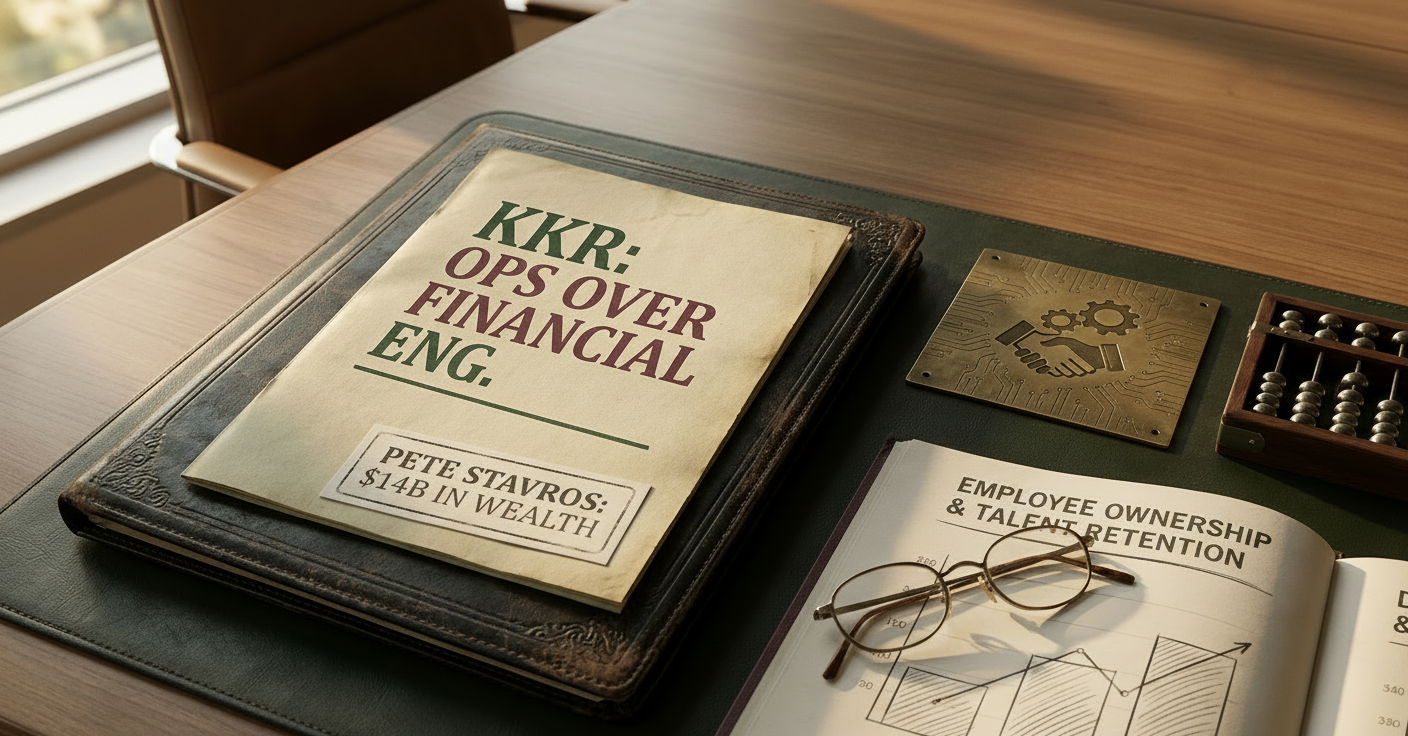
Cash-constrained founders are hitting a wall, and savvy investors know the real leverage is in operational excellence, not financial engineering.
📊 11 episodes across 10 podcasts
⏱ 536 minutes of intelligence analyzed
🎙 Featuring: Patrick O'Shaughnessy, Gavin Uberti, Rob Wachen, Gavin
|

The Big Shift
The days of relying on cheap money and multiple expansion to drive private equity returns are over. With interest rates nearly doubled since 2021, financial engineering is taking a backseat, and operational excellence is now the primary lever for value creation. This isn't just about cutting costs; it's about deeply understanding a business, fostering strong culture, and investing in talent.
Paul Isaac, Managing Partner at Isaac Management LLC, highlighted this shift, noting, "Operations is where all the bodies are buried. Operations is where companies go to live and die... Optimizing the technology that you're using is important. So operations, bar none, is the most powerful lever that you can pull." This echoes insights from KKR’s Pete Stavros, whose expansive employee ownership program, designed to boost engagement and productivity, has created $14 billion in worker wealth across 85 companies.
The market tension: Many bankers are still trying to sell companies at 2021 valuations, creating a significant disconnect in the lower-middle market as buyers adapt to higher interest costs. This forces a renewed focus on EBITDA growth through genuine operational improvements.
The move: GPs and operators need to pivot from financial arbitrage to deep operational engagement. This means developing internal talent, streamlining processes, and understanding customer needs granularly—not just what the P&L says. The era of high-growth, asset-light plays driven by cheap capital is giving way to a more disciplined, value-building approach centered on the core business.
"Operations is where all the bodies are buried. Operations is where companies go to live and die... Optimizing the technology that you're using is important. So operations, bar none, is the most powerful lever that you can pull."
— Paul Isaac, Managing Partner of Isaac Management LLC on The Private Equity Podcast, by Raw Selection
The Rundown
① Private market access for retail investors means semi-liquid credit, not PE.
Asset managers are pushing "democratization" of private markets, but PitchBook's Nizar Tarhuni clarified these are predominantly semi-liquid credit funds, not illiquid private equity, due to natural liquidity in credit investments. (Nizar Tarhuni on Private Equity Funcast)
→ The Signal: Don't mistake the rhetoric for reality; access funds for 401(k)s are targeting credit for a reason, but duration mismatch remains a significant risk if not properly managed, potentially introducing new market volatility.
② AI development needs specialized hardware to scale effectively, not just more GPUs.
Etched co-founders Gavin Uberti and Rob Wachen detailed their specialized AI chip for inference, arguing that thermal management and low-voltage architecture are crucial to widespread AI adoption, which general-purpose GPUs can't cost-effectively provide. (Gavin Uberti and Rob Wachen on Invest Like the Best with Patrick O'Shaughnessy)
→ Why it matters: Startups solving fundamental hardware bottlenecks like thermal throttling are building the picks and shovels for the next phase of AI, moving beyond the current compute-constrained environment and enabling broader, cheaper adoption.
③ Transparency and 'Systems Design' are paramount for AI adoption and customer trust.
Autodesk CMO Dara Treseder emphasized that velocity and governance are not mutually exclusive in AI, citing Starbucks' mishap as a system design failure, not just an AI problem, stressing the need for clear communication on AI use to prevent customer distrust. (Dara Treseder on Masters of Scale)
→ Actionable Insight: For any firm deploying AI, proactively designing for transparency and ethical governance is critical; avoiding this can lead to consumer backlash and reputational damage more severe than the efficiency gains.
④ Long-term value creation hinges on employee retention, as replacement costs soar.
Paul Isaac highlighted that replacing a $50k employee costs $85k, making talent development and retention a far more profitable strategy than short-sighted cost-cutting through layoffs. (Paul Isaac on The Private Equity Podcast, by Raw Selection)
→ The Playbook: Investors and operators must shift focus from simply reducing headcount to investing in their workforce, recognizing that high turnover can silently erode future profitability and operational stability.
⑤ Consumer product success increasingly relies on "proven, better, new" and tailored product offerings.
Mark Pincus of Zynga introduced his "Proven Better New" framework, emphasizing strategic copying and then improving on existing successful ideas, particularly relevant as Aldi thrives by offering fewer, curated choices and optimizing store efficiency over vast selection. (Mark Pincus on Masters of Scale, Scott Patton on Odd Lots)
→ The Counter-Intuitive Truth: In an age of overwhelming choice, simplifying the product offering can increase customer confidence and drive efficiency, suggesting a premium on curation and clear value proposition over sheer breadth of catalog.
Signal Board
🔥 HEATING UP
• Broad-based employee ownership program: KKR's Pete Stavros revealed their program has reached 85 companies, targeting $14 billion in wealth for 200,000 frontline workers, proving the model can scale effectively and drive significant returns. (Pete Stavros on Dry Powder: The Private Equity Podcast)
• Protein trend across various food categories: Aldi is observing a significant increase in sales of protein products and fiber-rich items, influenced by both GLP-1 medications and inflationary pressures. (Unknown Executive on Odd Lots)
• Operational Improvements as a Growth Lever: Paul Isaac stressed that operational efficiency and talent development are paramount in the current lower-middle market, outperforming financial engineering. (Paul Isaac on The Private Equity Podcast, by Raw Selection)
• Transparency and Valuation in Private Equity: PitchBook and Morningstar are actively working to address these issues to facilitate broader retail investor access to private markets. (Nizar Tarhuni on Private Equity Funcast)
🆕 ON WATCH
• semi-liquid vehicles 🆕: These funds are being developed to allow retail investors access to private assets, primarily private credit, driven by asset managers seeking new capital sources. (Nizar Tarhuni on Private Equity Funcast)
• Barcode innovation and efficiency in grocery retail 🆕: Aldi uses multi-barcode packaging and electronic shelf labels to dramatically cut labor costs and speed up checkout, a strategy that could spread more broadly. (Unknown Executive on Odd Lots)
• Autodesk's $350M AI workforce investment 🆕: Autodesk is committing $350 million to prepare the next generation for jobs in the AI era through technology training and credentialing. (Dara Treseder on Masters of Scale)
• Open source models for enterprise 🆕: Palantir and Nvidia's partnership highlights the critical need for enterprises to control their AI models and data, with open-source options offering cost and speed advantages over frontier models. (Chamath Palihapitiya on All-In with Chamath, Jason, Sacks & Friedberg)
• Duration mismatch 🆕: A concern for semi-liquid funds, which promise retail investors liquidity monthly or quarterly while investing in illiquid underlying assets like private credit. (Nizar Tarhuni on Private Equity Funcast)
🥶 COOLING OFF
• California's Fiscal Crisis and Potential Federal Bailout 🆕: Gavin Newsom's budget claims and potential calls for federal absorption of pension liabilities are garnering skepticism. (David Sacks on All-In with Chamath, Jason, Sacks & Friedberg)
• Fundraising drying up due to increased cost of capital 🆕: Traditional fundraising has slowed significantly since 2022, prompting asset managers to explore new capital sources like retail investors through structured products. (Nizar Tarhuni on Private Equity Funcast)
• RAMageddon: While still a concern, the extreme shortage of DRAM and RAM chips is leading companies like Apple to lobby for Chinese suppliers, potentially shifting global tech supply dynamics. (James Kynge on The Prof G Pod with Scott Galloway)
The Debate
Topic: The speed and scale of private market "democratization" for individual investors. 🐂 The bull case: Nizar Tarhuni from PitchBook argues that the shift towards retail access to private markets is inevitable and necessary, primarily driven by the shrinking public markets and the increasing number of high-growth companies remaining private. He sees semi-liquid credit funds as the most natural and safe entry point due to embedded liquidity, stating, "The best place where I think there's actually a ton of positive things happening is in the semi liquid credit markets. There's liquidity that naturally is embedded in credit investments." He believes it's about fairness, allowing everyday investors to participate in the growth of companies like SpaceX and Anthropic that stay private longer. 🐻 The bear case: While acknowledging the potential, Tarhuni and host Devin raise significant concerns about liquidity mismatches if not properly managed. Devin stated, "I think trying to manufacture liquidity via leverage or a different type of creative wrapper is probably not the way to do it. Because ultimately, when you own a private asset, there are things you have to do in that business to generate the return that you need, which means you need some time." The risk is that if these vehicles are not structured to truly match asset illiquidity with investor expectations, they could create systemic volatility, especially if investors need to withdraw capital faster than illiquid assets can be sold. Our read: The push for retail access to private markets is happening, but the smart money is highly selective, focusing on naturally liquid credit strategies rather than trying to engineer liquidity into truly illiquid assets.
The Bottom Line
The best investments right now aren't just about capital; they're about operators who can grind out value through relentless efficiency and a deep understanding of their business.
📖 Want the full episode breakdowns, guest details, and listen links?
Episode Guide
1. Dare to Lead with Brené Brown — "Sports as Leadership Theater and Recognizing Near Enemies"
Runtime: 43 min | Host: Brené Brown (Host, Vox Media Podcast Network) | Guest: Adam Grant (Organizational Psychologist, University of Pennsylvania)
Who should listen: Leaders looking to deepen their understanding of personal values and their impact on team dynamics. It's a masterclass in strategic self-awareness.
Brené Brown and Adam Grant explore the Buddhist concepts of 'near and far enemies' in leadership, emphasizing how virtues like discipline can be undermined by their 'near enemies' like rigidity. They draw parallels between elite athletes' practice-to-performance ratio and the critical need for leaders to invest in intentional preparation and 'pre-mortems' to solve problems before they arise, combating 'hyperbolic discounting' which devalues future time.
"People spend easily 95% of their time as elite, elite athletes practicing for performance. That's a tiny fraction of their career. Which is the exact opposite of what most leaders and team members do at work."
— Brené Brown, Host of Dare to Lead with Brené Brown
2. How I Built This with Guy Raz — "Advice Line with Ronnen Harary of Spin Master/PAW Patrol"
Runtime: 43 min | Host: Guy Raz (Host, Wondery) | Guest: Ronnen Harary (Co-founder and Chairman of the Board, Spin Master)
Who should listen: Aspiring entrepreneurs and founders navigating early growth, particularly those in CPG or seeking to balance growth with personal well-being.
Ronnen Harary shares insights from his book "No Experience Necessary," advocating for young entrepreneurship. He advises on adapting to market challenges like surging gold prices and scaling premium products. The discussion underscores the importance of choosing a growth path thoughtfully—whether aggressive retail expansion or controlled social media storytelling—and maintaining work-life balance in personal businesses.
"It's called no experience necessary. Why betting on yourself in your 20s is the best decision you'll ever make. And it's really a manifesto based on my lived experience about why I think that your 20s is the best time to start a business, if you're so inclined to."
— Ronnen Harary, Co-founder and Chairman of the Board at Spin Master
3. The Prof G Pod with Scott Galloway — "China Decode: Apple's China Chip Play, DeepSeek Seeking Billions, and the Californication of Chinese Food"
Runtime: 49 min | Host: Alice Han (Host, Vox Media Podcast Network) | Guest: James Kynge (Host, Vox Media Podcast Network)
Who should listen: Anyone needing a nuanced take on US-China tech and trade relations, particularly in semiconductors and AI investment.
Alice Han and James Kynge deep dive into Apple's lobbying efforts for Chinese chip access amid a global DRAM shortage, and DeepSeek's massive funding round, signaling China's AI ambitions. They also discuss Europe's "reverse Deng effect," where European countries seek tech transfers from Chinese firms, and the "Californication" of Chinese food culture—a surprising trend towards organic and premium products despite rising obesity.
"We are in a structural shortage of DRAM and RAM chips. So Ramageddon, I think is gonna last for quite some time. We’re just at the beginning of the trend."
— James Kynge, Host at Vox Media Podcast Network
4. Invest Like the Best with Patrick O'Shaughnessy — "Etched - Building AI Hardware to Make Inference Faster and Cheaper - [Invest Like the Best, EP.480]"
Runtime: 87 min | Host: Patrick O'Shaughnessy (CEO | Host, Positive Sum) | Guest: Gavin Uberti (Co-founder, Etched)
Who should listen: Investors and operators keen on understanding the fundamental infrastructure powering AI, beyond just software models.
Gavin Uberti and Rob Wachen, co-founders of Etched, share their journey building a specialized AI chip for inference, tackling thermal challenges with novel low-voltage technology. Their story highlights the immense potential of dedicated AI hardware to drive productivity and scientific discovery, emphasizing the need for infrastructure to support widespread AI adoption beyond the current limited user base, and the product-centric, vertically integrated development philosophy driving their progress.
"We're at 1/1000th of the global population actually using this stuff. If you want to serve at giant scale, a lot of things change."
— Gavin Uberti, Co-founder of Etched
5. Dry Powder: The Private Equity Podcast — "Employee Ownership at Scale w/ KKR's Pete Stavros"
Runtime: 17 min | Host: Hugh MacArthur (Host, Chairman of Bain's Global Private Equity Practice, Bain & Company) | Guest: Pete Stavros (Global Co-Head of Private Equity, KKR)
Who should listen: Private equity professionals and portfolio company executives looking for actionable strategies in value creation and employee engagement.
Pete Stavros details KKR's massive employee ownership program, covering 85 companies and 200,000 frontline workers, aiming to create $14 billion in wealth. He discusses the program's initial missteps and ultimate success in boosting productivity and engagement. Stavros also clarifies AI's current role as a helpful, but not yet transformational, lever across KKR's portfolio and highlights their evergreen vehicle's strategic importance in private wealth expansion.
"We've now done this with 85 companies. About 200,000 frontline workers have ownership in these programs. Across those 85 companies, we think they are in a position to make $14 billion of wealth for themselves."
— Pete Stavros, Global Co-Head of Private Equity at KKR
6. The Private Equity Podcast, by Raw Selection — "Insights into the Private Equity Lower-Middle Market"
Runtime: 29 min | Host: Alex Rawlings (Host, Raw Selection) | Guest: Paul Isaac (Managing Partner, Isaac Management LLC)
Who should listen: Private equity investors, particularly those focused on the lower-middle market, seeking alternative models and insights into operational value creation.
Paul Isaac discusses his firm's permanent-capital model, contrasting it with traditional PE. He stresses cultural understanding and operational improvements over financial engineering, citing the risks of overleveraging in the current high-interest environment. Isaac calls out the deal valuation disconnect and advocates for authenticity in seller interactions, underlining the critical role of talent development and employee retention in sustainable growth.
"Interest rates have pretty much doubled almost even more since 2021. And so when a, a company is going to market and they're talking to a banker or a broker, that banker's job is to sell the company at the best price that they can get for their, for their customer."
— Paul Isaac, Managing Partner of Isaac Management LLC
7. Masters of Scale — "Cannes Lions’ battle of the brands: Starbucks’ stumble, World Cup ads, and more"
Runtime: 31 min | Host: Bob Safian (Host of Rapid Response, WaitWhat) | Guest: Dara Treseder (CMO, Autodesk)
Who should listen: Marketing leaders and strategists needing to navigate AI adoption and brand building in a rapidly evolving digital landscape.
Bob Safian and Autodesk CMO Dara Treseder unpack the advertising world's adaptation to AI live from Cannes Lions. Treseder stresses transparency and robust system design for AI implementation to build customer trust, noting Starbucks' error as a critical system failure. The discussion covers the increasing influence of the creator economy and the importance of investing in the next-gen workforce for the AI era; Autodesk is committing $350 million to training and credentialing for AI jobs.
"I'm really focusing on investing in the people. There's not been enough conversations about how we are investing in the next generation... We actually just committed $350 million to invest in preparing the next generation for jobs in this AI era."
— Dara, Leader at Autodesk
8. Masters of Scale — "How to build breakout products, with Mark Pincus & Reid Hoffman"
Runtime: 30 min | Host: Reid Hoffman (Host, Masters of Scale) | Guest: Mark Pincus (Co-founder, Zynga)
Who should listen: Product strategists, innovators, and VCs looking for original approaches to product development and market disruption.
Mark Pincus, co-founder of Zynga, introduces his "Proven Better New" product development framework, advocating for learning from instincts and artful copying in lieu of purely novel ideas. He and Reid Hoffman draw parallels between past tech winters and the current AI landscape, noting overlooked consumer application potential. Pincus, a gaming pioneer, also discusses his strict screen time rules for his kids and argues for a metaverse future integrated with real-world social elements, while both critique VCs' overreliance on pattern recognition.
"This feels very analogous to Internet Nuclear winter. We called it in 02 to 03, right. When you started LinkedIn and I started Tribe. And this feels very like a similar moment that it's just it's not figured out, but you know it's going to be."
— Reid Hoffman, Host of Masters of Scale
9. Private Equity Funcast — "Private Equity is Coming For Your 401(k) (w/ PitchBook's Nizar Tarhuni)"
Runtime: 54 min | Host: Devin (Host, Private Equity Funcast) | Guest: Nizar Tarhuni (EVP of Research & Market Intelligence, PitchBook)
Who should listen: Investors and LPs interested in the evolving private market landscape and the implications of retail investor access.
Devin and Nizar Tarhuni discuss the "democratization" of private markets, largely through semi-liquid, evergreen credit funds aimed at retail investors. They explore the motivations, including asset managers seeking new capital as traditional fundraising slows, and investor demand for high-growth private company access. Concerns include fee structures and potential duration mismatch, with Tarhuni emphasizing the concentrated nature of venture capital success and PitchBook's efforts to enhance transparency despite these structural challenges.
"If you open up the market, where's the money going to go? On the flip side of that $200 billion coming into private equity. Doesn't mean that Apollo, Blackstone, Parker Gale all of a sudden are going to go buy assets from other private equity firms to release this constipation we have in the market of 40,000 private equity owned businesses that can't trade for whatever reason."
— Nizar Tarhuni, EVP of Research & Market Intelligence at PitchBook
10. All-In with Chamath, Jason, Sacks & Friedberg — "AI Sovereignty Wars, Palantir-Nvidia Deal, SCOTUS Birthright Ruling, Newsom's CA Budget Lie"
Runtime: 102 min | Host: Chamath Palihapitiya (Host, All-In Podcast, LLC) | Guest: David Sacks (Host, All-In Podcast, LLC)
Who should listen: Tech executives, investors, and policymakers grasping with the geopolitical and economic implications of AI development and deployment.
The All-In with Chamath, Jason, Sacks & Friedberg hosts dissect the concept of AI sovereignty, spurred by the Palantir-Nvidia partnership, highlighting the critical need for enterprises to control their AI models, data, and compute to protect proprietary knowledge from vertically integrating frontier model providers. Chamath Palihapitiya presents data showing open-source AI models can be cheaper and faster, while David Sacks warns against handing valuable data to model providers who might then compete with their own users. The discussion also ventures into AI's impact on employment, and the complexities of immigration policy and constitutional law.
"Everybody has an incentive for a competitive layer of the stack at the model layer, 100%. Really, the only companies who don't are Anthropic and OpenAI, because obviously they want to dominate, they want to be a duopoly."
— David Sacks, Host
11. Odd Lots — "How a Major Grocery Store Chain Can Dramatically Lower the Cost of Food"
Runtime: 51 min | Host: Joe Wiesenthal (Host, Bloomberg) | Guest: Scott Patton (US Chief Commercial Officer, Aldi)
Who should listen: Retail operators, logistics professionals, and anyone interested in the economics of grocery and supply chain efficiency.
Joe Wiesenthal and Tracy Alloway explore Aldi's highly efficient model for dramatically lowering food costs, focusing on its Manhattan strategy, fewer SKUs, and extensive private labels. Scott Patton, US Chief Commercial Officer, details how Aldi optimizes logistics with specialized transport for urban environments and cutting-edge barcode technology for rapid checkout. The conversation also touches on Aldi's rebranding efforts, response to consumer trends like GLP-1 medication impacts, and their unique 'Aisle of Shame' marketing approach.
"We have 2,000 SKUs in the store, probably 4,000 varieties... I would simply ask the customer, do you really need 40 choices for ketchups or is two... enough?"
— Scott Patton, US Chief Commercial Officer of Aldi