
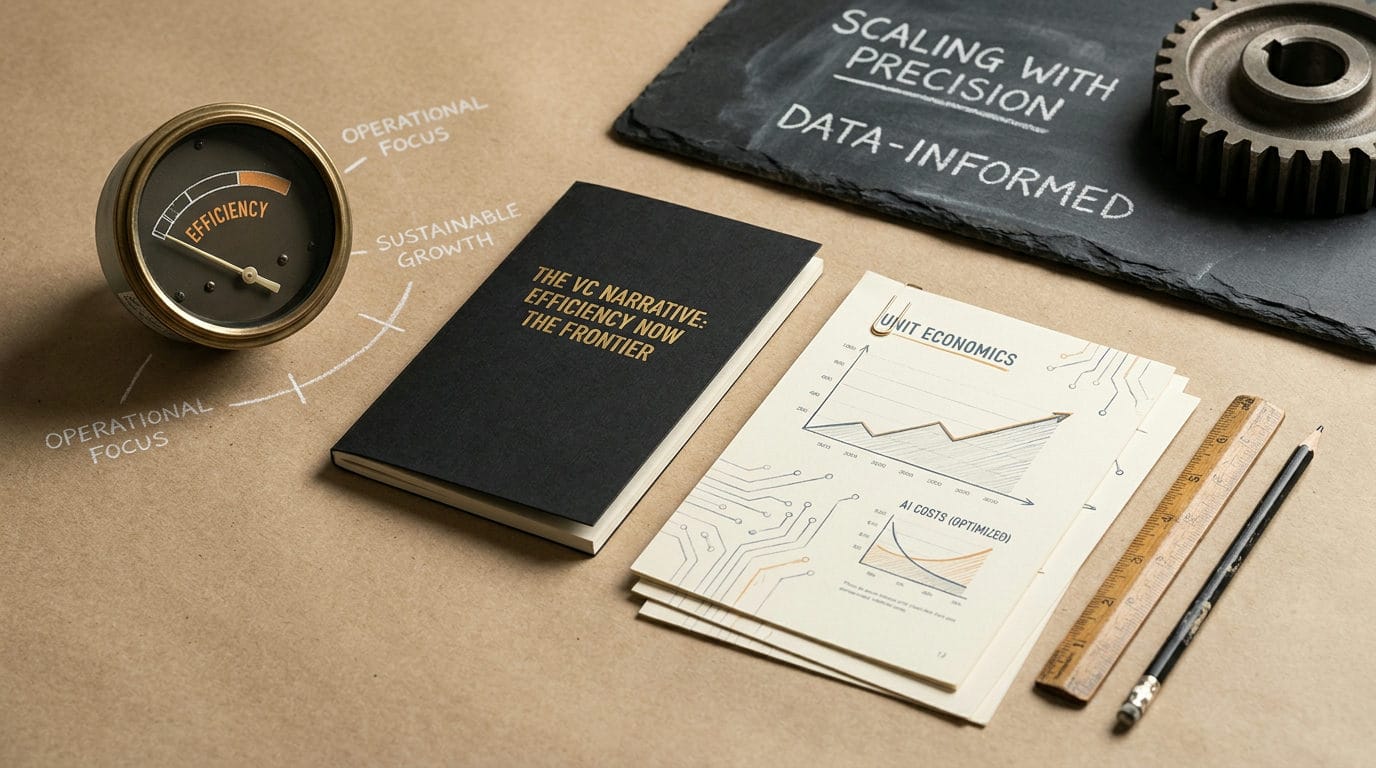
The smartest capital is quietly re-underwriting the cost of scale, focusing on efficiency and verifiable impact over headline-grabbing frontier bets.
The Intake
📊 11 episodes across 6 podcasts
⏱ 733 minutes of intelligence analyzed
🎙 Featuring: David Senra, Peter Sellis, Lenny Rachitsky, Daniel Dines, Josh Elman, Ben Horowitz, Nas, Grandmaster Caz, Steve Stoute, Kara Swisher, Scott Galloway, Jessica Tarlov, Ali Ghodsi, Martin Casado, Sarah Wang, Grant Lafontaine, Shaan Puri, Sam Parr, Joe Hudson, Jennifer Li, Gorkem Yurtseven, Batuhan Taskaya
|

The Big Shift
For years, the venture narrative was about speed and disruptive innovation at all costs. This week, conversations shifted dramatically to the hidden, foundational costs of scaling, whether it's an AI model or a multi-billion dollar e-commerce platform. Founders and investors are recognizing that durable advantage now comes from ruthless efficiency, precise process definition, and a deep understanding of unit economics and operational constraints. It's less about the next big idea and more about the tedious work of mastering the underlying mechanics, a lesson echoing from Sam Walton's early Walmart days to Databricks' current AI strategy.
Why it matters: This isn't just about preserving cash; it's about building businesses that can withstand market cycles and competitive pressures. The ability to control expenses "better than your competition" (Sam Walton on Founders) and to map work processes for AI (Daniel Dines on The Twenty Minute VC) are emerging as core competencies for any growth-stage company. The belief that "you can make a lot of different mistakes and still recover if you run an efficient operation" (Sam Walton, Founder of Walmart) underscores a fundamental return to operational rigor as the ultimate defensibility.
"You can make a lot of different mistakes and still recover if you run an efficient operation, or you can be brilliant and still go out of business if you're too inefficient."
— Sam Walton, Founder of Walmart on Founders
The signal: VCs are increasingly scrutinizing the "how" behind the "what." Companies demonstrating a clear path to cost control and operational excellence, especially in compute-intensive AI or logistics-heavy marketplaces, will attract capital. Those focused solely on product vision without a matching operational strategy will struggle.
The move: Re-evaluate your burn against a stricter definition of efficiency. How are you mapping internal processes? Where can AI truly reduce variable costs, not just add features? Fundamentally, are you operating with "iron fist within a velvet glove" (David Senra on Founders) discipline or are you burning through cash on unoptimized growth?
The Rundown
① The "Median PM is Bad" Thesis Sparks Debate.
Peter Sellis (Former first Product Manager at Snapchat, Former Head of Product at Discord) argues on Lenny's Podcast that the average product manager is "bad" because top talent exits to executive roles or entrepreneurship, leaving a diluted skill pool.
→ Why it matters: This provocative take challenges conventional wisdom about product organizations, suggesting a talent crisis at the core of many tech companies and a potential misallocation of resources towards average performers.
② Consumer AI Products Face a New Cost Reality.
Josh Elman (Partner, Andreessen Horowitz) on The a16z Show highlights that consumer AI products confront variable inference costs akin to early internet infrastructure, a stark contrast to the previously "cheap" cloud era.
→ The signal: This implies a necessary re-evaluation of monetization strategies for consumer AI, with the cheapest API calls no longer guaranteeing profitability as scale increases.
③ AI Safety Narratives Are a Misdirection from Real Threats.
Ali Ghodsi (Co-founder and CEO, Databricks) argues on The a16z Show that widespread AI existential risk narratives are irresponsible hype, distracting from the immediate and increasing danger of AI-powered cyberattacks.
→ What to watch: This shifts focus from hypothetical superintelligence to tangible, current cyber vulnerabilities, urging companies to prioritize robust security controls and automated defenses over abstract "pacing" debates.
④ Whatnot's Origin Story Debunks "Visionary Founder" Myth.
Grant Lafontaine (Founder, Whatnot) shared on My First Million that Whatnot began as a "full service Craigslist" idea, pivoting several times based on user data and niche market opportunities like Funko Pops, rather than a grand, unchanging vision.
→ The signal: Successful companies often evolve from narrow, user-driven needs, validating a pragmatic, iterative approach over a rigid, top-down "visionary" model for early-stage startups.
⑤ True Organizational Health Comes from Conflict Resolution.
Joe Hudson (Coach for CEOs and Entrepreneurs, The Art of Accomplishment) on My First Million asserts that the speed and effectiveness of resolving "hard conversations" (conflict) is the best measure of organizational health and efficiency.
→ Why it matters: This framework suggests that avoiding conflict is a root cause of inefficiency, making transparent and rapid resolution a competitive advantage for high-performing teams.
⑥ Europe's Tech Irrelevance Stems from Lack of Early-Stage Risk Appetite.
Daniel Dines (Founder and CEO, UiPath) expressed on The Twenty Minute VC his view that Europe is "largely irrelevant" in global tech, not due to talent, but a cultural aversion to large, early-stage venture bets compared to the US.
→ The signal: This highlights a systemic capital allocation challenge in Europe, suggesting a continued reliance on US capital and risk tolerance for foundational tech breakthroughs, especially in AI.
Signal Board
🔥 HEATING UP
• Control in AI Video Generation: AI video models are moving beyond speed to focus on precise, professional-grade control for VFX artists and Hollywood, enabling highly specific adjustments to camera, lighting, and motion. (Gorkem Yurtseven on The a16z Show)
• Cooperation Networks as a Driver of Human Success: The ability to form cooperative networks for mutual gain is being framed as a fundamental evolutionary advantage, now crucial for navigating complex global challenges like AI regulation. (Scott Galloway on Pivot)
• Whatnot's Trajectory: The live commerce platform demonstrated explosive growth from 30 sales to $1B in three years, signaling the immense potential and rapid scalability within the niche. (Grant Lafontaine on My First Million)
🆕 ON WATCH
• Organizational ontology: The creation of a structured, digitized "map of work" is critical for enterprises to effectively deploy AI agents and unlock significant productivity gains, positioning it as proprietary intelligence. (Ali Ghodsi on The a16z Show)
• H3 Max: fal AI's H3 Max video model is delivering 35x speedups and 2x cost reductions for video generation through system optimization and post-training, setting a new bar for efficient AI video. (Gorkem Yurtseven on The a16z Show)
• Limiting beliefs: Joe Hudson (Coach for CEOs and Entrepreneurs, The Art of Accomplishment) identifies these as core hindrances for ambitious individuals and startups, emphasizing that fears often stem from emotional, not actual, experiences. (Joe Hudson on My First Million)
🧊 COOLING OFF
• Existential AI risk is close to zero currently: Ali Ghodsi (Co-founder and CEO, Databricks) dismisses current existential AI risk narratives as irresponsible hype, contrasting them with immediate, tangible threats like AI-powered cyberattacks. (Ali Ghodsi on The a16z Show)
• Median PM is bad / Most product managers are bad and net negative: Peter Sellis (Former first Product Manager at Snapchat, Former Head of Product at Discord) suggests that the average PM adds little value, with top talent leaving the profession. (Peter Sellis on Lenny's Podcast)
The Debate
The conversation around AI development continues to be sharply divided between those advocating for caution and "pacing" and those pushing for rapid acceleration, often framing safety concerns as a distraction.
🐂 The bull case: Daniel Dines (Founder and CEO of UiPath) suggests on The Twenty Minute VC that the primary danger cited by 'good guys' advocating for pacing the frontier of AI development is an indirect attack on open source, framing it as a way to prevent 'bad boys' from accessing the technology. This perspective implies that calls for pacing are often a veiled attempt to consolidate power and control over AI development, hindering innovation.
🐻 The bear case: Kara Swisher and Scott Galloway on Pivot discuss how Mark Zuckerberg's pitch for AI self-regulation is largely dismissed by public distrust, highlighting a rare bipartisan consensus on the need for external AI regulation. This side argues that tech leaders cannot be trusted to police themselves, and the potential for misuse, especially regarding job displacement and security, necessitates governmental or societal oversight.
Our read: The debate isn't about whether AI poses risks, but who should define and control them, with a clear tension between industry self-interest and public safety concerns.
The Bottom Line
The smart money is moving from chasing AI's frontier to underwriting the hard, unsexy work of operational excellence, process mapping, and cost control—the true bedrock of durable scale.
Episode Guide
1. Founders: "#434 Sam Walton"
Runtime: 49 min | Host: David Senra | Guest: David Senra (Host, Founders Podcast)
Who should listen: Founders grappling with scale and competitive strategy in saturated markets, or anyone building a business where operational efficiency is key.
This episode details Sam Walton's relentless focus on cost efficiency, unconventional management, and shrewd competitive strategy, demonstrating how foundational principles of operational rigor and continuous learning built Walmart into an empire.
"You can make a lot of different mistakes and still recover if you run an efficient operation, or you can be brilliant and still go out of business if you're too inefficient."
— Sam Walton, Founder of Walmart
2. Lenny's Podcast: Product | Career | Growth: "90 minutes of unfiltered product advice from Snap and Discord’s product chief | Peter Sellis"
Runtime: 97 min | Host: Lenny Rachitsky, Lenny | Guest: Peter Sellis (Former first Product Manager at Snapchat, Former Head of Product at Discord, Snapchat, Discord)
Who should listen: Product leaders, founders, and anyone looking for a contrarian perspective on team design, product monetization, and the actual state of product management talent.
Peter Sellis offers controversial insights into product management, team structures (likening them to "terrorist organizations"), and the inherent challenges of monetizing platforms like Snapchat due to product design and user demographics.
"The great product managers are exiting the system, they're becoming founders, they're becoming executives, et cetera. And on the other side of the distribution, anybody who's in is doing anything possible to stay in. So the distribution, it just becomes more weighted, weighted like this."
— Peter Sellis, Former first Product Manager at Snapchat, Former Head of Product at Discord
3. The Twenty Minute VC (20VC): Venture Capital | Startup Funding | The Pitch: "20VC: Why AI Cannot Replace Humans in Enterprise | Why Work Processes Not Models Will Be The Most Valuable Asset in AI | Why Europe Has Lost and Building in the US vs EU with Daniel Dines, UiPath"
Runtime: 71 min | Host: Harry Stebbings | Guest: Daniel Dines (Founder and CEO, UiPath)
Who should listen: Enterprise AI investors, CEOs implementing AI strategies, and anyone interested in the geopolitical dynamics of tech innovation.
Daniel Dines of UiPath discusses AI's limitations in enterprise, emphasizing the value of well-documented work processes over models, and critically assesses Europe's declining tech relevance against the US.
"AI doesn't alter its weights on the job in the way humans are transformed by a job. This is a huge difference."
— Daniel Dines, Founder and CEO of UiPath
4. The a16z Show: "What Makes a Consumer AI Product Stick? | Josh Elman"
Runtime: 60 min | Host: Ollie Forsyth | Guest: Josh Elman (Partner, Andreessen Horowitz)
Who should listen: Consumer tech founders, product managers, and investors seeking to understand user retention and monetization challenges in the AI era.
Josh Elman explores the critical factors for consumer AI product stickiness, highlighting the ease of gaining attention versus the difficulty of retention, and the impact of inference costs on monetization strategy.
"It's never been easier to get consumers attention. What's harder I think is getting me not just to try something but to actually stick. It has to be such a good product, doing that one thing really well out of the box."
— Josh Elman, Partner at Andreessen Horowitz
5. The a16z Show: "Nas, Grandmaster Caz, Steve Stoute & Ben Horowitz on Paying Hip-Hop’s Pioneers Their Due"
Runtime: 57 min | Host: Ben Horowitz | Guest: Ben Horowitz (Host, Andreessen Horowitz), Nas (Artist), Grandmaster Caz (Artist), Steve Stoute (Founder of UnitedMasters, Translation)
Who should listen: Leaders interested in corporate social responsibility, the intersection of culture and business, and the tangible impact of giving back to communities.
Ben Horowitz, Nas, Steve Stoute, and Grandmaster Caz discuss the Paid in Full Foundation, which provides financial and recognition support to hip-hop pioneers, addressing historical injustices and celebrating cultural impact.
"Because in hip hop you can't just give somebody money. It has to be more than that. It has to be a recognition of what they did and who they are."
— Nas, Artist
6. Pivot: "Zuck's AI Safety Pitch, Canada Turns to Europe, and Kash Patel on Bestiality"
Runtime: 67 min | Host: Kara Swisher, Scott Galloway, Jess | Guest: Kara Swisher (Host, New York Magazine), Scott Galloway (Professor/Host, New York University Stern School of Business), Jessica Tarlov (Co-Host / Author, Fox News / Raging Moderates)
Who should listen: Anyone tracking the political and regulatory landscape of big tech, particularly AI, and its intersection with geopolitics and media dynamics.
Kara Swisher and Scott Galloway dissect Zuckerberg's AI safety stance, geopolitical shifts like Canada's turn to Europe, and the chilling effect of powerful figures on journalism, underscoring the growing distrust in self-regulation.
"Trump is the problem. I mean, Trump is a fundamental problem, but he's only exposed things that was our. That were already in people right there. It was just waiting to be pulled out of them"
— Jessica Tarlov, Co-Host of Raging Moderates / Author
7. My First Million: "Whatnot founder: This is the future of e-commerce"
Runtime: 62 min | Host: Shaan Puri, Sam Parr | Guest: Grant Lafontaine (Founder, Whatnot), Stephen Curry (Founder, Whatnot)
Who should listen: E-commerce founders, marketplace operators, and growth hackers interested in scaling strategies and the future of live shopping.
Grant Lafontaine, founder of Whatnot, shares the journey from a nascent idea to a billion-dollar live commerce platform, emphasizing user-driven pivots, niche market dominance, and early growth hacking tactics.
"Almost every great company starts an incredibly niche or small area and then takes that and catapults it forward."
— Grant Lafontaine, Founder of Whatnot
8. My First Million: "Coach for SpaceX & OpenAI destroys your limiting beliefs for 88 minutes straight"
Runtime: 88 min | Host: Shaan Puri, Sam Parr | Guest: Joe Hudson (Coach for CEOs and Entrepreneurs, The Art of Accomplishment), Unknown (Coach for SpaceX & OpenAI, Art of Accomplishment)
Who should listen: Founders, executives, and anyone seeking to overcome personal and organizational "limiting beliefs" and improve conflict resolution.
Joe Hudson, a coach for top founders, discusses how to identify and transform limiting beliefs, manage emotions, and use conflict as a mechanism for improving organizational health and efficiency.
"The emotion that you're trying to avoid is the emotion you're inviting in the exact way that you're trying to avoid it."
— Joe Hudson, Coach for CEOs and Entrepreneurs at The Art of Accomplishment
9. The a16z Show: "Databricks CEO on AI Pacing, Cyber Risk, and the Enterprise"
Runtime: 69 min | Host: Martin Casado, Sarah Wang | Guest: Ali Ghodsi (Co-founder and CEO, Databricks)
Who should listen: Enterprise leaders, cybersecurity professionals, and AI policy makers concerned with real-world AI risks and adoption strategies.
Ali Ghodsi, CEO of Databricks, debunks AI existential risk hype, stressing the immediate danger of AI-powered cyberattacks and the critical need for digitized internal context to unlock enterprise AI productivity.
"I think that right now the existential risk is close to zero. So why freak everybody out? It's not actually needed."
— Ali Ghodsi, Co-founder and CEO of Databricks
10. Pivot: "Trump’s Press Crackdown, Paramount Settles, and Anthropic’s $2 Trillion IPO"
Runtime: 73 min | Host: Kara Swisher, Scott Galloway | Guest: Kara Swisher (Host, New York Magazine), Scott Galloway (Host, New York Magazine), Jake Weisberg (Author of 'Profiles in Cowardice')
Who should listen: Investors, media executives, and strategists interested in the confluence of politics, media M&A, and the valuation dynamics of frontier tech companies.
Kara Swisher and Scott Galloway analyze the implications of Trump's press crackdowns, a "toothless" Paramount merger settlement, and the speculative $2 trillion IPO valuation for Anthropic, reflecting on media power and AI's "prisoner's dilemma."
"I used to think that when you had a billion dollars, that was the ultimate fuck you money... but it turns out it's I'm fucked money, because it gives Trump power over you."
— Jake Weisberg, Author of 'Profiles in Cowardice'
11. The a16z Show: "The Next Frontier of AI Video Is Control"
Runtime: 40 min | Host: Jennifer Li | Guest: Gorkem Yurtseven (Co-founder, fal), Batuhan Taskaya (Head of Engineering, fal), Kim (Guest), Votuan (Guest)
Who should listen: Creative professionals, media tech investors, and AI developers interested in the bleeding edge of generative video and its application in professional workflows.
This episode highlights fal AI's H3 Max video model, focusing on the shift from speed to granular control in AI video generation, enabling real-time, action-controlled output for professional creative applications.
"My bet today is we just need to improve quality more than like the speed at these speeds, right? Like let's fix the speed and let's try to push for quality and controllability of these models."
— Gorkem Yurtseven, Co-founder of fal