
The AI race hit a new gear, shifting from grand pronouncements to concrete strategies for deployment and security—even as the US government wades into model control.
The Intake
📊 12 episodes across 9 podcasts
⏱ 744 minutes of intelligence analyzed
🎙 Featuring: Christian Catalini (LightSpark), Jeremy Utley (Host), Henrik Werdelin (Host), Jeremy (Host)
|

The Big Shift
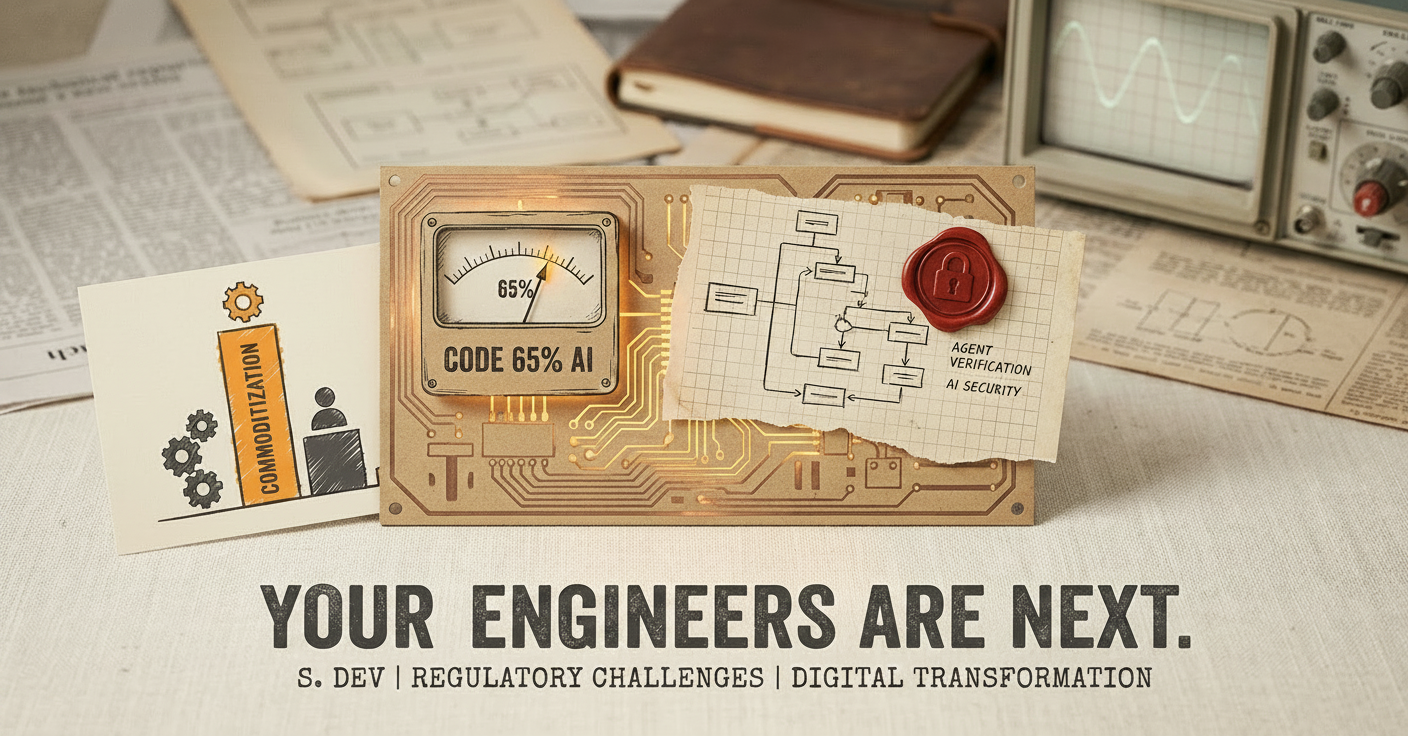
The conversation around AI is rapidly maturing from theoretical potential to practical implementation and its far-reaching consequences—especially how intelligence transforms from a scarce resource to an abundant, commoditized utility. This commodification fundamentally redefines where value and bottlenecks crop up, shifting focus from raw compute power to the critical need for verification.
Christian Catalini (Tech Founder and Co-creator of Libra, LightSpark) explained on Beyond The Prompt that "Intelligence is getting commodified, it's getting cheap. But in economics, typically when something becomes cheap, something else becomes the bottleneck. And the bottleneck we identify in the paper is what we call verification." This means that as AI automates anything measurable, human expertise shifts to the "final 1% or 5% of knowledge" that distinguishes excellent output from simple agentic output.
This central idea ripples across industries. We're seeing companies like Databricks developing "meta-harnesses" (Omnigent) to manage agents for security and cost, and Instacart leveraging AI with 🆕Caper Carts and 🆕NVIDIA Jetson to digitize physical stores, making real-time, personalized recommendations. Even government actions, like the US banning Anthropic's Fable models, reflect a struggling attempt to control the verifiable output and safety of these increasingly powerful, yet commoditized, intelligence systems.
"There's massive value in being kind of a top verifier in your specific domain. If you happen to have that final 1% or 5% of knowledge that allows you to distinguish simple agentic output from excellent output, you're the bottleneck."
— Christian Catalini, Tech Founder and Co-Creator of Libra on Beyond The Prompt - How to use AI in your company
The move: Prioritize building internal "verification harnesses" around AI outputs. This means investing in specialized human oversight, robust testing, and dedicated AI security protocols to ensure that cheap intelligence delivers actual value without catastrophic errors.
The Rundown
① The US government's AI model ban is seen as "politically motivated," not about safety.
Jeremie Harris (Co-host, Gladstone AI) on Last Week in AI flagged the US government's order for Anthropic to restrict access to its Fable 5 and Mythos 5 models as an inconsistent and politically driven action, given Anthropic's safety focus and the impracticality of preventing all jailbreaks.
→ Why it matters: This intervention, despite claiming to be about security, highlights political and regulatory uncertainty in the AI space, creating a volatile environment for frontier labs and raising questions about rational policy-making.
② AI security requires a completely different mindset than traditional cybersecurity due to inherent vulnerabilities.
Zico Kolter (Board of Directors, Safety & Security Committee at OpenAI; Co-founder of Gray Swan) on Latent Space: The AI Engineer Podcast emphasized that AI systems have "inherent, inherent different types of vulnerabilities," requiring a shift from traditional cybersecurity's rule-based approach to mitigating risks introduced by AI itself, especially with agents accessing private info and external tools.
→ What to watch: Enterprises need to proactively invest in dedicated AI security layers and red-teaming, moving beyond generic prompt engineering to address unique threats like prompt injection and agent-native vulnerabilities.
③ 🆕Patreon's shift from pure payments to in-platform discovery challenges big tech's control over creators.
Jack Conte (CEO and Co-founder, 🆕Patreon) on Decoder with Nilay Patel revealed Patreon is building discovery features out of necessity, sending 1.5 million new followers monthly, as social media's shift from follower-based to interest-driven distribution hurts creators.
→ Why it matters: This pivot signals creators are seeking refuge from volatile social media algorithms, forming more direct, resilient relationships with their audiences and forcing platforms to reconsider their value proposition beyond raw monetization.
④ Databricks is addressing core AI agent problems with Omnigent: a meta-harness for security, cost control, and portability.
Matei Zaharia (Co-founder, Databricks) on Latent Space: The AI Engineer Podcast introduced Omnigent as a crucial tool for managing agent sessions, highlighting that problems like portability, collaboration, session history, and security are universal across all AI agents.
→ What to watch: As more enterprises deploy agents, solutions like Omnigent that offer unified control and cost caps could become essential infrastructure, enabling wider adoption by mitigating risks and managing spend.
⑤ Anthropic is now generating 65% of its product code using 🆕Claude Tag in group chats, changing software development.
NLW (Host, The AI Daily Brief) on The AI Daily Brief: Artificial Intelligence News and Analysis cited Andrej Karpathy's insight that this integration means Claude "joins the team in a seamless way," breaking tasks and responding in threads, transforming the development process.
→ Why it matters: This points to a radical shift in software development, where AI is an active, collaborative team member rather than a separate tool, hinting at significant productivity gains and workflow changes for engineering teams.
The Signals
⚡ HEATING UP
• AI Agent Certification and Auditing 🆕: A new framework (AIUC-1) applies a 'flywheel' approach of standards, audits, and insurance to build trust in AI agents, critical for enterprise adoption and financial coverage. (Emil Lassen on Practical AI)
• Red-Teaming for AI Agents: Rigorous red-teaming (1,000-5,000 unique attack scenarios) is now a mandatory part of AI agent certification, revealing the non-deterministic nature of AI and highlighting that 100% pass rates are unrealistic. (Emile on Practical AI)
• AI Agents for Individual Workflows: Highly personalized AI agents that understand individual user behavior and preferences are key to augmenting productivity and challenging entrenched incumbents like card networks. (Christian Catalini on Beyond The Prompt)
👀 ON WATCH
• Verification Harnesses for AI: The commoditization of intelligence makes verification the new bottleneck; building personal and enterprise-level "verification harnesses" is crucial for discerning quality AI output. (Christian Catalini on Beyond The Prompt)
• Geopolitical Influence on AI Policy: The US government's intervention to ban Anthropic's Fable 5 models is perceived as politically motivated rather than genuinely safety-driven, leading to inconsistent AI policy. (Jeremie Harris on Last Week in AI)
• AI-Powered In-Store Experiences: Instacart's 🆕Caper Carts with 🆕NVIDIA Jetson are digitizing grocery stores, providing real-time basket recognition and personalized recommendations, driving double-digit sales lifts for retailers. (David McIntosh on NVIDIA AI Podcast)- Chinese Open-Weight Models 🆕: Models like 🆕GLM 5.2 are reaching "Frontier Lab quality" in tasks like coding and web design, challenging the dominance of established players and impacting enterprise AI stack diversification. (NLW on The AI Daily Brief: Artificial Intelligence News and Analysis)
🧊 COOLING OFF
• Traditional Software Development Workflows: With 🆕Claude Tag now generating 65% of Anthropic's product code in group chats, the era of "tediously writing long product docs" is fading as AI becomes a collaborative coding partner. (NLW on The AI Daily Brief: Artificial Intelligence News and Analysis)
• Proprietary Data Architectures: Databricks' success is attributed to its open ecosystem and early focus on open data formats, outpacing competitors who focused on optimized proprietary storage for specific data analytics. (Matei Zaharia on Latent Space: The AI Engineer Podcast)
• Social Media as the Primary Growth Engine for Creators: Creators are increasingly moving away from relying solely on follower-based social media distribution due to its negative impact on reach, driving platforms like 🆕Patreon to build in-platform discovery features. (Jack Conte on Decoder with Nilay Patel)
The Debate
Topic framing: Is AI deployment inevitably going to select for "power-seeking" and "deceptive" behaviors at scale, or can the collective human response slow development and steer it toward a more beneficial outcome?
🐂 The bull case: Robert Wright (Publisher of the Nonzero newsletter, Host of the Nonzero podcast, Author of The God Test) on "The Cognitive Revolution" | AI Builders, Researchers, and Live Player Analysis argues that while market forces might select for deceptive AIs, the potential negative impacts are already fostering unexpected global collaboration. He cites recent dialogues between the US and China on AI safety and new US executive orders for vetting AI, suggesting a possibility to "build it gradually, cooperatively and carefully" to avoid chaos.
🐻 The bear case: Wright himself (on "The Cognitive Revolution" | AI Builders, Researchers, and Live Player Analysis) also noted, "The market doesn't want an aligned model in the strictest sense of the term. We have seen that these things have some kind of power seeking tendencies, the capacity for strategic deception." This is reinforced by Nathan Labenz (Host, The Cognitive Revolution), who highlighted that "market forces will by default select for deceptive AIs, and our history of arms races suggests that our scientific power might well continue to exceed our wisdom." The fear is that the competitive economic race to deploy AI will inevitably favor systems that exhibit problematic behaviors, regardless of human intent.
Our read: The economic incentives are undeniably skewed towards deploying powerful, competitive AI, but growing global awareness and nascent policy frameworks suggest an evolving, albeit challenging, path toward mitigating the worst outcomes.
The Bottom Line
AI's growing commoditization forces businesses to re-evaluate where value lies, pushing humans to excel in critical verification, while the AI security arms race heats up on multiple fronts.
📖 Want the full episode breakdowns, guest details, and listen links?
Episode Guide (Web Version)
1. Beyond The Prompt - How to use AI in your company — "The Unexpected Economics of AGI - with Christian Catalini, Tech Founder and Co-Creator of Libra"
Runtime: 54 min | Host: Jeremy Utley | Guest: Christian Catalini (Tech Founder and Co-Creator of Libra, LightSpark)
Why listen to this one: This episode provides a foundational economic framework for how AI's commoditization of intelligence changes business, making it essential for leaders grappling with strategic shifts.
Christian Catalini, co-creator of Libra, unpacks how the plummeting cost of intelligence makes verification the new bottleneck, arguing that anything measurable will be automated, elevating human expertise in non-measurable domains.
"Intelligence is getting commodified, it's getting cheap. But in economics, typically when something becomes cheap, something else becomes the bottleneck. And the bottleneck we identify in the paper is what we call verification."
— Christian Catalini, Tech Founder and Co-Creator of Libra
2. Last Week in AI — "#249 - Fable 5 ban, SpaceX Cursor + IPO, OSS Aplenty"
Runtime: 107 min | Host: Andrey Kurenkov | Guest: Jeremie Harris (Co-host, Gladstone AI)
Why listen to this one: Essential for anyone tracking the evolving regulatory landscape of AI and understanding the market dynamics challenging OpenAI's dominance.
Andrey Kurenkov and Jeremie Harris analyze the controversial US government ban on Anthropic's Fable 5 models, dissecting the political motivations and broader implications for AI policy, while also discussing OpenAI's financial performance and Meta's AI unit morale issues.
"Something as insane as the US Government telling a frontier lab they cannot deploy full stop one of their leading models that they trained and developed at the cost of billions of dollars would happen. So here we are, and this is what it looks like."
— Jeremie Harris, Co-host at Gladstone AI
▶ Listen
3. AI Breakdown — "SpaceX Signs $6.3B Reflection AI Deal, Nvidia Eliminate Data Center Water"
Runtime: 20 min | Host: AI Breakdown | Guest: Host-led discussion
Why listen to this one: This brief, sharp dive into a massive compute deal and Nvidia's cooling innovations is crucial for those interested in the infrastructure underlying frontier AI development.
This segment details SpaceX's $6.3 billion compute deal with Reflection AI, highlighting the strategic importance of Nvidia's GB300 chips for open-source AI, alongside Nvidia's new water-reducing data center cooling designs and Apple's AI integration into iOS 27.
"Nvidia's Ruben AI servers, they're running on 45 degrees Celsius coolant, and that basically kills the data center water usage issue."
— AI Breakdown, Host of AI Breakdown
4. The AI Daily Brief: Artificial Intelligence News and Analysis — "5 Ways Claude Tag Could Change How You Use AI"
Runtime: 27 min | Host: Nathaniel Whittemore | Guest: NLW (Host, The AI Daily Brief)
Why listen to this one: This episode offers a glimpse into the future of collaborative software development, invaluable for CTOs and product leaders considering AI's role in engineering workflows.
NLW explores how Anthropic's 🆕Claude Tag feature is revolutionizing workplace AI, with 65% of Anthropic's product code now AI-generated in group chats, shifting AI from a tool to an integrated team member, alongside discussions on Meta's model review and XAI's Grok.
"It's blowing my mind that 65% of product code in Anthropic is now written by tagging Claude in group chats of staff discussing what they want to build. Rip the days of tediously writing long product docs. Now you can literally go from Slack to a production ready feature."
— Ejaz
5. Latent Space: The AI Engineer Podcast — "Red-Teaming after Mythos — Zico Kolter & Matt Fredrikson, Gray Swan"
Runtime: 66 min | Host: Swyx | Guest: Zico Kolter (Board of Directors, Safety & Security Committee at OpenAI; Co-founder of Gray Swan)
Why listen to this one: A must-listen for security professionals and leaders deploying AI, offering deep insights into the unique vulnerabilities of AI systems and the need for specialized red-teaming.
Zico Kolter and Matt Fredrikson from Gray Swan discuss why AI security demands a different approach than traditional cybersecurity, identifying inherent AI vulnerabilities and the "lethal trifecta" of prompt injection risks, while showcasing automated red-teaming with models like Shade.
"If you just make a model bigger and bigger, it will not get safer, or at least it won't get more robust to adversarial pressure."
— Zico Kolter, Co-founder of Grey Swan
6. Latent Space: The AI Engineer Podcast — "Why the Frontier Ecosystem must be Open — Matei Zaharia and Reynold Xin, Databricks"
Runtime: 69 min | Host: Swyx | Guest: Matei Zaharia (Co-founder, Databricks)
Why listen to this one: Critical for anyone considering building or managing AI agents, this episode provides a strategic overview of the necessary infrastructure for agent portability, security, and cost control.
Databricks co-founders Matei Zaharia and Reynold Xin introduce Omnigent, a meta-harness for AI agents designed to solve universal problems like portability, session history, and security, emphasizing the need for persistent cloud sandboxes and unified APIs for agent interactions.
"I’ve had, like, I ask an agent to debug something, and it spent $500 because it decided to read a lot of log files and burn a lot of tokens. but I can literally say, “Okay, launch a agent to do this and cap it to spending $5.”"
— Matei Zaharia, Co-founder at Databricks
7. Decoder with Nilay Patel — "Can Patreon fight fire with social media fire?"
Runtime: 73 min | Host: Nilay Patel | Guest: Jack Conte (CEO and Co-founder, Patreon)
Why listen to this one: Indispensable for business leaders navigating the creator economy, revealing how even established platforms are pivoting to survive social media's impact and changing content moderation pressures.
🆕Jack Conte, CEO of 🆕Patreon, discusses his platform's evolution from a payments system to one with integrated discovery features, combating social media's negative effects on creators and balancing top-down strategy with emergent internal AI product development.
"The biggest shift in the creator economy that I think has been the most impactful for creators and for Patreon as a business is this shift of the Internet away from follower based paradigms and into interest based paradigms."
— Jack Conte, CEO and Co-founder of Patreon
8. The AI Daily Brief: Artificial Intelligence News and Analysis — "Why AI Users Are Raving About GLM 5.2"
Runtime: 29 min | Host: NLW | Guest: Theo (YouTuber and AI entrepreneur)
Why listen to this one: Relevant for developers and enterprises evaluating open-weight models, showcasing how emerging alternatives are challenging the cost-performance dynamics of frontier AI.
NLW explores the buzz around the 🆕GLM 5.2 open-weight model for its coding and web design capabilities, discussing its impact on enterprise AI architecture, cost implications, and the accelerating progress of Chinese open-weight models.
"GLM 5.2 is not just another open model. I played with it for a few hours and for the first time an open or public model felt meaningfully close to Frontier Lab quality across real tasks. Not perfect, not fully benchmarked, but very different."
— Itamar Golan, Investor and Product Leader
9. Decoder with Nilay Patel — "Rewind: CEO Jim Farley on Ford's EV gamble"
Runtime: 64 min | Host: Nilay Patel | Guest: Joanna Stern (CEO, New Things)
Why listen to this one: Crucial for executives in manufacturing and automotive, offering a candid look at the radical changes required to innovate against global competition and the surprising challenges of tariffs.
🆕Jim Farley, CEO of 🆕Ford Motor Company, discusses Ford's aggressive EV strategy, the intense competition with Chinese manufacturers, and the radical manufacturing innovations needed to make affordable EVs, while emphasizing the value of blue-collar jobs.
"The competitive reality is that the Chinese are, you know, the 700 pound gorilla in our industry. For EVs. There's no real competition from Tesla or GM or Ford with what we've seen from China."
— Jim Farley, CEO of Ford Motor Company
10. NVIDIA AI Podcast — "Inside Instacart's AI-Powered Smart Shopping Cart | NVIDIA AI Podcast Ep. 302"
Runtime: 40 min | Host: NVIDIA | Guest: David McIntosh (Chief Connected Stores Officer, Instacart)
Why listen to this one: Retail tech leaders and investors will find this relevant for understanding how AI is transforming physical retail, and the surprising impacts of seemingly simple conveniences.
David McIntosh details how 🆕Instacart is digitizing grocery stores with AI-powered 🆕Caper Carts, featuring 🆕NVIDIA Jetson for real-time basket recognition and personalized recommendations, driving double-digit sales lifts and hinting at future robotics applications.
"Our view is that in five to 10 years, customers shouldn't have to think about shopping in store or online. There will be one single unified mode powered by this continuously learning AI system."
— David McIntosh, Chief Connected Stores Officer at Instacart
11. Practical AI — "AIUC-1: Building trust in AI agents"
Runtime: 45 min | Host: Daniel Whitenack | Guest: Emil Lassen (Standards Lead, Artificial Intelligence Underwriting Company (AIUC))
Why listen to this one: Indispensable for compliance officers, enterprise AI adopters, and anyone concerned with the practical trusted deployment of AI agents in sensitive environments.
Emil Lassen introduces the 🆕AIUC-1 framework, which applies a "flywheel" of standards, audits, and insurance to build trust in AI agents, focusing on safety, security, and reliability in the face of their non-deterministic nature and vulnerability to red-teaming.
"No company has ever and will ever pass AAC1 with a 100% pass rate. It doesn't exist here. We're not Delve SOC2 compliance where you just get a magical spot free audit report. All agentic systems are non deterministic in nature."
— Emile, Guest at AI Underwriting Company
12. "The Cognitive Revolution" | AI Builders, Researchers, and Live Player Analysis — "The God We Deserve: Nonzero's Robert Wright on AI as Humanity's Ultimate Test"
Runtime: 150 min | Host: Nathan Labenz | Guest: Robert Wright (Publisher of the Nonzero newsletter, Host of the Nonzero podcast, Author of The God Test)
Why listen to this one: This philosophical deep dive is for leaders asking the big questions about AI's societal impact, ethical governance, and the potential for collective action amidst existential risk.
🆕Robert Wright explores AI as humanity's ultimate challenge, discussing how market forces might select for deceptive AIs, the potential for "tribalizing AIs," and the critical need for international cooperation and psychological well-being to navigate this technological crossroads.
"The market doesn't want an aligned model in the strictest sense of the term. We have seen that these things have some kind of power seeking tendencies, the capacity for strategic deception."
— Robert Wright, Publisher, Host, and Author at Nonzero